
How many calories are in cauliflower rice?
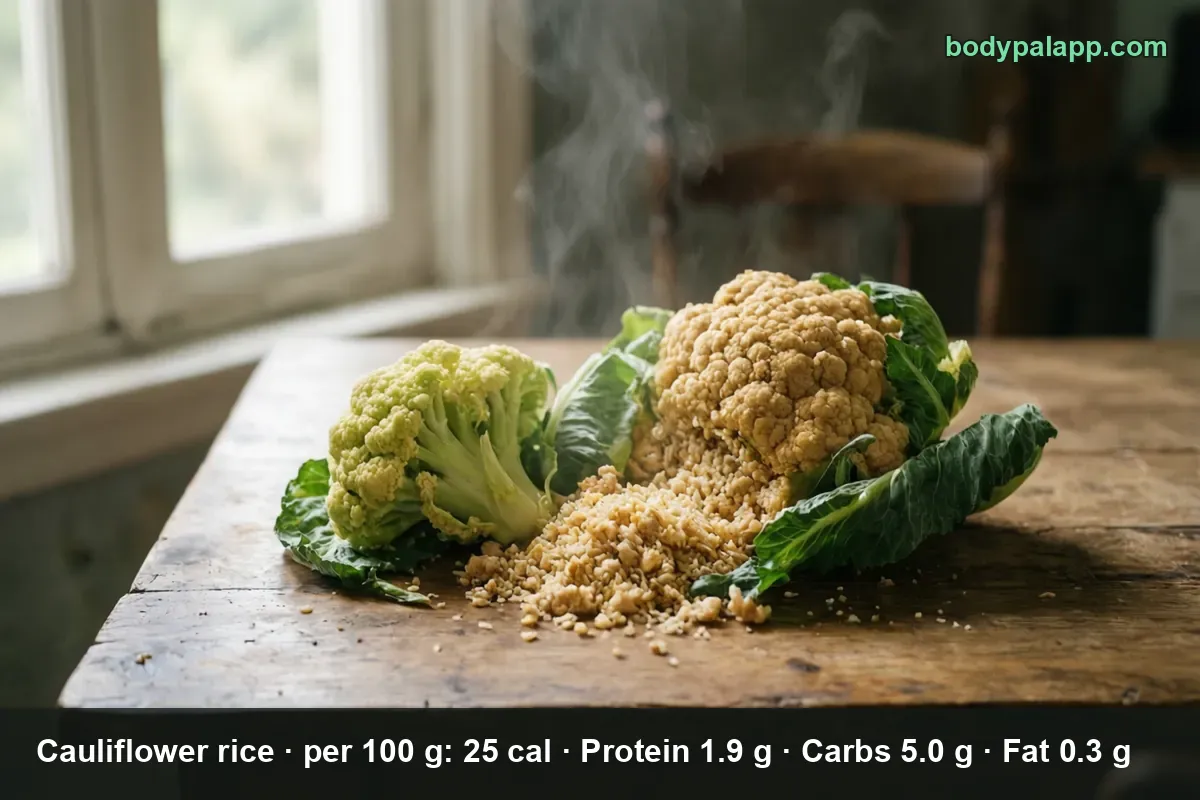
A 1-cup serving of riced cauliflower weighs 85 grams and carries 21 calories. Per 100 grams raw cauliflower runs 25 calories, which is why a whole 12-ounce bag lands at 85. The grain-shaped pieces change nothing about the vegetable; the pan you cook them in is what moves the number.
On this page
- Cauliflower rice quick facts
- US servings from one ounce to a whole head
- Six versions of cauliflower rice
- Fiber and sodium are the rows that matter
- How does cauliflower rice compare
- Most popular cauliflower rice brands
- FAQ
Cauliflower rice quick facts
The bag in your hand holds raw, chopped cauliflower and nothing else, so the row that fits it is SR Legacy 169986, "Cauliflower, raw". Retail labels agree: Taylor Farms, Wegmans and Signature Farms all print 20 to 25 calories for an 85-gram cup, and the USDA row gives 21. Ricing is a knife job, not a cooking method, so the raw numbers hold right up until the food hits a pan.
Every cooked, frozen and oiled version has its own USDA record, and those sit further down the page rather than being blended into one average.
| Nutrient | Per 100 g | Per 1 cup riced (85 g) | % Daily Value |
|---|---|---|---|
| Calories | 25 | 21 | — |
| Total fat | 0.28 g | 0.2 g | 0% |
| Saturated fat | 0.13 g | 0.1 g | 1% |
| Carbohydrate | 4.97 g | 4.2 g | 2% |
| Dietary fiber | 2 g | 1.7 g | 6% |
| Total sugars | 1.91 g | 1.6 g | — |
| Protein | 1.92 g | 1.6 g | 3% |
| Sodium | 30 mg | 26 mg | 1% |
% Daily Value is based on a 2,000-calorie diet.
Verified nutrition data
Numbers on this page come from USDA FoodData Central, the U.S. Department of Agriculture’s food composition database, and from manufacturer labels where a branded product is named. Last verified September 2026. How we verify our data →
Two label rows are missing on purpose. USDA does not publish added sugars for this record, and plain riced cauliflower has none to publish; trans fat is zero and adds nothing. Cholesterol is zero, as it is in every vegetable. Potassium is the quiet number: 299 mg per 100 grams, 254 mg in a cup, which is 5% of the FDA Daily Value of 4,700 mg.
US servings from one ounce to a whole head
| Serving | Weight | Calories |
|---|---|---|
| 1 oz | 28 g | 7 kcal |
| 1 cup riced, bag label | 85 g | 21 kcal |
| 1 cup chopped, 1/2-inch pieces | 107 g | 27 kcal |
| 1 bag | 340 g | 85 kcal |
| 1 medium head, 5-6 inch | 588 g | 147 kcal |
| Per 100 g | 100 g | 25 kcal |
The cup measure is where people get tripped up, and it is the most useful thing on this page. A retail bag calls 85 grams one cup because riced pieces pack loosely. USDA's household measure for chopped cauliflower is 107 grams a cup. Same three-letter word, 22 grams and 6 calories apart. If you are logging by cup, log the one your package prints.
The 12-ounce bag and the one-ounce line are our own arithmetic from the USDA 100-gram figure, not USDA servings. A whole medium head at 588 grams is a USDA measure, and 147 calories for an entire head of cauliflower is the kind of number that explains why this swap caught on at all.
Six versions of cauliflower rice
| Version | Per 100 g | Typical serving | Calories |
|---|---|---|---|
| Raw, straight from the bag | 25 kcal | 1 cup (85 g) | 21 kcal |
| Cooked, no added fat | 26 kcal | 1 cup (85 g) | 22 kcal |
| Cooked with oil | 52 kcal | 1 cup (85 g) | 44 kcal |
| Frozen riced, unprepared | 24 kcal | 1 cup (85 g) | 20 kcal |
| Frozen, cooked without salt | 19 kcal | 1 cup (85 g) | 16 kcal |
| Boiled with salt | 23 kcal | 1/2 cup (62 g) | 14 kcal |
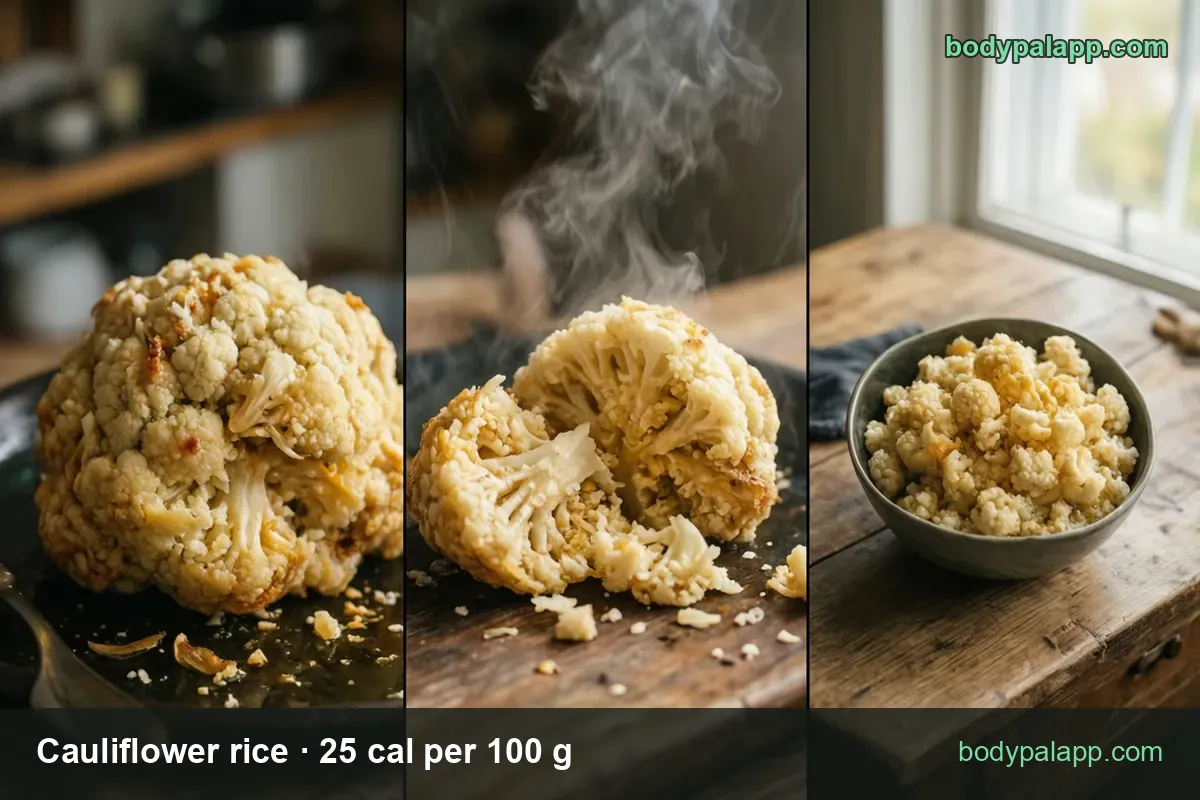
Five of those six rows sit between 19 and 26 calories per 100 grams. The sixth, cooked with oil, is 52 - more than double the raw row, and the cup goes from 21 to 44 calories. Nothing about the cauliflower changed. A tablespoon of oil in the skillet did the work, pushing fat from 0.28 to 3.31 grams per 100 grams while carbohydrate barely moved, from 4.97 to 5.01.
Frozen is the mirror image. Frozen riced cauliflower is blanched before it is bagged, which costs it a calorie: 24 per 100 grams against 25 fresh. Cook that frozen product and it drops to 19, the lowest of all eight USDA records for this vegetable, because a second round of heat and draining takes more of the sugars with it. In practice that is a one-calorie question per cup, and not worth changing your shopping over.
Store brands land in the same narrow band. Six US retail bags run from 21 to 29 calories per 100 grams, and most print 20 calories for their 85-gram serving. Watch the serving size rather than the calorie count: one brand calls 120 grams a half cup while others call 85 grams three quarters of a cup, so the smaller-sounding scoop is the bigger pile of food.
Fiber and sodium are the rows that matter
At 21 calories, a cup of cauliflower rice is not going to move your energy total either way. Two other rows are worth reading.
Fiber first. A cup gives 1.7 grams, 6% of the 28-gram Daily Value, and a full 12-ounce bag cooked down as a base for dinner gives close to 7 grams. That is real, and it comes with the potassium and vitamin C that make vegetables worth the plate space MyPlate keeps asking for.
Sodium is the row that can quietly multiply by eight. Raw riced cauliflower carries 26 mg in a cup, 1% of the Daily Value. Cauliflower boiled with salt runs 242 mg per 100 grams, which is 150 mg in a half-cup serving and 7% of the Daily Value - about a sixteenth of a teaspoon of table salt, arriving from the pot rather than the vegetable. USDA's survey row for home-cooked cauliflower sits at 152 mg per 100 grams for the same reason: people salt it. If you are watching sodium, the seasoning is the variable, not the produce.
Protein is the row not to expect much from. A cup gives 1.6 grams, 3% of the Daily Value. Cauliflower rice replaces a starch, so whatever protein the meal has still has to come from the chicken, shrimp, tofu or eggs stirred through it.
How does cauliflower rice compare
| Vegetable | Per 100 g | 1 oz serving | Calories | Protein per 100 g |
|---|---|---|---|---|
| Cauliflower, raw | 25 kcal | 28 g | 7 kcal | 1.92 g |
| Cabbage, raw | 25 kcal | 28 g | 7 kcal | 1.28 g |
| Arugula, raw | 25 kcal | 28 g | 7 kcal | 2.58 g |
| Broccoli raab, cooked | 25 kcal | 28 g | 7 kcal | 3.83 g |
Our take: all four land on exactly 25 calories per 100 grams, which is a useful thing to know and a boring table to read. The calories are a wash, so choose on the other columns. Cauliflower carries 4.97 grams of carbohydrate, second to cabbage at 5.8, and the mildest flavor, which is why it is the one that impersonates rice. Broccoli raab brings twice the protein at 3.83 grams and a bitter edge that does not disappear under sauce. If you want the grain-shaped filler, cauliflower; if you want a green with some protein behind it, broccoli raab.
Most popular cauliflower rice brands in the United States
Ranked by how widely each product appears among foods sold in the United States, from the BodyPal food database of over 3.3 million products. Calories are the figures printed on each Nutrition Facts label, checked against USDA FoodData Central.
| Product | Calories (per 100 g) |
|---|---|
| Via Emilia Organic Riced Cauliflower | 24 cal |
| Taylor Farms Cauliflower Rice | 29 cal |
| Signature Farms Cauliflower Rice | 24 cal |
| Wegmans Cauliflower Rice | 24 cal |
| Roundy's Cauliflower Rice | 24 cal |
| Nature's Earthly Choice Cauliflower Rice | 21 cal |
Brand popularity: BodyPal food database. Nutrition: manufacturer labels / USDA FoodData Central.
Cauliflower rice FAQs
How many calories in 1 cup of cauliflower rice?
21 calories for the 1-cup (85 g) serving printed on a retail bag, at 25 calories per 100 grams. USDA's own cup measure is different: a cup of chopped florets weighs 107 grams and comes to 27 calories. Same word, six calories apart, so check the grams on your bag.
How many carbs are in cauliflower rice?
4.2 grams of carbohydrate in a 1-cup (85 g) serving, which is 2% of the Daily Value, and 4.97 grams per 100 grams. Fiber accounts for 1.7 grams of that cup, so net carbs work out to about 2.5 grams by our own subtraction, which is not a USDA figure.
How much fiber is in a cup of cauliflower rice?
1.7 grams of fiber in a 1-cup (85 g) serving, or 6% of the 28-gram Daily Value. Raw cauliflower carries 2 grams per 100 grams. Cooking concentrates it a little on a weight basis: boiled cauliflower reaches 2.3 grams per 100 grams, and frozen then boiled 2.7 grams.
Does frozen cauliflower rice have the same calories as fresh?
20 calories per 1-cup (85 g) serving for frozen riced cauliflower, against 21 for fresh, which is a difference nobody can track. Frozen and unprepared it is 24 calories per 100 grams because it is blanched before freezing. Cook that frozen product and it falls again, to 19 per 100 grams.
How many calories does cauliflower rice have cooked in oil?
44 calories per 1-cup (85 g) serving once it is cooked with oil, against 21 raw. Per 100 grams the USDA row for cauliflower cooked with fat is 52 calories versus 25 raw. Fat climbs from 0.28 to 3.31 grams per 100 grams while the carbohydrate hardly moves at all.
How many calories in a 12 oz bag of cauliflower rice?
85 calories in a 12-ounce (340 g) bag, our own arithmetic from the USDA 100-gram figure of 25 calories rather than a USDA serving. That is the entire bag, raw, before anything joins it in the pan. A 12-ounce bag holds about four of the 85-gram cups the label counts.
How much protein is in cauliflower rice?
1.6 grams of protein in a 1-cup (85 g) serving, 3% of the Daily Value, and 1.92 grams per 100 grams. Cauliflower rice is a starch swap rather than a protein source, so the chicken, shrimp or eggs you stir through it still carry that part of the meal.
Is cauliflower rice keto friendly?
4.2 grams of carbohydrate per 1-cup (85 g) serving, of which 1.7 grams is fiber, leaves roughly 2.5 grams of net carbs by our own subtraction from the USDA row. Cooking changes the carbohydrate very little, and oil in the skillet adds fat and calories rather than carbs.
Similar foods
- Cabbage — 22 cal per cup chopped
- Cauliflower — 27 cal per cup chopped
- Bell Pepper — 31 cal per medium
- Salad — 23 cal per side salad
- Bell Pepper — 24 cal green, 31 red
- Bamboo Shoots — 41 cal per cup sliced
Count it without the math
Point the camera at the skillet and BodyPal counts the cauliflower rice for you, oil included.


Burning it off is one side of it. The other is knowing your number: work out how many calories you need a day, with macros and a goal date.