
How many calories are in caviar?
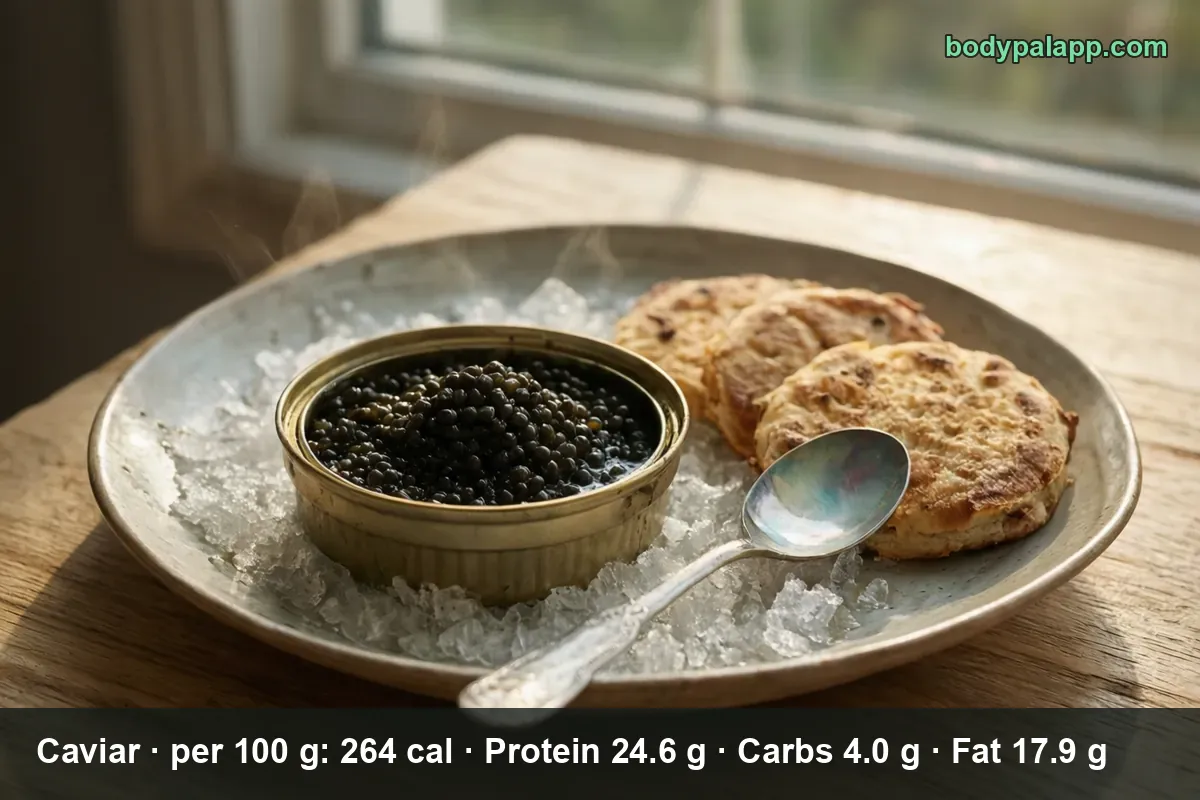
One level tablespoon of caviar weighs 16 g and carries 42 calories. Per 100 g the roe runs 264 calories, which sounds heavy until you remember nobody eats caviar by the cupful. The number that actually matters on a tin is the sodium: 240 mg in that same spoon.
On this page
- Caviar quick facts
- US servings, from a teaspoon to a 2 oz tin
- Jarred caviar runs lighter than the real thing
- Sodium and cholesterol are the rows to watch
- How does caviar compare?
- Most popular caviar brands
- FAQ
Caviar quick facts
The row behind every number on this page is SR Legacy 174188, "Fish, caviar, black and red, granular". It is the analytical record for cured, granular roe, and it carries both of the measures Americans actually use at the table: a tablespoon and an ounce. The survey record, FNDDS 2706332, repeats the same values line for line, so there was nothing to gain by switching.
Worth knowing before you read the table: USDA files black and red roe together in this one record. There is no separate sturgeon line and no separate salmon-roe line, so a spoon of osetra and a spoon of ikura come out at the same energy here.
| Nutrient | Per 100 g | Per 1 tablespoon (16 g) | % Daily Value |
|---|---|---|---|
| Calories | 264 | 42 | — |
| Total fat | 17.9 g | 2.9 g | 4% |
| Saturated fat | 4.06 g | 0.6 g | 3% |
| Carbohydrate | 4 g | 0.6 g | 0% |
| Dietary fiber | 0 g | 0 g | 0% |
| Total sugars | 0 g | 0 g | — |
| Protein | 24.6 g | 3.9 g | 8% |
| Sodium | 1500 mg | 240 mg | 10% |
| Cholesterol | 588 mg | 94 mg | 31% |
| Potassium | 181 mg | 29 mg | 1% |
% Daily Value is based on a 2,000-calorie diet.
Verified nutrition data
Numbers on this page come from USDA FoodData Central, the U.S. Department of Agriculture’s food composition database, and from manufacturer labels where a branded product is named. Last verified September 2026. How we verify our data →
Two rows you would see on a jar are missing above: added sugars and trans fat. USDA does not publish either value for granular caviar in this edition, so rather than guess at them, they stay off the table. Everything else is complete, including the cholesterol figure, which is the one most people are not expecting.
US servings, from a teaspoon to a 2 oz tin
| Serving | Weight | Calories |
|---|---|---|
| 1 teaspoon | 5.3 g | 14 kcal |
| 1 tablespoon | 16 g | 42 kcal |
| 2 tablespoons | 32 g | 84 kcal |
| 1 oz | 28.35 g | 75 kcal |
| 2 oz tin | 56.7 g | 150 kcal |
| Per 100 g | 100 g | 264 kcal |
Two of these are USDA household measures: the 16 g tablespoon and the 28.35 g ounce come straight off record 174188. The teaspoon, the two-tablespoon spoonful and the 2 oz tin are our own arithmetic from the USDA 100 g figure, not USDA servings, scaled the same way you would scale any label.
The tin is the number to hold on to. Small retail tins are sold in 1 oz and 2 oz sizes, and a 2 oz tin shared between two people is a 75-calorie course each. Finish one yourself with crackers and you are at 150 calories from the roe alone, plus 851 mg of sodium, which is where the arithmetic stops being cheap.
An ounce is roughly a heaped tablespoon and a half, so if you are logging by eye, count spoons rather than trying to judge ounces off a dish of crushed ice.
Jarred caviar runs lighter than the real thing
The jar in the supermarket refrigerator case and the tin behind the counter are not the same food nutritionally. Lumpfish and whitefish roe are dyed, packed in brine and sold under names like Romanoff; sturgeon and trout roe are cured with far less water in them. The calorie gap follows.
| Version | Per 100 g | Label serving | Calories |
|---|---|---|---|
| Black and red caviar, granular | 264 kcal | 1 tablespoon (16 g) | 42 kcal |
| Black lumpfish caviar, jarred | 143 kcal | 1 Tbsp (14 g) | 20 kcal |
| Red whitefish caviar, jarred | 133 kcal | 1 Tbsp (15 g) | 20 kcal |
| Vodka-cured lumpfish caviar | 179 kcal | 1 Tbsp (14 g) | 25 kcal |
| Osetra caviar, malossol | 267 kcal | 1 Tbsp (15 g) | 40 kcal |
| Steelhead trout caviar | 333 kcal | 1 Tbsp (15 g) | 50 kcal |
Read that spread and the point is obvious: the jarred products run between 32% and 50% below the 264 per 100 g of granular caviar, while osetra lands almost exactly on it at 267 and steelhead trout roe goes well past it at 333. So "caviar" logged from a jar and "caviar" logged from a tin can differ by more than double per spoon, 20 against 50.
If you are logging from a jar, use the label. If you are logging a spoonful of the real thing at a restaurant, 264 per 100 g is the honest number.
Sodium and cholesterol are the rows to watch
Nothing in the calorie column of this page is alarming. A tablespoon at 42 calories is a rounding error in a day's eating. The two rows that move are the ones salt-curing and fish eggs put there.
Sodium first. Caviar is 1,500 mg per 100 g, about two-thirds of a teaspoon of table salt in a small dish. One tablespoon is 240 mg, 10% of the FDA Daily Value of 2,300 mg. An ounce is 425 mg, 18%. Two tablespoons on blini put you at 480 mg, 21%, before anything else on the plate. The Dietary Guidelines for Americans hold the same 2,300 mg ceiling, and most people are already over it from bread and deli meat, so a caviar course is best treated as a salt event rather than a calorie event.
Cholesterol is the bigger surprise, and it is the highest percentage anywhere in the quick facts table. Caviar carries 588 mg per 100 g. That is 94 mg in a tablespoon, 31% of the 300 mg Daily Value, and 167 mg in an ounce, 56%. A 2 oz tin eaten solo comes to 333 mg, past the full Daily Value. Current federal advice no longer sets a hard numeric cap on dietary cholesterol, but the label still prints a percentage, and this is one of the few foods where a single spoon fills a third of it.
The good news in the same column is protein. At 24.6 g per 100 g, caviar sits alongside the seafood MyPlate counts in its protein group, giving 3.9 g a tablespoon and 7.0 g an ounce, 8% and 14% of the 50 g Daily Value. Carbohydrate is 4 g per 100 g with zero fiber and zero sugars, which is why the roe reads as almost pure fat and protein.
How does caviar compare?
| Fish | Per 100 g | US serving | Calories |
|---|---|---|---|
| Caviar, black and red, granular | 264 kcal | 1 oz (28.35 g) | 75 kcal |
| Salmon, grilled | 259 kcal | 1 oz (28.35 g) | 73 kcal |
| Eel | 273 kcal | 1 oz (28.35 g) | 77 kcal |
| Pickled fish | 262 kcal | 1 oz (28.35 g) | 74 kcal |
Our take: on energy, caviar is unremarkable. All four of these land within four calories of each other per ounce, 73 to 77, because they are all oily fish protein at roughly the same fat level. What separates caviar is not the calorie column but what curing adds to it, and USDA does not publish sodium for the grilled salmon, eel or pickled fish records, so that column cannot be put side by side here. Judge caviar as a salt-and-cholesterol food you eat by the spoon, and judge grilled salmon as the one you eat by the fillet. For protein per ounce the two are close, 7.0 g against 7.3 g, and the salmon is the cheaper way to get it.
Most popular caviar brands in the United States
Ranked by how widely each product appears among foods sold in the United States, from the BodyPal food database of over 3.3 million products. Calories are the figures printed on each Nutrition Facts label, checked against USDA FoodData Central.
| Product | Calories (per 100 g) |
|---|---|
| Romanoff Black Lumpfish Caviar | 143 cal |
| Romanoff Red Whitefish Caviar | 133 cal |
| Romanoff Vodka Lumpfish Caviar | 179 cal |
| Romanoff Caviar White Fish | 143 cal |
| Osetra Caviar Malossol | 267 cal |
| Caviar Star White Sturgeon Caviar | 254 cal |
Brand popularity: BodyPal food database. Nutrition: manufacturer labels / USDA FoodData Central.
Caviar FAQs
How many calories are in a tablespoon of caviar?
A level tablespoon of granular black or red caviar weighs 16 g and carries 42 calories. That is 3.9 g of protein, 2.9 g of fat and barely any carbohydrate. The number stays small because the portion is small: per 100 g the same roe runs 264 calories.
How many calories are in an ounce of caviar?
One ounce, 28.35 g, comes to 75 calories, and the ounce is a USDA household measure on record 174188 rather than our own scaling. It brings 7.0 g of protein, 5.1 g of fat, 425 mg of sodium and 167 mg of cholesterol. An ounce is roughly a heaped tablespoon and a half.
Is caviar high in sodium?
Yes, caviar carries 1,500 mg of sodium per 100 g, so one tablespoon delivers 240 mg, or 10% of the FDA Daily Value of 2,300 mg. An ounce reaches 425 mg, 18%. Salt is what cures the roe, so there is no low-sodium version of the traditional product.
How much protein is in caviar?
Caviar is 24.6 g of protein per 100 g, which puts a tablespoon at 3.9 g and an ounce at 7.0 g. That is 8% and 14% of the 50 g Daily Value. Gram for gram it rivals grilled salmon at 25.9 g, but nobody eats caviar by the fillet.
Is caviar high in cholesterol?
Very high: at 588 mg per 100 g, one tablespoon holds 94 mg and an ounce 167 mg, which is 31% and 56% of the 300 mg Daily Value. It is the highest percentage on the whole label. Dietary cholesterol no longer has a numeric limit in the Dietary Guidelines, but the row is worth seeing.
Is caviar keto friendly?
On carbohydrate, yes: 4 g per 100 g means a tablespoon holds 0.6 g and an ounce 1.1 g, with zero fiber and zero sugars. The energy split is 17.9 g of fat to 24.6 g of protein per 100 g. Sodium, at 240 mg a tablespoon, is the number that limits how much you pile on.
How many calories are in lumpfish caviar?
Jarred black lumpfish caviar is 143 calories per 100 g, so the 14 g tablespoon on the label is 20 calories, less than half the 42 of granular caviar. Red whitefish roe is lighter still at 133 per 100 g, and the vodka-cured lumpfish version 179.
Red caviar vs black caviar calories?
They share one number: 264 calories per 100 g. USDA files black and red granular roe in a single record, 174188, so there is no separate salmon-roe line to compare. Branded jars split them, and there red whitefish roe is 133 per 100 g against 143 for black lumpfish.
Similar foods
- Shrimp Egg Roll — 165 cal per egg roll
- Popcorn Shrimp — 230 cal per 3 oz serving
- Salmon Baked — 384 cal per fillet
- Salmon Fillet 6 Oz — 466 cal per 6 oz fillet
- Salmon Portion — 310 cal per 4 oz portion
- Salmon Steak — 575 cal per steak
Count it without the math
Point the camera at the plate and BodyPal counts the spoonfuls for you, blini and all.


How long does it take to burn off caviar?
One tablespoon (16 g) is 42 kcal. Enter your weight and the amount you ate to see how long it takes you to burn that off:
lb
| Activity | Time to burn 42 kcal |
|---|---|
| Walking, brisk | 8 min |
| Cycling, moderate | 5 min |
| Swimming, moderate | 6 min |
| Jogging | 5 min |
| Weight training, moderate | 9 min |
Times are for a 155 lb adult at a steady pace; change the weight to see yours. The amount is set to the portion in the text (16 g); change it to what you actually ate. BodyPal works this out from your steps automatically.
Want the bigger picture? Calculate your daily calorie needs — your maintenance figure, a target for losing or gaining, and the date you get there.