
How many calories are in cheese eggs?
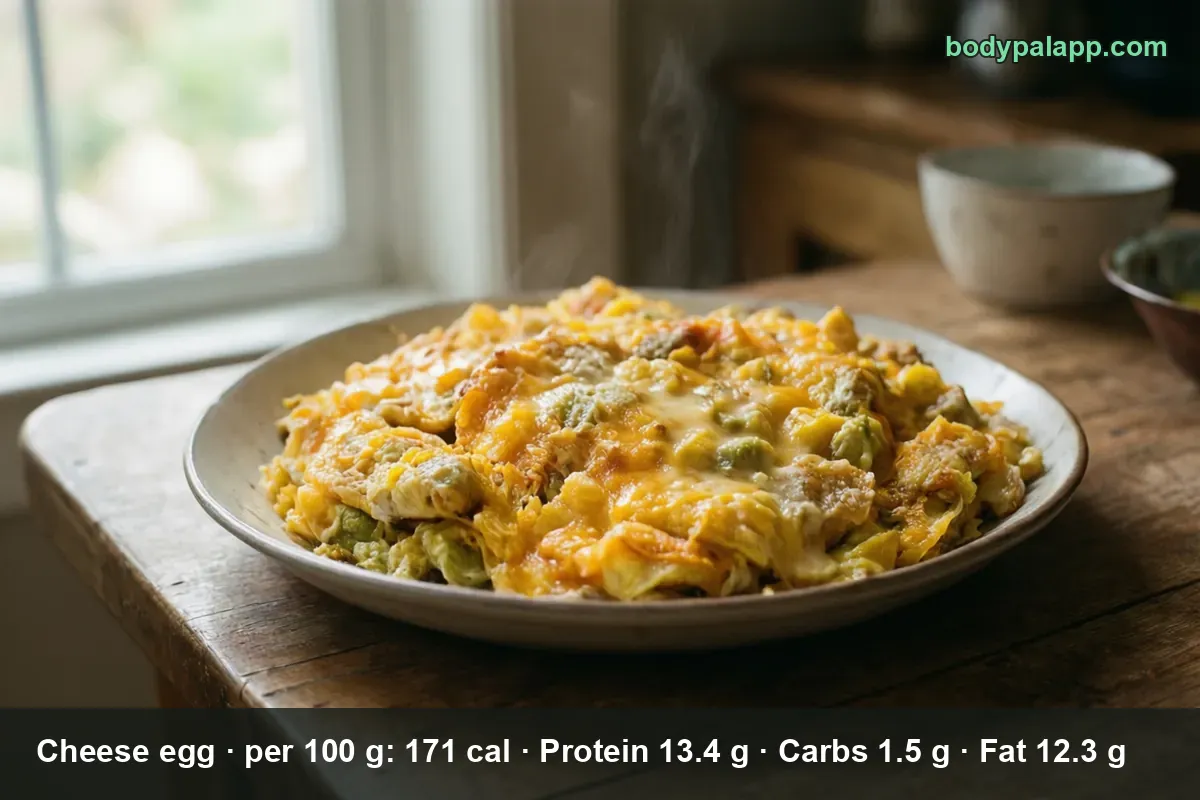
A 1-cup serving of scrambled eggs with cheese runs 135 grams and 231 calories. Per 100 grams the dish is 171 calories, and a single egg's worth is 103. Almost all of that is fat and protein. The whole cup holds 2 grams of carbohydrate.
On this page
- Cheese egg quick facts
- US servings from one egg to a full cup
- Butter oil margarine or cooking spray
- Egg white cheese eggs and store-bought egg bites
- Cholesterol is the row to watch
- How do cheese eggs compare
- Most popular cheese egg brands
- Cheese egg FAQs
Cheese egg quick facts
The record behind every number here is FNDDS 2707212, "Egg omelet or scrambled egg, with cheese, no added fat". That is the plain version: eggs, cheese, a hot pan and nothing else. Every calorie in it comes from the eggs and the cheese, which makes it the honest baseline. The moment butter or oil enters the pan you are looking at a different USDA record, and those get their own section below.
Two rows you would see on a packaged label are missing. This FNDDS release does not publish added sugars or trans fat for the entry, so both are left out rather than guessed. Neither eggs nor cheddar contain added sugar in any case.
| Nutrient | Per 100 g | Per 1 cup (135 g) | % Daily Value |
|---|---|---|---|
| Calories | 171 | 231 | — |
| Total fat | 12.34 g | 16.7 g | 21% |
| Saturated fat | 4.9 g | 6.6 g | 33% |
| Carbohydrate | 1.49 g | 2.0 g | 1% |
| Dietary fiber | 0 g | 0 g | 0% |
| Total sugars | 0.54 g | 0.7 g | — |
| Protein | 13.41 g | 18.1 g | 36% |
| Sodium | 344 mg | 464 mg | 20% |
% Daily Value is based on a 2,000-calorie diet.
Verified nutrition data
Numbers on this page come from USDA FoodData Central, the U.S. Department of Agriculture’s food composition database, and from manufacturer labels where a branded product is named. Last verified September 2026. How we verify our data →
Two more numbers matter enough to name. Cholesterol is 368 mg per 100 g, or 497 mg in the cup, which is 166% of the Daily Value. Potassium is modest at 134 mg per 100 g, 181 mg in the cup, 4% DV. The 464 mg of sodium is roughly a fifth of a teaspoon of table salt, and most of it rides in on the cheese rather than the shaker.
US servings from one egg to a full cup
| Serving | Weight | Calories |
|---|---|---|
| 1 oz | 28 g | 48 kcal |
| One egg, scrambled with cheese | 60 g | 103 kcal |
| Two eggs, scrambled with cheese | 120 g | 205 kcal |
| 1 cup | 135 g | 231 kcal |
| Three eggs, a big skillet plate | 180 g | 308 kcal |
| Per 100 g | 100 g | 171 kcal |
The cup, the one-egg and the two-egg portions are USDA household measures for this record. The three-egg plate and the ounce are our own arithmetic from the USDA 100-gram figure, not USDA servings.
Here is the trap worth knowing. A USDA cup of cheese eggs weighs 135 grams, not the 240 grams a cup of liquid weighs. Scrambled curds are full of air, so people who log "one cup" while picturing a cup of milk overshoot the weight by nearly double and inflate the entry to something like 410 calories. Weigh it once and you will never guess again.
The other useful fact is how flat the scale is. Because the dish is 171 calories per 100 grams, each extra egg you crack costs about 103 calories cooked with cheese and no fat. A three-egg plate at 308 calories still fits a 350 to 450-calorie breakfast with a piece of fruit on the side.
Butter oil margarine or cooking spray
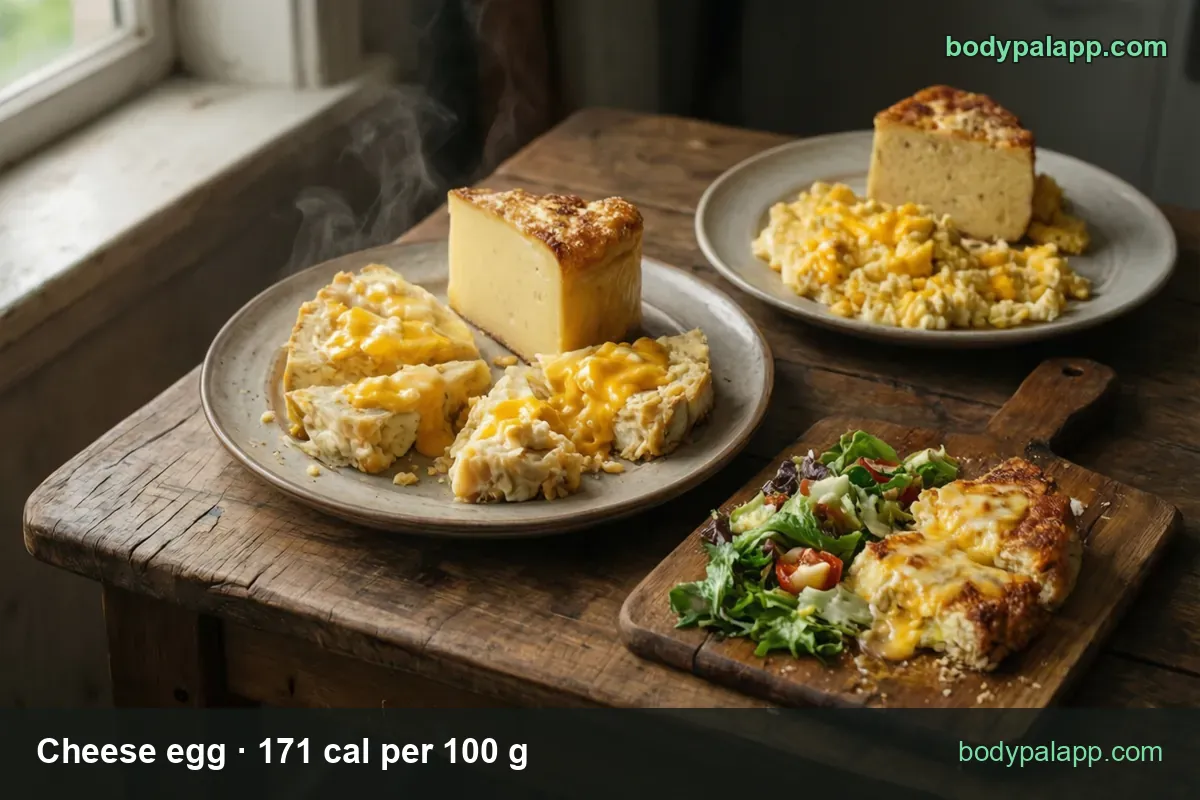
USDA keeps a separate record for each fat you cook the eggs in, and the spread is bigger than most people expect.
| Version | Per 100 g | Typical serving | Calories |
|---|---|---|---|
| No added fat (base) | 171 kcal | 1 cup, 135 g | 231 kcal |
| Made with cooking spray | 176 kcal | 1 cup, 135 g | 238 kcal |
| Made with margarine | 194 kcal | 1 cup, 135 g | 262 kcal |
| Made with butter | 203 kcal | 1 cup, 135 g | 274 kcal |
| Made with oil | 212 kcal | 1 cup, 135 g | 286 kcal |
Same eggs, same cheese, 55 calories between the lightest and the heaviest cup. Cooking spray is the cheapest insurance: 7 calories more than a dry nonstick pan, and it keeps the curds off the metal. Oil is the priciest, because a tablespoon poured into a pan mostly ends up in the eggs.
Butter does something the calorie column hides. It lifts saturated fat from 4.9 grams per 100 grams to 7.23, a 48% jump, while oil leaves saturated fat almost where it started at 5.39 even though it adds the most calories. If your reason for watching the pan is saturated fat rather than calories, that reverses the ranking.
Egg white cheese eggs and store-bought egg bites
Order the egg white version and USDA has a row for it too: egg white, omelet, scrambled or fried, with cheese is 132 calories per 100 grams. A 135-gram cup works out to about 178 calories, our own arithmetic from the 100-gram figure. Fat falls from 12.34 grams to 8.51 and protein holds at 11.27 grams per 100 grams, so you give up little of what makes the dish filling. Sodium goes the other way, 371 mg per 100 grams against 344, because the cheese is now doing more of the flavor work.
Refrigerated egg bites are the packaged shortcut, and they land all over the map. Three-cheese bites run 160 to 294 calories per 100 grams depending on brand, and once sausage or bacon joins the cup they sit near 208 to 238. A two-piece pack of 130 grams typically shows 230 to 309 calories on the label, above a home cup of the same weight. Read the piece count before the calorie number, since one brand's serving is two bites and another's is four.
Cholesterol is the row to watch
The calorie count is unremarkable. At 231 calories, a cup of cheese eggs is about 12% of a 2,000-calorie day, less than a bagel with cream cheese. The row that jumps is cholesterol: 497 mg in that cup, 166% of the FDA Daily Value of 300 mg. The yolks carry it, which is exactly why the egg white record drops to 132 calories per 100 grams.
Saturated fat is the second one to check. The base version is 6.6 grams in a cup, 33% DV, and cooking it in butter pushes the 100-gram figure to 7.23 grams. Sodium at 464 mg is 20% DV before you salt the plate or add bacon.
Against all that, the protein column is genuinely strong. Eggs are counted in the MyPlate protein foods group, and 18.1 grams in one cup is 36% of the Daily Value for 231 calories, a ratio very few breakfasts match. If you are watching cholesterol, splitting the pan between whole eggs and whites keeps most of the protein and cuts the yolk count.
How do cheese eggs compare
| Dish | Per 100 g | US serving | Calories |
|---|---|---|---|
| Cheese eggs, no added fat | 171 kcal | 1 cup, 135 g | 231 kcal |
| Cheese eggs with meat | 177 kcal | 1 cup, 135 g | 239 kcal |
| Cheese eggs with tomatoes | 154 kcal | 1 cup, 135 g | 208 kcal |
| Egg sandwich on white bread with cheese | 248 kcal | 1 sandwich, 135 g | 335 kcal |
Our take: the plate does not decide this, the bread does. Adding ham or sausage to the pan costs 8 calories per cup, which is noise, and tomatoes are the only entry here lighter than plain cheese eggs at 208 per cup because the water in them dilutes everything. Put the same eggs between two slices of white bread and you are at 335 calories with 22.85 grams of carbohydrate per 100 grams instead of 1.49. For weight loss, keep the eggs and skip the roll. For staying full to lunch, the two-egg version at 205 calories with 16.1 grams of protein does more per calorie than any sandwich on this table.
Most popular cheese egg brands in the United States
Ranked by how widely each product appears among foods sold in the United States, from the BodyPal food database of over 3.3 million products. Calories are the figures printed on each Nutrition Facts label, checked against USDA FoodData Central.
| Product | Calories (per 100 g) |
|---|---|
| Great Value Turkey Sausage & Cheese Egg Bites | 208 cal |
| Eggland's Best Three Cheese Egg Bites | 160 cal |
| Rim Rock Farms 3 Cheese Egg Bites | 177 cal |
| ShopRite Three Cheese Egg Bites | 294 cal |
| 365 by Whole Foods Market Sausage & Cheese Egg Bites | 238 cal |
| Great Value Bacon & Cheese Egg Bites | 223 cal |
Brand popularity: BodyPal food database. Nutrition: manufacturer labels / USDA FoodData Central.
Cheese egg FAQs
How many calories are in cheese eggs?
A 1-cup serving of scrambled eggs with cheese, cooked with no added fat, is 231 calories for 135 grams, or 171 calories per 100 grams. That cup also carries 18.1 grams of protein and only 2 grams of carbohydrate, which is why it reads as a heavy breakfast on a light carb budget.
How many calories in 2 scrambled eggs with cheese?
Two eggs scrambled with cheese weigh about 120 grams and land at 205 calories. That is 16.1 grams of protein and 14.8 grams of fat, scaled from the USDA 100-gram figures. Add butter to the pan and the same two eggs climb to roughly 244 calories.
Do cheese eggs have carbs?
Barely: cheese eggs hold 1.49 grams of carbohydrate per 100 grams, so a full cup has 2 grams, which is 1% of the Daily Value. Sugars are 0.7 grams per cup and fiber is zero. The carbohydrates show up only when bread, potatoes or a tortilla join the plate.
How much protein is in scrambled eggs with cheese?
A 1-cup serving delivers 18.1 grams of protein, 36% of the Daily Value, from 13.41 grams per 100 grams. One egg's worth is 8.0 grams and two eggs with cheese give 16.1 grams. For most people that single cup covers more than a third of the day's protein target.
Are cheese eggs keto friendly?
On the numbers, yes: 2 grams of carbohydrate and zero fiber in a 231-calorie cup, with 16.7 grams of fat and 18.1 grams of protein. Cooking them in butter raises the cup to 274 calories without adding carbohydrate. Only the bread or hash browns alongside change that math.
How much cholesterol is in eggs with cheese?
A 1-cup serving carries 497 milligrams of cholesterol, 166% of the Daily Value, from 368 milligrams per 100 grams. One egg's worth is about 221 milligrams. Switching to the egg white version cuts the calories to 132 per 100 grams, and the yolk is where the cholesterol sits.
Is butter or cooking spray better for scrambled eggs with cheese?
Cooking spray costs 238 calories a cup against 274 for butter, a 36-calorie gap. The bigger difference is saturated fat: 4.9 grams per 100 grams with spray versus 7.23 with butter. If you are watching saturated fat, the spray is the better pick; butter buys flavor.
How many calories in egg white scrambled eggs with cheese?
The egg white version with cheese is 132 calories per 100 grams, so a 135-gram cup is about 178 calories by our own arithmetic from that figure. Protein stays high at 11.27 grams per 100 grams, and fat falls from 12.34 grams to 8.51.
Similar foods
- Omelet — 305 cal for 3-egg omelet
- Egg — 72 cal per large egg
- Crepe — 179 cal per crepe
- Pancake — 423 cal for 3 medium pancakes
- Toast with butter — 100 cal per slice with butter
- Shrimp Tempura Roll — 432 cal per roll, 8 pieces
Count it without the math
Point the camera at the skillet and BodyPal counts the cheese eggs for you, cheddar and all.


How long does it take to burn off cheese eggs?
A 1-cup (135 g) serving is 231 kcal. Enter your weight and the amount you ate to see how long it takes you to burn that off:
lb
| Activity | Time to burn 231 kcal |
|---|---|
| Walking, brisk | 46 min |
| Cycling, moderate | 29 min |
| Swimming, moderate | 33 min |
| Jogging | 27 min |
| Weight training, moderate | 51 min |
Times are for a 155 lb adult at a steady pace; change the weight to see yours. The amount is set to the portion in the text (135 g); change it to what you actually ate. BodyPal works this out from your steps automatically.
Burning it off is one side of it. The other is knowing your number: work out how many calories you need a day, with macros and a goal date.