
How many calories are in a cheese sandwich?
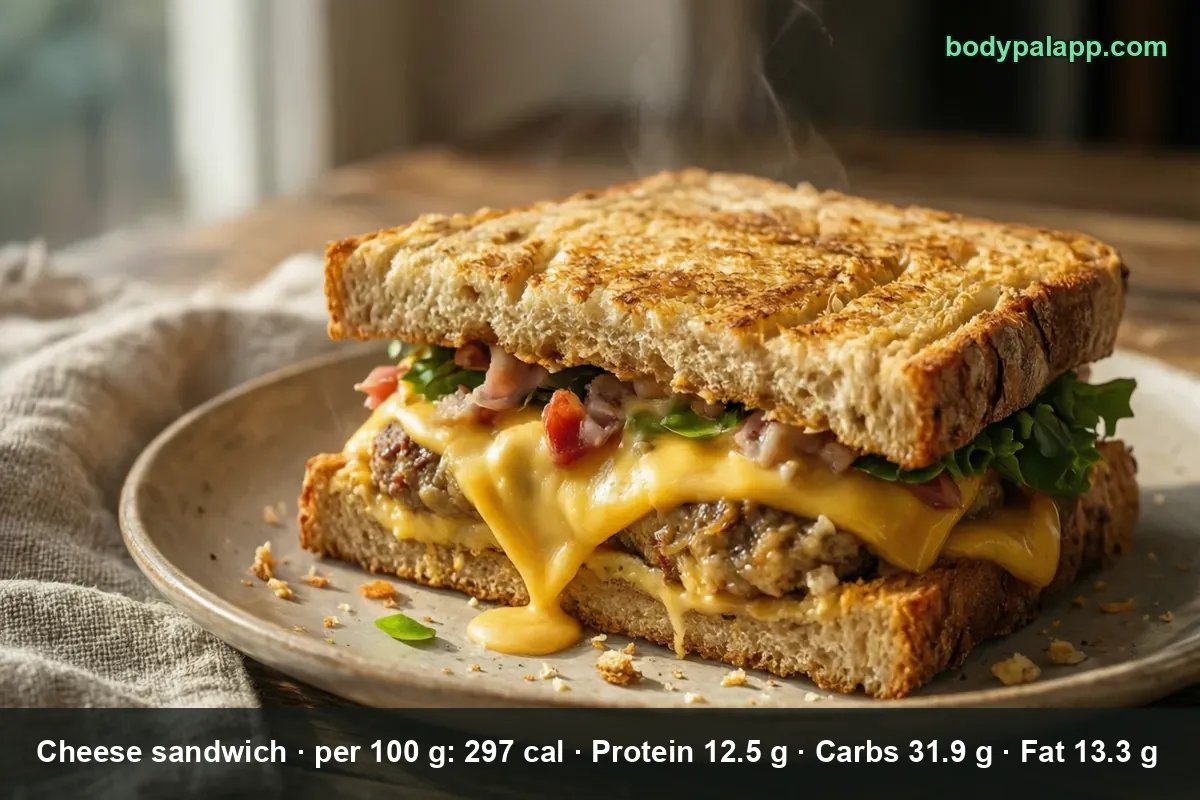
A plain cheese sandwich weighs 102 g and carries 303 calories. Per 100 g it runs 297 calories, which puts two slices of bread and a couple of slices of cheese in the same range as a deli sandwich half. Toasting it in butter is what changes the math, not the bread.
On this page
- Cheese sandwich quick facts
- US servings, from one ounce to two sandwiches
- Grilled cheese and the other USDA builds
- Sodium and saturated fat are the rows to watch
- How does a cheese sandwich compare?
- Most popular cheese sandwich brands
- FAQ
Cheese sandwich quick facts
The number above comes from the USDA's generic record, FNDDS 2705794, "Cheese sandwich, NFS". NFS means not further specified: bread, cheese, nothing declared about the type of either, and no pan. It is the row that matches what most people mean when they type the question, and it is the one USDA gives a household serving of "1 sandwich" at 102 g. Grilled versions and the named cheeses are separate records, and they get their own section below.
One thing to say up front, because the difference is bigger than people expect: this record is a cold, assembled sandwich. If yours came out of a skillet with butter, skip ahead — you want a different number entirely.
| Nutrient | Per 100 g | Per 1 sandwich (102 g) | % Daily Value |
|---|---|---|---|
| Calories | 297 | 303 | — |
| Total fat | 13.29 g | 13.6 g | 17% |
| Saturated fat | 6.91 g | 7.0 g | 35% |
| Carbohydrate | 31.89 g | 32.5 g | 12% |
| Dietary fiber | 1.4 g | 1.4 g | 5% |
| Total sugars | 5.08 g | 5.2 g | — |
| Protein | 12.46 g | 12.7 g | 25% |
| Sodium | 853 mg | 870 mg | 38% |
% Daily Value is based on a 2,000-calorie diet.
Verified nutrition data
Numbers on this page come from USDA FoodData Central, the U.S. Department of Agriculture’s food composition database, and from manufacturer labels where a branded product is named. Last verified September 2026. How we verify our data →
Two label rows are missing from that table on purpose. Added sugars and trans fat are not published in this FNDDS release for this food, so there is nothing honest to put in those cells. Cholesterol and potassium are there in the record: 36 mg and 154 mg per 100 g, which work out to 37 mg of cholesterol (12% DV) and 157 mg of potassium (3% DV) in one sandwich. The Daily Values used here are the FDA's, the same ones printed on the packages in your kitchen.
US servings, from one ounce to two sandwiches
| Serving | Weight | Calories |
|---|---|---|
| 1 oz | 28 g | 83 kcal |
| Half a sandwich | 51 g | 151 kcal |
| One sandwich | 102 g | 303 kcal |
| Two sandwiches | 204 g | 606 kcal |
| Per 100 g | 100 g | 297 kcal |
Only one line there is a USDA household measure: the 102 g sandwich. The ounce, the half, and the pair are our own arithmetic from the USDA 100 g figure, scaled straight down or up.
The 102 g figure deserves a second look, because it is smaller than most people picture. That is roughly two 28 g slices of sandwich bread and about 45 g of cheese — a modest one-slice-of-cheese build. Pile on a third slice of cheese and you are closer to 130 g, which is about 386 calories at the same density. Weigh your sandwich once on a kitchen scale and you will know forever whether you run light or heavy against the USDA record. It takes ten seconds and it is the single most useful thing you can do with a food scale.
Half a sandwich, at 151 calories, is genuinely useful as a serving. It is what turns a cheese sandwich into a side for tomato soup rather than the whole lunch.
Grilled cheese and the other USDA builds
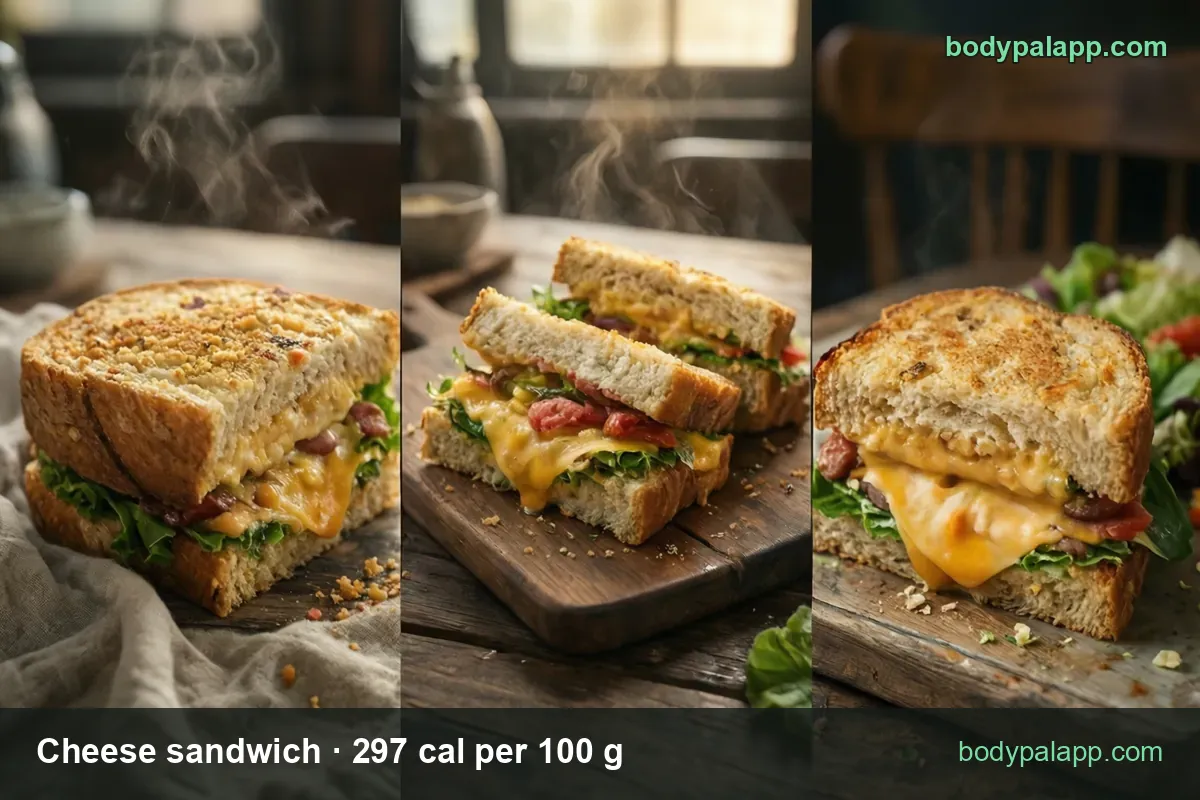
USDA keeps a separate record for nearly every combination of cheese, bread, and pan. Here they are at the same 102 g sandwich weight, so the comparison is fair.
| Version | Per 100 g | Typical sandwich | Calories |
|---|---|---|---|
| Cheese sandwich, NFS | 297 kcal | 102 g | 303 kcal |
| Grilled cheese, NFS | 343 kcal | 102 g | 350 kcal |
| Grilled cheese, cheddar, white bread | 368 kcal | 102 g | 375 kcal |
| Grilled cheese, American, white bread | 343 kcal | 102 g | 350 kcal |
| Grilled cheese, reduced fat cheese, white bread | 307 kcal | 102 g | 313 kcal |
| Cheese sandwich, cheddar, wheat bread | 323 kcal | 102 g | 330 kcal |
| Cheese sandwich, reduced fat cheese, white bread | 256 kcal | 102 g | 261 kcal |
Every 102 g weight in that table except the plain and the cheddar-on-wheat row is our own scaling from the USDA 100 g figures, not a listed USDA serving.
The pattern is clear once the weights are held steady. Grilling costs about 46 calories on the generic record — 343 per 100 g against 297 — and all of it is fat: 20.78 g per 100 g grilled against 13.29 g cold. That is the butter or oil in the pan, and it is a bigger swing than anything you do with the filling.
The heaviest record on this page is grilled cheddar on white bread at 368 calories per 100 g, or 375 in a sandwich. The lightest is reduced fat cheese on white bread at 256, or 261. Same two slices of bread, a 114-calorie gap. If you want to keep the toasted texture and lose most of the penalty, grilled with reduced fat cheese lands at 313 — ten calories above a cold, full-fat sandwich.
Packaged versions land in the same neighborhood. The one clean retail label in the USDA Branded database, a frozen American grilled cheese sandwich, lists 330 calories per 100 g and 310 for its 94 g sandwich — right between the cold generic and the grilled generic, which is about what a factory-made, lightly toasted sandwich should be.
Sodium and saturated fat are the rows to watch
Calories are not the interesting part of this food. Salt is. One 102 g sandwich carries 870 mg of sodium, 38% of the 2,300 mg Daily Value, from a lunch that a lot of people treat as light. That is roughly a third of a teaspoon of table salt, and the Dietary Guidelines for Americans put most adults over the sodium limit already before lunch is counted.
Here is where the cheese choice actually matters, and it is not where you would guess. The American-cheese build on wheat bread runs 848 mg of sodium per 100 g — about 865 mg per sandwich, 38% DV — while cheddar on wheat bread runs 528 mg, about 539 mg per sandwich, or 23% DV. The two are within 28 calories of each other per 100 g. Processed slices move the salt; they barely move the calories.
Saturated fat is the other row. A plain sandwich has 7.0 g, 35% of the 20 g Daily Value, in something you might eat twice a week without thinking. Reduced fat cheese on white bread brings that down to about 4.2 g, or 21% DV, and it does it without touching the sodium in any meaningful way — that record still carries 759 mg per 100 g. So reduced fat cheese is a fat lever, not a salt lever. If you are watching sodium, the better move is cheddar or another aged block cheese instead of processed slices.
Wheat bread is a third, smaller lever. It leaves calories almost where they were — 323 per 100 g with cheddar against 325 on white — but takes fiber from 1.4 g per 100 g to 3.2 g, about 3.3 g in a sandwich, or 12% DV instead of 5%. MyPlate counts that toward the half-your-grains-whole target, and it is a free change.
How does a cheese sandwich compare?
| Sandwich | Per 100 g | US serving | Calories |
|---|---|---|---|
| Cheese sandwich, NFS | 297 kcal | 1 sandwich, 102 g | 303 kcal |
| Cheddar on white bread | 325 kcal | 1 sandwich, 102 g | 332 kcal |
| American cheese on wheat bread | 295 kcal | 1 sandwich, 102 g | 301 kcal |
| Reduced fat cheese on white bread | 256 kcal | 1 sandwich, 102 g | 261 kcal |
Our take: for weight loss, the reduced fat cheese build is the one worth making — 261 calories and 4.2 g of saturated fat, and you keep a real sandwich instead of a sad one. For a lunch that holds you until dinner, take the cheddar on wheat bread: 330 calories, about 16.6 g of protein, and 3.3 g of fiber, which is the most filling combination in this group. The American-cheese sandwich has no advantage on either count — it is within two calories of the generic and carries 848 mg of sodium per 100 g, just under the generic's 853 mg. And if you toast it, count the butter: that is worth more than every choice above put together.
Most popular cheese sandwich brands in the United States
Ranked by how widely each product appears among foods sold in the United States, from the BodyPal food database of over 3.3 million products. Calories are the figures printed on each Nutrition Facts label, checked against USDA FoodData Central.
| Product | Calories (per 100 g) |
|---|---|
| Chef MJ American Grilled Cheese Sandwich | 330 cal |
Brand popularity: BodyPal food database. Nutrition: manufacturer labels / USDA FoodData Central.
Cheese sandwich FAQs
How many calories are in a cheese sandwich?
A standard 102 g cheese sandwich carries 303 calories, working out to 297 calories per 100 g. That is the USDA's generic, untoasted record: two slices of bread with cheese and nothing else. Add butter and toast it and the same sandwich climbs to about 350 calories.
How many calories are in a grilled cheese sandwich?
A grilled cheese sandwich runs 343 calories per 100 g, so a 102 g sandwich lands near 350 calories. The bread and cheese barely change; the fat does, rising from 13.29 g to 20.78 g per 100 g. Grilled with cheddar on white bread, it reaches 375 calories.
How many calories in a cheese sandwich on white bread?
Cheddar on white bread is 325 calories per 100 g, or 332 for a 102 g sandwich. Swap in reduced fat cheese on the same white bread and it drops to 256 per 100 g, or 261 per sandwich. The bread is not what separates those two numbers.
How much protein is in a cheese sandwich?
A 102 g cheese sandwich supplies 12.7 g of protein, 25% of the 50 g Daily Value. Cheddar on wheat bread is the strongest of the USDA builds at 16.3 g per 100 g, about 16.6 g in one sandwich. That is respectable lunch protein, but it is not a protein food.
How much sodium is in a cheese sandwich?
One sandwich carries 870 mg of sodium, 38% of the 2,300 mg Daily Value and roughly a third of a teaspoon of table salt. Bread and cheese both contribute. Cheddar on wheat bread is the low option at 528 mg per 100 g, about 539 mg in a sandwich.
Is a cheese sandwich good for weight loss?
At 303 calories, a cheese sandwich fits inside a 350 to 450 calorie lunch with room for fruit, and half a sandwich is 151. The catch is 7.0 g of saturated fat, 35% of the Daily Value. Reduced fat cheese cuts that to about 4.2 g and the sandwich to 261 calories.
Does wheat bread make a cheese sandwich healthier?
Wheat bread changes fiber, not calories: cheddar on wheat is 323 calories per 100 g against 325 on white. Fiber goes from 1.4 g to 3.2 g per 100 g, about 3.3 g per sandwich, or 12% of the Daily Value instead of 5%. Sodium is unchanged.
How many calories in half a cheese sandwich?
Half a sandwich is 51 g and 151 calories, our own arithmetic from the USDA 100 g figure rather than a listed serving. It also halves the sodium to about 435 mg and the saturated fat to 3.5 g. Paired with a cup of soup, the plate still lands near 300.
Similar foods
- Cheeseburger — 488 cal per cheeseburger
- Wonton wrapper — 23 cal per wonton wrapper
- Honey — 64 cal per tablespoon
- Condensed Milk — 122 cal per 2 tbsp
- Maple Syrup — 216 cal for 1/4 cup
- Gouda cheese — 75 cal per slice
Count it without the math
Point the camera at the plate and BodyPal counts the sandwich for you, cheese, bread and butter included.


How long does it take to burn off 303 kcal of cheese sandwich?
One sandwich (102 g) is 303 kcal. Enter your weight and the amount you ate to see how long it takes you to burn that off:
lb
| Activity | Time to burn 303 kcal |
|---|---|
| Walking, brisk | 1 hr 1 min |
| Cycling, moderate | 38 min |
| Swimming, moderate | 43 min |
| Jogging | 36 min |
| Weight training, moderate | 1 hr 7 min |
Times are for a 155 lb adult at a steady pace; change the weight to see yours. The amount is set to the portion in the text (102 g); change it to what you actually ate. BodyPal works this out from your steps automatically.
One food is easy to picture; a whole day is harder. See how many calories you need a day and what a deficit actually looks like.