
How many calories are in cherry tomatoes?
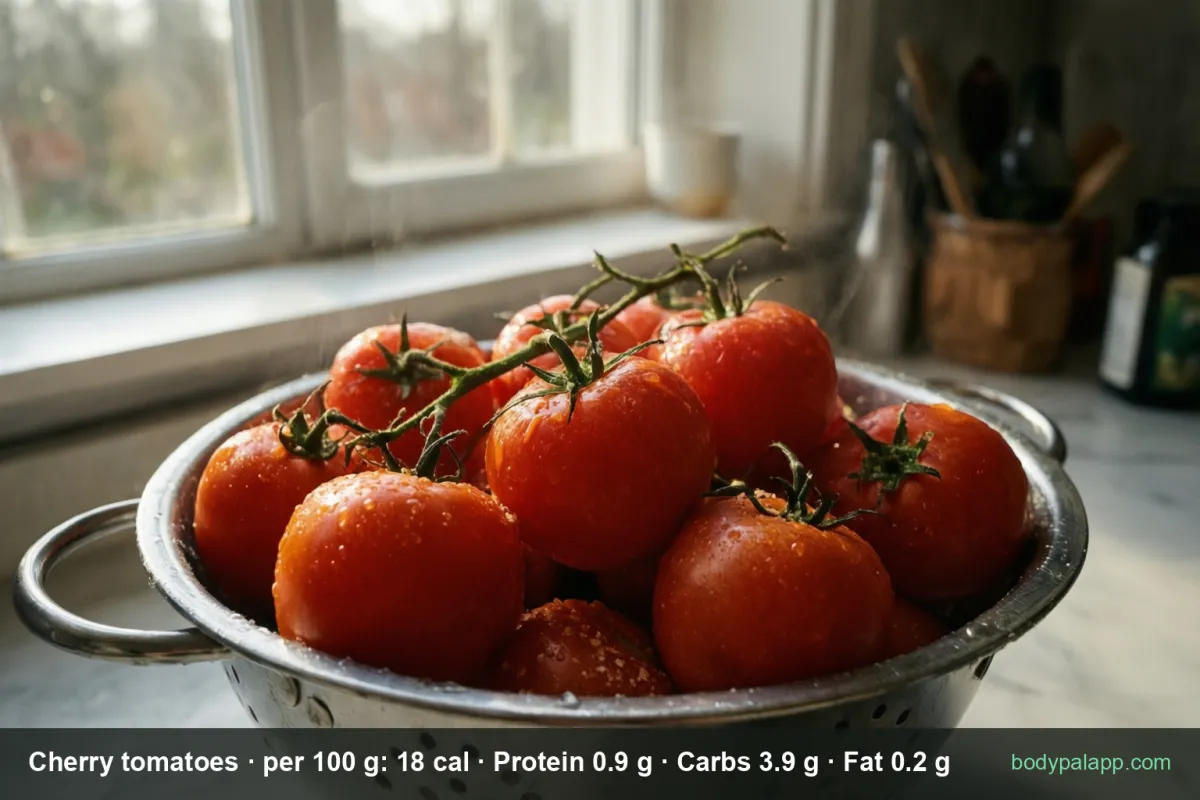
A cup of cherry tomatoes weighs 149 g and carries 27 calories. Per 100 g the raw fruit is 18 calories, which makes it one of the lightest things you can put on a plate by volume. A single tomato off the vine is 3 calories, and a 10-piece snack box lands at 31.
On this page
- Cherry tomato quick facts
- US servings, from one tomato to a snack box
- Cooked, canned and stewed cherry tomatoes
- Potassium and fiber are the rows worth reading
- How do cherry tomatoes compare?
- Most popular cherry tomatoes brands
- Cherry tomato FAQs
Cherry tomato quick facts
There is no separate USDA entry for cherry tomatoes. The numbers below come from SR Legacy 170457, "Tomatoes, red, ripe, raw, year round average", the record that covers red ripe raw tomatoes of every size. It is also the only tomato record that carries the two household measures a shopper actually holds: one cup of cherry tomatoes at 149 g, and one cherry tomato at 17 g.
That matters more than it sounds. Nearly every result for this question quotes a per-100-g figure and leaves you to guess how many tomatoes that is. A cup is the unit people log, so the cup column is the one to read.
| Nutrient | Per 100 g | Per 1 cup cherry tomatoes (149 g) | % Daily Value |
|---|---|---|---|
| Calories | 18 | 27 | — |
| Total fat | 0.2 g | 0.3 g | 0% |
| Saturated fat | 0.03 g | 0.0 g | 0% |
| Carbohydrate | 3.89 g | 5.8 g | 2% |
| Dietary fiber | 1.2 g | 1.8 g | 6% |
| Total sugars | 2.63 g | 3.9 g | — |
| Protein | 0.88 g | 1.3 g | 3% |
| Sodium | 5 mg | 7 mg | 0% |
% Daily Value is based on a 2,000-calorie diet.
Verified nutrition data
Numbers on this page come from USDA FoodData Central, the U.S. Department of Agriculture’s food composition database, and from manufacturer labels where a branded product is named. Last verified September 2026. How we verify our data →
Two rows you will not find here: added sugars and trans fat. The SR Legacy edition does not measure either one for raw vegetables, so listing them would mean inventing numbers, and a fresh tomato has no added sugar by definition. Cholesterol is zero. Potassium is the standout at 237 mg per 100 g, or 353 mg in a cup, which is 8% of the Daily Value.
US servings, from one tomato to a snack box
| Serving | Weight | Calories |
|---|---|---|
| 1 cherry tomato | 17 g | 3 kcal |
| 1 oz | 28 g | 5 kcal |
| 1 cup cherry tomatoes | 149 g | 27 kcal |
| 10 cherry tomatoes | 170 g | 31 kcal |
| Per 100 g | 100 g | 18 kcal |
The cup and the single tomato are USDA household measures, published with the record itself. The 10-piece line is our own arithmetic from the USDA 100 g figure, not a USDA serving, because tomatoes leave the store in clamshells and nobody counts them into a measuring cup first. The 1 oz row is the same kind of scaling.
There is also an NLEA serving of 148 g on the record, the reference amount used for labeling. It rounds to the same 27 calories as the 149 g cup, so if your app offers both, the choice makes no difference.
Here is the trap worth knowing. A cup of whole cherry tomatoes holds 149 g, while a cup of chopped regular tomatoes holds 180 g and reaches 32 calories. Round fruit leaves air between the pieces; chopped fruit fills it. Logging cherry tomatoes as "1 cup tomatoes" overstates them by about a fifth. At 27 calories the error is trivial. The same packing rule applied to a cup of rice or nuts is not.
Cooked, canned and stewed cherry tomatoes
Roast a tray of cherry tomatoes and they collapse into something far sweeter, but the calorie math barely moves. Water leaves, so the same weight of cooked tomato holds a little more protein and carbohydrate, while fiber drops from 1.2 g to 0.7 g per 100 g. The cup gets heavier, though: cooked tomatoes pack at 240 g per cup against 149 g raw, and that is what pushes a cup of them to 43 calories.
| Version | Per 100 g | Typical serving | Calories |
|---|---|---|---|
| Cherry tomatoes, raw | 18 kcal | 1 cup (149 g) | 27 kcal |
| One cherry tomato, raw | 18 kcal | 1 tomato (17 g) | 3 kcal |
| Grape tomatoes, retail label | 36 kcal | 3 oz (84 g) | 30 kcal |
| Tomatoes, cooked | 18 kcal | 1 cup (240 g) | 43 kcal |
| Canned in tomato juice, no salt added | 16 kcal | 1 cup (240 g) | 38 kcal |
| Stewed tomatoes | 79 kcal | 1 cup (101 g) | 80 kcal |
Stewed is the row that breaks the pattern. At 79 calories per 100 g it is more than four times the raw fruit, because the USDA recipe behind it includes oil and breadcrumbs. It is a tomato dish, not a tomato. Canned stewed tomatoes straight from the can are a different record and sit at 26 calories per 100 g, sweetened with a little sugar and seasoned.
Retail grape tomatoes read higher than USDA does. Store labels run from 29 to 36 calories per 100 g, and a supermarket 3 oz pack (84 g) declares 30 calories. That gap is label rounding from a small declared serving, not a different vegetable. Canned cherry tomato brands land in the same band, 23 to 28 calories per 100 g, with the juice they are packed in doing most of the lifting.
Potassium and fiber are the rows worth reading
Calories are not the interesting part of this food. A cup covers 8% of the Daily Value for potassium and 6% for fiber while spending 27 calories, which is roughly one and a third percent of a 2,000-calorie day. The Daily Values on the Nutrition Facts label put fiber at 28 g and potassium at 4,700 mg, and most American diets fall short on both. Cherry tomatoes count toward the vegetable group on MyPlate, where a cup of raw whole tomatoes counts as a cup-equivalent.
Sodium is where the versions separate, and it has nothing to do with calories. Raw cherry tomatoes hold 5 mg per 100 g. Canned in tomato juice with no salt added, 10 mg. The same can, salted, 115 mg. Canned stewed tomatoes, 221 mg. The USDA stewed recipe reaches 455 mg per 100 g, about a fifth of a teaspoon of table salt in every small serving. If you are watching sodium, the raw clamshell and the no-salt-added can are the two picks that stay out of the way.
Protein is negligible at 1.3 g per cup, 3% of the Daily Value, so cherry tomatoes are filler and flavor rather than a building block. Fat is 0.3 g, and saturated fat rounds to zero. Whatever calories end up on the plate come from what you dress them with: a tablespoon of olive oil adds more than four cups of tomatoes do.
How do cherry tomatoes compare?
| Tomato | Per 100 g | US serving | Calories |
|---|---|---|---|
| Cherry tomatoes, raw | 18 kcal | 1 cup (149 g) | 27 kcal |
| Tomatoes, cooked | 18 kcal | 1 cup (240 g) | 43 kcal |
| Canned in tomato juice | 16 kcal | 1 cup (240 g) | 38 kcal |
| Tomatoes, cooked, stewed | 79 kcal | 1 cup (101 g) | 80 kcal |
Our take: per 100 g only the canned row is lighter than raw at 16 calories, and cooked ties it exactly at 18, so the choice is never about calories. It is about weight and salt. A cup of the cooked or canned versions is heavier than a cup of whole cherry tomatoes, which is why they log at 43 and 38 instead of 27. For a salad or a snack, raw cherry tomatoes are the cheapest volume on the table. For sauce, use the no-salt-added can and add your own seasoning, because the canned salted row carries 23 times the sodium of the fresh fruit, 115 mg against 5 mg per 100 g.
Most popular cherry tomatoes brands in the United States
Ranked by how widely each product appears among foods sold in the United States, from the BodyPal food database of over 3.3 million products. Calories are the figures printed on each Nutrition Facts label, checked against USDA FoodData Central.
| Product | Calories (per 100 g) |
|---|---|
| Mutti Cherry Tomatoes | 28 cal |
| DeLallo Whole Cherry Tomatoes | 27 cal |
| Colavita Cherry Tomatoes | 23 cal |
| Nature's Promise Organic Grape Tomatoes | 29 cal |
| Nina Cherry Tomatoes | 26 cal |
| Giant Eagle Grape Tomatoes | 36 cal |
Brand popularity: BodyPal food database. Nutrition: manufacturer labels / USDA FoodData Central.
Cherry tomato FAQs
How many calories are in one cherry tomato?
One cherry tomato weighs about 17 g and carries 3 calories, based on the USDA raw tomato record at 18 calories per 100 g. Ten of them, roughly a snack box, come to 170 g and 31 calories. That is our own arithmetic from the 100 g figure, not a separate USDA serving.
How many calories in a cup of cherry tomatoes?
A cup of whole cherry tomatoes is 149 g and 27 calories. It brings 5.8 g of carbohydrate, 1.8 g of fiber, 1.3 g of protein and 7 mg of sodium. The USDA NLEA serving of 148 g lands on the same 27 calories, so the two are interchangeable in a food log.
How many calories in 10 cherry tomatoes?
Ten cherry tomatoes weigh about 170 g and come to 31 calories, our own arithmetic from the USDA 100 g figure of 18 calories rather than a listed serving. That works out to 6.6 g of carbohydrate and 2.0 g of fiber. Sizes vary, so a box of small ones runs lighter.
Are cherry tomatoes higher in calories than regular tomatoes?
No. Both sit at 18 calories per 100 g in the USDA data, which uses a single record for red ripe raw tomatoes. The cup is what differs: whole cherry tomatoes pack at 149 g for 27 calories, while a cup of chopped regular tomatoes weighs 180 g and reaches 32 calories.
How many carbs are in cherry tomatoes?
A cup holds 5.8 g of carbohydrate, 2% of the Daily Value, with 1.8 g of that as fiber and 3.9 g as naturally occurring sugars. Per 100 g the figures are 3.89 g of carbohydrate and 1.2 g of fiber. A single 17 g tomato carries about 0.7 g of carbohydrate.
Are cherry tomatoes keto friendly?
A cup gives 5.8 g of carbohydrate against 1.8 g of fiber, so about 4 g of net carbs by our own subtraction. Five tomatoes weigh roughly 85 g and land at 15 calories with 3.3 g of carbohydrate. That fits inside most low-carb budgets when they are eaten by the handful.
Do cherry tomatoes have sugar?
Yes, 2.63 g per 100 g, which works out to 3.9 g in a 149 g cup. All of it occurs naturally in the fruit. The USDA SR Legacy record does not publish added sugars for raw vegetables, and fresh tomatoes have none. Total sugars carry no Daily Value on the Nutrition Facts label.
Are grape tomatoes and cherry tomatoes the same calories?
In USDA terms yes: both fall under the same raw red tomato record at 18 calories per 100 g. Retail labels for grape tomatoes read higher, from 29 to 36 calories per 100 g, because label values are rounded from a small declared serving. A 3 oz pack (84 g) declares 30 calories.
Similar foods
- Lemon — 17 cal per lemon
- Lime — 20 cal per medium lime
- Watermelon Chunks — 46 cal per cup
- Watermelon Cubes — 46 cal per cup
- Watermelon Whole — 1355 cal per watermelon
- 5 Strawberries — 19 cal per 5 medium strawberries
Count it without the math
Point the camera at the bowl and BodyPal counts the tomatoes for you, cup or handful.


How long does it take to burn off cherry tomatoes?
A 1-cup (149 g) serving is 27 kcal. Enter your weight and the amount you ate to see how long it takes you to burn that off:
lb
| Activity | Time to burn 27 kcal |
|---|---|
| Walking, brisk | 5 min |
| Cycling, moderate | 3 min |
| Swimming, moderate | 4 min |
| Jogging | 3 min |
| Weight training, moderate | 6 min |
Times are for a 155 lb adult at a steady pace; change the weight to see yours. The amount is set to the portion in the text (149 g); change it to what you actually ate. BodyPal works this out from your steps automatically.
One food is easy to picture; a whole day is harder. See how many calories you need a day and what a deficit actually looks like.