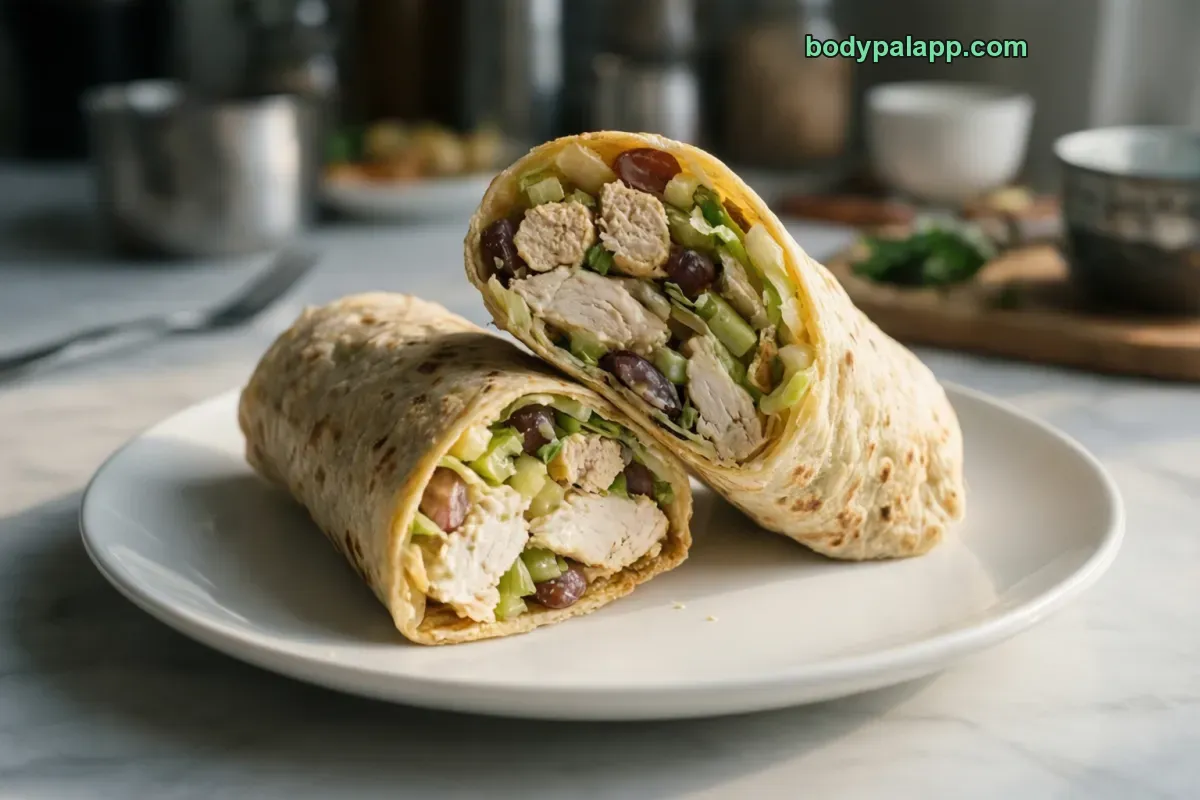
Chicken salad wrap calories come to 538 for one 200 g wrap and 269 per 100 g. The thing to notice is the dressing: fat supplies 55% of those calories, more than protein and carbs combined. One wrap also carries 1,206 mg of sodium, which is 52% of the daily value.
538kcal
1 wrap · 200 g, ready to eat
19%protein
26 gProtein
34 gCarbs
33 gFat
How to burn off 538 kcal
—Walking, brisk
—Jogging
—Cycling, moderate
—Swimming
Skip the math. BodyPal counts these calories from your steps and workouts automatically.
Nutrition facts
Ready to eat · per 200 g
Calories
538 kcal
Protein
26 g
Carbohydrate
34 g
Fat
33 g
Saturated fat
9 g
Cholesterol
96 mg
Sodium
1206 mg
Potassium
354 mg
Iron
2.8 mg
Source: USDA FoodData Central
🛡️
Verified nutrition data
Numbers on this page come from USDA FoodData Central, the U.S. Department of Agriculture’s food composition database, and from manufacturer labels where a branded product is named. Last verified September 2026. How we verify our data →
Chicken salad wrap: calories, protein and sodium by serving
Percent of daily value uses the FDA reference of 2,000 kcal a day.
Serving
kcal
Protein
Carbs
Fat
Sodium
% DV kcal
1 wrap (200 g)
538
25.8 g
34 g
33.1 g
1,206 mg
27%
4 oz portion (113 g)
304
14.6 g
19.2 g
18.7 g
681 mg
15%
100 g
269
12.9 g
17 g
16.6 g
603 mg
13%
3 × 1 wrap (200 g)
1,614
77.3 g
3,618 mg
5 × 1 wrap (200 g)
2,690
128.9 g
6,030 mg
One wrap is a 538-calorie lunch, not a light snack
A standard 200 g wrap lands at 538 calories, about 27% of a 2,000-calorie daily value. That puts it in full-meal territory, closer to a burger than to a side salad. The tortilla looks thin, but the filling is dense, and a deli wrap packs a lot of it into a small roll.
Smaller portions scale down cleanly. A 4 oz portion (113 g) comes to 304 calories and 14.6 g of protein, roughly 15% of the daily calorie value. If you split a wrap and eat 100 g, you are at 269 calories. That half-wrap approach works well when the wrap sits next to soup or fruit rather than standing alone.
The total climbs fast when wraps multiply. Two wraps reach 1,076 calories and 2,412 mg of sodium, which already passes the 2,300 mg daily value on its own. Three wraps hit 1,614 calories. Party platters cut into pinwheels make this easy to miss, because nobody counts slices the way they count whole wraps.
Fat is more than half of every bite
The calorie split is 55% fat, 25% carbs and 19% protein. Per 100 g that works out to 16.6 g of fat, 17 g of carbs and 12.9 g of protein. The chicken itself is lean, so the fat comes mostly from the mayonnaise-style dressing that binds the salad.
A full wrap holds 33.1 g of fat against a daily value of 78 g. Saturated fat is 4.5 g per 100 g, set against a 20 g daily value, so it is a moderate number rather than an alarming one. Cholesterol sits at 48 mg per 100 g.
Protein is still respectable. One wrap delivers 25.8 g, which is 52% of the 50 g daily value. That is enough to make the wrap filling. The catch is that you pay for that protein with roughly twice as many fat calories, which is the opposite of what a plain grilled chicken wrap would give you.
Sodium is the row to watch
At 603 mg per 100 g, sodium is the number that stands out most. One 200 g wrap carries 1,206 mg, or 52% of the 2,300 mg daily value, in a single lunch item. Seasoned chicken, dressing, the tortilla and any pickles or cheese all add to it.
The 4 oz portion (113 g) brings that down to 681 mg, or 30% of the daily value. If you watch sodium, that smaller portion is the easiest lever you have. Pairing it with fresh produce rather than chips or a pickle spear keeps the rest of the meal from piling on more.
Two wraps in a day push you to 2,412 mg before anything else you eat is counted. Five wraps across a week of lunches would add up to 6,030 mg, which is worth knowing if the wrap is your default grab-and-go meal.
Low fiber means it needs a side
One wrap has only 2.6 g of fiber against a 28 g daily value, and 5.3 g of sugars. It is filling because of fat and protein, not because of bulk. Adding raw vegetables, a piece of fruit or a broth-based soup brings volume to the plate without many extra calories.
Treat the wrap as the main course of the meal. If breakfast or dinner runs heavy, the 4 oz portion at 304 calories fits more easily than the full 538. Store-bought versions vary by recipe; Archer Farms Tarragon Chicken Salad Wrap, Wawa Rotisserie White Meat Chicken Salad Wrap and Etai's Curried Chicken Salad Wrap all use different dressings and fillings, so check the label when you can.
Potassium is modest at 177 mg per 100 g, so the wrap does little for that row on its own. If you want to log the wrap quickly, BodyPal can record it from a photo and match it to the serving you actually ate.
How does chicken salad wrap compare?
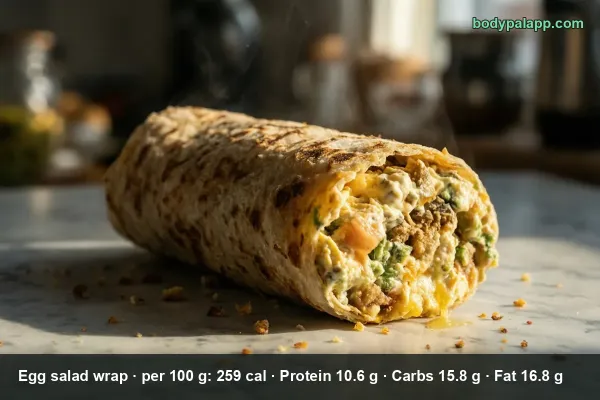
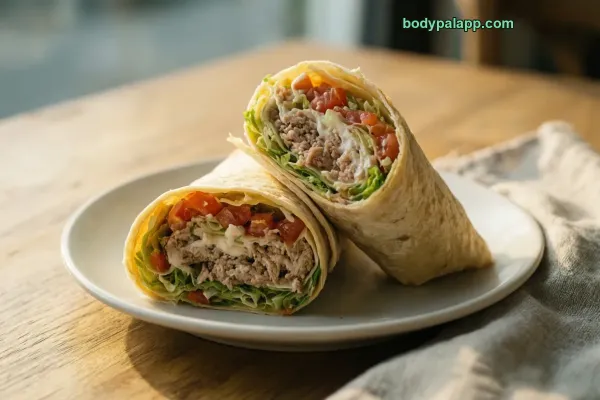
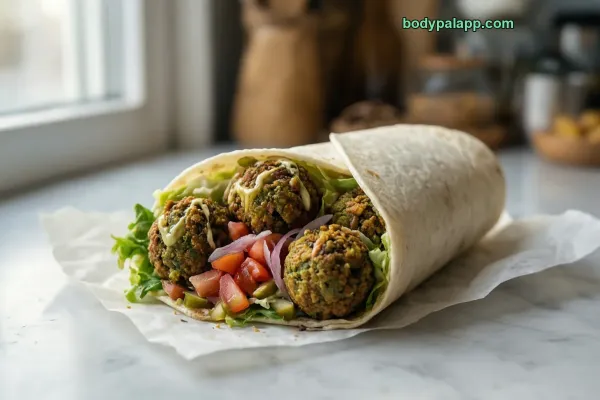
Here is how a chicken salad wrap stacks up against tuna, tuna salad and falafel wraps, per 100 g and per usual serving.
Verdict: For the fewest calories pick the tuna wrap at 488 per wrap, and for the least sodium pick falafel at 359 mg per 100 g. For staying full, the chicken salad wrap wins on protein with 12.9 g per 100 g versus 10.6 g for tuna and 6.2 g for falafel.
Most popular chicken salad wrap brands in the United States
About 538 calories in one wrap (200 g), or 269 calories per 100 g.
Is a chicken salad wrap good for weight loss?
One wrap has 538 calories, 25.8 g of protein and 33.1 g of fat. Store-bought versions range from 197 to 279 calories per 100 g.
Chicken salad wrap vs tuna wrap: which has fewer calories?
Per 100 g, a chicken salad wrap has 269 calories and a tuna wrap 244, so the tuna wrap is 25 calories lower.
How much protein is in a chicken salad wrap?
One chicken salad wrap has 25.8 g of protein, along with 34.0 g of carbs and 33.1 g of fat.
How much sodium is in a chicken salad wrap?
One 200 g chicken salad wrap has 1,206 mg of sodium, which is 52% of the daily value. A 4 oz portion (113 g) cuts that to 681 mg, or 30% of the daily value.
How many calories are in half a chicken salad wrap?
About 269 calories, since 100 g, roughly half of a 200 g wrap, comes to 269. A 4 oz portion (113 g) is 304 calories with 14.6 g of protein.
How much fat is in a chicken salad wrap?
One wrap contains 33.1 g of fat, and fat supplies 55% of its calories. Per 100 g there are 16.6 g of fat, including 4.5 g of saturated fat.
How many calories are in two chicken salad wraps?
Two wraps come to 1,076 calories and 51.6 g of protein. They also carry 2,412 mg of sodium, which is more than the 2,300 mg daily value.
How much fiber and sugar does a chicken salad wrap have?
One wrap has 2.6 g of fiber and 5.3 g of sugars. That fiber is small next to the 28 g daily value, so a side of vegetables or fruit helps fill the gap.