
How many calories are in an egg salad wrap?
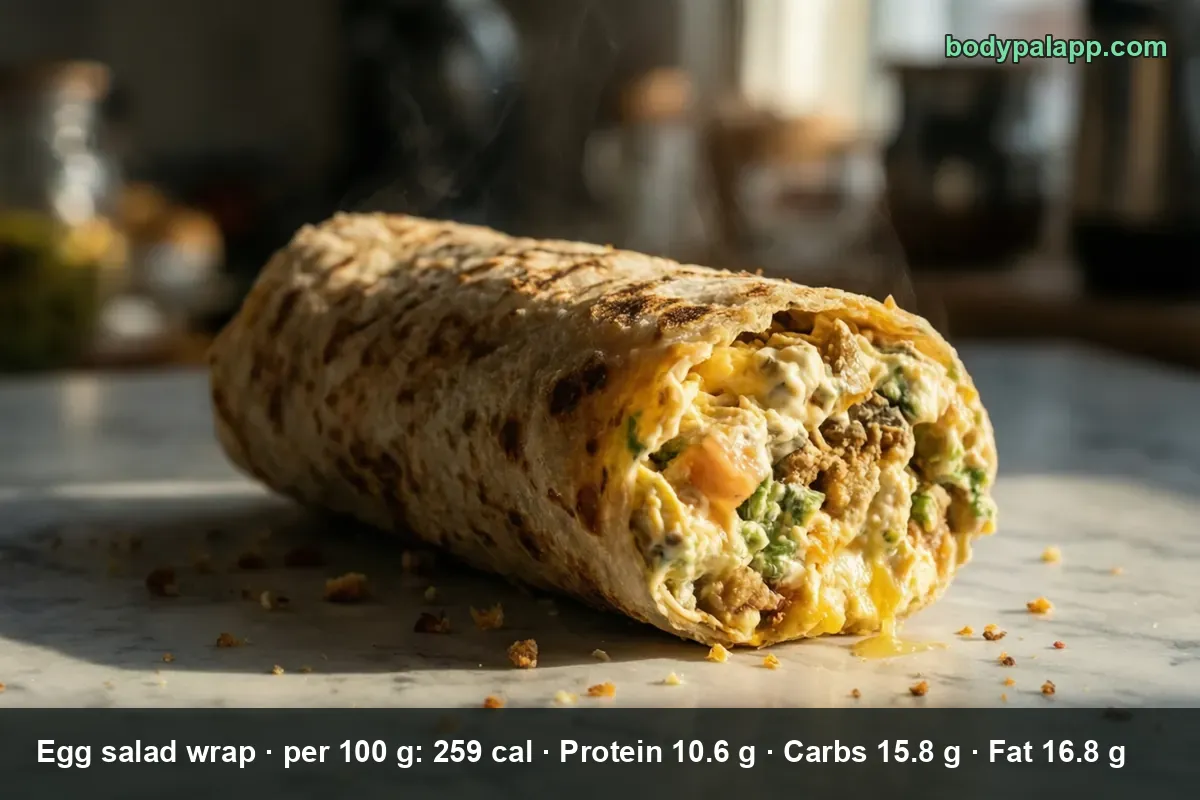
A deli-size egg salad wrap weighs 198 g and carries 513 calories. Per 100 g the assembled wrap runs 259 calories, about the same density as the egg salad on its own. The difference is the size. The base wrapped around the filling is what pushes one lunch past 500.
On this page
- Egg salad wrap quick facts
- US servings, from one ounce to a deli wrap
- Wrap versions and what the filling does
- Cholesterol is the row that jumps
- How does an egg salad wrap compare?
- Most popular egg salad wrap brands
- Egg salad wrap FAQs
Egg salad wrap quick facts
There is no USDA record called "egg salad wrap." The closest assembled build is FNDDS 2707281, "Egg salad sandwich on wheat", and it is the right number for the thing in your hand: a flour tortilla and a whole-wheat bread base land in the same density range, so the filling-to-base ratio, not the shape of the base, drives the total. The records named "Egg salad, made with..." are the filling only, with no base at all. Those sit further down this page in the variants table, where they belong.
| Nutrient | Per 100 g | Per 1 wrap (198 g) | % Daily Value |
|---|---|---|---|
| Calories | 259 | 513 | — |
| Total fat | 16.75 g | 33.2 g | 43% |
| Saturated fat | 3.51 g | 6.9 g | 35% |
| Carbohydrate | 15.81 g | 31.3 g | 11% |
| Dietary fiber | 1.8 g | 3.6 g | 13% |
| Total sugars | 2.41 g | 4.8 g | — |
| Protein | 10.64 g | 21.1 g | 42% |
| Sodium | 399 mg | 790 mg | 34% |
| Cholesterol | 205 mg | 406 mg | 135% |
| Potassium | 133 mg | 263 mg | 6% |
% Daily Value is based on a 2,000-calorie diet.
Verified nutrition data
Numbers on this page come from USDA FoodData Central, the U.S. Department of Agriculture’s food composition database, and from manufacturer labels where a branded product is named. Last verified September 2026. How we verify our data →
Two rows you will see on a packaged label are missing here: added sugars and trans fat. FNDDS does not publish either for assembled mixed dishes, so rather than guess them, they are left out. Everything else is on the table above, including cholesterol and potassium, which are optional on a printed panel but useful on this food in particular. The %DV column uses the FDA Daily Values for a 2,000-calorie day.
US servings, from one ounce to a deli wrap
| Serving | Weight | Calories |
|---|---|---|
| 1 oz | 28 g | 73 kcal |
| Half a wrap | 99 g | 256 kcal |
| One small wrap | 139 g | 360 kcal |
| One wrap, deli size | 198 g | 513 kcal |
| Per 100 g | 100 g | 259 kcal |
The two wrap weights come from US retail labels for ready-made egg salad sandwiches: 198 g for the standard deli size, 139 g for the smaller cafe or gas-station build. The half wrap at 99 g and the 1 oz line are our own arithmetic from the USDA 100 g figure, not USDA servings, which matters if you are logging a shared wrap rather than a whole one.
That 139 g version is the sleeper. It looks like a modest downgrade and it is: 360 calories against 513, a saving of 153 for one size step, without touching the recipe at all. Branded packs confirm the spread. USDA's retail records include a Walmart egg salad sandwich at 400 calories for 152 g, a Taylor Farms one at 490 for 211 g, and a Brown Bag Sandwich Co. whole-wheat build at 270 for 139 g.
Wrap versions and what the filling does
| Version | Per 100 g | Typical portion | Calories |
|---|---|---|---|
| Wrap on a whole-wheat base | 259 kcal | 1 wrap (198 g) | 513 kcal |
| Wrap on a white base | 260 kcal | 1 wrap (198 g) | 515 kcal |
| Filling, full-fat mayonnaise | 257 kcal | 1 cup (222 g) | 571 kcal |
| Filling, creamy dressing | 212 kcal | 1 cup (222 g) | 471 kcal |
| Filling, light mayonnaise | 172 kcal | 1 cup (222 g) | 382 kcal |
| Filling, fat-free dressing | 139 kcal | 1 cup (222 g) | 309 kcal |
The cup weight is USDA's household measure for the filling; the calories on those four lines are scaled from the published 100 g figures.
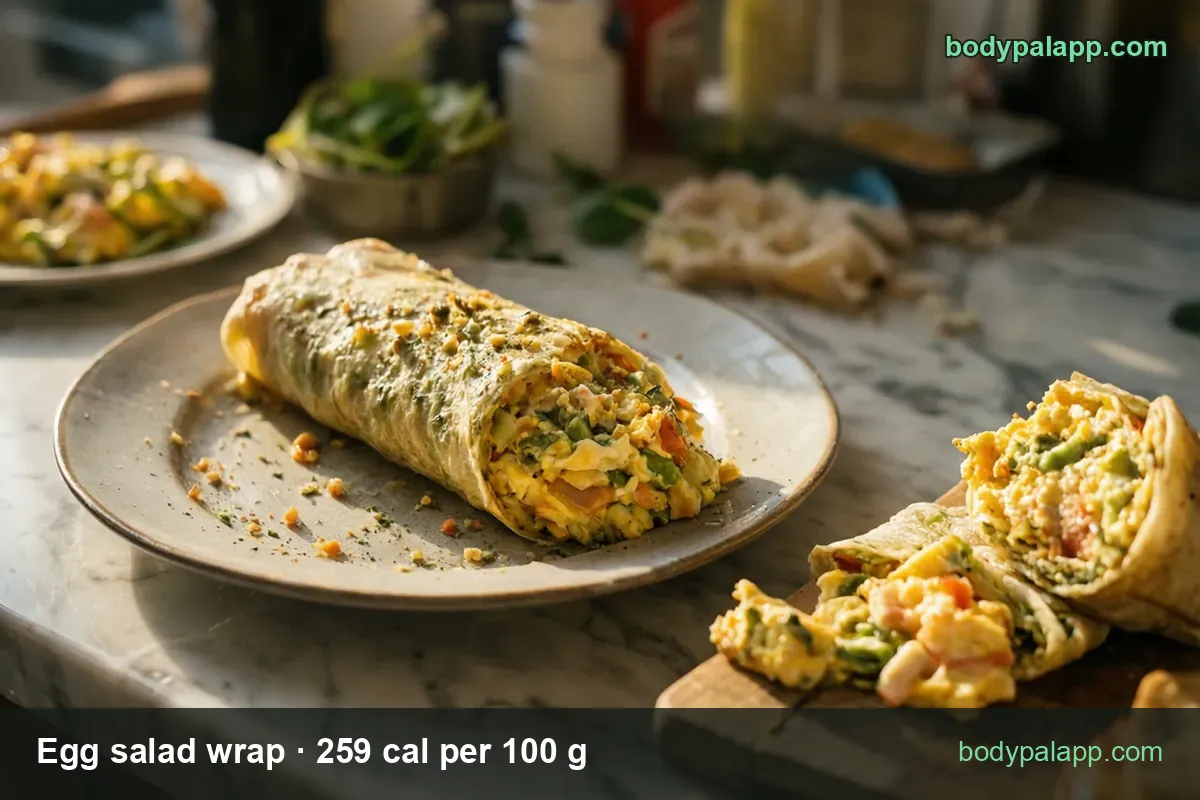
Whole wheat versus white is a non-event on calories: 259 against 260 per 100 g, 513 against 515 for a 198 g portion. The row that actually moves is fiber, 1.8 g per 100 g on the wheat build against 0.8 g on the white one. Over a whole wrap that is 3.6 g versus 1.6 g, or 13% of the Daily Value versus 6%.
The dressing is where the real money is. Egg salad made with full-fat mayonnaise is 257 calories per 100 g; light mayonnaise takes it to 172. That is 85 calories saved per 100 g of filling, and 189 calories over a 1 cup batch, 571 down to 382. A fat-free dressing goes further still, to 139 per 100 g and 309 per cup.
There is a catch nobody prints on the deli case. As the fat comes out, the sodium goes up. The full-fat mayonnaise filling is the lowest-sodium version at 378 mg per 100 g. The light Italian dressing version, at 143 calories per 100 g, carries 437 mg. If you swap for calories, you are trading in the other direction on salt.
Cholesterol is the row that jumps
Look down the %DV column and one number is not like the others. Total fat is 43% of a day, protein 42%, saturated fat 35%, sodium 34%. Cholesterol is 135%. One 198 g wrap delivers 406 mg against a 300 mg Daily Value, and that comes almost entirely from the eggs, with a smaller contribution from the mayonnaise. The Dietary Guidelines for Americans advise keeping dietary cholesterol as low as possible while still eating a nutritionally adequate pattern; this is the food where that advice actually bites.
The flip side is genuinely good. Protein is 21.1 g in one wrap, 42% of the Daily Value, and eggs are one of the protein foods MyPlate counts toward the daily group. For 513 calories you get a full lunch's worth of protein plus 3.6 g of fiber, which most sandwich-counter lunches at that calorie level do not manage.
Sodium is the quiet one: 790 mg, 34% of a day, roughly a third of a teaspoon of table salt in a single wrap. That is fine on its own and less fine if the rest of the day is packaged food. If you are watching sodium, the half wrap at 395 mg is the easier version to fit in.
Here is the number that surprises most people who log this food. The carbohydrates are not from the eggs at all. The filling on its own is 1.01 g of carbohydrate per 100 g. The assembled wrap is 15.81 g. Every gram of that difference is the base. So if you are cutting carbs, cutting the tortilla in half does far more than changing the dressing; if you are cutting calories, the dressing does far more than the tortilla.
How does an egg salad wrap compare?
| Food | Per 100 g | US serving | Calories |
|---|---|---|---|
| Egg salad wrap, whole-wheat base | 259 kcal | 1 wrap (198 g) | 513 kcal |
| Egg salad sandwich on white | 260 kcal | 1 sandwich (198 g) | 515 kcal |
| Egg salad, full-fat mayonnaise | 257 kcal | 1 cup (222 g) | 571 kcal |
| Egg salad, creamy dressing | 212 kcal | 1 cup (222 g) | 471 kcal |
Our take: on a per-100-g basis these four are closer than they look, and three of them sit within 3 calories of each other. What separates them is portion behavior. A wrap is a fixed object and you eat one; a cup of filling is a scoop, and scoops grow. If you are counting calories, the wrap is the safer format precisely because it is pre-portioned. If you want the lowest number without giving up the food, swap the dressing before you shrink the wrap: light mayonnaise cuts 189 calories over a cup of filling, while dropping from a 198 g wrap to a 139 g one cuts 153.
Most popular egg salad wrap brands in the United States
Ranked by how widely each product appears among foods sold in the United States, from the BodyPal food database of over 3.3 million products. Calories are the figures printed on each Nutrition Facts label, checked against USDA FoodData Central.
| Product | Calories (per 100 g) |
|---|---|
| Walmart Egg Salad Sandwich | 263 cal |
| Archer Farms Egg Salad Sandwich | 262 cal |
| Taylor Farms Egg Salad Sandwich | 232 cal |
| Open Acres Egg Salad on Wheat Wedge | 213 cal |
| Brown Bag Sandwich Co. Egg Salad on Wheat | 194 cal |
| Molly's Egg Salad Whole Wheat Sandwich | 188 cal |
Brand popularity: BodyPal food database. Nutrition: manufacturer labels / USDA FoodData Central.
Egg salad wrap FAQs
How many calories are in an egg salad wrap?
A deli-size egg salad wrap of 198 g holds 513 calories, based on the USDA record for egg salad on a whole-wheat base at 259 calories per 100 g. A smaller 139 g wrap comes to 360. Most of those calories ride in the filling's fat, not in the base.
How many calories in half an egg salad wrap?
Half a deli wrap is 99 g and 256 calories, our own arithmetic from the USDA 100 g figure rather than a listed USDA serving. That half still brings 10.5 g of protein and 395 mg of sodium, so splitting the wrap splits every row on the label evenly.
How much protein is in an egg salad wrap?
One 198 g wrap gives 21.1 g of protein, 42% of the Daily Value, from 10.64 g per 100 g. The filling on its own is 10.26 g per 100 g, so protein density barely changes once it is wrapped. The base adds bulk and carbohydrate, not much protein.
Is an egg salad wrap healthy?
One wrap covers 42% of the Daily Value for protein and 13% for fiber, which is strong for a sandwich-counter lunch. It also carries 135% of the Daily Value for cholesterol and 43% for total fat. As an occasional 513-calorie lunch it works; as a daily habit those two rows are the ones to watch.
Egg salad wrap vs egg salad sandwich: which has more calories?
A 198 g portion is 513 calories on the whole-wheat build against 515 on white bread. USDA lists them at 259 and 260 calories per 100 g. The real gap is fiber: 1.8 g per 100 g on whole wheat versus 0.8 g on white, or 3.6 g versus 1.6 g per portion.
How much cholesterol is in an egg salad wrap?
A 198 g wrap carries 406 mg of cholesterol, 135% of the 300 mg Daily Value and by far the highest percentage on its label. The eggs are the reason, with the mayonnaise adding a little more. Half a wrap brings it down to 203 mg, or 68% of the Daily Value.
How do I make a lower calorie egg salad wrap?
Switch the dressing: egg salad made with light mayonnaise is 172 calories per 100 g against 257 with full-fat mayonnaise, and a fat-free dressing drops it to 139. Across a 1 cup, 222 g batch of filling that is 571 calories versus 382 or 309, without changing the base at all.
How much sodium is in a store-bought egg salad wrap?
The USDA record puts one 198 g wrap at 790 mg of sodium, 34% of the Daily Value and roughly a third of a teaspoon of table salt. Store brands are not all alike, and lighter dressings tend to carry more salt, not less, so the printed label beats any average here.
Similar foods
- Pancake — 423 cal for 3 medium pancakes
- Crepe — 179 cal per crepe
- Omelet — 305 cal for 3-egg omelet
- Toast with butter — 100 cal per slice with butter
- Egg — 72 cal per large egg
- Bagel — 277 cal per bagel
Count it without the math
Point the camera at the plate and BodyPal counts the wrap for you, filling and all.


How long does it take to burn off 513 kcal of egg salad wrap?
One wrap (198 g) is 513 kcal. Enter your weight and the amount you ate to see how long it takes you to burn that off:
lb
| Activity | Time to burn 513 kcal |
|---|---|
| Walking, brisk | 1 hr 43 min |
| Cycling, moderate | 1 hr 4 min |
| Swimming, moderate | 1 hr 13 min |
| Jogging | 1 hr |
| Weight training, moderate | 1 hr 54 min |
Times are for a 155 lb adult at a steady pace; change the weight to see yours. The amount is set to the portion in the text (198 g); change it to what you actually ate. BodyPal works this out from your steps automatically.
Burning it off is one side of it. The other is knowing your number: work out how many calories you need a day, with macros and a goal date.