
How many calories are in breaded chicken tenders?
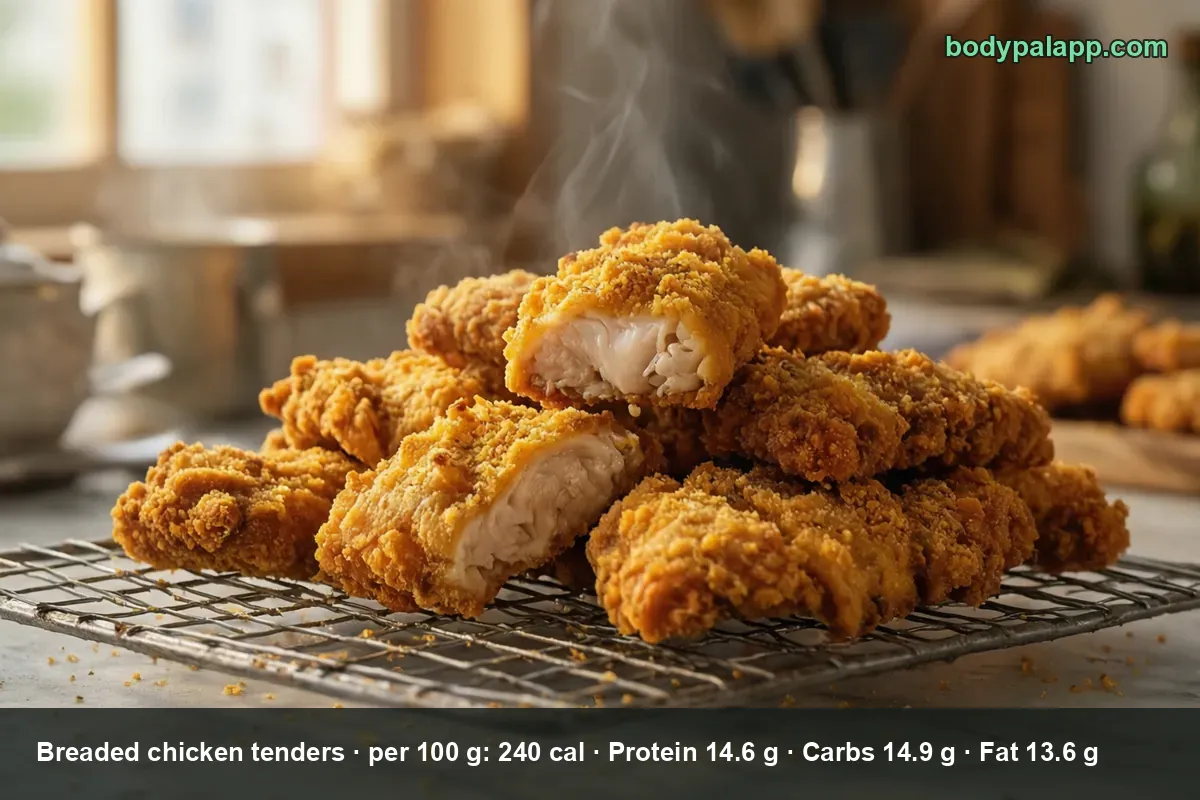
Three breaded chicken tenders weigh about 120 g and carry 288 calories. Per 100 g the from-frozen version runs 240 calories, with 17.5 g of protein and 632 mg of sodium in those three strips. One strip on its own is 96. Where the tenders came from moves the number as much as how many you eat.
On this page
- Breaded chicken tender quick facts
- US servings from one strip to a full cup
- Where the tenders came from changes the number
- Uncooked and microwaved tenders
- Sodium is the row to watch
- How do breaded chicken tenders compare?
- Most popular breaded chicken tenders brands
- FAQ
Breaded chicken tender quick facts
Six USDA records answer to the name "chicken tenders," and they are not interchangeable. The one used here is FNDDS 2706102, "Chicken tenders or strips, breaded, from frozen" — the bag out of the freezer, spread on a rack, baked or air-fried at home. That is the food most people are holding when they look this up, so it gets the headline number.
The restaurant and fast-food records live further down the page. They describe the same strips dropped into a deep fryer, which is a cooking difference, not a data difference. Nothing here is averaged between rows.
| Nutrient | Per 100 g | Per 3 strips (120 g) | % Daily Value |
|---|---|---|---|
| Calories | 240 | 288 | — |
| Total fat | 13.58 g | 16.3 g | 21% |
| Saturated fat | 2.44 g | 2.9 g | 15% |
| Carbohydrate | 14.86 g | 17.8 g | 6% |
| Dietary fiber | 1.7 g | 2.0 g | 7% |
| Total sugars | 0.57 g | 0.7 g | — |
| Protein | 14.62 g | 17.5 g | 35% |
| Sodium | 527 mg | 632 mg | 27% |
% Daily Value is based on a 2,000-calorie diet.
Verified nutrition data
Numbers on this page come from USDA FoodData Central, the U.S. Department of Agriculture’s food composition database, and from manufacturer labels where a branded product is named. Last verified September 2026. How we verify our data →
Two rows you would see on a retail package are missing: added sugars and trans fat. The 2021–2023 FNDDS release does not publish either value for this dish, so listing them would mean inventing them. Cholesterol comes in at 36 mg per 100 g, which is 43 mg in three strips (14% DV), and potassium at 281 mg per 100 g, or 337 mg per serving (7% DV). The three-strip column is our own arithmetic from the USDA 100 g figure, not a USDA serving size.
US servings from one strip to a full cup
| Serving | Weight | Calories |
|---|---|---|
| 1 tender or finger | 17 g | 41 kcal |
| 1 oz | 28 g | 68 kcal |
| 1 strip | 40 g | 96 kcal |
| Per 100 g | 100 g | 240 kcal |
| 3 strips, one plate | 120 g | 288 kcal |
| 1 cup | 140 g | 336 kcal |
USDA lists the 17 g finger, the 40 g strip and the 140 g cup as household measures for this record. The ounce and the three-strip plate are our own arithmetic from the 100 g figure.
The gap between "1 tender" and "1 strip" is where most logging errors start. A 17 g finger is the cocktail-size piece from a party tray; a 40 g strip is the long tender you get in a five-piece box. Same word, more than twice the calories. Weigh the first plate once and you will know which one your usual brand is.
Where the tenders came from changes the number
| Version | Per 100 g | Typical piece | Calories |
|---|---|---|---|
| From frozen, baked at home | 240 kcal | 1 strip (40 g) | 96 kcal |
| From other sources | 262 kcal | 1 tender or finger (50 g) | 131 kcal |
| From school lunch | 270 kcal | 1 strip (40 g) | 108 kcal |
| From fast food | 271 kcal | 1 tender or finger (50 g) | 136 kcal |
| From a restaurant | 283 kcal | 1 tender or finger (50 g) | 142 kcal |
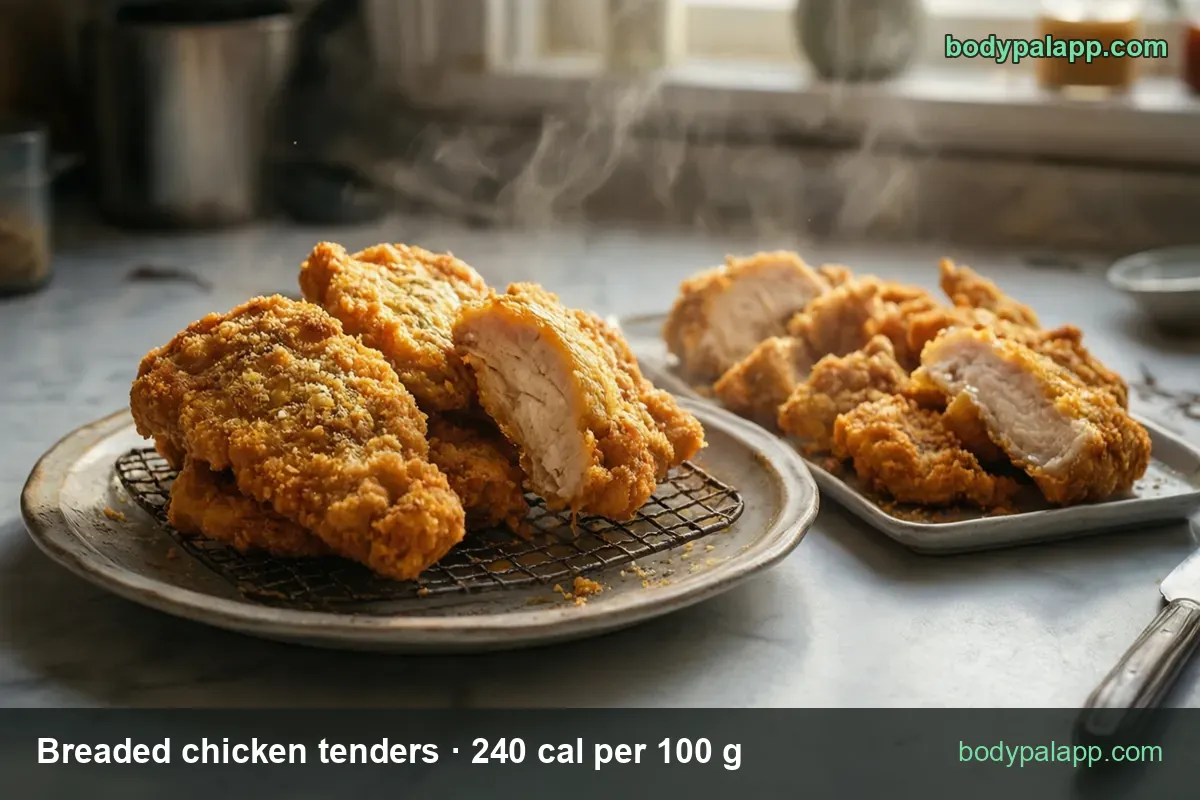
Spread across the set, the difference between the freezer bag and a sit-down restaurant is 43 calories per 100 g, an 18% jump on the same food. None of that comes from the chicken. It comes from a deep fryer full of hot oil versus a rack in a hot oven.
School lunch tenders are the odd one out. At 270 calories per 100 g they sit near the fast-food figure, but they get there differently: 22.86 g of carbohydrate per 100 g against 17.25 g for fast food, because the coating is thicker and the strips are smaller. They also carry the most fiber in the group, 2.2 g per 100 g.
If a menu just says "chicken tenders" with no other detail, USDA has a record for that too — the NFS entry, which mirrors the fast-food values exactly at 271 calories per 100 g. USDA has no branded supermarket rows for this food in the current index, so a Tyson or Perdue box is best logged against the from-frozen record and then checked against the package panel.
Uncooked and microwaved tenders
| Version | Per 100 g | Typical piece | Calories |
|---|---|---|---|
| Uncooked, straight from the bag | 263 kcal | 3 oz (85 g) | 224 kcal |
| Cooked in the microwave | 252 kcal | 1 oz (28 g) | 71 kcal |
Here is the result nobody expects. Raw breaded tenders are 263 calories per 100 g — more than the 240 they read after baking from frozen, not less. With most meat, raw is the heavier number per ounce because cooking drives off water and concentrates everything. Breaded tenders break that rule in the other direction: the fat is already in the coating before the oven ever gets involved, and baking renders some of it out onto the rack.
So "I'll count it raw, it must be lower" is wrong here. It costs you 23 calories per 100 g. The microwaved record is lower still at 252, and it is the lowest-sodium version in the whole set at 446 mg per 100 g, though nobody microwaves a tender for the texture.
Sodium is the row to watch
Calories are the reason people search for this food. Sodium is the reason they should stay on the page. Three strips from frozen carry 632 mg, 27% of the FDA Daily Value of 2,300 mg. That is roughly a quarter teaspoon of table salt in a portion most people treat as a light protein.
Scale it to a cup and the trap opens. One cup from frozen is 738 mg, 32% of the day. The same cup of fast-food strips is 1,077 mg — 47% — before a dipping sauce, fries or a soda joins the tray. Restaurant strips are saltier still at 791 mg per 100 g.
Set against that, the fat rows are mild. Saturated fat in three strips is 2.9 g, 15% of the Daily Value; the restaurant version only pushes that to 3.62 g for the same weight. Protein is the row that earns its place: 17.5 g in three strips, 35% of the Daily Value, which covers a decent share of what MyPlate counts as a day's protein foods. If you are watching sodium, bake from frozen and skip the ranch. If you are chasing protein, the strips do the job — they just bring 17.8 g of carbohydrate along for the ride.
How do breaded chicken tenders compare?
| Food | Per 100 g | US serving | Calories |
|---|---|---|---|
| Breaded chicken tenders, from frozen | 240 kcal | 1 oz (28 g) | 68 kcal |
| Chicken tenders or strips, NFS | 271 kcal | 1 oz (28 g) | 77 kcal |
| Breaded chicken patty | 287 kcal | 1 oz (28 g) | 81 kcal |
| Chicken nuggets, NFS | 307 kcal | 1 oz (28 g) | 87 kcal |
All four ounce servings are our own arithmetic from the USDA 100 g figures, so the shapes compare fairly.
Our take: baked from frozen, the tender is the lightest of the four per gram — 240 against 307 for nuggets, a 28% gap that comes almost entirely from fat, 13.58 g versus 20.36 g per 100 g. Nuggets lose because more of a nugget is coating wrapped around ground meat. But do not read the tender as the protein champion: at 14.62 g per 100 g it has the least protein of the four, and per calorie the NFS strips actually beat it, 7.1 g of protein per 100 calories against 6.1 g. For a weight-loss plate, home-baked tenders. For maximum protein per bite, the fast-food-style strips, if you can live with the 769 mg of sodium.
Most popular breaded chicken tenders brands in the United States
Ranked by how widely each product appears among foods sold in the United States, from the BodyPal food database of over 3.3 million products. Calories are the figures printed on each Nutrition Facts label, checked against USDA FoodData Central.
| Product | Calories (per 100 g) |
|---|---|
| Perdue Breaded Chicken Tenders | 221 cal |
| Rim Rock Farms Breaded Chicken Tenders | 190 cal |
| Tyson Uncooked Breaded Chicken Tenders | 219 cal |
| Simple Truth Mild Buffalo Style Breaded Chicken Tenders | 214 cal |
Brand popularity: BodyPal food database. Nutrition: manufacturer labels / USDA FoodData Central.
Breaded chicken tender FAQs
How many calories are in 3 breaded chicken tenders?
288 calories for three strips weighing about 120 g, using the USDA record for breaded tenders baked from frozen at 240 calories per 100 g. That plate also carries 17.5 g of protein, 17.8 g of carbohydrate from the breading, and 632 mg of sodium, which is 27% of the Daily Value.
How many calories in one breaded chicken strip?
96 calories for a single 40 g strip baked from frozen. A smaller tender or finger of 17 g is 41 calories, and one ounce works out to 68. Fast-food and restaurant strips are bigger and richer: a 50 g tender is 136 or 142 calories.
Are breaded chicken tenders high in protein?
17.5 g of protein in three strips, which is 35% of the Daily Value. That is genuinely useful, but it arrives alongside 16.3 g of fat and 17.8 g of carbohydrate from the coating, so the plate works out to about 6.1 g of protein per 100 calories rather than the near-pure protein of a bare cutlet.
How much sodium is in breaded chicken tenders?
632 mg in three strips from frozen, or 27% of the Daily Value, about a quarter teaspoon of table salt. A full cup pushes that to 738 mg. Fast-food strips are saltier at 769 mg per 100 g, so the same cup there hits 1,077 mg, and restaurant strips reach 791 mg.
Do air fryer chicken tenders have fewer calories?
240 calories per 100 g is the closest USDA figure, since FoodData Central publishes no separate air fryer record. An air fryer uses the same frozen, pre-breaded product with no added oil, so the from-frozen row is the right one to log, and it is already 43 calories lighter per 100 g than the restaurant version.
Chicken tenders vs chicken nuggets: which has fewer calories?
Tenders win: 240 calories per 100 g baked from frozen against 307 for chicken nuggets, a 28% gap. Per ounce that is 68 calories versus 87. Nuggets carry 20.36 g of fat per 100 g to the tenders' 13.58 g, because more of a nugget is coating and ground meat.
How many calories in a cup of chicken tenders?
336 calories for one cup, which USDA puts at 140 g of tenders baked from frozen. That is more than three strips, and it brings 738 mg of sodium, 32% of the Daily Value. A cup of fast-food strips would be 379 calories and 1,077 mg of sodium instead.
Are frozen chicken tenders healthier than restaurant ones?
On the numbers, yes: 240 calories per 100 g against 283, and 527 mg of sodium against 791 mg. Saturated fat drops from 3.02 g to 2.44 g per 100 g. The restaurant version does carry more protein, 18.82 g against 14.62 g, so it is a trade rather than a rout.
Similar foods
- Bagel — 277 cal per bagel
- Sesame bagel — 277 cal per medium bagel
- Bread — 75 cal per medium slice
- Fish Cake — 180 cal per cake or patty
- French Bread — 174 cal per medium slice
- Syrian Bread — 157 cal per medium pita
Count it without the math
Point the camera at the plate and BodyPal counts the tenders for you, breading and all.


How long does it take to burn off 288 kcal of chicken tenders?
Three strips (120 g) is 288 kcal. Enter your weight and the amount you ate to see how long it takes you to burn that off:
lb
| Activity | Time to burn 288 kcal |
|---|---|
| Walking, brisk | 58 min |
| Cycling, moderate | 36 min |
| Swimming, moderate | 41 min |
| Jogging | 34 min |
| Weight training, moderate | 1 hr 4 min |
Times are for a 155 lb adult at a steady pace; change the weight to see yours. The amount is set to the portion in the text (120 g); change it to what you actually ate. BodyPal works this out from your steps automatically.
Want the bigger picture? Calculate your daily calorie needs — your maintenance figure, a target for losing or gaining, and the date you get there.