
How many calories are in chicken tetrazzini?
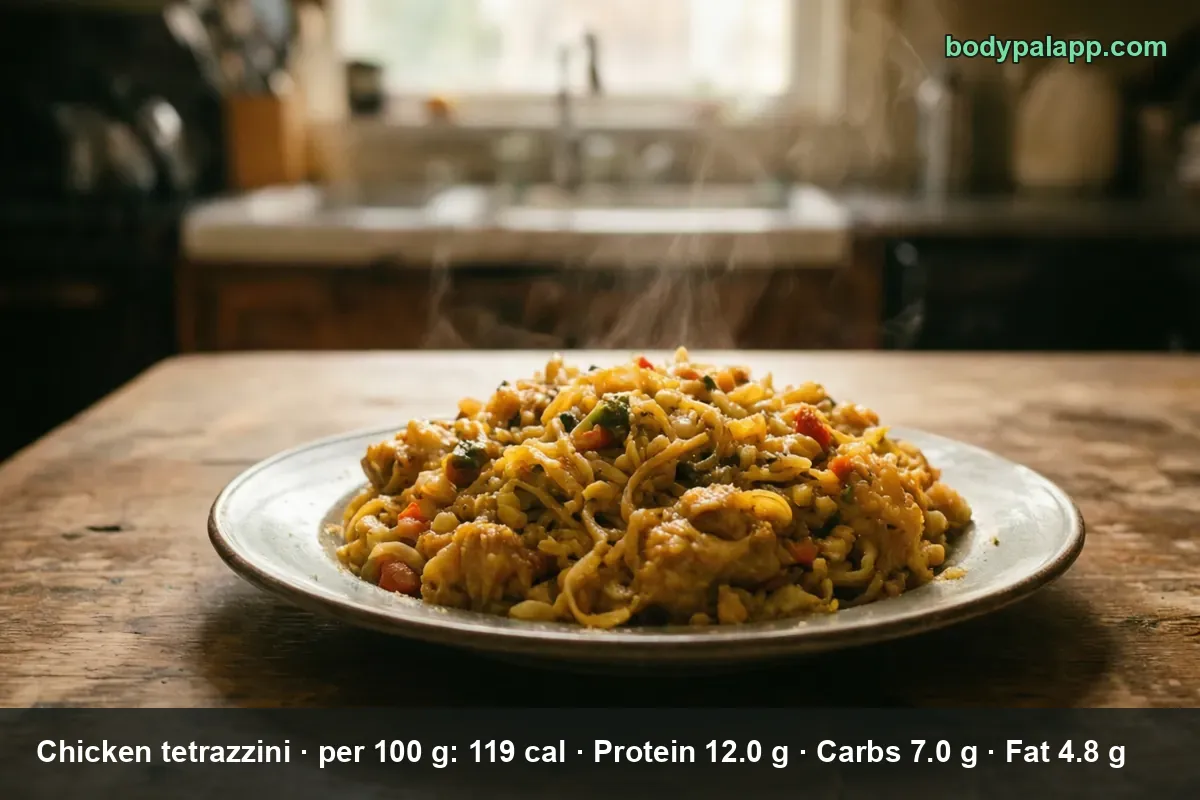
A 1-cup serving of chicken tetrazzini weighs 246 g and carries 293 calories, or 119 calories per 100 g. That is lighter than the cream-sauce reputation suggests, and the reason is the ratio: the USDA record is heavy on chicken and sauce, light on spaghetti, so protein outweighs starch.
On this page
- Chicken tetrazzini quick facts
- US servings, from one ounce to a full plate
- Frozen, deli and home-style versions
- Sodium is the row to watch
- How does chicken tetrazzini compare?
- Most popular chicken tetrazzini brands
- Chicken tetrazzini FAQs
Chicken tetrazzini quick facts
The number above comes from the USDA FNDDS entry 2706534, "Chicken or turkey tetrazzini". That is the finished, baked dish as it lands on a plate — the version on a weeknight table or a cafeteria line, and the one people are holding when they look this up. It is also the only USDA record for the dish itself. The branded rows exist too, but a frozen entree and a supermarket deli bowl are different products with different recipes, so they get their own section instead of being blended into the headline figure.
One thing to hold on to before the table: the difference between these records is the cooking, not the source. Every number here traces back to the same database.
| Nutrient | Per 100 g | Per 1 cup (246 g) | % Daily Value |
|---|---|---|---|
| Calories | 119 | 293 | — |
| Total fat | 4.79 g | 11.8 g | 15% |
| Saturated fat | 1.73 g | 4.3 g | 21% |
| Carbohydrate | 6.96 g | 17.1 g | 6% |
| Dietary fiber | 0.5 g | 1.2 g | 4% |
| Total sugars | 0.24 g | 0.6 g | — |
| Protein | 11.96 g | 29.4 g | 59% |
| Sodium | 386 mg | 950 mg | 41% |
% Daily Value is based on a 2,000-calorie diet.
Verified nutrition data
Numbers on this page come from USDA FoodData Central, the U.S. Department of Agriculture’s food composition database, and from manufacturer labels where a branded product is named. Last verified September 2026. How we verify our data →
Two rows are absent on purpose. There is no added-sugars figure because USDA does not publish added sugars for this FNDDS record, and there is no trans fat figure for the same reason. Cholesterol and potassium do exist: a cup gives 93 mg of cholesterol (31% of the Daily Value) and 317 mg of potassium (7%). The FDA Daily Value reference sets those benchmarks at 300 mg and 4,700 mg.
US servings, from one ounce to a full plate
| Serving | Weight | Calories |
|---|---|---|
| 1 oz | 28 g | 34 kcal |
| 1/2 cup | 123 g | 146 kcal |
| 1 cup | 246 g | 293 kcal |
| 1 1/2 cups | 369 g | 439 kcal |
| 1 plate, quantity not specified | 307 g | 365 kcal |
| Per 100 g | 100 g | 119 kcal |
Two of these are USDA household measures: the 1-cup portion at 246 g and the "plate, quantity not specified" portion at 307 g. That second one is worth knowing about, because it is USDA's own estimate of what an unmeasured serving looks like when someone spoons tetrazzini onto a dinner plate — and it is 25% heavier than a level cup. The half cup, the cup and a half, and the ounce are our own arithmetic scaled from the 119-per-100-g figure, not USDA servings.
The gap between the cup and the plate is the practical trap here. Nobody measures a casserole with a cup measure. If you serve yourself the way most people do, you are logging 365 calories, not 293, and the sodium moves with it.
Frozen, deli and home-style versions
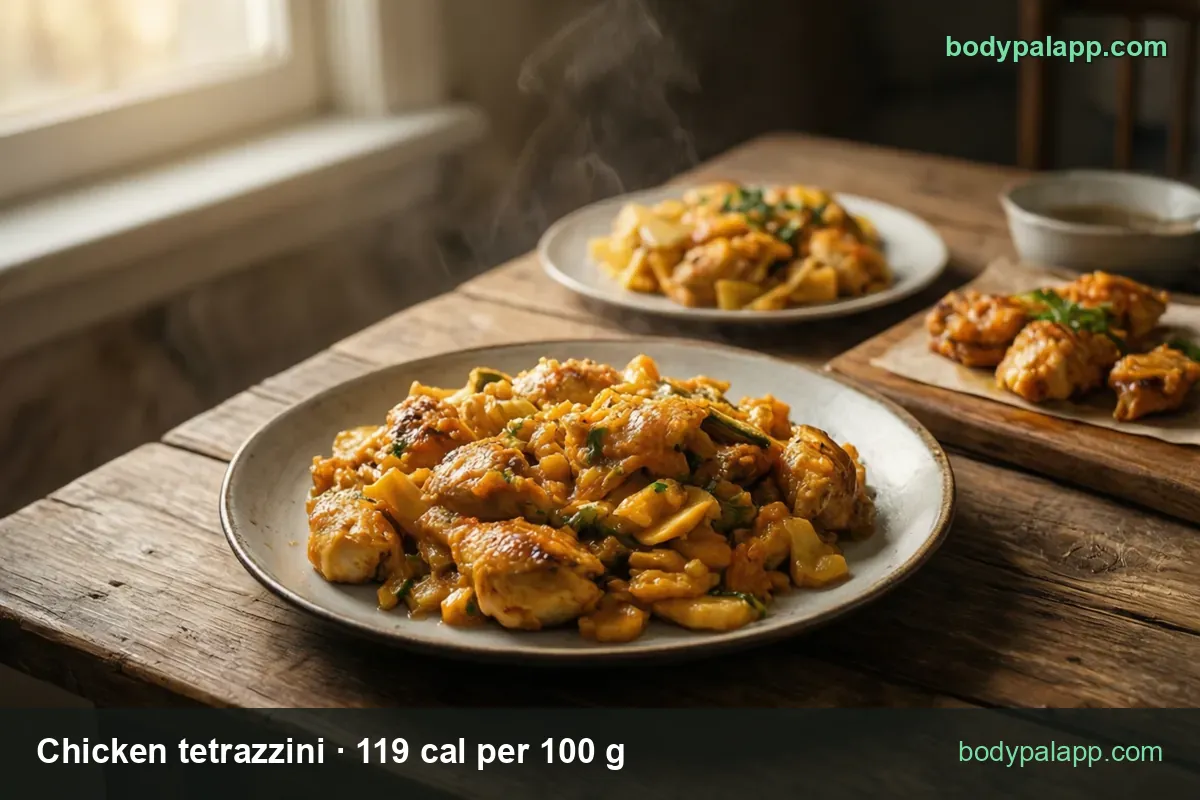
The name covers three quite different foods on a US shelf, and they are not interchangeable in a food diary.
| Version | Per 100 g | Typical portion | Calories |
|---|---|---|---|
| Home-style chicken or turkey tetrazzini | 119 kcal | 1 cup, 246 g | 293 kcal |
| Stouffer's Turkey Tetrazzini, frozen | 124 kcal | 1 package, 340 g | 422 kcal |
| Ukrop's chicken tetrazzini, deli bowl | 208 kcal | 1 bowl, 283 g | 589 kcal |
The frozen entree is the least surprising of the three. At 124 calories per 100 g it sits within five calories of the home-style dish, so the extra 129 calories in a Stouffer's tray come almost entirely from portion size — 340 g against 246 g. It is made with turkey rather than chicken, which is why the USDA record is titled "chicken or turkey" in the first place; the two birds land in the same place nutritionally.
The deli bowl is the outlier. At 208 calories per 100 g it is the densest of the three by a wide margin, roughly 75% more energy in every gram than the home-style version. Put that density in a 283 g container — only 37 g more food than a cup — and one bowl comes to 589 calories, double the cup. Deli kitchens build tetrazzini for flavor and holding time, which usually means more butter, more cheese and more cream per spoonful.
There is a fourth variation worth naming even though USDA has no separate record for it. The FNDDS figure of 6.96 g of carbohydrate per 100 g is low for anything described as a pasta dish, which tells you this recipe is sauce-forward. Home cooks who double the spaghetti will land above these carbohydrate numbers, and the calories will follow.
Sodium is the row to watch
Calories are not the constraint in this dish. Sodium is. A single cup delivers 950 mg, which is 41% of the 2,300 mg Daily Value, and it does so inside a 293-calorie serving. Serve the plate portion instead and you are at 1,185 mg, or 52% of a day, before anything else on the table. A second helping puts you past the whole-day mark at one meal, and bread or a dressed side salad closes much of the gap on its own.
The Dietary Guidelines for Americans treat sodium as one of the nutrients most Americans overconsume, and a cream-and-cheese casserole is a textbook source. If you are watching salt, the half-cup portion at 475 mg is the straightforward fix — our own arithmetic from the USDA 100 g figure — served alongside vegetables rather than as the whole plate.
The protein column runs the opposite way. Chicken tetrazzini gives 29.4 g of protein in a cup, 59% of the Daily Value, from a serving that supplies only about 15% of a day's calories. Very few casseroles do that. Saturated fat at 4.3 g (21% of the Daily Value) is the one middle-ground row: not alarming in one cup, worth noticing at the 307 g plate size, where it reaches 5.3 g. For where a dish like this fits on a plate, MyPlate is the usual reference point — it counts as a mixed protein-and-grain dish, which is exactly what the numbers show.
How does chicken tetrazzini compare?
| Dish | Per 100 g | US serving | Calories |
|---|---|---|---|
| Chicken tetrazzini | 119 kcal | 1 cup, 246 g | 293 kcal |
| Chicken or turkey fricassee | 121 kcal | 1 cup, 244 g | 295 kcal |
| Chicken and vegetables au gratin with rice, frozen | 120 kcal | 1 entree, 258 g | 310 kcal |
| Chicken curry with rice | 116 kcal | 1 cup, 200 g | 232 kcal |
All four sit inside a five-calorie band per 100 g, from 116 to 121. Choosing between them on calorie density alone is pointless — the serving size decides the total, which is why the curry looks lightest here largely because its cup weighs 200 g instead of 246 g.
Our take: on protein, tetrazzini wins the group outright at 11.96 g per 100 g, ahead of the fricassee at 10.68 g and the au gratin entree at 10.67 g, and more than double the curry's 4.96 g. If you want a filling, high-protein main and you are not counting sodium, tetrazzini is the pick of the four. If sodium is the number you are managing, the curry gives you a similar plate for 232 calories with more of its energy from rice — 15.12 g of carbohydrate per 100 g against tetrazzini's 6.96 g — than from a cream sauce — take the tetrazzini in a half-cup portion instead, and pair it with something green.
Most popular chicken tetrazzini brands in the United States
Ranked by how widely each product appears among foods sold in the United States, from the BodyPal food database of over 3.3 million products. Calories are the figures printed on each Nutrition Facts label, checked against USDA FoodData Central.
| Product | Calories (per 100 g) |
|---|---|
| Ukrop's Chicken Tetrazzini | 208 cal |
| Stouffer's Turkey Tetrazzini | 124 cal |
Brand popularity: BodyPal food database. Nutrition: manufacturer labels / USDA FoodData Central.
Chicken tetrazzini FAQs
How many calories are in a cup of chicken tetrazzini?
One cup of chicken tetrazzini weighs 246 g and carries 293 calories, since the dish runs 119 calories per 100 g. That is a moderate main course by volume. Most of the energy comes from the cream sauce and the chicken rather than from the spaghetti underneath it.
How much protein is in chicken tetrazzini?
A 1-cup serving delivers 29.4 g of protein, 59% of the FDA Daily Value, from 11.96 g per 100 g. Per calorie that beats most pasta bakes, because the chicken and the dairy in the sauce carry it rather than the noodles. Half a cup still gives you 14.7 g.
How many carbs does chicken tetrazzini have?
One cup holds 17.1 g of carbohydrate, only 6% of the Daily Value, from 6.96 g per 100 g. That is low for a dish built on spaghetti, because the USDA record is sauce-heavy and pasta-light. A home recipe made with twice the spaghetti will read higher.
Is chicken tetrazzini high in sodium?
Yes. One cup carries 950 mg of sodium, 41% of the 2,300 mg Daily Value, and a 307 g plate portion reaches 1,185 mg, or 52% of a day. Sodium runs out long before the calories do here, which makes portion size the main lever at dinner.
How many calories are in Stouffer's turkey tetrazzini?
Stouffer's Turkey Tetrazzini is 124 calories per 100 g, so the 340 g package comes to 422 calories. Per gram it is almost identical to the home-style dish at 119, but the tray holds far more than a cup, and that is where the extra 129 calories appear.
Is chicken tetrazzini healthy?
One cup is 293 calories with 29.4 g of protein and 950 mg of sodium. The protein column is genuinely strong at 59% of the Daily Value; the sodium column is the weak one at 41%. If you are watching salt, a half-cup portion beside a salad is the better build.
How many calories are in a deli chicken tetrazzini bowl?
A 283 g supermarket deli bowl runs 589 calories, because that product is 208 calories per 100 g against 119 for the home-style dish. It is the same food name at roughly 75% more energy per gram, in a container only 37 g heavier than a measuring cup.
Does chicken tetrazzini have added sugar?
USDA does not publish added sugars for this FNDDS record, so there is no figure to quote. Total sugars are 0.24 g per 100 g, which works out to 0.6 g in a cup. Those are trace amounts from the milk and onion in the sauce, not from sweetener.
Similar foods
- Shrimp Lo Mein — 242 cal per cup
- Olive — 26 cal for 5 large olives
- Masoor Dal — 207 cal per cup cooked
- Mexican rice — 279 cal per cup
- Egg Foo Yung — 108 cal per patty
- Snow Cone — 256 cal per snow cone
Count it without the math
Point the camera at the plate and BodyPal counts the tetrazzini for you, sauce and all.


How long does it take to burn off 293 kcal of chicken tetrazzini?
A 1-cup (246 g) serving is 293 kcal. Enter your weight and the amount you ate to see how long it takes you to burn that off:
lb
| Activity | Time to burn 293 kcal |
|---|---|
| Walking, brisk | 59 min |
| Cycling, moderate | 37 min |
| Swimming, moderate | 42 min |
| Jogging | 34 min |
| Weight training, moderate | 1 hr 5 min |
Times are for a 155 lb adult at a steady pace; change the weight to see yours. The amount is set to the portion in the text (246 g); change it to what you actually ate. BodyPal works this out from your steps automatically.
Burning it off is one side of it. The other is knowing your number: work out how many calories you need a day, with macros and a goal date.