
How many calories are in Mexican rice?
A full cup of Mexican rice is 279 calories, or 115 calories per 100 grams. Half a cup, which is the portion that actually shows up beside the beans, is 140. Order the same cup in a restaurant and it is 450 — the recipe barely changes, the oil and the packing do.
On this page
- Mexican rice quick facts
- Why USDA calls it Spanish rice
- US servings, from a side spoon to a full cup
- What the oil in the pan costs
- The sodium is the bigger number
- The carton number is for powder
- How does Mexican rice compare?
- Most popular mexican rice brands
- FAQ
Mexican rice quick facts
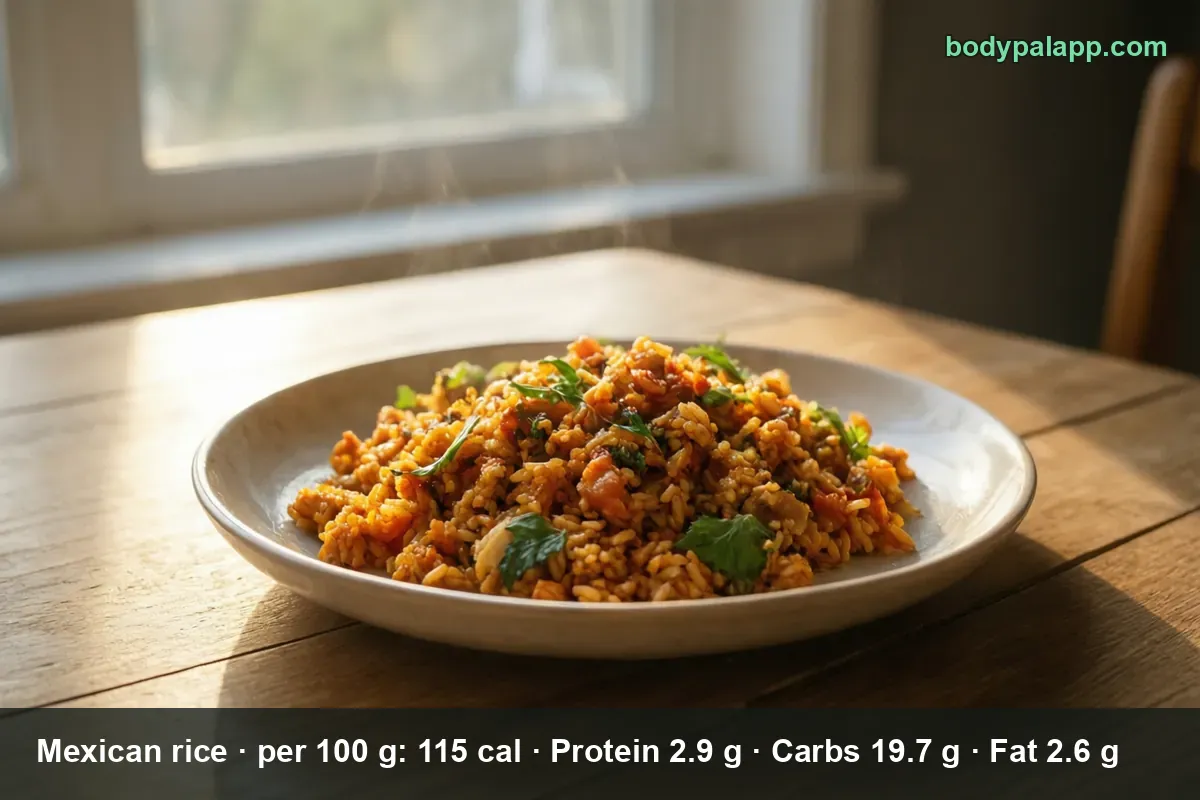
Every headline figure on this page comes off one record: FNDDS 2709085, "Spanish rice, fat added", which is rice toasted in oil and simmered with tomato. That is the pan almost every American kitchen makes it in, and it is the version a taqueria scoops onto the plate.
| Nutrient | Per 100 g | Per 1 cup (243 g) | % Daily Value |
|---|---|---|---|
| Calories | 115 | 279 | 14% |
| Total fat | 2.6 g | 6.3 g | 8% |
| Saturated fat | 0.5 g | 1.2 g | 6% |
| Carbohydrate | 19.65 g | 47.7 g | 17% |
| Dietary fiber | 1.1 g | 2.7 g | 10% |
| Total sugars | 1.55 g | 3.8 g | — |
| Protein | 2.87 g | 7.0 g | 14% |
| Sodium | 310 mg | 753 mg | 33% |
% Daily Value is based on a 2,000-calorie diet.
Verified nutrition data
Numbers on this page come from USDA FoodData Central, the U.S. Department of Agriculture’s food composition database, and from manufacturer labels where a branded product is named. Last verified September 2026. How we verify our data →
Two rows a packaged label would carry are missing here, and leaving them blank would be worse than leaving them out. USDA's survey records do not report added sugars or trans fat for this code, so neither appears above rather than sitting as an invented zero. Total sugars carry no Daily Value on a US label at all, which is why that cell holds a dash instead of a percentage.
Two more numbers ride along on the same record and never reach a calorie chart: 3 mg of cholesterol and 123 mg of potassium per 100 grams, which works out to 7 mg and 299 mg in a cup.
Why USDA calls it Spanish rice
Type "Mexican rice" into the federal database and the food you are holding comes back under a different name. USDA files the dish as Spanish rice, and there is no separate Mexican rice record to find. Same rice, same tomato, same skillet, different label on the filing cabinet.
There are four codes for the plain side under that name, and picking between them is most of the work behind this page:
| USDA record | Per 100 g | What it describes |
|---|---|---|
| 2709085, fat added | 115 | Rice toasted in oil, then simmered — this page |
| 2709086, no added fat | 101 | Same dish, dry pan |
| 2709087, fat not specified | 115 | Numerically identical to 2709085 |
| 2709084, from a restaurant | 185 | Served portion, cooked commercially |
The "fat not specified" line is a duplicate down to the last decimal, so it adds nothing. The choice that matters is between the home pan and the restaurant one, and the gap is 70 calories per 100 grams — a difference in cooking, not a disagreement between sources.
We lead with the oil version for a plain reason: nobody makes this rice in a dry pan by accident. Toasting the grain in fat until it turns opaque is the step that separates Mexican rice from plain boiled rice with tomato stirred through it.
US servings, from a side spoon to a full cup
| Serving | Weight | Calories |
|---|---|---|
| 1 oz | 28 g | 32 |
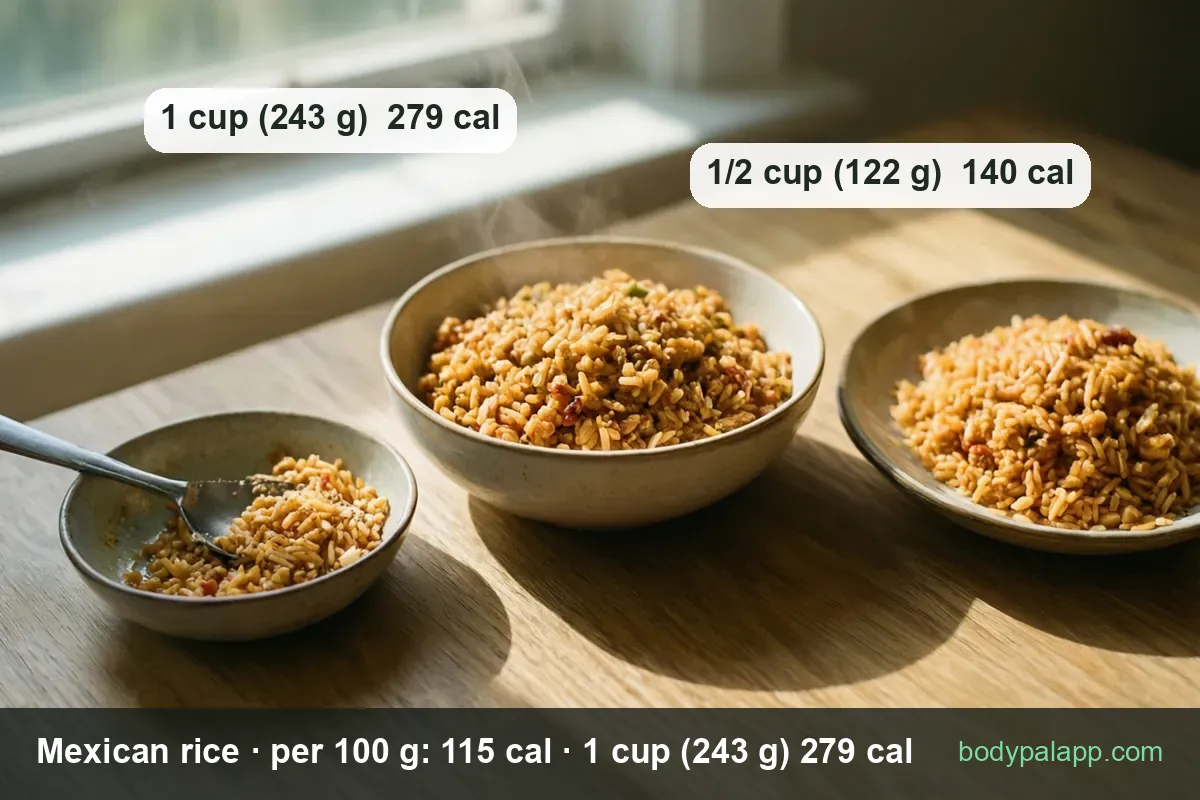
| 1/2 cup, typical side | 122 g | 140 |
| 3/4 cup | 182 g | 209 |
| 1 cup | 243 g | 279 |
| 100 g | 100 g | 115 |
The half cup is the row most people need. A restaurant side, a scoop next to enchiladas, the spoonful that fills the gap on the plate — that is 122 grams and 140 calories, 7% of a 2,000-calorie day, with 378 mg of sodium. It is a genuinely small thing.
The heaped cup in the photo is twice that, and heaping is easy with a rice this loose. Cooked rice in a sauce does not level itself the way a dry grain does, so the difference between a scoop and a serving is a wrist movement worth 139 calories.
One warning about grams, because it changes the answer by half. USDA's older SR Legacy line for restaurant Spanish rice lists a cup at 116 grams, which would put a restaurant cup at 215 calories. A cup of cooked, sauced rice weighing 116 grams would be half the density of water, which sauced rice is not. The survey records give 243 grams for a cup of the plain dish, and that is what this page uses.
Raw rice does not belong on this page either. Mexican rice is always measured cooked, because the grain absorbs its weight several times over in stock, and the dry mix in a carton is a different food entirely at 363 calories per 100 grams.
What the oil in the pan costs
| Version | Per 100 g | Serving | Calories |
|---|---|---|---|
| Cooked with added fat, this page | 115 | 1 cup (243 g) | 279 |
| Cooked without added fat | 101 | 1 cup (243 g) | 245 |
| From a restaurant | 185 | 1 cup (243 g) | 450 |
| With ground beef | 163 | 1 cup (230 g) | 375 |
| Box mix, prepared as directed | 125 | per 100 g | 125 |
| Box mix, dry from the carton | 363 | 1/2 cup dry (70 g) | 254 |
Skip the oil and a cup drops from 279 to 245 calories. That is 34 calories and 3.8 grams of fat for the tablespoon the rice is toasted in, which is a smaller penalty than most people assume and a smaller saving than most recipes promise. If you like the toasted flavor, it costs about as much as a bite of tortilla.
The restaurant version is the row that moves your day. At 185 calories per 100 grams it is 1.6 times the home pan, so a cup lands at 450. Carbohydrate climbs from 47.7 to 75.7 grams in the same cup, because commercial rice is cooked softer, packed denser and finished with more fat. Nothing about the ingredient list changed; the plate got heavier.
Rice with ground beef stops being a side dish. A 230 g cup is 375 calories with 22.3 grams of protein, 45% of the Daily Value, against 7.0 grams in the plain version. Log it as a main course, because at that protein level it is one.
The sodium is the bigger number
Calories are why people search for this rice. Sodium is why they should.
- Half cup, 122 g: 378 mg
- One cup, 243 g: 753 mg, or 33% of the Daily Value
- One restaurant cup, 243 g: 1,283 mg, or 56%
A single home-cooked cup uses a third of the 2,300 mg Daily Value — about a third of a teaspoon of table salt — for 279 calories. The restaurant cup uses over half the day on a side dish, before the entree arrives with its own seasoning. The CDC puts most American sodium in restaurant and packaged food rather than the shaker, and this is exactly the shape of that statistic: 450 calories carrying 1,283 mg.
Here is the part that catches people out. Cooking without oil saves 34 calories and saves nothing at all on sodium — the no-fat record is 763 mg per cup, marginally higher than the 753 mg version, because the stock and tomato do the salting and they do not change. The lever for calories and the lever for sodium are not the same lever.
Protein and fiber are honest but modest: 7.0 grams and 2.7 grams in a cup, 14% and 10% of the Daily Value. MyPlate counts a cup of cooked rice as two ounce-equivalents of grains, and this one is refined rather than whole, so it does the grain job without doing the whole-grain job.
The carton number is for powder
Pick up a box of Spanish rice mix and the label says roughly 363 calories per 100 grams. That number is real and it describes nothing you will eat.
Dry mix is rice, dehydrated tomato and seasoning with the water taken out. Cook it and the same food reads 125 calories per 100 grams — about a third of the shelf figure, and close to the 115 of a homemade pan. Sodium behaves the same way: 1,085 mg per 100 grams dry, 349 mg per 100 grams prepared.
The trap is scooping. Half a cup of dry mix is 70 grams and 254 calories, which is nearly a full cup of finished rice once it swells. If a food log offers you "Spanish rice mix" and the number looks alarming, check whether it says dry or prepared before you change what you eat.
How does Mexican rice compare?
| Version | Per 100 g | Serving | Calories | Protein / Carbs / Fat |
|---|---|---|---|---|
| Mexican rice, cooked in oil | 115 | 1 cup (243 g) | 279 | 7.0 / 47.7 / 6.3 g |
| Mexican rice, no added fat | 101 | 1 cup (243 g) | 245 | 7.1 / 48.4 / 2.5 g |
| Mexican rice, from a restaurant | 185 | 1 cup (243 g) | 450 | 8.0 / 75.7 / 12.9 g |
| Mexican rice with ground beef | 163 | 1 cup (230 g) | 375 | 22.3 / 34.0 / 15.9 g |
Every line is the same dish cooked four ways, so this is a fair comparison rather than a lineup of unrelated foods. The spread is enormous for one recipe: 245 to 450 calories in an identical cup, a difference of 205 that owes nothing to the ingredients on the label.
Our take: at home, cook it in oil and serve half a cup. That is 140 calories and 378 mg of sodium, and it tastes like the version you wanted. The restaurant cup is the one to halve, since 450 calories and 1,283 mg of sodium is a lot to spend on the thing beside the main. And if you are cooking rice with ground beef in it, stop calling it a side — 375 calories with 22.3 grams of protein is dinner, and it is a decent one.
Most popular mexican rice brands in the United States
Ranked by how widely each product appears among foods sold in the United States, from the BodyPal food database of over 3.3 million products. Calories are the figures printed on each Nutrition Facts label, checked against USDA FoodData Central.
| Product | Calories (per 100 g) |
|---|---|
| Minute Spanish Rice | 144 cal |
| Old El Paso Spanish Rice | 350 cal |
| Lundberg Organic Whole Grain Spanish Rice | 357 cal |
| La Preferida Spanish Rice with Bell Peppers & Onions | 64 cal |
| Old El Paso Mexican Rice | 174 cal |
| McCormick Mexican Rice | 354 cal |
Brand popularity: BodyPal food database. Nutrition: manufacturer labels / USDA FoodData Central.
Mexican rice FAQs
How many calories are in Mexican rice?
279 calories in a 1-cup (243 g) serving, at 115 calories per 100 grams. That cup carries 7.0 g of protein, 47.7 g of carbohydrate, 6.3 g of fat and 753 mg of sodium. Half a cup, the usual side portion, is 140 calories.
How many calories are in restaurant Mexican rice?
450 calories for a cup, at 185 per 100 grams — 1.6 times the home version. Carbohydrate rises from 47.7 g to 75.7 g and fat from 6.3 g to 12.9 g in the same 243 g cup. Restaurant rice is cooked softer, packed denser and finished with more oil.
How many calories are in 1/2 cup of Mexican rice?
140 calories for 122 grams, which is 7% of a 2,000-calorie day. It brings 378 mg of sodium, 3.5 g of protein and about 24 g of carbohydrate. A heaped cup is close to double at 279 calories, and heaping is easy with rice this loose.
Does cooking Mexican rice without oil save calories?
It saves 34 calories a cup: 245 instead of 279, with fat falling from 6.3 g to 2.5 g. USDA lists both versions separately, at 101 and 115 calories per 100 grams. The saving is real but small, and it does nothing for sodium: the no-fat cup is 763 mg against 753 mg here.
How much sodium is in Mexican rice?
753 mg in a cup, which is 33% of the 2,300 mg Daily Value, or roughly a third of a teaspoon of table salt. A half-cup side is 378 mg. A restaurant cup reaches 1,283 mg, over half the day's sodium in a side dish.
How many carbs are in Mexican rice?
47.7 g in a cup, 17% of the 275 g Daily Value, at 19.65 g per 100 grams. Of that, 3.8 g is sugar and 2.7 g is fiber. The restaurant version is far higher at 75.7 g a cup, because it is denser rather than sweeter.
Is Mexican rice the same as Spanish rice?
In US nutrition data, yes: the 115 calories per 100 grams on this page come from the Spanish rice line. USDA has no record called Mexican rice, so the dish is filed under that name instead. Rice toasted in fat and simmered with tomato is one food under two names.
Is Mexican rice a healthy side dish?
A half-cup side is 140 calories with 1.3 g of fiber and 378 mg of sodium, which is a modest side by any measure. The full cup is where it adds up: 279 calories and 33% of the day's sodium. It is refined grain, so it fills the grains slot without the whole-grain benefit.
Similar foods
- Masoor Dal — 207 cal per cup cooked
- Olive — 26 cal for 5 large olives
- Shrimp Lo Mein — 242 cal per cup
- Tuna steak — 185 cal per steak, 6 oz
- Chicken Tikka Masala — 257 cal per cup
- Turkey deli meat — 89 cal for 3 slices
Count it without the math
Point the camera at the plate and BodyPal tells the half cup from the heaped one.


How long does it take to burn off Mexican rice?
A 1-cup (243 g) serving is 279 kcal. Enter your weight and the amount you ate to see how long it takes you to burn that off:
lb
| Activity | Time to burn 279 kcal |
|---|---|
| Walking, brisk | 56 min |
| Cycling, moderate | 35 min |
| Swimming, moderate | 40 min |
| Jogging | 33 min |
| Weight training, moderate | 1 hr 2 min |
Times are for a 155 lb adult at a steady pace; change the weight to see yours. The amount is set to the portion in the text (243 g); change it to what you actually ate. BodyPal works this out from your steps automatically.
Burning it off is one side of it. The other is knowing your number: work out how many calories you need a day, with macros and a goal date.