
How many calories are in chicken tikka?
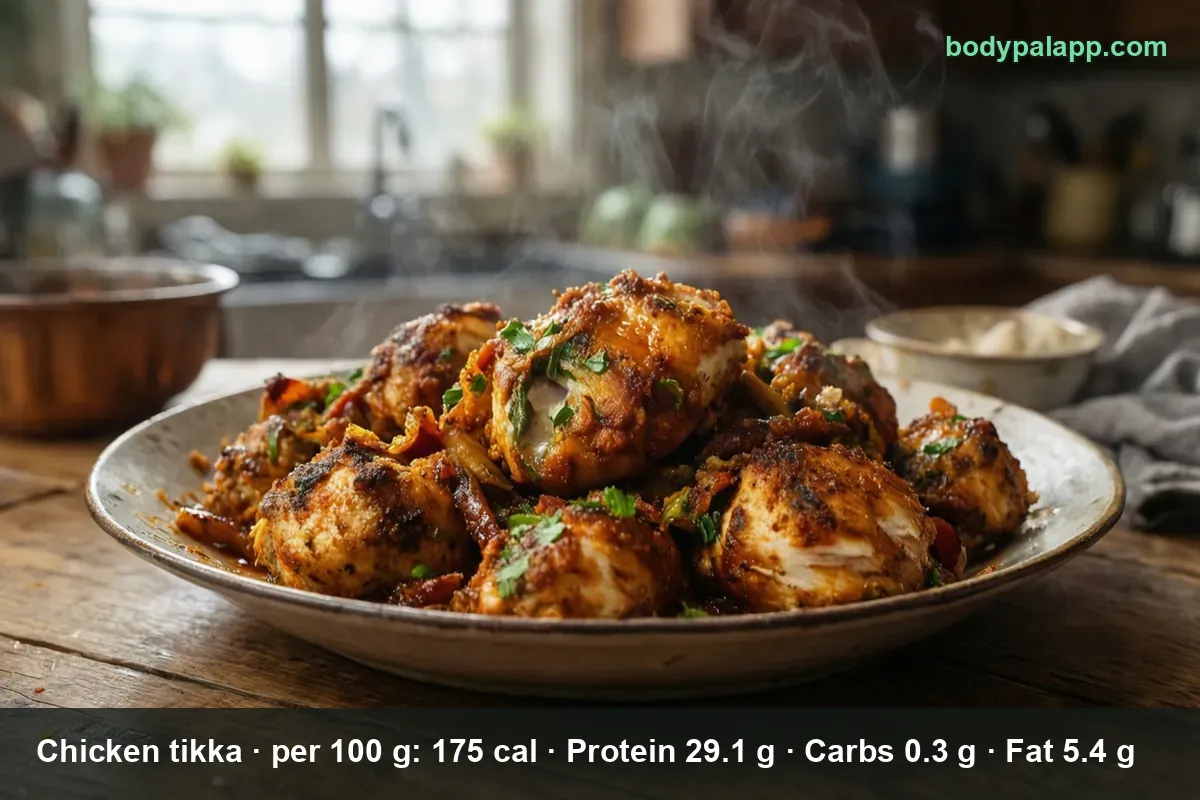
A 1-cup serving of diced chicken tikka, 135 g of boneless marinated meat, is 236 calories. Per 100 g the meat runs 175 calories. That is a plate of tandoor-style pieces with no sauce on them: 39.3 g of protein, 0.4 g of carbohydrate and 7.3 g of fat in the cup.
On this page
- Chicken tikka quick facts
- US servings, from one ounce to a full cup
- Thigh, bone-in and other cuts of tikka
- Tikka vs tikka masala: the sauce changes everything
- Sodium is the row to watch, not fat
- How does chicken tikka compare?
- Most popular chicken tikka brands
- Chicken tikka FAQs
Chicken tikka quick facts
USDA does not publish a record called "chicken tikka." What it does publish is the dish stripped to its definition: boneless chicken breast marinated, then baked, broiled or roasted, with the skin left on the plate. That record is FNDDS 2705962, "Chicken breast, baked, broiled, or roasted with marinade, skin not eaten, from raw", and it is the one used through this page. Every "tikka" entry in the database itself is a sauce, a paste, a samosa or a finished masala meal, none of which is the skewered meat people order.
The household measure USDA attaches to that record is one cup of cooked diced meat, 135 g. That is roughly six to eight boneless pieces off a skewer.
| Nutrient | Per 100 g | Per 1 cup, diced (135 g) | % Daily Value |
|---|---|---|---|
| Calories | 175 | 236 | — |
| Total fat | 5.38 g | 7.3 g | 9% |
| Saturated fat | 0.993 g | 1.3 g | 7% |
| Carbohydrate | 0.31 g | 0.4 g | 0% |
| Dietary fiber | 0 g | 0 g | 0% |
| Total sugars | 0.28 g | 0.4 g | — |
| Protein | 29.13 g | 39.3 g | 79% |
| Sodium | 423 mg | 571 mg | 25% |
% Daily Value is based on a 2,000-calorie diet.
Verified nutrition data
Numbers on this page come from USDA FoodData Central, the U.S. Department of Agriculture’s food composition database, and from manufacturer labels where a branded product is named. Last verified September 2026. How we verify our data →
Two rows you would see on a supermarket label are missing here on purpose: added sugars and trans fat. USDA does not report either one for its survey dishes, so putting a number in those cells would mean inventing it. Cholesterol and potassium do exist for this record: the cup carries 127 mg of cholesterol, 42% of the FDA Daily Value of 300 mg, and 471 mg of potassium, 10% of the 4,700 mg value.
The shape of that table is unusual for a restaurant dish. Carbohydrate is 0.4 g per cup and fiber is flat zero. Almost the entire 236 calories is protein and fat, which is why chicken tikka behaves so differently from the rice and bread it usually shares a plate with.
US servings, from one ounce to a full cup
| Serving | Weight | Calories |
|---|---|---|
| 1 oz, cooked | 28 g | 50 kcal |
| 1 medium slice or piece | 60 g | 105 kcal |
| 1 large or thick piece | 85 g | 149 kcal |
| 1 medium breast | 120 g | 210 kcal |
| 1 cup, cooked and diced | 135 g | 236 kcal |
| Per 100 g | 100 g | 175 kcal |
Those weights are USDA household measures for the record itself, not our own conversions, which makes this one of the easier dishes to log honestly. The trap is the cup. A cup of diced meat is denser than most people picture, and the meat packs tighter than cubes of vegetable would, so 135 g of tikka does not look like a full cup on a plate once it is spread out.
The safer approach at a restaurant is to count pieces. A boneless tikka piece off a skewer usually falls between the medium slice at 60 g and the thick piece at 85 g, so 105 to 149 calories each. Eight pieces is a cup, give or take, and a cup is dinner-sized protein for most people.
Weighing raw is the other place this goes wrong. Chicken loses roughly a quarter of its weight in a tandoor or under a broiler, so 4 oz of raw marinated breast comes off the skewer at close to 3 oz cooked. The USDA record is the cooked meat. If you log 4 oz because that is what went on the scale before cooking, you have added about a third too much.
Thigh, bone-in and other cuts of tikka
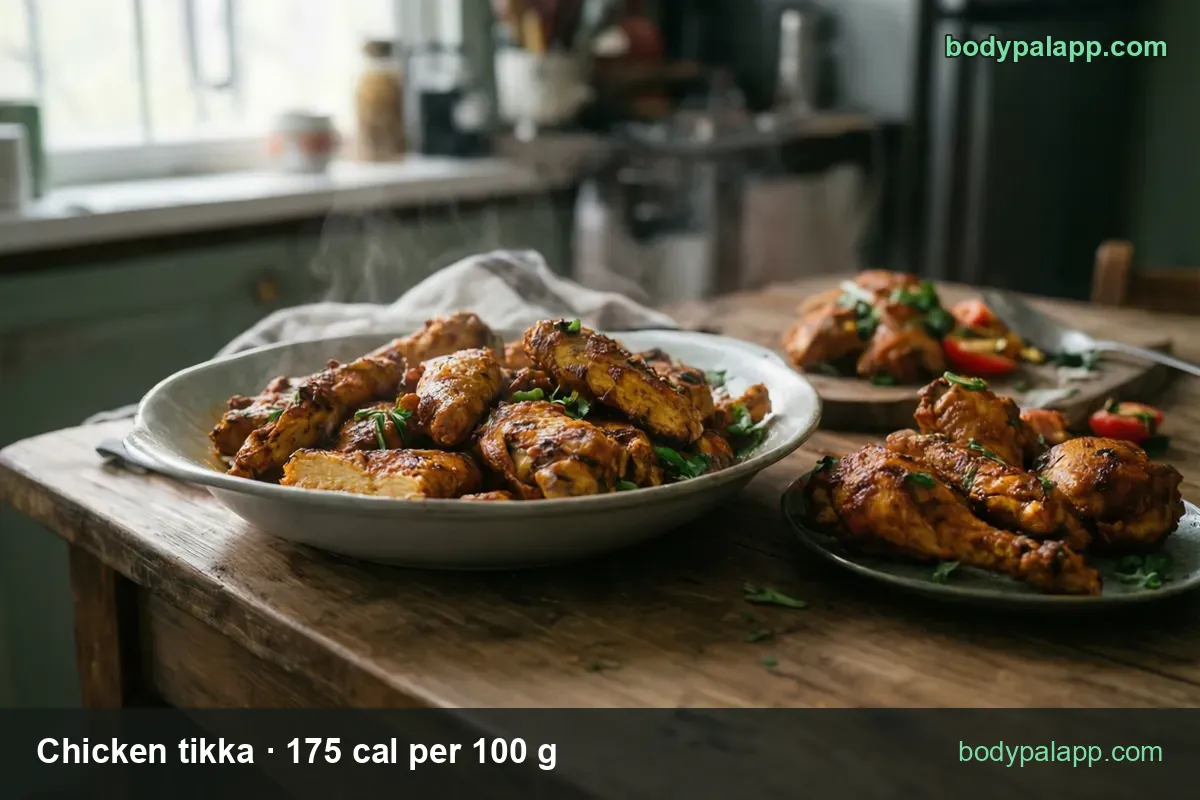
Not every tikka is breast. Restaurants cut thigh meat for the version that stays juicy, and a bone-in tikka or tandoori quarter is a different thing again on the scale.
| Version | Per 100 g | Typical serving | Calories |
|---|---|---|---|
| Boneless breast tikka, marinated | 175 kcal | 1 cup, diced (135 g) | 236 kcal |
| Thigh meat tikka | 192 kcal | 1 medium thigh (70 g) | 134 kcal |
| Bone-in tikka, leg and drumstick | 183 kcal | 1 leg quarter (120 g) | 220 kcal |
| Mixed pieces, cut not specified | 179 kcal | 1 cup, diced (135 g) | 242 kcal |
| Breast grilled with no marinade | 176 kcal | 1 cup, diced (135 g) | 238 kcal |
| Breast with the skin eaten | 204 kcal | 1 cup, diced (135 g) | 275 kcal |
Thigh meat is 192 calories per 100 g against 175 for breast, a 17-calorie gap that most people overestimate wildly. One medium thigh is only 134 calories, and the extra fat is what keeps it from drying out over live coals. If you are choosing between them for a single dinner, the cut barely moves the total.
The skin is the real fork in the road. The same breast with the skin eaten is 204 calories per 100 g and 10.45 g of fat, against 175 calories and 5.38 g without it, so a cup of skin-on meat comes to about 275 calories. That last figure is our own arithmetic from the USDA 100 g value, not a USDA serving. Nearly all of the 39 extra calories per cup is fat, and saturated fat more than doubles.
One number in that table is quietly the most useful on the page. Plain grilled breast with no marinade at all is 176 calories per 100 g, one calorie above the marinated version. The yogurt, ginger, garlic, chili and lemon that make it tikka contribute essentially nothing to the calorie count.
Tikka vs tikka masala: the sauce changes everything
These are two different meals with almost the same name, and confusing them is the single most common logging error on this dish.
| Version | Per 100 g | US serving | Calories |
|---|---|---|---|
| Chicken tikka, the meat alone | 175 kcal | 1 cup, diced (135 g) | 236 kcal |
| Chicken tikka masala, curry with sauce | 107 kcal | 1 cup (240 g) | 257 kcal |
| Chicken tikka kabob with vegetables | 104 kcal | 1 shish kabob (202 g) | 210 kcal |
Look at what the sauce does. Per 100 g the curry is 107 calories against 175 for the dry meat, so by density the saucy version wins comfortably. But nobody eats a curry by the 100 g. A cup of sauce and chicken weighs 240 g where a cup of diced meat weighs 135 g, and the finished cup lands at 257 calories, more than the 236 of the meat alone.
The macros tell the rest of it. The curry cup gives about 15.6 g of protein and 902 mg of sodium; the tikka cup gives 39.3 g of protein and 571 mg of sodium. Those two curry figures are our own scaling of the USDA 100 g record up to the 240 g cup. You are paying more calories for less than half the protein, because most of what filled the bowl was cream, tomato and oil. That is before any rice or naan on the side.
Retail meals sit in the same place. USDA's Branded records for US supermarket chicken tikka masala trays run from 110 to 167 calories per 100 g, and because the packages run from 156 g to 340 g, a single one comes to between 261 and 469 calories. The lightest tray by density is not the lightest dinner; the package size decides that.
Skewers with vegetables between the meat are the cheapest version of all: 104 calories per 100 g and 210 calories for a 202 g kabob. Peppers and onions displace chicken, which is why the whole skewer costs less than a cup of pure meat.
Sodium is the row to watch, not fat
Fat is a non-issue here. Saturated fat is 1.3 g per cup, 7% of the Daily Value, low for anything that arrives hot off a grill.
Sodium is a different story. One cup carries 571 mg, 25% of the 2,300 mg Daily Value, or about a quarter of a teaspoon of table salt. The comparison that explains it is plain grilled breast at 353 mg per 100 g against 423 mg for the marinated version. Roughly 70 mg of sodium per 100 g goes in with the yogurt marinade, and it stays in the meat. Order a second portion, add a sauce, add naan, and a single dinner clears half the day's sodium easily.
Protein is where this dish is genuinely hard to beat: 39.3 g in a cup, 79% of the 50 g Daily Value, from a food with no fiber, no sugar to speak of and 0.4 g of carbohydrate. MyPlate counts one ounce of cooked chicken as one ounce-equivalent from the protein foods group, so a 135 g cup is close to five of them in one sitting.
How does chicken tikka compare?
| Dish | Per 100 g | US serving | Calories |
|---|---|---|---|
| Chicken tikka, marinated breast | 175 kcal | 1 cup, diced (135 g) | 236 kcal |
| Grilled breast, no marinade | 176 kcal | 1 cup, diced (135 g) | 238 kcal |
| Grilled chicken, cut not specified | 179 kcal | 1 cup, diced (135 g) | 242 kcal |
| Grilled chicken thigh | 192 kcal | 1 medium thigh (70 g) | 134 kcal |
Our take: chicken tikka is the lightest of the four per 100 g, and the spread across all of them is 17 calories, which is noise on a dinner plate. Choose by what you actually want. For weight loss, the boneless breast tikka gives 39.3 g of protein for 236 calories, all but level with plain grilled breast for the best protein per calorie here. For staying full without cooking anything dry, thigh meat costs 17 calories per 100 g more and is worth it. What decides the meal is never the cut; it is whether the sauce, the rice and the naan arrive with it.
Most popular chicken tikka brands in the United States
Ranked by how widely each product appears among foods sold in the United States, from the BodyPal food database of over 3.3 million products. Calories are the figures printed on each Nutrition Facts label, checked against USDA FoodData Central.
| Product | Calories (per 100 g) |
|---|---|
| Lidl Chicken Tikka Masala | 110 cal |
| Signature Select Chicken Tikka Masala | 115 cal |
| Deep Indian Kitchen Chicken Tikka Masala | 145 cal |
| Performance Kitchen Chicken Tikka Masala | 138 cal |
| Ethnic Gourmet Chicken Tikka Masala | 122 cal |
| Sukhi's Chicken Tikka Masala | 167 cal |
Brand popularity: BodyPal food database. Nutrition: manufacturer labels / USDA FoodData Central.
Chicken tikka FAQs
How many calories are in chicken tikka?
A 1-cup serving of diced chicken tikka, 135 g, is 236 calories, and the meat runs 175 calories per 100 g. A medium breast portion of 120 g lands at 210. Those figures cover boneless marinated chicken cooked without skin and without any sauce poured over it.
How many calories in one piece of chicken tikka?
USDA's medium cut, 60 g, is 105 calories, and a thick piece of 85 g is 149, so a typical boneless tikka piece falls somewhere in between. One ounce of cooked meat, 28 g, is 50 calories. Count roughly six to eight pieces to a cup.
Is chicken tikka the same as chicken tikka masala?
No. Chicken tikka is 175 calories per 100 g of plain marinated meat; chicken tikka masala, the curry with the sauce, is 107 calories per 100 g. Because the bowl is bigger, a 1-cup serving of the curry is 257 calories against 236 for a cup of the meat.
How much protein is in chicken tikka?
A 1-cup serving carries 39.3 g of protein, which is 79% of the FDA Daily Value of 50 g. Per 100 g the meat delivers 29.13 g. Almost nothing else is in it: 0.4 g of carbohydrate per cup and no fiber at all.
Is chicken tikka good for weight loss?
At 175 calories per 100 g with 29.13 g of protein and 0.31 g of carbohydrate, chicken tikka is one of the leanest hot dinners you can log, and the cup is 236 calories. What surrounds it decides the meal: rice, naan and sauce add far more than the cut of chicken does.
Is chicken tikka high in sodium?
One cup has 571 mg of sodium, 25% of the 2,300 mg Daily Value and about a quarter teaspoon of table salt. The yogurt-and-spice marinade is why: the same breast grilled plain holds 353 mg per 100 g against 423 mg for the marinated version.
Chicken tikka vs tandoori chicken calories?
USDA has no separate tandoori chicken record, so the closest read is marinated baked or broiled breast at 175 calories per 100 g against plain grilled breast at 176. Tandoori and tikka are cooked the same way, and the marinade moves sodium, from 353 mg to 423 mg, not calories.
How many calories in a chicken tikka skewer?
One chicken and vegetable shish kabob of 202 g is 210 calories, at 104 calories per 100 g. The vegetables threaded between the meat pull the density down. A cup of the meat alone, 135 g, is 236 calories, so a loaded skewer eats lighter than it looks.
Similar foods
- Egg Fried Rice — 289 cal per cup
- Tamale — 244 cal per tamale
- Chicken Fried Rice — 343 cal per cup
- Enchilada Casserole — 381 cal per cup
- Tomato Pie — 130 cal per slice
- Enchilada — 267 cal per enchilada
Count it without the math
Point the camera at the plate and BodyPal counts the pieces for you, marinade and all.


How long does it take to burn off chicken tikka?
A 1-cup (135 g) serving is 236 kcal. Enter your weight and the amount you ate to see how long it takes you to burn that off:
lb
| Activity | Time to burn 236 kcal |
|---|---|
| Walking, brisk | 47 min |
| Cycling, moderate | 30 min |
| Swimming, moderate | 34 min |
| Jogging | 28 min |
| Weight training, moderate | 52 min |
Times are for a 155 lb adult at a steady pace; change the weight to see yours. The amount is set to the portion in the text (135 g); change it to what you actually ate. BodyPal works this out from your steps automatically.
Want the bigger picture? Calculate your daily calorie needs — your maintenance figure, a target for losing or gaining, and the date you get there.