
How many calories are in chicken yakisoba?
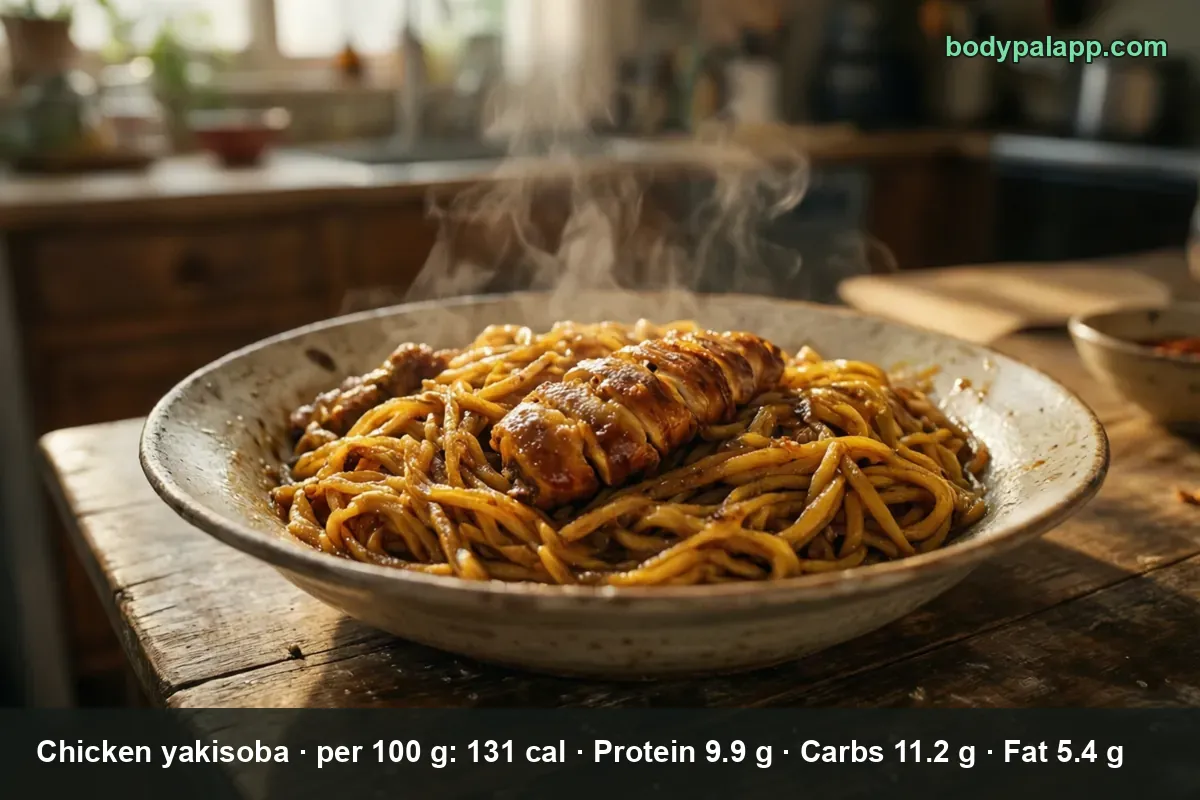
A 1-cup serving of chicken yakisoba runs 288 calories, and the dish itself is 131 calories per 100 g. That is a stir-fry number, not a fried-noodle number: most of the bowl is chicken, cabbage and sauce-slicked noodles. The catch is not the calories at all — it is the 898 mg of sodium riding along.
On this page
- Chicken yakisoba quick facts
- US servings, from one ounce to a two-cup bowl
- Noodles in, noodles out: the 105-calorie swing
- Packets, trays and bags: the store versions
- Sodium is the row to watch
- How does chicken yakisoba compare?
- Most popular chicken yakisoba brands
- Chicken yakisoba FAQs
Chicken yakisoba quick facts
There is no line in USDA FoodData Central that literally says "yakisoba." The dish is filed under FNDDS 2706687, "Chicken or turkey chow mein or chop suey with noodles" — chicken, vegetables and wheat noodles tossed in a soy-based sauce in a hot pan. That is the plate a person searching for yakisoba calories is actually holding, so it is the row this page counts from. The related record without noodles describes a different preparation, not a different source.
| Nutrient | Per 100 g | Per 1 cup (220 g) | % Daily Value |
|---|---|---|---|
| Calories | 131 | 288 | — |
| Total fat | 5.43 g | 11.9 g | 15% |
| Saturated fat | 1.46 g | 3.2 g | 16% |
| Carbohydrate | 11.15 g | 24.5 g | 9% |
| Dietary fiber | 1.5 g | 3.3 g | 12% |
| Total sugars | 1.54 g | 3.4 g | — |
| Protein | 9.91 g | 21.8 g | 44% |
| Sodium | 408 mg | 898 mg | 39% |
% Daily Value is based on a 2,000-calorie diet.
Verified nutrition data
Numbers on this page come from USDA FoodData Central, the U.S. Department of Agriculture’s food composition database, and from manufacturer labels where a branded product is named. Last verified September 2026. How we verify our data →
Two rows you would see on a package are missing here: added sugars and trans fat. This edition of FNDDS does not publish either nutrient for mixed dishes, so guessing them would be worse than leaving them out. Cholesterol and potassium do exist on the record — 73 mg and 383 mg in a cup, or 24% and 8% of their Daily Values, using the FDA reference amounts.
The line that should stop you is protein. A single cup covers 44% of the daily target, which is unusual for something that reads on the menu as a noodle dish. That is the chicken doing the work, not the noodles.
US servings, from one ounce to a two-cup bowl
| Serving | Weight | Calories |
|---|---|---|
| 1 oz | 28 g | 37 kcal |
| Half a cup | 110 g | 144 kcal |
| One cup, USDA measure | 220 g | 288 kcal |
| One and a half cups | 330 g | 432 kcal |
| Two cups, takeout bowl | 440 g | 576 kcal |
| Per 100 g | 100 g | 131 kcal |
Only the 1-cup line is a USDA household measure. Everything else in that table is our own arithmetic from the USDA 100 g figure, scaled up or down, not a separate USDA serving.
The gap between what people log and what they eat lives in this table. A cup of noodles is not much — it fills the bottom third of a soup bowl. Restaurant and food-court portions of yakisoba are routinely two cups or more, and at 576 calories that is no longer a light lunch. If you are eyeballing it, weigh one bowl once on a kitchen scale. You will probably never guess it the same way again.
Noodles in, noodles out: the 105-calorie swing
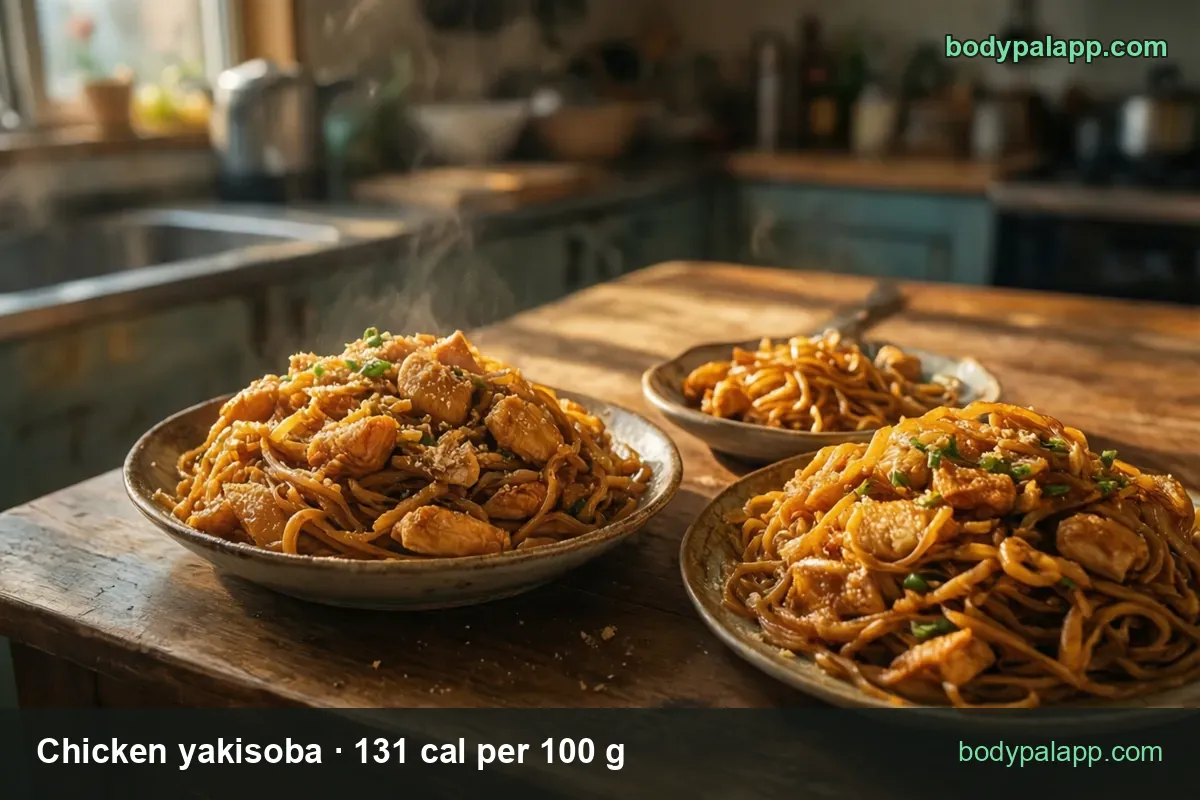
Same chicken. Same cabbage, carrot and onion. Same sauce. Take the noodles out and FNDDS 2706798 drops to 83 calories per 100 g, so a 1-cup serving falls from 288 to 183 calories — a 105-calorie difference per cup, and the biggest cut you can make without shrinking the bowl.
The macros move in a way that is worth seeing. Carbohydrate collapses from 11.15 g to 3.84 g per 100 g, fat eases from 5.43 g to 3.23 g, and protein barely budges: 9.91 g against 9.78 g. In other words, you can cut more than a third of the calories out of the bowl without losing any meaningful protein. That is the trade most people are looking for when they ask whether yakisoba is a diet food.
The other direction works too. If a half-noodle bowl sounds joyless, keep the noodles and shrink the bowl: one cup instead of two saves 288 calories.
Packets, trays and bags: the store versions
Most chicken yakisoba in America comes out of a package, and the packages do not agree with each other or with the homemade version.
| Version | Per 100 g | Typical serving | Calories |
|---|---|---|---|
| Chicken yakisoba with noodles (USDA base row) | 131 kcal | 1 cup (220 g) | 288 kcal |
| Chicken stir-fry, no noodles | 83 kcal | 1 cup (220 g) | 183 kcal |
| Instant packet, Maruchan chicken flavor | 441 kcal | half container (57 g) | 250 kcal |
| Frozen meal, Benihana Yakisoba Chicken | 148 kcal | 1 package (283 g) | 419 kcal |
| Refrigerated bag, Ling Ling chicken yakisoba | 138 kcal | 1 bag (283 g) | 391 kcal |
| Yakisoba sauce | 111 kcal | 2 Tbsp (36 g) | 40 kcal |
That 441 figure looks alarming next to 131, and it is the single most misread number in this category. Instant packets are measured dry. Once the noodles absorb water they roughly triple in weight, which is why a dry Maruchan reads at 441 calories per 100 g while a ready-to-heat Ling Ling bag reads 138. Compare packages, not per-100-g columns: half a Maruchan container is 250 calories, the full Ling Ling bag is 391, and the Benihana tray is 419.
The Maruchan serving size deserves its own warning. The label splits one container in two, but the container is a single sealed brick of noodles that nobody halves at 11pm. Logged honestly, that is 500 calories.
Sauce is the quiet one. Two tablespoons of bottled yakisoba sauce add only 40 calories — trivial on the calorie side, and not trivial at all on the next number.
Sodium is the row to watch
One cup delivers 898 mg of sodium, 39% of the 2,300 mg Daily Value. That is about two-fifths of a teaspoon of table salt in a portion most people would call small.
Now stack the realistic version: two cups from a takeout container is 1,796 mg, and two tablespoons of yakisoba sauce brushed on at the end add roughly another 890 mg. You are at 2,686 mg from one dish — past the entire daily limit the Dietary Guidelines for Americans use, before breakfast and dinner are counted.
Nothing about that makes yakisoba a bad meal. It makes it a meal to build a day around rather than add to one. If you are watching sodium, the no-noodle version helps a little (344 mg per 100 g instead of 408 mg), but the bigger win is cooking it yourself and keeping the sauce bottle in the fridge after the first pour.
On the other side of the ledger, 21.8 g of protein per cup is a genuinely good showing for a mixed dish, and it comes from a lean protein food rather than from cheese or oil. Saturated fat stays at 3.2 g per cup, 16% of the Daily Value.
How does chicken yakisoba compare?
| Dish | Per 100 g | US serving | Calories |
|---|---|---|---|
| Chicken yakisoba, noodles in | 131 kcal | 1 cup (220 g) | 288 kcal |
| Chicken chow mein, no noodles | 83 kcal | 1 cup (220 g) | 183 kcal |
| Beef chow mein, no noodles | 82 kcal | — | — |
| Chow fun noodles with vegetables, meatless | 74 kcal | — | — |
USDA does not publish a cup weight for the beef and chow fun records, so those two stay on the 100 g column rather than get a serving invented for them.
Our take: chicken yakisoba is the heaviest of the four per gram, and the noodles are the only reason. Beef and chicken land within one calorie of each other per 100 g once the noodles come out (82 against 83), which means swapping the meat changes almost nothing — the beef row is even slightly ahead on protein, 10.76 g against 9.78 g. The meatless chow fun is the lightest per 100 g at 74 calories, but it carries 1.56 g of protein, so it will not hold you the way the chicken version does. For weight loss, order the chicken stir-fry and ask for the noodles on the side. For a real meal that keeps you full, take the 288-calorie cup as it comes and stop at one.
Most popular chicken yakisoba brands in the United States
Ranked by how widely each product appears among foods sold in the United States, from the BodyPal food database of over 3.3 million products. Calories are the figures printed on each Nutrition Facts label, checked against USDA FoodData Central.
| Product | Calories (per 100 g) |
|---|---|
| Maruchan Yakisoba Hot & Spicy Chicken | 446 cal |
| Benihana Yakisoba Chicken | 148 cal |
| Ling Ling Chicken Yakisoba Noodles | 138 cal |
| Maruchan Chicken Flavor Yakisoba | 441 cal |
| Maruchan Roast Chicken Flavor Yakisoba | 435 cal |
| Brothers Kitchen Teriyaki Chicken with Yakisoba Noodles | 207 cal |
Brand popularity: BodyPal food database. Nutrition: manufacturer labels / USDA FoodData Central.
Chicken yakisoba FAQs
How many calories are in a cup of chicken yakisoba?
A 1-cup serving is 288 calories, based on 131 calories per 100 g. That cup weighs 220 g and brings 21.8 g of protein, 24.5 g of carbohydrate and 11.9 g of fat. Restaurant portions are usually closer to two cups, which lands near 576 calories.
How much protein is in chicken yakisoba?
21.8 g of protein in a 1-cup serving, which is 44% of the Daily Value on a 2,000-calorie diet. Per 100 g the dish carries 9.91 g. That is a strong number for a noodle bowl, and it comes almost entirely from the chicken rather than the noodles.
Is chicken yakisoba high in sodium?
Yes: 898 mg in one cup, or 39% of the 2,300 mg Daily Value. Two cups would put you over 1,700 mg before anything else you eat that day. Two tablespoons of bottled yakisoba sauce brushed on at the end add roughly another 890 mg on top of that.
How many calories are in Maruchan chicken yakisoba?
250 calories per half container of Maruchan Chicken Flavor Yakisoba, which is 56.7 g dry. The whole container is 500 calories, because almost nobody splits one. Per 100 g the dry packet reads 441 calories, more than three times the 131 calories per 100 g of the finished stir-fry.
How many calories are in Benihana chicken yakisoba?
419 calories for the 10 oz (283 g) Benihana Yakisoba Chicken package, at 148 calories per 100 g. That is one tray, one sitting. Per gram it sits close to the homemade version, 148 against 131, so the extra calories come from the size of the package rather than the recipe.
Is chicken yakisoba good for weight loss?
A 1-cup serving at 288 calories fits a normal lunch, and the 21.8 g of protein helps it hold. Leaving the noodles out drops the same cup to 183 calories. If you are watching sodium more than calories, the 898 mg per cup is the number to manage instead.
Chicken yakisoba vs chicken chow mein: which has more calories?
They share one USDA record at 131 calories per 100 g, or 288 per cup. FoodData Central files chicken yakisoba under chow mein and chop suey with noodles. The no-noodle chow mein row is the lighter one, 83 per 100 g and 183 per cup. Sauce and noodle thickness do the rest.
How many carbs are in chicken yakisoba noodles?
24.5 g of carbohydrate in a 1-cup serving, or 11.15 g per 100 g, with 3.3 g of fiber and 3.4 g of total sugars. That is low for a noodle dish because the cup is mostly chicken and vegetables. A dry instant packet is a different story entirely.
Similar foods
- Chicken Chow Mein — 288 cal per cup
- Half And Half — 20 cal per tbsp
- Snow Cone — 256 cal per snow cone
- Egg Foo Yung — 108 cal per patty
- Lasagna — 286 cal per piece
- Shrimp Lo Mein — 242 cal per cup
Count it without the math
Point the camera at the bowl and BodyPal counts the noodles, the chicken and the sauce for you.


How long does it take to burn off 288 kcal of chicken yakisoba?
A 1-cup (220 g) serving is 288 kcal. Enter your weight and the amount you ate to see how long it takes you to burn that off:
lb
| Activity | Time to burn 288 kcal |
|---|---|
| Walking, brisk | 58 min |
| Cycling, moderate | 36 min |
| Swimming, moderate | 41 min |
| Jogging | 34 min |
| Weight training, moderate | 1 hr 4 min |
Times are for a 155 lb adult at a steady pace; change the weight to see yours. The amount is set to the portion in the text (220 g); change it to what you actually ate. BodyPal works this out from your steps automatically.
Burning it off is one side of it. The other is knowing your number: work out how many calories you need a day, with macros and a goal date.