
How many calories in a corn muffin?
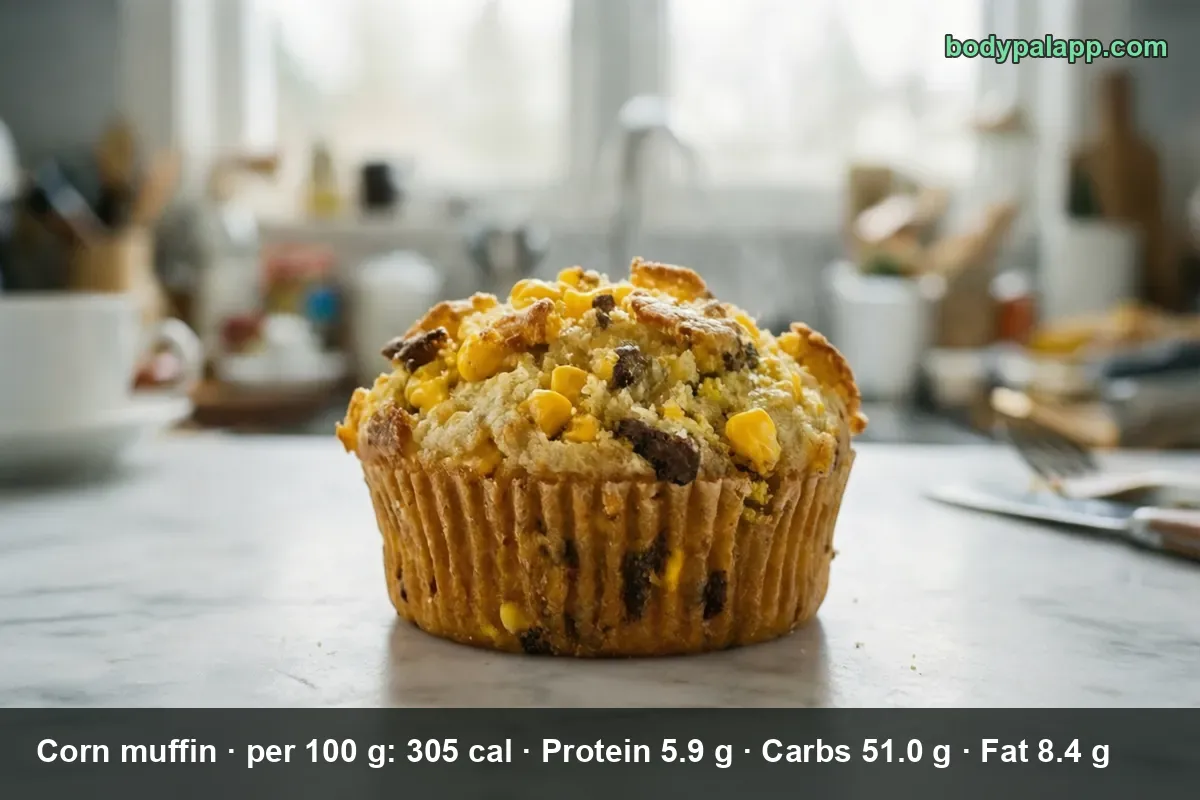
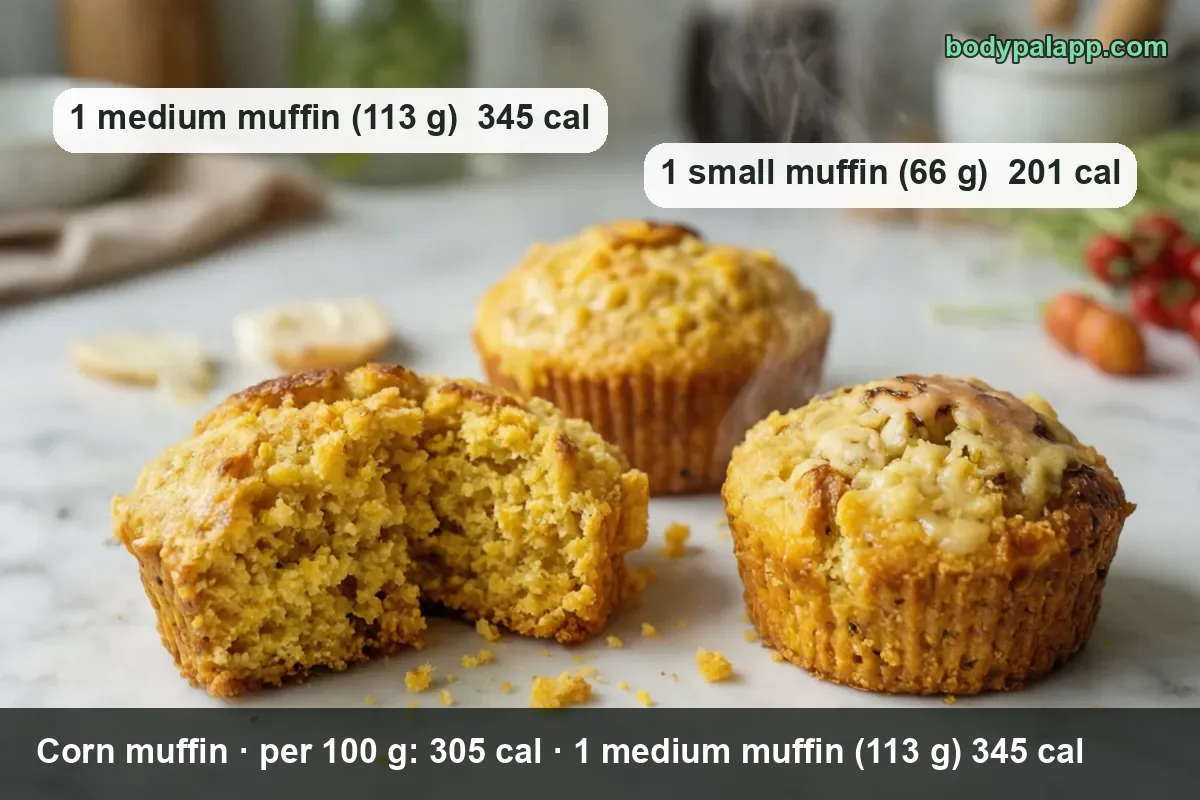
A medium corn muffin is 345 calories, using the 113 g size USDA treats as standard, or 305 calories per 100 g. A small 66 g muffin is 201. The extra large one sitting in a coffee shop basket is 512. Nothing about the recipe moves that number much — the weight of the muffin moves everything.
On this page
- Corn muffin quick facts
- The box says 418, the muffin says 305
- US serving sizes, from a mini to an extra large
- Homemade, boxed and toaster muffins
- Sodium is the number to watch
- How does a corn muffin compare?
- Most popular corn muffin brands
- FAQ
Corn muffin quick facts
These figures come from SR Legacy 175002, USDA's record for a commercially prepared corn muffin — the baked one from a store or bakery case, not a mix. The serving column is one medium muffin at 113 g, which is USDA's own household weight for that record.
| Nutrient | Per 100 g | Per 1 medium muffin (113 g) | % Daily Value |
|---|---|---|---|
| Calories | 305 | 345 | — |
| Total fat | 8.4 g | 9.5 g | 12% |
| Saturated fat | 1.35 g | 1.5 g | 8% |
| Carbohydrate | 51 g | 57.6 g | 21% |
| Dietary fiber | 3.4 g | 3.8 g | 14% |
| Total sugars | 17.78 g | 20.1 g | — |
| Protein | 5.9 g | 6.7 g | 13% |
| Sodium | 385 mg | 435 mg | 19% |
% Daily Value is based on a 2,000-calorie diet.
Verified nutrition data
Numbers on this page come from USDA FoodData Central, the U.S. Department of Agriculture’s food composition database, and from manufacturer labels where a branded product is named. Last verified September 2026. How we verify our data →
Two lines you would find on a wrapper are missing here, and both are missing for the same reason: SR Legacy does not publish them for this food. There is no added sugars row and no trans fat row. Guessing at either would be worse than leaving them off, so the 20.1 g of sugars in a medium muffin is the total — corn is not a sweet grain, and most of that came out of a sugar bag.
Fiber is the row worth a second look. A medium corn muffin carries 3.8 g, which is 14% of the FDA Daily Value of 28 g, and cornmeal is the reason. It is more fiber than most pastries hand back and roughly the same share of the day as the muffin's fat.
Cholesterol runs 26 mg per 100 g, about 29 mg in a medium muffin, from the eggs and butter in the batter. Potassium is minor at 69 mg per 100 g. Neither one changes how you should think about the muffin; sodium does, and that gets its own section below.
The box says 418, the muffin says 305
Search for corn muffin calories and a big number keeps surfacing: 418 per 100 g. It is a real USDA figure, from Bread, cornbread, dry mix, enriched, and it describes something nobody eats.
That 418 is the powder. Dry mix is flour, cornmeal, sugar and leavening with the water taken out, so it is dense by definition. One ounce of it, 28.35 g, is 119 calories. A standard 8.5 oz box of mix (241 g) holds 1,007 calories before you crack an egg into it.
Baking changes the arithmetic in the direction people never expect. You add water, egg and oil, and the finished muffins are less calorie-dense than the powder was — 321 calories per 100 g for the USDA record Muffins, corn, dry mix, prepared, against 418 for the mix in the box. Water weighs plenty and carries nothing.
So a medium muffin baked from a box lands at 363 calories, about 18 more than a bakery one. The gap is small. What is not small is what comes with it, and it is not calories.
US serving sizes, from a mini to an extra large
| Serving | Weight | Calories |
|---|---|---|
| 1 mini muffin | 17 g | 52 |
| 1 oz | 28.35 g | 86 |
| 1 small muffin | 66 g | 201 |
| 1 medium muffin | 113 g | 345 |
| 1 large muffin | 139 g | 424 |
| 1 extra large muffin | 168 g | 512 |
| 100 g | 100 g | 305 |
Every gram weight in that table except the ounce comes out of USDA's portion file for record 175002. The spread is the story: the same muffin, described the same way, runs from 52 calories to 512. A factor of ten.
That is why "one corn muffin" is close to meaningless as a log entry. A mini from a party tray and a domed bakery muffin are the same food and a 460-calorie difference. Packaged corn muffins on US shelves land across that whole range too — a 33 g toaster-size one is around 120 calories, while store-bakery muffins run 71 g to 114 g, which puts the realistic default right around USDA's medium.
The practical move: weigh one muffin from whatever you buy regularly, once. Divide by 100, multiply by 305, and you have a number that is good for every muffin from that bakery for the rest of the year.
Homemade, boxed and toaster muffins
| Version | Per 100 g | Serving | Calories |
|---|---|---|---|
| Bakery, commercially prepared (this page) | 305 | 1 medium (113 g) | 345 |
| Home recipe | 307 | 1 medium (113 g) | 347 |
| Baked from a boxed mix | 321 | 1 medium (113 g) | 363 |
| Toaster-type corn muffin | 346 | 1 muffin (33 g) | 114 |
| Corn muffin mix, dry | 418 | 1 oz (28.35 g) | 119 |
| Corn muffin mix, whole box | 418 | 8.5 oz (241 g) | 1007 |
Three ways of making the same muffin land within 18 calories of each other. Anyone hoping that baking at home is the low-calorie route should read that row twice: a home-recipe muffin is 347 calories, two more than the bakery version.
The composition does shift, though, and in an interesting direction. The home recipe holds 7.34 g of sugars per 100 g against the bakery muffin's 17.78 g — less than half. It pays for that with fat, 10.51 g per 100 g against 8.4 g, and with sodium, 519 mg against 385 mg. Home baking swaps sugar for butter and baking soda. It also lifts protein a little, to 7.02 g per 100 g.
The toaster muffin is a different object rather than a smaller one. At 33 g it is 114 calories, but per gram it is the densest baked version in the table at 346 calories per 100 g. Three of them are still fewer calories than one bakery muffin.
Sodium is the number to watch
Corn muffins get filed under sugar. The number that should make you look twice is the one on the other end of the label.
- Bakery corn muffin, 113 g: 435 mg of sodium, 19% of the day
- Home recipe, 113 g: 587 mg, about a quarter of the day
- Baked from a boxed mix, 113 g: 898 mg, 39% of the day
The Daily Value is 2,300 mg. One bakery muffin is a fifth of it before anything else on the plate, and two of them at breakfast take you to 38% — from a food most people would call a side.
The boxed-mix row is the one that should change behavior. Baking soda, baking powder and salt all arrive premeasured in the box and none of them cook off, so the finished muffin holds 795 mg per 100 g. A single medium muffin from a box is 898 mg, which is more sodium than a typical serving of many foods people actively avoid for exactly that reason, and it costs you 18 extra calories to get there. If sodium is a number you track, the box is the version to skip — not the bakery case.
Grain foods carry more of America's sodium than most people assume, which is part of why MyPlate puts the emphasis on whole grains and on what gets baked in alongside them, and why the Dietary Guidelines for Americans treat baked goods as a leading source of added sugars and saturated fat in the diet at once.
How does a corn muffin compare?
| Muffin | Per 100 g | Serving | Calories | Protein | Carbs | Fat |
|---|---|---|---|---|---|---|
| Corn muffin (this page) | 305 | 1 medium (113 g) | 345 | 6.7 g | 57.6 g | 9.5 g |
| Blueberry muffin | 375 | 1 medium (113 g) | 424 | 5.1 g | 59.9 g | 18.2 g |
| Oat bran muffin | 270 | 1 medium (113 g) | 305 | 7.9 g | 54.6 g | 8.4 g |
| Plain muffin, home recipe | 296 | 1 muffin (57 g) | 169 | 3.9 g | 23.6 g | 6.5 g |
| English muffin, plain | 227 | 1 muffin (57 g) | 129 | 5.1 g | 25.2 g | 1.0 g |
The blueberry comparison is the one people come looking for, and corn wins it by 79 calories. The reason is not sugar. A medium corn muffin holds 20.1 g of sugars against roughly 35.6 g in a blueberry muffin, but sugar at 4 calories a gram cannot explain a 79-calorie gap on its own. Fat can: 9.5 g against 18.2 g. The blueberry muffin is a richer batter, and richness is what you are paying for.
Corn also beats it on fiber by a wide margin — 3.4 g per 100 g against 1.1 g, roughly three times as much. Against an oat bran muffin, that advantage reverses: oat bran carries 4.6 g per 100 g, about 5.2 g in a medium muffin, for 40 fewer calories and more protein.
Our take: among sweet muffins the corn one is the sensible pick, with less fat and triple the fiber of a blueberry muffin for 79 fewer calories, and it is the better choice if you want something that eats like a real portion. If the goal is simply the lowest number on the plate, none of them competes with a plain English muffin at 129 calories and 1.0 g of fat — that is not the same food, and pretending otherwise helps nobody. And if you bake your own, do it for the sugar cut, not for the calories: you will save half the sugar and gain a third more sodium.
Most popular corn muffin brands in the United States
Ranked by how widely each product appears among foods sold in the United States, from the BodyPal food database of over 3.3 million products. Calories are the figures printed on each Nutrition Facts label, checked against USDA FoodData Central.
| Product | Calories (per 100 g) |
|---|---|
| Publix Bakery Corn Muffins | 329 cal |
| The Muffin Mam Corn Muffin | 437 cal |
| Walmart Sweet Corn Muffins | 354 cal |
| Thomas' Corn Muffins | 364 cal |
| Otis Spunkmeyer Corn Muffin Whole Grain | 335 cal |
| Cafe Valley Bakery Gourmet Corn Muffins | 394 cal |
Brand popularity: BodyPal food database. Nutrition: manufacturer labels / USDA FoodData Central.
Corn muffin FAQs
How many calories are in a corn muffin?
345 calories in a medium corn muffin, the 113 g size USDA uses for a commercially prepared muffin, or 305 calories per 100 g. That serving carries 57.6 g of carbohydrate, 9.5 g of fat, 6.7 g of protein and 3.8 g of fiber. A small 66 g muffin is 201 calories.
How many calories are in a large corn muffin?
424 calories for USDA's large muffin at 139 g, and 512 for the extra large at 168 g. At the other end, a mini muffin of 17 g is 52 calories and a small one of 66 g is 201. Every one of those is the same muffin at 305 calories per 100 g — only the size changes.
Corn muffin or blueberry muffin — which has fewer calories?
The corn muffin, by 79 calories. A medium 113 g corn muffin is 345 calories against 424 for a blueberry muffin of the same weight. Most of that gap is fat, 9.5 g against 18.2 g, not sugar. Corn also gives about three times the fiber, 3.4 g per 100 g against 1.1 g.
Are corn muffins healthy?
A medium corn muffin is 345 calories with 3.8 g of fiber, 14% of the 28 g Daily Value, which is more than most bakery items return. It also brings 20.1 g of sugars and 435 mg of sodium, 19% of the day. Federal advice on grain foods sits at MyPlate. It reads as a breakfast pastry, not a side dish.
How many carbs are in a corn muffin?
57.6 g of carbohydrate in a medium 113 g muffin, which is 21% of the 275 g Daily Value, from 51 g per 100 g. Of that total, 3.8 g is fiber and 20.1 g is sugars. A small 66 g muffin comes to about 33.7 g of carbohydrate.
How much sugar is in a corn muffin?
20.1 g of total sugars in a medium 113 g bakery muffin, or 17.78 g per 100 g. USDA publishes no added sugars figure for this record, so there is no split between the sugar baked in and any natural sugar. A home recipe is far lower at 7.34 g per 100 g.
How much sodium is in a corn muffin?
435 mg in a medium 113 g muffin, 19% of the 2,300 mg Daily Value, from 385 mg per 100 g. A muffin baked from a boxed mix more than doubles it to 898 mg, or 39% of the day, because the salt and leavening arrive premeasured in the box.
How many calories are in a homemade corn muffin?
347 calories for a 113 g muffin made from a home recipe, at 307 calories per 100 g — two calories more than the bakery version. Home baking cuts the sugars to 7.34 g per 100 g but raises fat to 10.51 g and sodium to 519 mg. Baking your own saves sugar, not calories.
Similar foods
- Pumpkin Loaf — 183 cal per slice
- Burrito Tortilla — 220 cal per 10-inch tortilla
- Spinach Tortilla — 132 cal per tortilla
- Wrap Tortilla — 220 cal per wrap
- Zucchini Bread — 122 cal per slice
- Irish Soda Bread — 223 cal per slice
Count it without the math
Point the camera at the muffin and BodyPal logs the size you actually picked up, mini or extra large, without a scale.


How long does it take to burn off a corn muffin?
A medium corn muffin (113 g) is 345 kcal. Enter your weight and the amount you ate to see how long it takes you to burn that off:
lb
| Activity | Time to burn 345 kcal |
|---|---|
| Walking, brisk | 1 hr 9 min |
| Cycling, moderate | 43 min |
| Swimming, moderate | 49 min |
| Jogging | 41 min |
| Weight training, moderate | 1 hr 17 min |
Times are for a 155 lb adult at a steady pace; change the weight to see yours. The amount is set to the portion in the text (113 g); change it to what you actually ate. BodyPal works this out from your steps automatically.
This table assumes you know your daily total. If you do not, the daily calorie calculator works it out from five numbers.