
How many calories are in an egg and cheese English muffin?
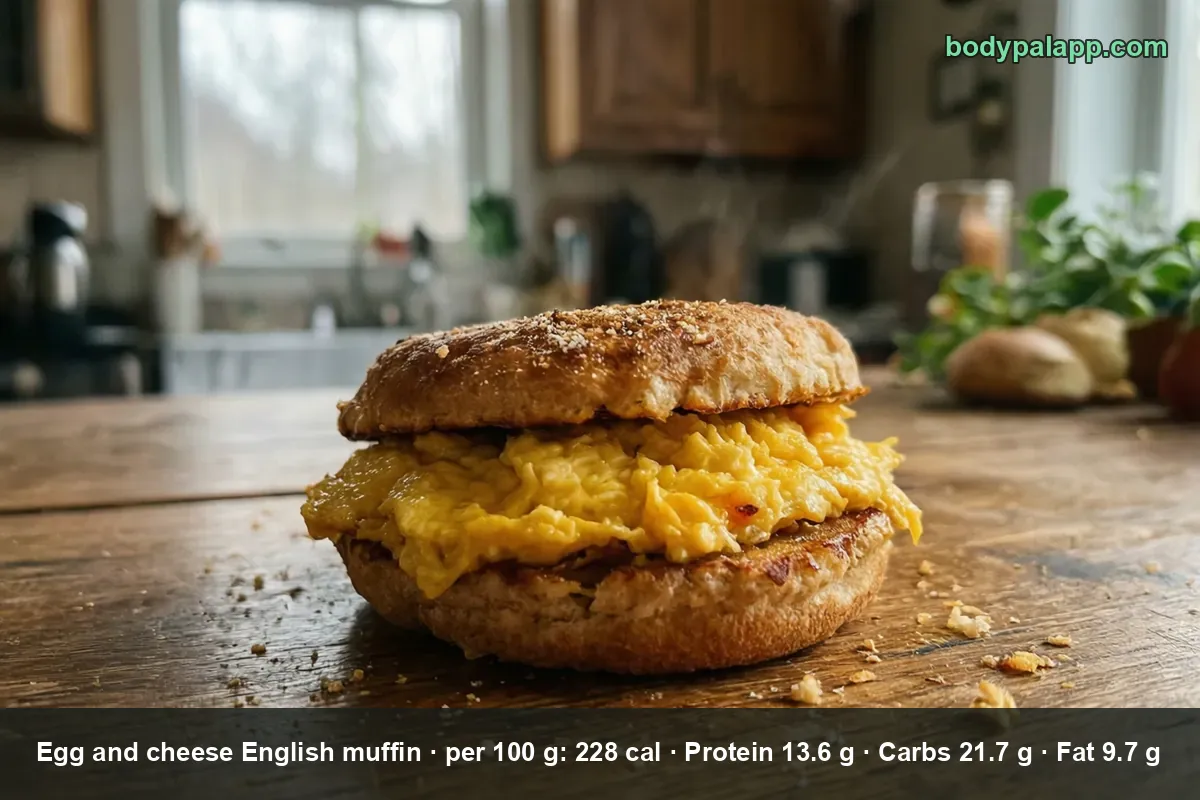
One egg and cheese English muffin weighs 126 g and carries 287 calories. Per 100 g the sandwich runs 228 calories, which is modest for a hot breakfast. Most of that weight is egg, melted cheese and a thin bread ring, not batter, butter or sausage fat.
On this page
- Egg and cheese English muffin quick facts
- US servings, from one ounce to two sandwiches
- Sausage, frozen and homemade versions
- Cholesterol is the row to watch, not calories
- How does an egg and cheese English muffin compare?
- Most popular egg and cheese english muffin brands
- FAQ
Egg and cheese English muffin quick facts
Here is the first thing worth knowing, and almost nobody says it out loud: USDA has no record for a plain egg-and-cheese English muffin with no meat at all. The closest match in the database is SR Legacy 172033, "Fast foods, english muffin, with egg, cheese, and canadian bacon", and that is the row this page runs on. Canadian bacon is a thin, lean round of cured pork loin, so it nudges the fat and sodium up a little without changing the shape of the sandwich.
The alternative would have been the sausage version, and that is a different food entirely. It carries 286 calories per 100 g against 228 here. If your sandwich came without meat, treat 287 as a slight overestimate and shave roughly a tenth off.
| Nutrient | Per 100 g | Per 1 sandwich (126 g) | % Daily Value |
|---|---|---|---|
| Calories | 228 | 287 | — |
| Total fat | 9.66 g | 12.2 g | 16% |
| Saturated fat | 3.59 g | 4.5 g | 23% |
| Carbohydrate | 21.67 g | 27.3 g | 10% |
| Dietary fiber | 0.4 g | 0.5 g | 2% |
| Total sugars | 2.13 g | 2.7 g | — |
| Protein | 13.64 g | 17.2 g | 34% |
| Sodium | 617 mg | 777 mg | 34% |
| Cholesterol | 168 mg | 212 mg | 71% |
| Potassium | 173 mg | 218 mg | 5% |
% Daily Value is based on a 2,000-calorie diet.
Verified nutrition data
Numbers on this page come from USDA FoodData Central, the U.S. Department of Agriculture’s food composition database, and from manufacturer labels where a branded product is named. Last verified September 2026. How we verify our data →
There is no added-sugars row above, and that is not an oversight: the SR Legacy edition of this record does not measure added sugars, so the line is left out rather than guessed at. Total sugars are 2.7 g a sandwich, which is trivial either way and comes mostly from the muffin. Potassium is the quiet one, 218 mg a sandwich, only 5% of the Daily Value.
US servings, from one ounce to two sandwiches
| Serving | Weight | Calories |
|---|---|---|
| 1 oz | 28.35 g | 65 kcal |
| Half a sandwich | 63 g | 144 kcal |
| One sandwich | 126 g | 287 kcal |
| Two sandwiches | 252 g | 575 kcal |
| Per 100 g | 100 g | 228 kcal |
Only one of those is a USDA household measure: the 126 g sandwich. The half, the double and the ounce rows are our own arithmetic from the USDA 100 g figure, not USDA servings, which is why they scale cleanly and why they carry no rounding surprises.
The 126 g figure is worth checking against your own breakfast, because muffin size is the variable people forget. A supermarket English muffin runs 55 to 66 g on its own; add a large egg and a slice of American cheese and you land close to 126 g. A bakery-size muffin or two eggs pushes the sandwich toward 160 g, which is around 365 calories by the same arithmetic. Weigh the sandwich once and you will know which camp yours is in for good.
Two sandwiches, 575 calories, is a real serving in the sense that people order it, and it is the point where a light breakfast becomes a heavy one. It also carries 1,554 mg of sodium, which is two thirds of the day.
Sausage, frozen and homemade versions
| Version | Per 100 g | Typical piece | Calories |
|---|---|---|---|
| With Canadian bacon | 228 kcal | 1 sandwich, 126 g | 287 kcal |
| With sausage | 286 kcal | 1 item, 165 g | 472 kcal |
| Frozen, store brand | 186 kcal | 1 sandwich, 145 g | 270 kcal |
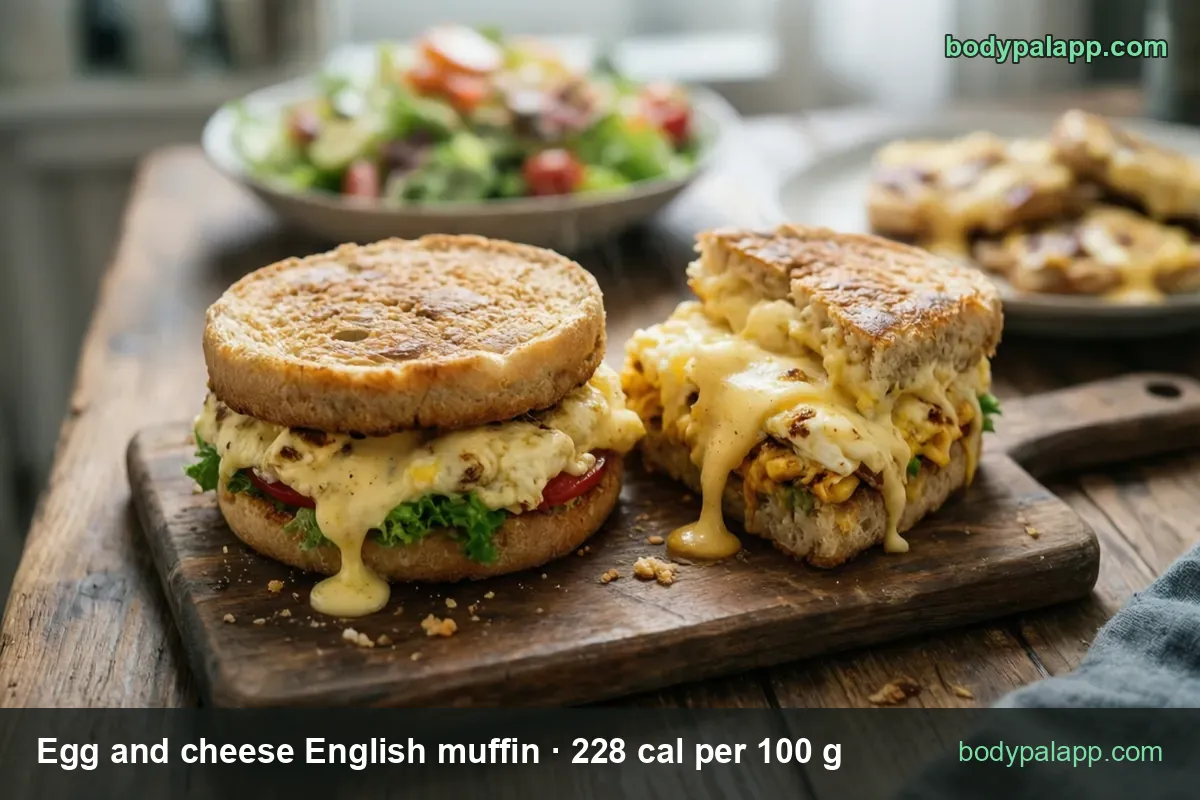
The sausage patty is the entire story of this food. Swapping the round of Canadian bacon for a sausage patty takes the sandwich from 287 to 472 calories, a jump of 185, and almost all of it is fat: 18.1 g per 100 g against 9.66 g. Protein barely moves, 13.38 g per 100 g versus 13.64 g. You pay 185 calories and get nothing back on the nutrient you were buying breakfast for.
The frozen sandwich is the surprise. At 186 calories per 100 g it is the lightest of the three, and even at 145 g it lands at 270 calories, under the smaller fresh sandwich. Frozen breakfast sandwiches use thinner cheese and a smaller egg round, and the numbers show it. One caution on that record: its protein field reads 101.38 g per 100 g, which is impossible for a sandwich and is plainly a label data-entry error, so we quote it for calories and serving size only.
Homemade is where you have the most control and the fewest published numbers. USDA does not carry a record for a from-scratch egg and cheese English muffin, so no honest figure can be given for it here. What the rows above do tell you is where the calories live: the muffin and the cheese are fixed, the meat is optional, and the cooking fat is yours to choose. An egg cooked dry in a nonstick pan instead of in butter is the single easiest change.
Cholesterol is the row to watch, not calories
At 287 calories, this sandwich is about 14% of a 2,000-calorie day. That is unremarkable. Two rows on the label are far less so.
Cholesterol comes first: 212 mg in one sandwich, 71% of the 300 mg Daily Value the FDA prints on the Nutrition Facts label. The whole egg supplies most of it, the cheese and cured pork the rest. Current federal advice in the Dietary Guidelines for Americans no longer sets a numeric daily cap for dietary cholesterol, advising instead that intake be kept as low as possible within a healthy eating pattern. So the 71% is a label percentage, not a limit you have blown.
Sodium is the one to actually plan around: 777 mg, 34% of the 2,300 mg Daily Value, in a single small sandwich. That is roughly a third of a teaspoon of table salt before you touch the coffee, the hash browns or lunch. If you are watching sodium, the frozen sandwich at 490 mg per 100 g is the softer landing among the branded options.
Then there is fiber, going the opposite way: 0.5 g a sandwich, 2% of the Daily Value. Protein does the heavy lifting at 17.2 g, a full 34% of the Daily Value, so hunger is handled, but the sandwich contributes essentially nothing toward the grains-and-produce side of MyPlate. A whole-wheat muffin and a piece of fruit on the side fix that without touching the protein.
How does an egg and cheese English muffin compare?
| Breakfast | Per 100 g | US serving | Calories |
|---|---|---|---|
| Egg and cheese English muffin | 228 kcal | 1 sandwich, 126 g | 287 kcal |
| Sausage, egg and cheese English muffin | 286 kcal | 1 item, 165 g | 472 kcal |
| McDonald's Big Breakfast | 285 kcal | 1 item, 9.5 oz, 269 g | 768 kcal |
| McDonald's Deluxe Breakfast | 285 kcal | 1 item, 14.8 oz, 420 g | 1196 kcal |
Look at the middle column before the last one. Three of these four foods sit within one calorie per 100 g of each other, at 285 and 286, and the egg and cheese muffin is the only one below them at 228. The reason the plate totals run from 287 to 1,196 is not richness, it is size: 126 g against 420 g. Platter breakfasts are not denser than a sandwich, they are simply three times bigger.
Our take: for a calorie-controlled breakfast the plain egg and cheese muffin is the pick, and it is not close. It gives you 17.2 g of protein for 287 calories, where the Big Breakfast asks 768 calories for 27.3 g. If you want more food, buy a second sandwich at 575 total before you buy a platter at 768. The one number that should make you pause is sodium, not calories.
Most popular egg and cheese english muffin brands in the United States
Ranked by how widely each product appears among foods sold in the United States, from the BodyPal food database of over 3.3 million products. Calories are the figures printed on each Nutrition Facts label, checked against USDA FoodData Central.
| Product | Calories (per 100 g) |
|---|---|
| Tasty Brands Sausage Egg Cheese English Muffin | 186 cal |
Brand popularity: BodyPal food database. Nutrition: manufacturer labels / USDA FoodData Central.
Egg and cheese English muffin FAQs
How many calories are in an egg and cheese English muffin?
287 calories for a 126 g sandwich, or 228 calories per 100 g. That is the USDA figure for an English muffin with egg, cheese and a slice of Canadian bacon, the closest record to the sandwich most people eat. Half of one comes to 144 calories.
How much protein is in an egg and cheese English muffin?
17.2 g of protein in one 126 g sandwich, which is 34% of the 50 g Daily Value. The egg and the cheese do that work between them, and per calorie it beats any pastry breakfast easily. Per 100 g the sandwich carries 13.64 g of protein.
How many calories in a sausage, egg and cheese English muffin?
472 calories for a 165 g sausage, egg and cheese English muffin, against 287 for the version with Canadian bacon. The sausage patty is the whole difference: 18.1 g of fat per 100 g instead of 9.66 g. Same bread, same egg, 185 more calories.
How much sodium is in an egg and cheese English muffin?
777 mg of sodium in one sandwich, or 34% of the 2,300 mg Daily Value, split between the cheese, the cured meat and the muffin itself. That is roughly a third of a teaspoon of table salt. Per 100 g the figure is 617 mg.
How many carbs are in an egg and cheese English muffin?
27.3 g of carbohydrate in a 126 g sandwich, which is 10% of the Daily Value, and only 0.5 g of that is fiber. Sugars are low at 2.7 g. The muffin supplies nearly all of the carbohydrate; the egg and the cheese add almost none.
Does an egg and cheese English muffin have a lot of cholesterol?
212 mg of cholesterol in one sandwich, 71% of the 300 mg Daily Value and the highest percentage on this label. The whole egg accounts for most of it. Federal guidance no longer sets a numeric daily limit, but the Nutrition Facts label still prints the 300 mg value.
Is an egg and cheese English muffin good for weight loss?
At 287 calories with 17.2 g of protein, it fits a calorie-controlled breakfast better than most drive-through options. The sausage version at 472 calories fits less easily, and two sandwiches come to 575. If you are watching sodium, the 777 mg in one is the real trade-off.
How many calories in half an egg and cheese English muffin?
144 calories for half a sandwich, 63 g, which is our own arithmetic from the USDA 100 g figure rather than a listed USDA serving. Half also means about 8.6 g of protein and 389 mg of sodium. It works well next to a piece of fruit.
Similar foods
- Steak And Eggs — 366 cal per regular steak
- Crepe — 179 cal per crepe
- Waffle cone — 556 cal per Waffle cone with 2 scoops
- Hash Brown — 119 cal per patty
- Cheese Omelet — 264 cal per omelet, 2 eggs
- Cheese Omelet — 264 cal for 2-egg omelet
Count it without the math
Point the camera at the plate and BodyPal counts the sandwich for you, cheese and all.


How long does it take to burn off 287 kcal of egg cheese English muffin?
One sandwich (126 g) is 287 kcal. Enter your weight and the amount you ate to see how long it takes you to burn that off:
lb
| Activity | Time to burn 287 kcal |
|---|---|
| Walking, brisk | 57 min |
| Cycling, moderate | 36 min |
| Swimming, moderate | 41 min |
| Jogging | 34 min |
| Weight training, moderate | 1 hr 4 min |
Times are for a 155 lb adult at a steady pace; change the weight to see yours. The amount is set to the portion in the text (126 g); change it to what you actually ate. BodyPal works this out from your steps automatically.
Burning it off is one side of it. The other is knowing your number: work out how many calories you need a day, with macros and a goal date.