
How many calories are in a cheese omelet?
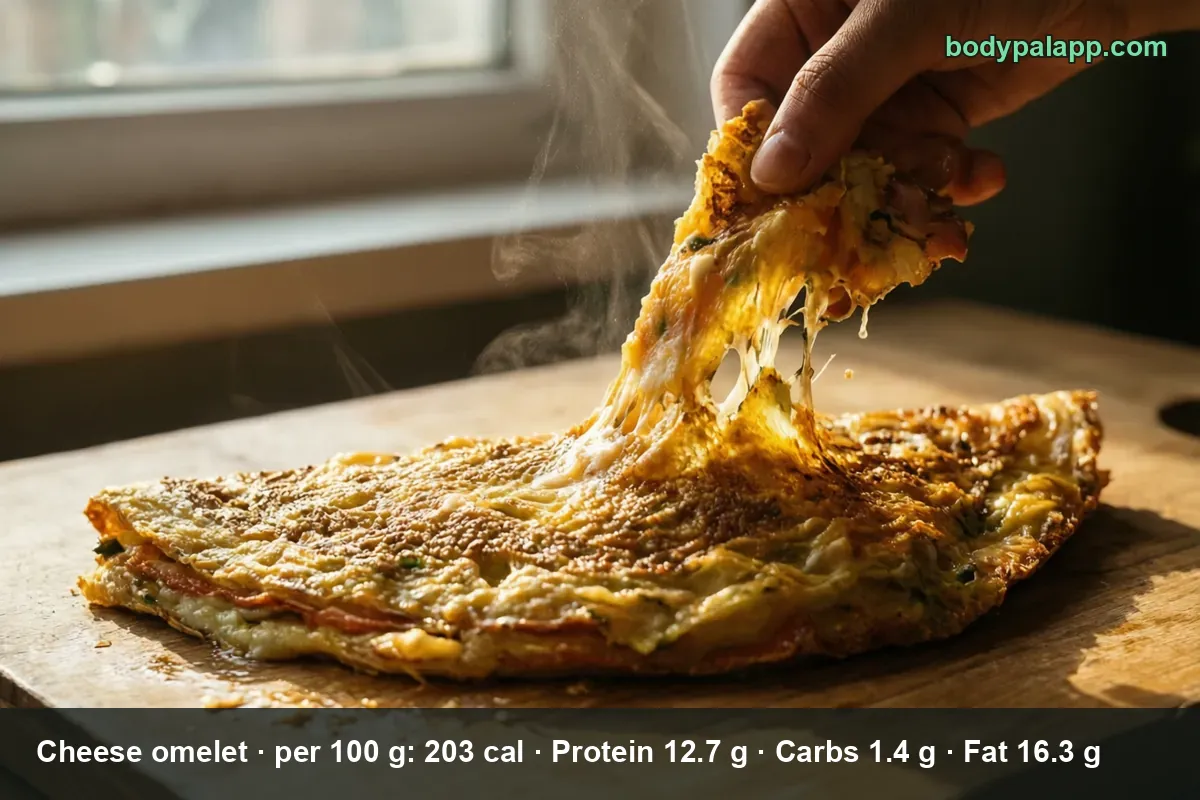
A 2-egg cheese omelet cooked in butter weighs about 130 g and carries 264 calories. Per 100 g that same omelet runs 203 calories, with 12.69 g of protein and 16.34 g of fat. The cheese pushes the fat up. The butter in the pan pushes it higher still, and both are counted here.
On this page
- Cheese omelet quick facts
- US servings from one ounce to a three egg diner plate
- What the pan does to a cheese omelet
- Egg white omelets and the ham and cheese version
- Cholesterol and saturated fat are the rows to watch
- How does a cheese omelet compare
- Most popular cheese omelet brands
- FAQ
Cheese omelet quick facts
The record that matches what most people actually eat is USDA FNDDS 2707209, "Egg omelet or scrambled egg, with cheese, made with butter". That is the American home version: eggs beaten, a pat of butter in a nonstick skillet, a handful of shredded cheddar or American folded in before the omelet is turned out. The oil, margarine, spray and no-fat records exist too, and they get their own section further down, because the fat you cook in moves the number more than the cheese does.
The 130 g column below is USDA's own 2-egg portion for that record, not a scaled guess.
| Nutrient | Per 100 g | Per 2-egg omelet (130 g) | % Daily Value |
|---|---|---|---|
| Calories | 203 | 264 | — |
| Total fat | 16.34 g | 21.2 g | 27% |
| Saturated fat | 7.23 g | 9.4 g | 47% |
| Carbohydrate | 1.41 g | 1.8 g | 1% |
| Dietary fiber | 0 g | 0 g | 0% |
| Total sugars | 0.54 g | 0.7 g | — |
| Protein | 12.69 g | 16.5 g | 33% |
| Sodium | 354 mg | 460 mg | 20% |
| Cholesterol | 360 mg | 468 mg | 156% |
| Potassium | 128 mg | 166 mg | 4% |
% Daily Value is based on a 2,000-calorie diet.
Verified nutrition data
Numbers on this page come from USDA FoodData Central, the U.S. Department of Agriculture’s food composition database, and from manufacturer labels where a branded product is named. Last verified September 2026. How we verify our data →
Two rows you would see on a packaged omelet are missing here: added sugars and trans fat. USDA does not publish added sugars or trans fat for FNDDS mixed dishes, so rather than invent them we leave them out. Nothing is lost in practice, since a plain cheese omelet carries 0.54 g of total sugars per 100 g, which is milk sugar from the cheese rather than a sweetener. The 460 mg of sodium is worth reading as salt too: that is roughly a fifth of a teaspoon of table salt, most of it from the cheese rather than the shaker.
US servings from one ounce to a three egg diner plate
| Serving | Weight | Calories |
|---|---|---|
| 1 oz | 28.35 g | 58 kcal |
| One-egg omelet portion | 65 g | 132 kcal |
| 2-egg omelet | 130 g | 264 kcal |
| 1 cup, chopped | 135 g | 274 kcal |
| 3-egg diner omelet | 195 g | 396 kcal |
| Per 100 g | 100 g | 203 kcal |
The one-egg portion, the 2-egg omelet and the 1 cup measure are USDA household measures for this record. The 3-egg diner plate at 195 g is our own arithmetic from the USDA 100 g figure, not a USDA serving: it is one egg portion added to the 2-egg omelet, which is how a restaurant three-egger is built. The 1 oz line is scaled the same way, for anyone weighing a leftover wedge.
Watch the cup. A cup of chopped omelet weighs 135 g, which is more than the 130 g 2-egg omelet, so "one cup" is not the small measure it sounds like. If you are logging by eye, the flat two-egg omelet that fills an 8-inch skillet is the 264-calorie one. A thick, folded three-egg omelet that hangs off the edge of the plate is closer to 396.
Cheese is the wild card the USDA record already includes. If you go heavy and add another ounce of shredded cheddar beyond what the record assumes, you are adding calories on top of these numbers, not inside them.
What the pan does to a cheese omelet
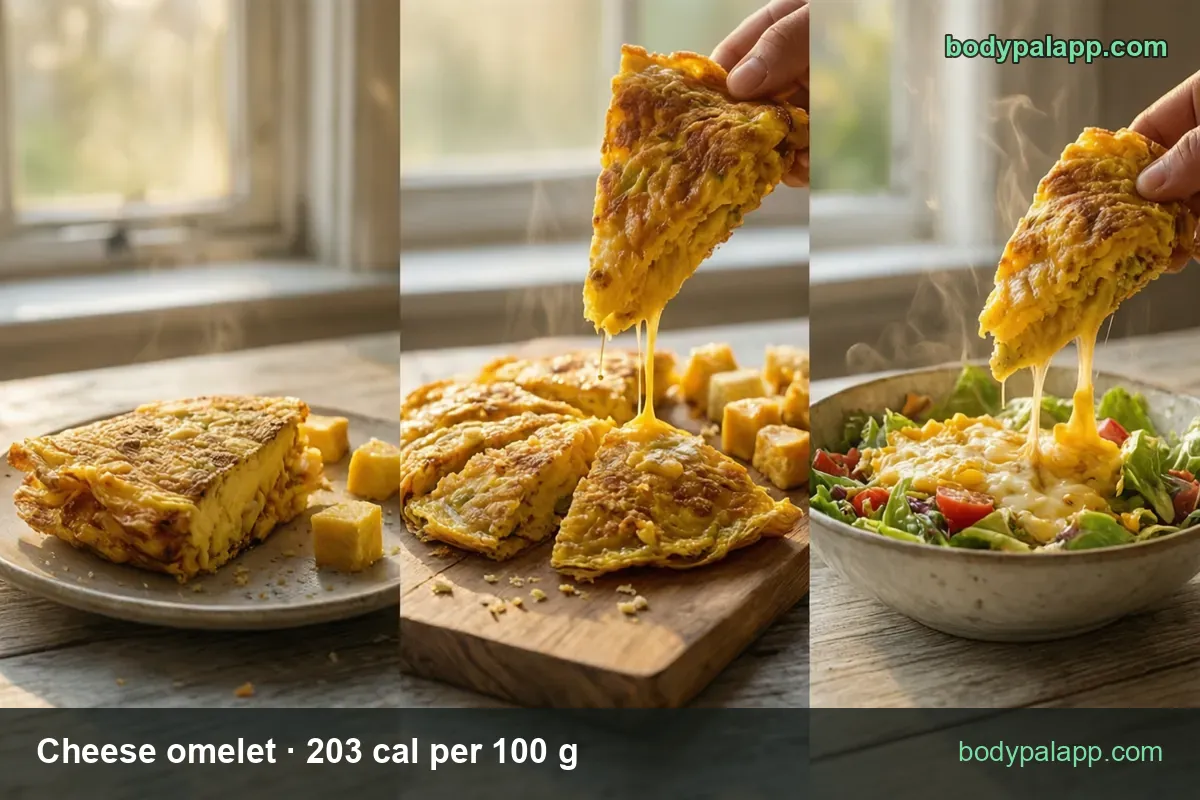
Here is the finding that surprises people: the fat in the skillet, not the cheese, is what separates a light omelet from a heavy one. Same eggs, same cheese, four different pans.
| Version | Per 100 g | Typical piece | Calories |
|---|---|---|---|
| Made with butter | 203 kcal | 2-egg omelet, 130 g | 264 kcal |
| Made with oil | 212 kcal | one-egg portion, 65 g | 138 kcal |
| Made with margarine | 194 kcal | 2-egg omelet, 130 g | 252 kcal |
| Made with cooking spray | 176 kcal | 2-egg omelet, 130 g | 229 kcal |
| No added fat | 171 kcal | one-egg portion, 60 g | 103 kcal |
The margarine, spray and no-added-fat portions at 130 g and 60 g are our own arithmetic from each record's USDA 100 g figure, not USDA servings; the butter and oil pieces are USDA household measures.
Run the two ends against each other. Butter gives you 264 calories for a 2-egg omelet; the same omelet with no added fat is 222, our own arithmetic from the 171 kcal per 100 g figure for record 2707212. That is a 42-calorie gap for a decision you make in two seconds. Cooking spray lands in between at 229, which is why it is the easiest single swap on this page.
The oil version is the odd one. At 212 calories per 100 g it is the highest of the five, because oil pours more freely than butter melts. Its saturated fat is lower though, 5.39 g per 100 g against 7.23 g for butter. So oil buys you a better fat profile and costs you a few calories. Butter is the reverse trade.
Egg white omelets and the ham and cheese version
Dropping the yolks changes everything at once. USDA's egg white omelet with cheese is 132 calories per 100 g, so a 1 cup serving of 135 g is 178 calories against 274 for the butter version. Protein barely moves, 11.27 g per 100 g against 12.69 g, and cholesterol falls off a cliff: 15 mg per 100 g instead of 360 mg. If you eat omelets often and cholesterol is on your mind, this is the version that solves it without giving up the cheese.
Going the other way, an omelet with cheese and meat folded in runs 209 calories per 100 g. A 2-egg version at 130 g comes to 272 calories, our own arithmetic from that 100 g figure, with 399 mg of sodium per 100 g against 354 mg for plain cheese. The ham is a small calorie story and a real sodium one: the meat, not the eggs, is what lifts the sodium on a diner omelet.
Store-bought omelets are lighter than they look, mostly because they are smaller. A Jimmy Dean Cheddar Cheese Omelet is 110 calories for its 71 g piece, and Eggland's Best Three Cheese Omelets list 220 calories for one 111 g omelet, both under the 264 of a homemade two-egg. Bob Evans cheddar and parmesan omelet rolls come in at 100 calories for a 57 g roll. None of them are a two-egg breakfast; they are one-egg breakfasts sold as a unit.
Cholesterol and saturated fat are the rows to watch
Calories are not the interesting number on a cheese omelet. Saturated fat and cholesterol are.
A 2-egg cheese omelet cooked in butter carries 9.4 g of saturated fat, which is 47% of the FDA Daily Value of 20 g, before you have touched the bacon on the side. Scale it to the 3-egg diner plate and you are at 14.1 g, or 70% of the day's DV from a single breakfast. The Dietary Guidelines for Americans put saturated fat at under 10% of daily calories, which is the same ballpark. If you eat this omelet, the rest of the day wants to be leaner.
Cholesterol reads dramatic on the label: 468 mg for the 2-egg omelet, 156% of the 300 mg DV. Current federal guidance no longer sets a hard daily cap on dietary cholesterol, so treat the percentage as information rather than an alarm, and take it as one more reason the egg white version at 15 mg per 100 g exists.
The good row is protein. Those 16.5 g are 33% of the DV in a breakfast that costs 264 calories, which is a strong ratio for a hot meal. MyPlate counts eggs as a protein food, and this is one of the cheapest ways to hit a third of your protein before 9 a.m. It is also a breakfast plenty of people eat several times a week, which is exactly why the pan matters: a small habit, repeated daily.
How does a cheese omelet compare
All four measured the same way, as a 1 cup serving of 135 g, so the comparison is honest.
| Omelet | Per 100 g | US serving | Calories |
|---|---|---|---|
| Cheese omelet, made with butter | 203 kcal | 1 cup, 135 g | 274 kcal |
| Cheese omelet, made with oil | 212 kcal | 1 cup, 135 g | 286 kcal |
| Cheese omelet, no added fat | 171 kcal | 1 cup, 135 g | 231 kcal |
| Egg white omelet with cheese | 132 kcal | 1 cup, 135 g | 178 kcal |
Our take: if you are cutting calories, cook the omelet with spray or nothing and keep the cheese. That is the 231-calorie cup, 43 fewer than butter, and the cheese is the part you actually taste. If you want the biggest drop on this page, the egg white version at 178 calories per cup is the lightest of the four by a wide margin and still delivers real protein. Only go egg white if you are chasing cholesterol or a hard calorie target, though; the yolk is where a lot of the flavor and most of the nutrients live. For fullness on a long morning, the butter omelet at 274 per cup is not a bad deal at all.
Most popular cheese omelet brands in the United States
Ranked by how widely each product appears among foods sold in the United States, from the BodyPal food database of over 3.3 million products. Calories are the figures printed on each Nutrition Facts label, checked against USDA FoodData Central.
| Product | Calories (per 100 g) |
|---|---|
| Jimmy Dean Cheddar Cheese Omelet | 155 cal |
| Eggland's Best Three Cheese Omelets | 198 cal |
| Bob Evans Cheddar & Parmesan Cheese Omelet Rolls | 175 cal |
| Artisan Kitchens Three Cheese Small Batch Omelets | 172 cal |
| Simple Truth Three Cheese Egg Bites | 280 cal |
Brand popularity: BodyPal food database. Nutrition: manufacturer labels / USDA FoodData Central.
Cheese omelet FAQs
How many calories are in a cheese omelet?
264 calories for a standard 2-egg cheese omelet cooked in butter, weighing 130 g. Per 100 g the omelet runs 203 calories. A single-egg portion of 65 g is 132 calories, and a cup of chopped omelet, 135 g, comes to 274 calories.
How many calories in a 2 egg cheese omelet?
264 calories, using USDA's own 130 g two-egg portion for an omelet made with butter. That comes with 16.5 g of protein, 21.2 g of fat and 460 mg of sodium. Cook the same omelet with no added fat and it drops to 222 calories.
How many calories in a 3 egg cheese omelet?
396 calories for a 195 g three-egg omelet cooked in butter, which is our own arithmetic from the USDA 203 kcal per 100 g figure rather than a USDA serving. It also carries 14.1 g of saturated fat, 70% of the Daily Value, before toast or potatoes.
How much protein is in a cheese omelet?
16.5 g of protein in a 2-egg cheese omelet of 130 g, which is 33% of the 50 g Daily Value. Per 100 g the omelet holds 12.69 g. An egg white omelet with cheese is close behind at 11.27 g per 100 g.
Is a cheese omelet good for weight loss?
At 264 calories with 16.5 g of protein, a 2-egg cheese omelet fits a calorie target well for a hot breakfast. The lever is the pan: cooking spray brings it to 229 and no added fat to 222. If you are watching saturated fat, 9.4 g is 47% of the DV.
How many calories in an egg white omelet with cheese?
178 calories for a 1 cup serving of 135 g, at 132 calories per 100 g. That is 96 calories less than the same cup of a butter-cooked whole-egg omelet. Protein holds up at 11.27 g per 100 g, and cholesterol falls to 15 mg per 100 g.
Does cooking an omelet in butter add calories?
Yes, about 42 calories on a two-egg omelet. Butter takes it to 264, cooking spray to 229 and no added fat at all to 222. Oil is the highest at 212 calories per 100 g, though its saturated fat is lower, 5.39 g against 7.23 g for butter.
How much cholesterol is in a cheese omelet?
468 mg in a 2-egg cheese omelet of 130 g, or 156% of the 300 mg Daily Value, and 360 mg per 100 g. Federal guidance no longer sets a hard daily cap. The egg white version, at 15 mg per 100 g, removes nearly all of it.
Similar foods
- Omelet — 305 cal for 3-egg omelet
- Crepe — 179 cal per crepe
- Egg — 72 cal per large egg
- Pancake — 423 cal for 3 medium pancakes
- Toast with butter — 100 cal per slice with butter
- Fish Cake — 180 cal per cake or patty
Count it without the math
Point the camera at the skillet and BodyPal counts the omelet for you, cheese and all.


How long does it take to burn off 264 kcal of cheese omelet?
A 2-egg omelet (130 g) is 264 kcal. Enter your weight and the amount you ate to see how long it takes you to burn that off:
lb
| Activity | Time to burn 264 kcal |
|---|---|
| Walking, brisk | 53 min |
| Cycling, moderate | 33 min |
| Swimming, moderate | 38 min |
| Jogging | 31 min |
| Weight training, moderate | 59 min |
Times are for a 155 lb adult at a steady pace; change the weight to see yours. The amount is set to the portion in the text (130 g); change it to what you actually ate. BodyPal works this out from your steps automatically.
Burning it off is one side of it. The other is knowing your number: work out how many calories you need a day, with macros and a goal date.