
How many calories are in steak and eggs?
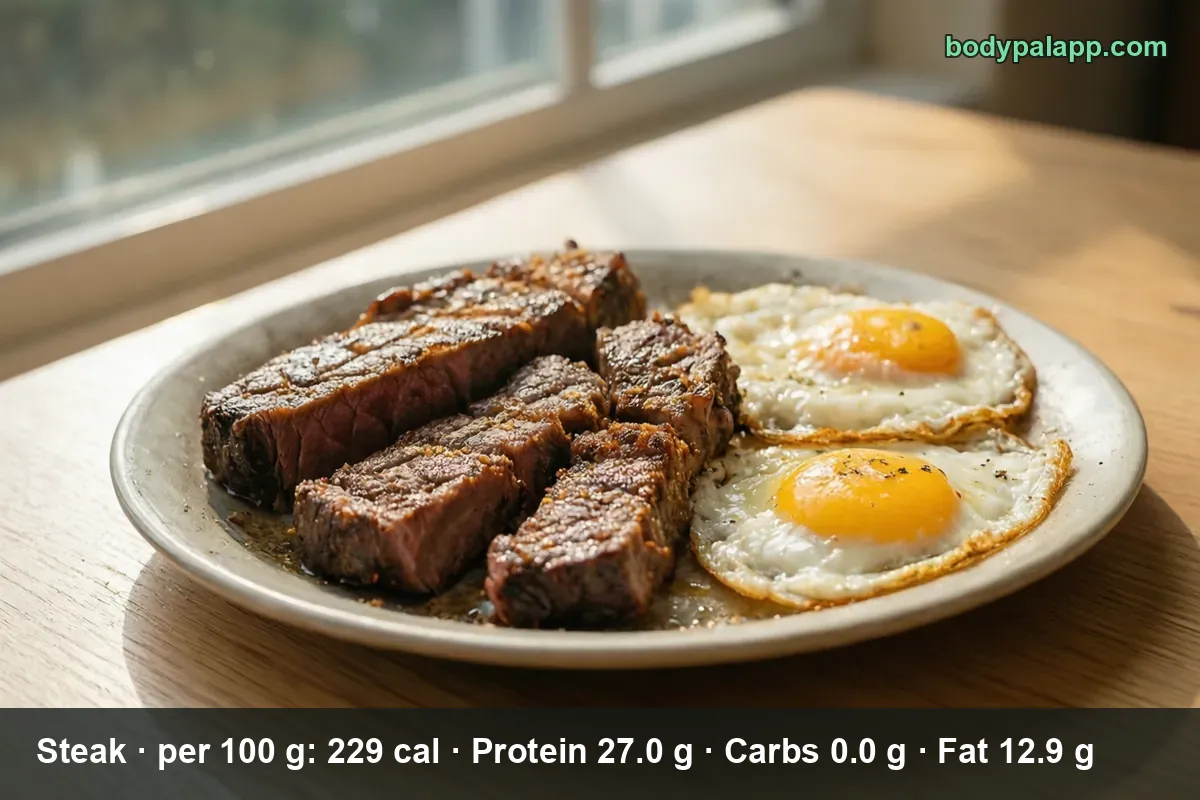
A regular steak weighs 160 g and carries 366 calories; per 100 g the cooked meat runs 229 calories. Add the two fried eggs that come with it and the classic diner plate lands at 566 calories, 56 g of that protein and close to none of it carbohydrate.
On this page
- Steak and eggs quick facts
- US servings from one ounce to a thick cut
- The whole plate with two fried eggs
- Steak cuts eggs and the diner bagel
- Cholesterol is the row to watch
- How does steak and eggs compare?
- Most popular steak and egg brands
- FAQ
Steak and eggs quick facts
USDA does not publish a single record for the plate. The only entry that carries both words is a fast-food breakfast bagel, which is a sandwich and not what sits on the platter. So the lead number here is the steak itself, taken from FNDDS 2705824, "Beef, steak, NFS" — the not-further-specified record, which is the average across every cut people actually order. The eggs get their own record and their own line further down, and the two are added for the plate.
Everything below is cooked weight. A 160 g cooked steak starts life as roughly 2 oz more on the grill: meat loses about a quarter of its weight to water, so 4 oz raw lands near 3 oz cooked. Weighing after cooking is the only way these figures hold.
| Nutrient | Per 100 g | Per 1 regular steak (160 g) | % Daily Value |
|---|---|---|---|
| Calories | 229 | 366 | — |
| Total fat | 12.88 g | 20.6 g | 26% |
| Saturated fat | 5.29 g | 8.5 g | 42% |
| Carbohydrate | 0 g | 0 g | 0% |
| Dietary fiber | 0 g | 0 g | 0% |
| Total sugars | 0 g | 0 g | — |
| Protein | 27 g | 43.2 g | 86% |
| Sodium | 369 mg | 590 mg | 26% |
% Daily Value is based on a 2,000-calorie diet.
Verified nutrition data
Numbers on this page come from USDA FoodData Central, the U.S. Department of Agriculture’s food composition database, and from manufacturer labels where a branded product is named. Last verified September 2026. How we verify our data →
There is no added sugars row and no trans fat row because FNDDS does not publish either for this record; plain broiled beef has no added sugar to report anyway. Two figures worth pulling out of the record: cholesterol is 83 mg per 100 g, so 133 mg in the steak, and potassium is 321 mg per 100 g, or 514 mg — 11% of the Daily Value, which is more potassium than most people expect from red meat.
US servings from one ounce to a thick cut
| Serving | Weight | Calories |
|---|---|---|
| 1 oz cooked | 28 g | 64 kcal |
| 4 oz cooked | 113 g | 259 kcal |
| One thin steak | 120 g | 275 kcal |
| One regular steak | 160 g | 366 kcal |
| One thick steak | 240 g | 550 kcal |
| Per 100 g | 100 g | 229 kcal |
Thin, regular and thick are the USDA household portions for this record, which is why they sit at odd gram weights rather than tidy ounces. The 1 oz and 4 oz lines are our own arithmetic from the USDA 100 g figure, not USDA servings — useful, because a restaurant menu talks in ounces and USDA does not.
The gap between thin and thick is the one to notice. Same cut, same pan, 275 calories against 550: the thickness of the steak doubles the number before anyone chooses ribeye over round. A steakhouse "petite" and a steakhouse cut are two different meals.
The whole plate with two fried eggs
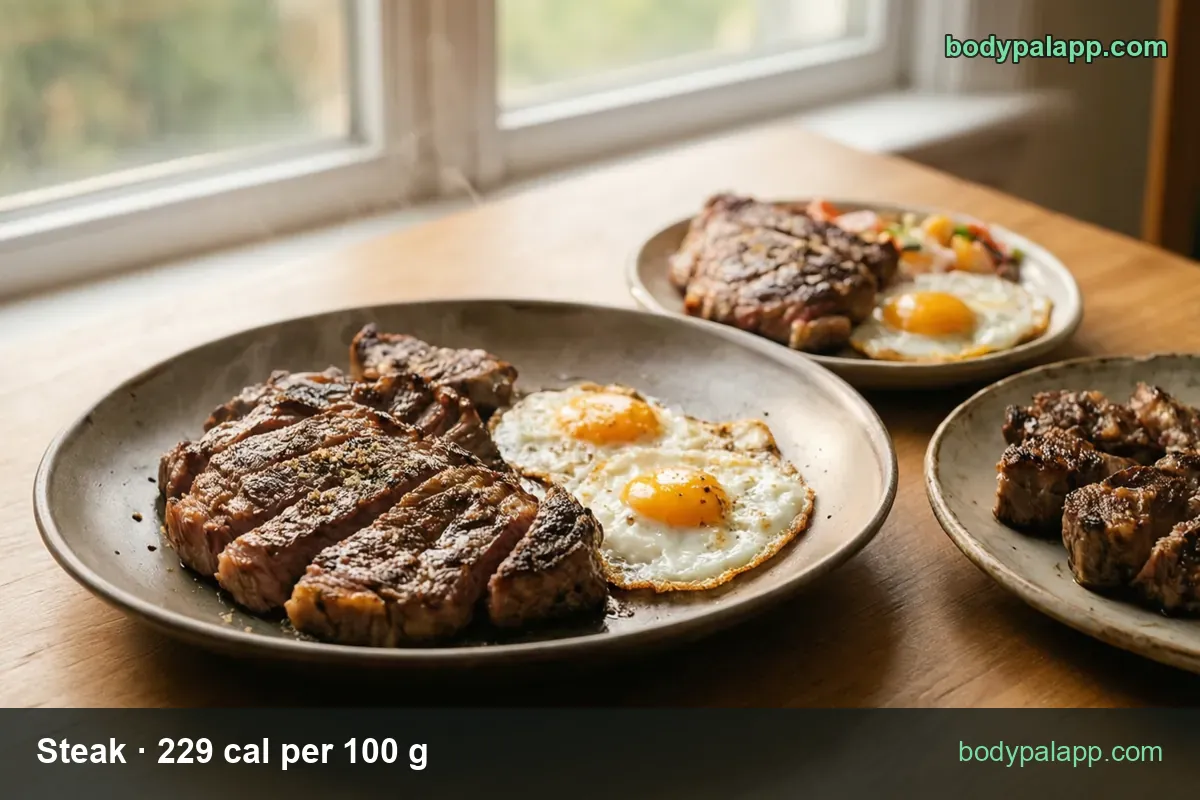
Two large eggs fried in butter weigh about 110 g and run 182 calories per 100 g, from FNDDS 2707159. That is 200 calories on the side of the steak.
| Component | Weight | Calories | Protein |
|---|---|---|---|
| Steak, regular, all cuts | 160 g | 366 kcal | 43.2 g |
| Two eggs fried in butter | 110 g | 200 kcal | 12.8 g |
| The plate | 270 g | 566 kcal | 56.0 g |
The eggs are just over a third of the plate's number and roughly a quarter of the protein. Cooked in a dry nonstick pan instead of butter, the same two eggs come to about 157 calories, so the fat in the pan is worth 43 calories — real, but not the line that decides this breakfast.
At 56 g, the plate clears the FDA Daily Value for protein of 50 g in one sitting, which is why steak and eggs keeps showing up in high-protein breakfast plans. MyPlate counts an ounce of cooked meat and one egg each as a single ounce-equivalent of protein foods, so this plate is close to eight of them.
Steak cuts eggs and the diner bagel
The cut moves the total more than the pan does. Round and ribeye are the same 160 g of beef and 196 calories apart.
| Version | Per 100 g | Typical portion | Calories |
|---|---|---|---|
| Round steak, leanest | 166 kcal | 1 regular steak, 160 g | 266 kcal |
| Tenderloin | 196 kcal | 1 regular steak, 160 g | 314 kcal |
| Sirloin, lean only eaten | 216 kcal | 1 regular steak, 160 g | 346 kcal |
| Steak, NFS, all cuts | 229 kcal | 1 regular steak, 160 g | 366 kcal |
| Ribeye, lean and fat eaten | 289 kcal | 1 regular steak, 160 g | 462 kcal |
| Country fried steak | 306 kcal | 100 g | 306 kcal |
| Two eggs fried in butter | 182 kcal | 2 eggs, 110 g | 200 kcal |
The sirloin, ribeye and country fried portion figures are our own arithmetic from the USDA 100 g values, not USDA servings. Country fried is the only steak in the table with meaningful carbohydrate in it — 7.94 g per 100 g from the breading, against 0 g for every plain cut — and at 306 calories per 100 g it beats even ribeye eaten with its fat.
Retail labels tell the same story from the raw side: a Landis lean sirloin tip steak is listed at 159 calories per 100 g, a Meijer top sirloin at 219, a Thousand Hills grass-fed ribeye at 286. Grass-fed does not mean lean; the cut is doing the work.
Then there is the drive-through version. A steak, egg and cheese bagel weighs about 254 g and comes to 716 calories at 282 per 100 g, with 22.99 g of carbohydrate per 100 g and 642 mg of sodium. Same three ingredients, a bread wrapper, and 150 more calories than the plate.
Cholesterol is the row to watch
Most people brace for the sodium in steak and eggs. It is not the standout. The plate carries 879 mg of sodium, 38% of the FDA Daily Value of 2,300 mg — a normal breakfast number, and roughly what a third of a teaspoon of table salt would add.
Cholesterol is the outlier: about 571 mg on the plate, 190% of the 300 mg Daily Value, with the two yolks contributing most of it. Saturated fat is the other one to log — 8.5 g in the steak alone is 42% of the day's 20 g, and a ribeye eaten with its fat brings 15.4 g, 77% of the day's value on its own.
None of that makes the plate off-limits; it makes it a meal to plan around rather than add to. If your day already includes cheese, butter and another cut of red meat, the round steak version at 266 calories and 4.25 g of fat per 100 g leaves far more room.
How does steak and eggs compare?
| Food | Per 100 g | US serving | Calories |
|---|---|---|---|
| Steak, NFS, all cuts | 229 kcal | 1 regular steak, 160 g | 366 kcal |
| Round steak | 166 kcal | 1 regular steak, 160 g | 266 kcal |
| Tenderloin steak | 196 kcal | 1 regular steak, 160 g | 314 kcal |
| Egg, fried in butter | 182 kcal | 1 egg, 55 g | 100 kcal |
Our take: if the goal is losing weight, order round and keep both eggs. Round with two fried eggs is 466 calories with 60 g of protein — a cheaper plate than the average-cut version at 566, and the swap costs nothing you would notice under a runny yolk. If the goal is staying full until dinner, the standard 566-calorie plate is one of the most efficient breakfasts on any diner menu, because almost none of those calories are carbohydrate and the protein is high enough to carry six or seven hours. The version to think twice about is the country fried steak, where breading and frying oil add calories that bring nothing with them.
Most popular steak and egg brands in the United States
Ranked by how widely each product appears among foods sold in the United States, from the BodyPal food database of over 3.3 million products. Calories are the figures printed on each Nutrition Facts label, checked against USDA FoodData Central.
| Product | Calories (per 100 g) |
|---|---|
| Landis Lean Sirloin Tip Beef Steaks | 159 cal |
| Landis Wafer Sliced Lean Sirloin Tip Beef Steaks | 160 cal |
| Bridger Beef Shaved Beef Steak | 143 cal |
| Lincoln Packing Shaved Beef Steak | 161 cal |
| Meijer Top Sirloin Beef Steak | 219 cal |
| Thousand Hills Ribeye 100% Grass Fed Beef Steak | 286 cal |
Brand popularity: BodyPal food database. Nutrition: manufacturer labels / USDA FoodData Central.
Steak and eggs FAQs
How many calories are in steak and eggs?
About 566 calories for the standard plate: a 160 g regular steak at 366 calories plus two eggs fried in butter at 200. The steak alone is 229 calories per 100 g. Skip the butter and the same plate drops to roughly 523 calories.
How many calories in a 6 oz steak with two fried eggs?
A 6 oz cooked steak is 170 g, which works out to 389 calories from the USDA 100 g figure by our own arithmetic. Two eggs fried in butter add 200, so the plate comes to about 589 calories with roughly 59 g of protein.
How much protein is in steak and eggs?
About 56 g on the standard plate: 43.2 g from the 160 g steak and 12.8 g from two fried eggs. That is 112% of the FDA Daily Value of 50 g in a single meal, and it arrives with no carbohydrate at all from the meat.
How many calories in steak and 2 eggs cooked without oil?
About 523 calories. The 160 g steak stays at 366, and two eggs cooked without added fat come to roughly 157 instead of the 200 they carry fried in butter. The butter is worth 43 calories here — a real line, but not a decisive one.
Which steak cut has the fewest calories?
Round, at 166 calories per 100 g, or 266 for a 160 g steak. Tenderloin follows at 196, sirloin with the fat trimmed at 216, the all-cuts average at 229, and ribeye eaten with its fat at 289. Country fried steak tops the list at 306.
Is steak and eggs good for weight loss?
At 566 calories it is a substantial breakfast, but 56 g of protein for that price is efficient. Choosing round instead of the average cut takes it to 466, and dropping the butter takes it to 423. If you are watching calories, the cut matters more than the eggs.
Is steak and eggs keto?
Yes, on the numbers: the steak carries 0 g of carbohydrate and two fried eggs about 1 g, so the plate totals roughly 1 g. Fat comes to 36.7 g and protein to 56 g. Breaded country fried steak breaks that, adding 7.94 g of carbohydrate per 100 g.
How much cholesterol is in steak and eggs?
About 571 mg, or 190% of the 300 mg Daily Value — 133 mg from the steak and the rest from the two yolks. Sodium is the milder number here at 879 mg, 38% of the daily limit, unless the kitchen salts the pan heavily.
Similar foods
- Egg And Cheese English Muffin — 287 cal per sandwich
- Crepe — 179 cal per crepe
- Waffle cone — 556 cal per Waffle cone with 2 scoops
- Hash Brown — 119 cal per patty
- Cheese Omelet — 264 cal per omelet, 2 eggs
- Cheese Omelet — 264 cal for 2-egg omelet
Count it without the math
Point the camera at the plate and BodyPal counts the steak and the eggs separately, cut and all.


How long does it take to burn off steak and eggs?
One regular steak (160 g) is 366 kcal. Enter your weight and the amount you ate to see how long it takes you to burn that off:
lb
| Activity | Time to burn 366 kcal |
|---|---|
| Walking, brisk | 1 hr 13 min |
| Cycling, moderate | 46 min |
| Swimming, moderate | 52 min |
| Jogging | 43 min |
| Weight training, moderate | 1 hr 21 min |
Times are for a 155 lb adult at a steady pace; change the weight to see yours. The amount is set to the portion in the text (160 g); change it to what you actually ate. BodyPal works this out from your steps automatically.
This table assumes you know your daily total. If you do not, the daily calorie calculator works it out from five numbers.