
How many calories are in an egg bagel with cream cheese?
One medium egg bagel, 3-1/2 to 4 inches across and 105 g, is 292 calories, and the dough runs 278 calories per 100 g. That number is the bread alone. Add cream cheese, eggs or bacon and you are logging a different food, which is where most of the calories hide.
On this page
- Egg bagel quick facts
- US servings from mini to large
- Where the cream cheese fits
- Egg bagel sandwiches and mini bagels
- Sodium is the row to watch
- How does an egg bagel compare?
- Most popular egg bagel brands
- FAQ
Egg bagel quick facts
The row behind every number here is SR Legacy 174901, "Bagels, egg". It is the only USDA record for an egg bagel that also carries household measures by diameter, which matters more than it sounds: a bagel is sold by the piece, and the piece is anything from 26 g to 131 g. The record describes the baked bagel with nothing on it and nothing in it.
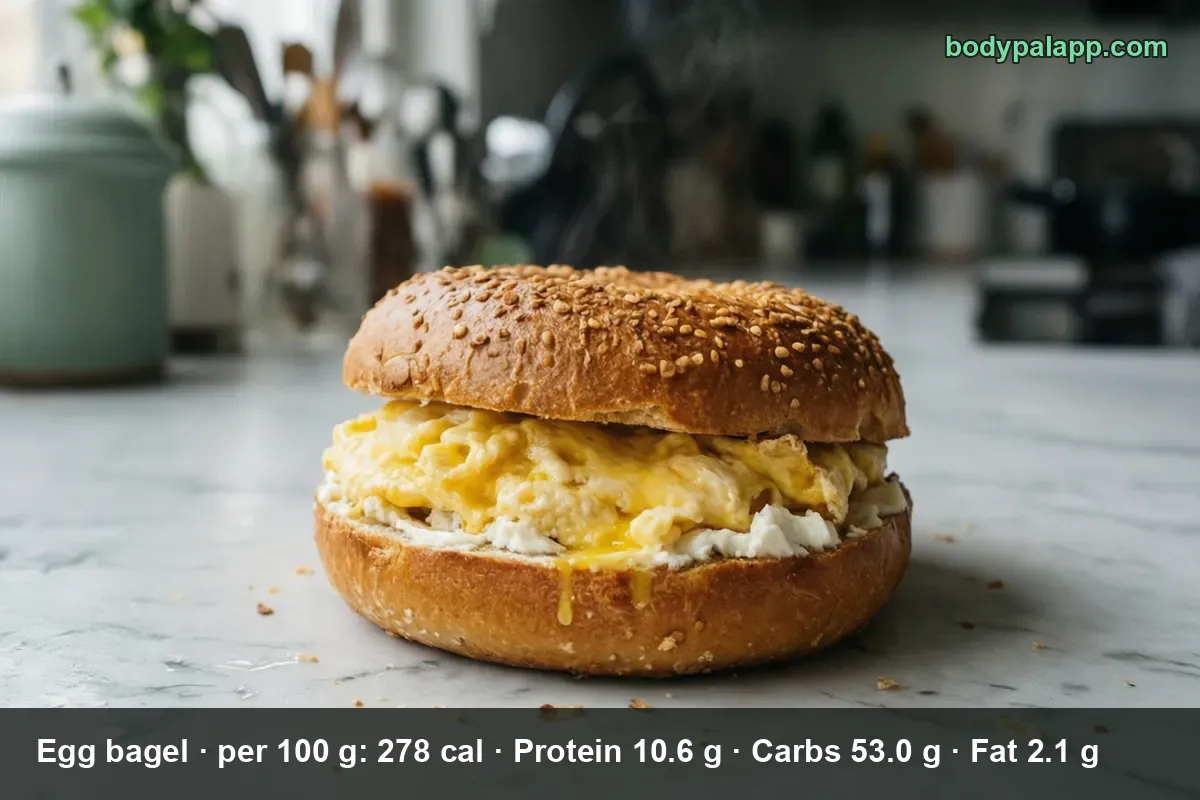
The photograph at the top of this page shows an egg bagel split and filled with scrambled eggs, because that is how most people eat one. The 292-calorie figure is not that sandwich. It is the bread you are holding before the first spoonful goes on, and the sandwich versions get their own numbers further down.
| Nutrient | Per 100 g | Per 1 medium bagel (105 g) | % Daily Value |
|---|---|---|---|
| Calories | 278 | 292 | 15% |
| Total fat | 2.1 g | 2.2 g | 3% |
| Saturated fat | 0.42 g | 0.4 g | 2% |
| Carbohydrate | 53 g | 55.7 g | 20% |
| Dietary fiber | 2.3 g | 2.4 g | 9% |
| Protein | 10.6 g | 11.1 g | 22% |
| Sodium | 505 mg | 530 mg | 23% |
% Daily Value is based on a 2,000-calorie diet.
Verified nutrition data
Numbers on this page come from USDA FoodData Central, the U.S. Department of Agriculture’s food composition database, and from manufacturer labels where a branded product is named. Last verified September 2026. How we verify our data →
There is no total sugars row and no added sugars row above, and no trans fat row either: this SR Legacy edition does not publish those values for egg bagels, so leaving them blank beats guessing. Cholesterol and potassium are published — 24 mg and 68 mg per 100 g, which works out to 25 mg of cholesterol (8% of the Daily Value) and 71 mg of potassium (2%) in a medium bagel. Daily Values follow the FDA nutrition labeling reference amounts.
The line worth staring at is total fat. Two point one grams per 100 g makes this one of the leanest breakfast breads in the database. Everything fatty about a bagel breakfast arrives afterward.
US servings from mini to large
| Serving | Weight | Calories |
|---|---|---|
| 1 mini bagel, 2-1/2" | 26 g | 72 kcal |
| 1 oz | 28 g | 79 kcal |
| 1 small bagel, 3" | 69 g | 192 kcal |
| 1 medium bagel, 3-1/2" to 4" | 105 g | 292 kcal |
| 1 large bagel, 4-1/2" | 131 g | 364 kcal |
| Per 100 g | 100 g | 278 kcal |
Every weight in that table is a USDA household measure tied to the diameter of the bagel, not our own estimate. The ounce row is USDA's too, at 28.35 g rounded to 28.
The spread is the whole story. A mini at 72 calories and a large at 364 are five times apart, and in a food diary both get typed as "a bagel." That single word is worth 292 calories of error at the extremes, which is more than most people's entire breakfast budget. If you buy from a bakery rather than a bag, put the bagel on a kitchen scale once and remember the number; bakery bagels frequently overshoot the 105 g medium.
Diameter is a fair proxy when there is no scale. Three inches is roughly the width of a coffee mug rim and lands near 192 calories. Four and a half inches covers most of a side plate and lands near 364.
Where the cream cheese fits
USDA's egg bagel record covers flour, egg and salt, so the schmear is not inside the 292. Our source data for this page carries no standalone USDA record for cream cheese, and rather than borrow a figure from memory we leave the spread unpriced here: weigh what comes out of the tub and log it as its own line.
One packaged product in the data does bundle the two. Bantam Bagels sells an egg bagel ball stuffed with cheddar cream cheese at 270 calories per 100 g, and the label serving of 1.3 oz (37 g) is 100 calories. That is a useful anchor, because it shows how little a small dose of cream cheese moves a bagel per gram: the stuffed ball sits at 270 calories per 100 g, just under the plain dough's 278, since a light filling in a small piece does not swing the ratio much. Scale the same spread onto a 105 g medium bagel and the arithmetic changes fast.
Store-brand egg bagels sit in a narrow band. Across the five plain US labels in our source set, density runs from 271 calories per 100 g for 1st National Bagel Company up to 303 for Kroger's Bakery Fresh Goodness everything egg bagels, with USDA's 278 sitting comfortably inside that range. The label piece varies more than the density does: Kroger's bagel is 99 g and 300 calories, while Lender's and Roundy's both label an 81 g bagel at 220 and 230 calories.
Egg bagel sandwiches and mini bagels

| Version | Per 100 g | Typical piece | Calories |
|---|---|---|---|
| Egg bagel, plain | 278 kcal | 1 medium bagel, 105 g | 292 kcal |
| Mini egg bagel | 278 kcal | 1 mini bagel, 26 g | 72 kcal |
| Egg bagel with scrambled egg | 251 kcal | 1 regular, 185 g | 464 kcal |
| Egg bagel with ham and egg | 238 kcal | 1 regular, 205 g | 488 kcal |
| Egg bagel with bacon and egg | 268 kcal | 1 regular, 200 g | 536 kcal |
| Egg bagel with sausage and egg | 274 kcal | 1 regular, 230 g | 630 kcal |
| Fast-food bagel with egg, sausage and cheese | 295 kcal | 1 item, 219 g | 646 kcal |
Read that table by the right-hand column, not the left. Filled bagels are less calorie-dense per gram than the plain bread in four of the five cases — the egg and ham carry water, and water weighs — yet every one of them costs more than the bagel alone, because the finished sandwich weighs roughly twice as much.
The filling also flips the fat profile. Plain dough is 2.1 g of fat per 100 g. The scrambled-egg version is 8.43 g per 100 g, four times as much, and the sausage build reaches 13.09 g. The dough never changed; the pan did.
Ham is the quiet swap. At 238 calories per 100 g it is the lightest build per gram in the table, and a 205 g ham-and-egg bagel at 488 calories comes in below the 200 g bacon version at 536 — but its sodium runs to 510 mg per 100 g against the plain bagel's 505, so you trade fat for salt rather than removing anything.
Minis deserve their own line. At 26 g and 72 calories each, two of them come to 144 calories, less than a small 3-inch bagel at 192. When the goal is the bagel experience on a budget, the mini is the lever, not a low-calorie spread.
Sodium is the row to watch
Cholesterol is what people expect to worry about with anything called an egg bagel, and it is a non-event: 25 mg in a medium bagel, 8% of the Daily Value. Sodium is the number that actually moves. One medium bagel is 530 mg, or 23% of the 2,300 mg Daily Value — about a quarter teaspoon of table salt, before the schmear, before the ham.
That is close to a quarter of the day's allowance in a food most people treat as a plain vehicle for toppings. Build it into a bacon-and-egg sandwich at 536 mg of sodium per 100 g and a 200 g sandwich reaches 1,072 mg, 47% of the daily figure on its own. If you are watching salt, the plain bagel with something unsalted on top is the better pick, and the fast-food builds are the worst of the group.
The good news on the same record: 11.1 g of protein per medium bagel is 22% of the Daily Value, unusually high for bread, and 2.4 g of fiber is 9%. MyPlate's grains guidance treats a bagel as roughly two ounce-equivalents of grain, so a medium one is already a third of a typical daily grain target.
How does an egg bagel compare?
| Breakfast item | Per 100 g | US serving | Calories |
|---|---|---|---|
| Egg bagel, plain | 278 kcal | 1 medium bagel, 105 g | 292 kcal |
| Egg sandwich on bagel | 251 kcal | 1 regular, 185 g | 464 kcal |
| Egg sandwich on bagel with bacon | 268 kcal | 1 regular, 200 g | 536 kcal |
| Fast-food bagel with egg, sausage and cheese | 295 kcal | 1 item, 219 g | 646 kcal |
Our take: the plain egg bagel is the cheapest serving in this group by a wide margin, yet only the fast-food build is denser per gram than it is. Density is the wrong lens for a bagel — portion size decides everything. If you want a bagel breakfast under 350 calories, buy the bread and control what goes on it; if you buy the assembled sandwich, the sausage-and-cheese version at 646 calories is more than double the bagel you started from. For a real breakfast that stays near 400, a medium bagel with a measured spread beats any of the ready-made builds on this table.
Most popular egg bagel brands in the United States
Ranked by how widely each product appears among foods sold in the United States, from the BodyPal food database of over 3.3 million products. Calories are the figures printed on each Nutrition Facts label, checked against USDA FoodData Central.
| Product | Calories (per 100 g) |
|---|---|
| Bakery Fresh Goodness Everything Egg Bagels | 303 cal |
| Roundy's Egg Bagels | 284 cal |
| Lender's Egg Bagels | 272 cal |
| Kroger Fresh Egg Bagels | 293 cal |
| 1st National Bagel Company Egg Bagels | 271 cal |
| Bantam Bagels Egg Bagel Stuffed with Cheddar Cream Cheese | 270 cal |
Brand popularity: BodyPal food database. Nutrition: manufacturer labels / USDA FoodData Central.
Egg bagel FAQs
How many calories are in an egg bagel with cream cheese?
The bagel is 292 calories before anything goes on it, and USDA's egg bagel record stops at the bread. The one cream-cheese figure in our source set is Bantam Bagels' egg bagel stuffed with cheddar cream cheese: 100 calories in a 37 g ball. Weigh your schmear and add it.
How many calories are in a plain egg bagel?
A plain egg bagel is 292 calories for a medium 3-1/2 to 4 inch piece weighing 105 g, or 278 calories per 100 g. A small 3-inch bagel is 192 calories and a 4-1/2 inch large is 364. Nothing on this page includes butter or spread.
How much protein is in an egg bagel?
A medium 105 g egg bagel carries 11.1 g of protein, which is 22% of the FDA Daily Value of 50 g. Per 100 g the dough runs 10.6 g. That is high for a bread, and it comes from the wheat and the egg in the dough rather than from any filling.
How many carbs are in an egg bagel?
A medium egg bagel has 55.7 g of carbohydrate, 20% of the 275 g Daily Value, with 2.4 g of that as fiber. Per 100 g the figure is 53 g. Carbohydrate is the big line on this food; fat is almost absent at 2.2 g per medium bagel.
How big is a medium bagel in grams?
USDA lists a medium bagel, 3-1/2 to 4 inches across, at 105 g. A small 3-inch is 69 g, a large 4-1/2 inch is 131 g and a mini 2-1/2 inch is 26 g. Bakery bagels often run heavier than the packaged piece, so weigh yours once.
How many calories are in a mini egg bagel?
A mini egg bagel, 2-1/2 inches across and 26 g, is 72 calories. That is one-fifth of a large 4-1/2 inch bagel at 364 calories. Minis are the easiest way to keep a bagel breakfast light, since two of them still land at only 144 calories together.
Does an egg bagel contain real egg?
Yes. USDA files the food as "Bagels, egg," and the record shows 24 mg of cholesterol per 100 g, or 25 mg in a medium bagel, which is 8% of the Daily Value. Plain wheat dough carries none. The egg is worked into the dough, not added as a filling.
How much sodium is in an egg bagel?
A medium egg bagel holds 530 mg of sodium, 23% of the 2,300 mg Daily Value and roughly a quarter teaspoon of table salt. Per 100 g the figure is 505 mg. That is before cream cheese, ham or bacon, each of which pushes the sandwich total higher.
Similar foods
- Pancake — 423 cal for 3 medium pancakes
- Crepe — 179 cal per crepe
- Toast with butter — 100 cal per slice with butter
- Omelet — 305 cal for 3-egg omelet
- Egg — 72 cal per large egg
- Syrian Bread — 157 cal per medium pita
Count it without the math
Point the camera at the plate and BodyPal counts the bagel for you, schmear and all.


How long does it take to burn off an egg bagel?
One medium bagel (105 g) is 292 kcal. Enter your weight and the amount you ate to see how long it takes you to burn that off:
lb
| Activity | Time to burn 292 kcal |
|---|---|
| Walking, brisk | 58 min |
| Cycling, moderate | 36 min |
| Swimming, moderate | 42 min |
| Jogging | 34 min |
| Weight training, moderate | 1 hr 5 min |
Times are for a 155 lb adult at a steady pace; change the weight to see yours. The amount is set to the portion in the text (105 g); change it to what you actually ate. BodyPal works this out from your steps automatically.
This table assumes you know your daily total. If you do not, the daily calorie calculator works it out from five numbers.