
How many calories are in an egg bagel?
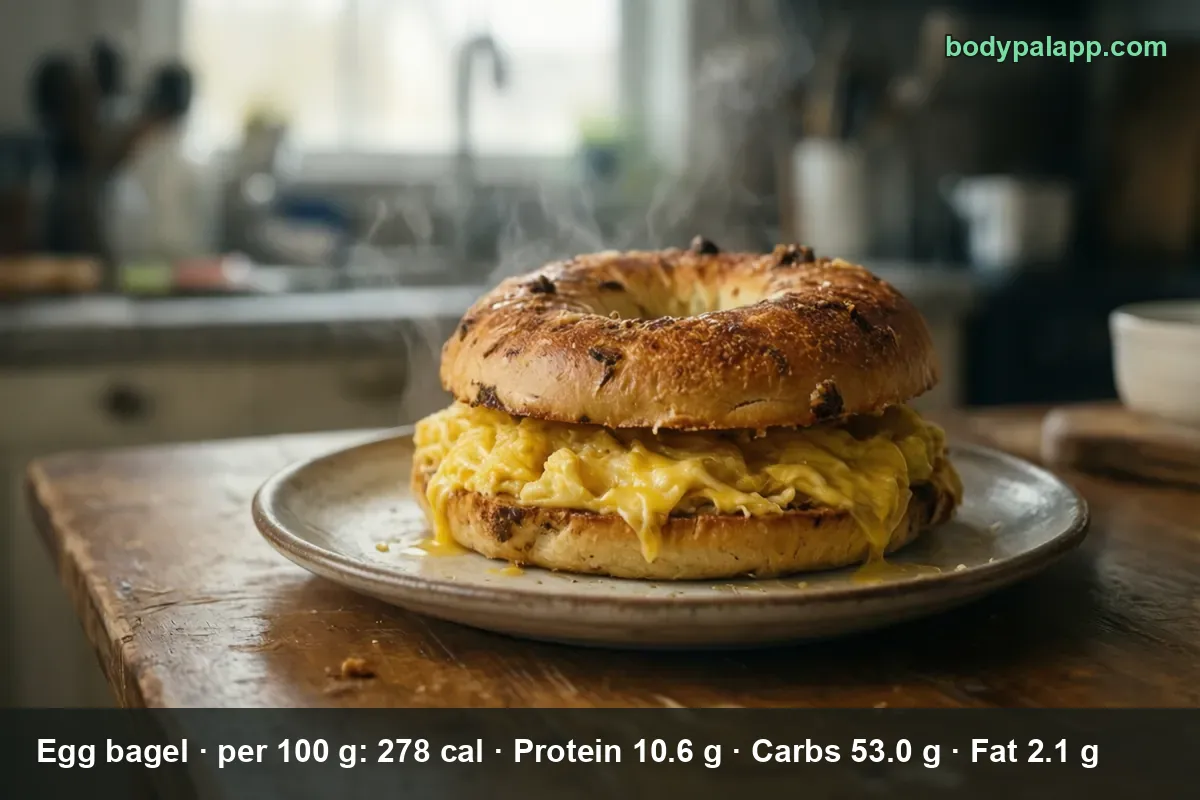
One medium egg bagel, the 3-1/2 to 4 inch kind off the bakery rack, weighs 105 g and carries 292 calories. Per 100 g the bread runs 278 calories. That is the bagel by itself. Split it and scramble eggs into it and the whole thing moves to 464.
On this page
- Egg bagel quick facts
- US servings, from a mini bagel to a large one
- Mini, large, and the egg bagel sandwich
- Sodium is the row to watch, not cholesterol
- How does an egg bagel compare?
- Most popular egg bagel brands
- Egg bagel FAQs
Egg bagel quick facts
The number people want is for the thing in their hand: the yellow-crumbed bagel itself, before cream cheese, before anything gets scrambled. That is USDA's SR Legacy record 174901, "Bagels, egg", and it is the row this page is built on. USDA also publishes several "Egg sandwich on bagel" records, but those are a filled sandwich, which is a different food with a different weight and a different answer. Those get their own section further down.
The medium column below is USDA's own household measure for this record, a 3-1/2 to 4 inch bagel at 105 g, not a size we invented.
| Nutrient | Per 100 g | Per 1 medium bagel (105 g) | % Daily Value |
|---|---|---|---|
| Calories | 278 | 292 | — |
| Total fat | 2.1 g | 2.2 g | 3% |
| Saturated fat | 0.42 g | 0.4 g | 2% |
| Carbohydrate | 53 g | 55.7 g | 20% |
| Dietary fiber | 2.3 g | 2.4 g | 9% |
| Protein | 10.6 g | 11.1 g | 22% |
| Sodium | 505 mg | 530 mg | 23% |
| Cholesterol | 24 mg | 25 mg | 8% |
| Potassium | 68 mg | 71 mg | 2% |
% Daily Value is based on a 2,000-calorie diet.
Verified nutrition data
Numbers on this page come from USDA FoodData Central, the U.S. Department of Agriculture’s food composition database, and from manufacturer labels where a branded product is named. Last verified September 2026. How we verify our data →
There is no sugar row here on purpose. The SR Legacy edition of record 174901 does not carry total sugars, added sugars or trans fat at all, so quoting a figure would mean borrowing one from a different food. Retail labels on egg bagels usually show a few grams of sugar from the dough, but that belongs to the brand, not to this record. The Daily Value percentages come from FDA's Daily Value reference.
Two rows are worth a second look before you scroll. Protein at 22% of a day's value is unusually high for something that reads as plain bread, and sodium at 23% is high for something you have not salted yet.
US servings, from a mini bagel to a large one
| Serving | Weight | Calories |
|---|---|---|
| 1 mini bagel, 2-1/2 in | 26 g | 72 kcal |
| 1 small bagel, 3 in | 69 g | 192 kcal |
| 1 medium bagel, 3-1/2 to 4 in | 105 g | 292 kcal |
| 1 large bagel, 4-1/2 in | 131 g | 364 kcal |
| 1 oz | 28.35 g | 79 kcal |
| Per 100 g | 100 g | 278 kcal |
The four bagel sizes are USDA household measures published with record 174901, so the diameters and the gram weights both come from the same place. The ounce line is our own arithmetic from the USDA 100 g figure, not a USDA serving, and it exists because a lot of people weigh a bagel on a kitchen scale in ounces rather than measuring it with a ruler.
Here is the trap, and it is the single most useful thing on this page. "One egg bagel" covers a 105 g bakery bagel at 292 calories and a 131 g deli-counter bagel at 364. Same three words on the tracking app, 72 calories apart. Over a five-day work week that gap is 360 calories, roughly a whole extra bagel, logged as nothing. Weigh yours once and you will know which size your usual store sells forever after.
Retail brands sit in the same neighborhood but not on the same number. Across six USDA Branded records for US supermarket egg bagels, the density runs from 246 to 303 calories per 100 g. Lender's egg bagels are 272 per 100 g and 220 for their 81 g label bagel; Kroger's Bakery Fresh Goodness Everything Egg Bagels are 303 per 100 g and 300 for a 99 g bagel. Albertsons prints half a bagel, 57 g, as one serving at 140 calories, so the Nutrition Facts panel on that package is describing half of what most people eat.
Mini, large, and the egg bagel sandwich

| Version | Per 100 g | Typical piece | Calories |
|---|---|---|---|
| Mini egg bagel | 278 kcal | 1 mini bagel (26 g) | 72 kcal |
| Large egg bagel | 278 kcal | 1 large bagel (131 g) | 364 kcal |
| Egg sandwich on bagel | 251 kcal | 1 regular (185 g) | 464 kcal |
| Egg sandwich on bagel, with ham | 238 kcal | 1 regular (205 g) | 488 kcal |
| Egg sandwich on bagel, with bacon | 268 kcal | 1 regular (200 g) | 536 kcal |
| Egg sandwich on bagel, with sausage | 274 kcal | 1 regular (230 g) | 630 kcal |
The mini is the quiet win. At 26 g and 72 calories it is a quarter of a medium bagel, and if the point of the bagel is the chew and the schmear rather than the volume, it does the same job for a quarter of the cost. Four minis, though, are 288 calories, which is a medium bagel with extra steps.
The filled sandwiches look strange on the 100 g column and it is worth explaining why. Egg sandwich on bagel is 251 calories per 100 g, lower than the bare bagel's 278, and the version with ham drops further to 238. Nothing is being made lighter. Eggs and ham are mostly water, so they dilute the density while adding weight, and weight is what you actually eat. One regular 185 g egg sandwich on a bagel is 464 calories, about 1.6 times a medium bagel. The sausage version at 230 g reaches 630, more than double the medium bagel. Density per 100 g is the wrong lens for a sandwich; total grams is the right one.
Bacon and sausage do most of that work through fat. The plain bagel is 2.1 g of fat per 100 g. The sausage sandwich is 13.09 g per 100 g, six times as fatty by density before you count the extra 125 g of sandwich.
Sodium is the row to watch, not cholesterol
The name says egg, so people expect cholesterol. There is some, and it is small: 25 mg in a medium bagel, 8% of the Daily Value. Egg solids go into the dough mainly for color and a softer crumb, and they show up more in the yellow tint than in the nutrition panel.
Salt is the row that matters. One medium egg bagel is 530 mg of sodium, 23% of the 2,300 mg Daily Value, or about a quarter teaspoon of table salt, before butter, cream cheese, deli meat or a pickle. A large bagel is around 662 mg. The Dietary Guidelines for Americans put 2,300 mg as the daily limit for adults, and breakfast bread quietly taking a quarter of it is the kind of thing that only shows up when you total the day.
The number that redeems the bagel is protein: 11.1 g in a medium, 22% of the Daily Value, mostly from wheat gluten rather than the egg. Fiber is thinner at 2.4 g, 9% of the Daily Value, because this is a refined-flour bread. If half your grains for the day are meant to be whole, as MyPlate suggests, the egg bagel is firmly in the other half. If you are watching sodium, the mini is the version that keeps the flavor and drops the salt to a rounding error.
How does an egg bagel compare?
| Food | Per 100 g | US serving | Calories |
|---|---|---|---|
| Egg bagel | 278 kcal | 1 medium bagel, 105 g | 292 kcal |
| Egg sandwich on bagel | 251 kcal | 1 regular, 185 g | 464 kcal |
| Egg sandwich on bagel, with bacon | 268 kcal | 1 regular, 200 g | 536 kcal |
| Bagel with egg, sausage patty, cheese and condiments | 295 kcal | 1 item, 219 g | 646 kcal |
Our take: the bagel is not the problem, the build is. Of the four rows here, the plain egg bagel is the only one under 300 calories, and it is the second-densest per 100 g while being by far the lightest per serving. The counter-service item with sausage patty and cheese is 646 calories, more than twice a medium bagel, and it gets there mostly on 16.97 g of fat per 100 g against the bagel's 2.1 g. For weight loss, keep the bagel and change the topping, or drop to the small 69 g size at 192 calories. For a breakfast that holds until lunch, the plain egg sandwich on a bagel at 464 buys 22 g of protein for 172 calories more than the bare bagel, which is a better trade than the bacon version.
Most popular egg bagel brands in the United States
Ranked by how widely each product appears among foods sold in the United States, from the BodyPal food database of over 3.3 million products. Calories are the figures printed on each Nutrition Facts label, checked against USDA FoodData Central.
| Product | Calories (per 100 g) |
|---|---|
| Bakery Fresh Goodness Everything Egg Bagels | 303 cal |
| Roundy's Egg Bagels | 284 cal |
| Lender's Egg Bagels | 272 cal |
| Kroger Fresh Egg Bagels | 293 cal |
| Albertsons Egg Bagel | 246 cal |
| 1st National Bagel Company Egg Bagels | 271 cal |
Brand popularity: BodyPal food database. Nutrition: manufacturer labels / USDA FoodData Central.
Egg bagel FAQs
How many calories are in an egg bagel?
A medium egg bagel, 3-1/2 to 4 inches across and about 105 g, has 292 calories. The USDA figure for the bread is 278 calories per 100 g, so a smaller 69 g bakery bagel lands at 192 and a 131 g deli-counter one at 364. Nothing spread on top is included.
How many calories in a large egg bagel?
A large egg bagel, 4-1/2 inches across at 131 g, is 364 calories. That is 72 more than the medium 105 g bagel, and both get called one bagel on a menu board. Weigh yours once: the gap between the two sizes is a quarter of the medium bagel's whole total.
How much protein is in an egg bagel?
A medium 105 g egg bagel has 11.1 g of protein, 22% of the Daily Value, from 10.6 g per 100 g. That is high for bread, and most of it comes from wheat gluten rather than from the egg. A large 131 g bagel pushes the figure to about 13.9 g.
How many carbs are in an egg bagel?
A medium egg bagel carries 55.7 g of carbohydrate, 20% of the Daily Value, with 2.4 g of that as fiber. Per 100 g the bread is 53 g of carbs. A large one reaches about 69.4 g, a quarter of a day's Daily Value from one piece of bread.
How many calories in a Lender's egg bagel?
Lender's egg bagels are listed at 272 calories per 100 g in USDA's Branded database, and the label serving of one 81 g bagel is 220 calories. That is lighter than a bakery medium at 292 because the frozen bagel is smaller, not because the recipe itself is any leaner.
How many calories in an egg sandwich on a bagel?
One regular egg sandwich on a bagel, 185 g, is 464 calories. Per 100 g it is 251, lower than the plain egg bagel's 278, because eggs bring water with them. Add bacon and a 200 g sandwich hits 536 calories; the sausage version at 230 g reaches 630.
Does an egg bagel contain real egg?
Yes, and the cholesterol row shows it: 25 mg in a medium 105 g bagel, 8% of the Daily Value. Egg yolk and egg solids go into the dough, which is what gives the crumb its yellow tint. The amount is small enough to change color and softness more than nutrition.
How much sodium is in an egg bagel?
A medium egg bagel has 530 mg of sodium, 23% of the 2,300 mg Daily Value, or about a quarter teaspoon of table salt. Per 100 g the bread is 505 mg, and a large 131 g bagel is around 662 mg. Anything salty spread on top adds to that.
Similar foods
- Pancake — 423 cal for 3 medium pancakes
- Crepe — 179 cal per crepe
- Toast with butter — 100 cal per slice with butter
- Omelet — 305 cal for 3-egg omelet
- Egg — 72 cal per large egg
- Syrian Bread — 157 cal per medium pita
Count it without the math
Point the camera at the plate and BodyPal counts the bagel for you, size and filling included.


How long does it take to burn off egg bagel?
One medium bagel (105 g) is 292 kcal. Enter your weight and the amount you ate to see how long it takes you to burn that off:
lb
| Activity | Time to burn 292 kcal |
|---|---|
| Walking, brisk | 58 min |
| Cycling, moderate | 36 min |
| Swimming, moderate | 42 min |
| Jogging | 34 min |
| Weight training, moderate | 1 hr 5 min |
Times are for a 155 lb adult at a steady pace; change the weight to see yours. The amount is set to the portion in the text (105 g); change it to what you actually ate. BodyPal works this out from your steps automatically.
One food is easy to picture; a whole day is harder. See how many calories you need a day and what a deficit actually looks like.