
How many calories are in egg bake?
A 1-cup serving of egg bake weighs 164 g and carries 287 calories. Per 100 g the dish runs 175 calories, lighter than plain baked eggs with fat added, which is the first surprise. The cup also delivers 18.7 g of protein and 689 mg of sodium, and that sodium is the number worth watching.
On this page
- Egg bake quick facts
- US servings, from one ounce to a full cup
- Baked eggs, custard and frozen bites
- Sodium is the row to watch
- How does egg bake compare?
- Most popular egg bake brands
- Egg bake FAQs
Egg bake quick facts
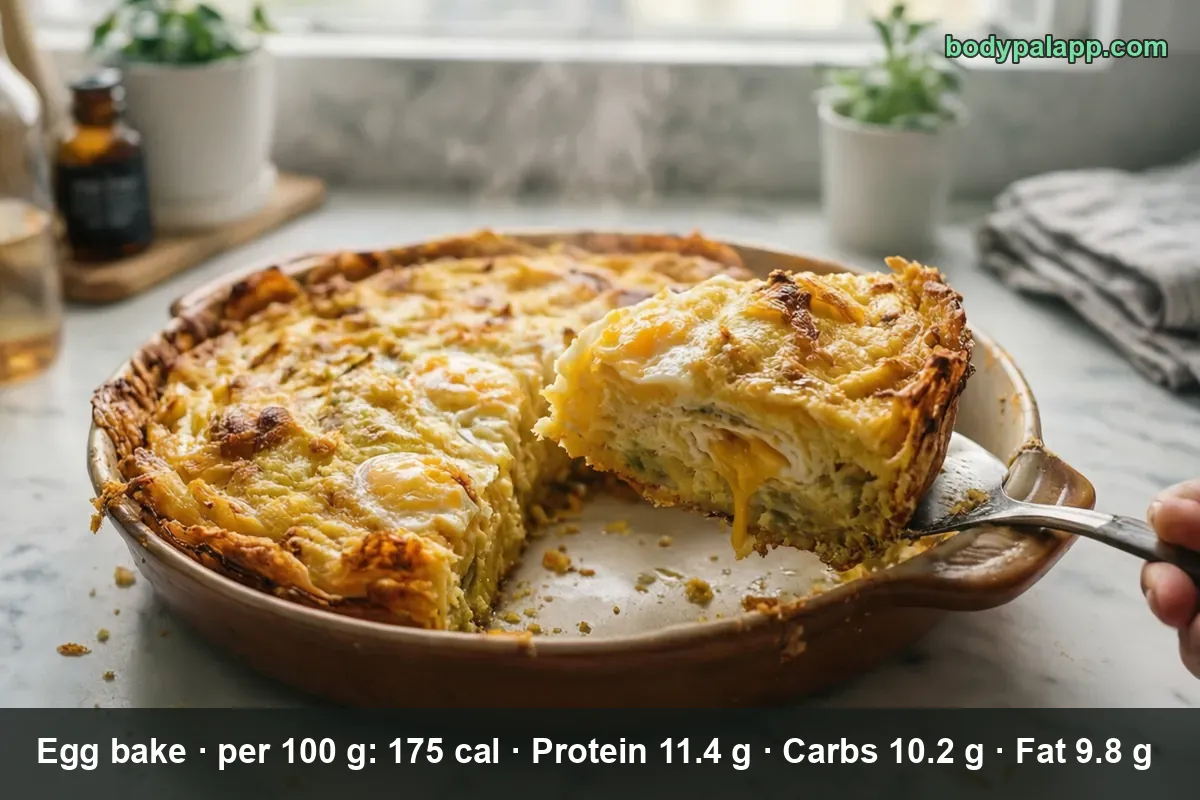
An American egg bake is not baked eggs. It is a casserole: eggs and milk poured over torn bread, then cheese and a breakfast meat, baked until it sets. The USDA record that matches that plate is FNDDS 2707192, "Egg casserole with bread, cheese, milk and meat", and every number on this page comes from it unless another record is named.
The records called "Egg, whole, baked" describe eggs cooked alone, with no bread and no milk. They are a different food with almost no carbohydrate, so they sit further down the page as a comparison rather than as the headline.
| Nutrient | Per 100 g | Per 1 cup (164 g) | % Daily Value |
|---|---|---|---|
| Calories | 175 | 287 | — |
| Total fat | 9.75 g | 16.0 g | 20% |
| Saturated fat | 3.9 g | 6.4 g | 32% |
| Carbohydrate | 10.22 g | 16.8 g | 6% |
| Dietary fiber | 0.4 g | 0.7 g | 2% |
| Total sugars | 2.77 g | 4.5 g | — |
| Protein | 11.43 g | 18.7 g | 37% |
| Sodium | 420 mg | 689 mg | 30% |
% Daily Value is based on a 2,000-calorie diet.
Verified nutrition data
Numbers on this page come from USDA FoodData Central, the U.S. Department of Agriculture’s food composition database, and from manufacturer labels where a branded product is named. Last verified September 2026. How we verify our data →
Two rows you would expect on a packaged label are missing here: added sugars and trans fat. USDA does not publish either value for this mixed-dish record, so they are left out rather than guessed. The 4.5 g of total sugars in a cup is mostly milk sugar, not anything anyone stirred in.
Cholesterol and potassium are worth naming in passing. A cup carries 187 mg of cholesterol, 62% of the Daily Value, and 302 mg of potassium, 6%. Both follow from the eggs, and both are lower per cup than you would expect, for the reason set out below.
US servings, from one ounce to a full cup
| Serving | Weight | Calories |
|---|---|---|
| 1 cubic inch | 11.8 g | 21 kcal |
| 1 oz | 28 g | 49 kcal |
| 1/2 cup | 82 g | 144 kcal |
| 1 cup | 164 g | 287 kcal |
| Per 100 g | 100 g | 175 kcal |
The cup and the cubic inch are USDA household measures for this record. The half cup and the ounce are our own arithmetic from the USDA 100 g figure, not USDA servings, which is why they land on tidy round weights.
Most home cooks do not serve egg bake by the cup, though. They cut a pan into squares. A 9-by-13-inch pan divided eight ways gives pieces that weigh close to a cup each, so 287 calories is a fair number for a generous square; cut the same pan twelve ways and you are near 190. Both of those are scaled from the 175-calories-per-100-g figure rather than measured, so treat them as a range and not a label.
The one-ounce line is there for a reason. Egg bake is a dish people go back to, and each extra ounce of leftovers scraped from the corner of the dish is another 49 calories. Three small return trips cost as much as a second half cup.
Baked eggs, custard and frozen bites

| Version | Per 100 g | Typical piece | Calories |
|---|---|---|---|
| Egg bake with bread, cheese, milk and meat | 175 kcal | 1 cup (164 g) | 287 kcal |
| Baked whole eggs, fat added | 185 kcal | 1 cup (135 g) | 250 kcal |
| Baked whole eggs, no added fat | 143 kcal | 1 cup (135 g) | 193 kcal |
| Baked eggs, unspecified fat | 185 kcal | 1 egg (55 g) | 102 kcal |
| Baked egg custard, sweet | 104 kcal | 1/2 cup (141 g) | 147 kcal |
| Frozen egg bake bites, turkey sausage and cheddar | 211 kcal | 1 bite (57 g) | 120 kcal |
Baked whole eggs with fat added run 185 calories per 100 g, more per gram than the egg bake, and yet a cup of them comes in at 250, below the 287 of the egg bake. Eggs alone are loose in the cup. A set casserole is not.
Skip the added fat and baked whole eggs fall to 143 calories per 100 g and 193 a cup, the lightest cup on the page. That single change, no butter or oil in the dish, is worth more than any topping swap in the casserole.
Sweet baked egg custard is the outlier at 104 calories per 100 g. Sugar and extra milk replace the cheese, bread and meat, and the whole thing gets lighter, not heavier, which surprises most people. Its half-cup serving of 147 calories is close to a half cup of egg bake at 144.
The frozen aisle version, Sunny Fresh egg bake bites with turkey sausage and cheddar, runs 211 calories per 100 g in a 57 g bite of 120 calories. Denser per gram than anything homemade in the table, because there is no bread padding the volume out.
Sodium is the row to watch
Egg bake is a protein win. A cup covers 18.7 g, 37% of the Daily Value, from a breakfast most people finish in five minutes. MyPlate counts eggs as a protein food, and this dish stacks cheese and meat on top of them.
The sodium is where it turns. One cup is 689 mg, 30% of the 2,300 mg Daily Value the FDA sets on the Nutrition Facts label, or roughly a third of a teaspoon of table salt. A cup of plain baked eggs with fat added is 335 mg, less than half of it. The eggs are innocent here; the bread, the cheese and the breakfast sausage brought the salt. If you are watching sodium, this is the dish to make with unsalted bread and half the meat, not the dish to shrink by an ounce.
Saturated fat behaves the same way. A cup is 6.4 g, 32% of the Daily Value, and most of it comes from the cheese and the meat rather than the yolks.
Cholesterol runs the other direction, which almost nobody expects. A cup of egg bake carries 187 mg, 62% of the Daily Value. A cup of baked whole eggs with fat added carries 524 mg, 175%. The bread and milk are dilution: they take up room the yolks would otherwise fill, so the casserole is the lower-cholesterol way to eat a cup of eggs even though it is the higher-calorie one.
How does egg bake compare?
| Dish | Per 100 g | US serving | Calories |
|---|---|---|---|
| Egg bake with bread, cheese and meat | 175 kcal | 1 cup, 164 g | 287 kcal |
| Baked whole eggs, fat added | 185 kcal | 1 cup, 135 g | 250 kcal |
| Baked whole eggs, no added fat | 143 kcal | 1 cup, 135 g | 193 kcal |
| Baked egg custard, sweet | 104 kcal | 1/2 cup, 141 g | 147 kcal |
Our take: for weight loss, baked whole eggs with no added fat are the pick at 193 calories a cup, and they still carry more protein per 100 g than the casserole does. For staying full until lunch, the egg bake earns its 287, because 18.7 g of protein and a bulky, chewy texture beat 250 calories of loose eggs on the same plate. What the casserole does not deserve is a second helping: cup two puts you at 574 calories and 1,378 mg of sodium, which is 60% of a day of salt before noon. Cut the pan into squares before it reaches the table and the decision is already made.
Most popular egg bake brands in the United States
Ranked by how widely each product appears among foods sold in the United States, from the BodyPal food database of over 3.3 million products. Calories are the figures printed on each Nutrition Facts label, checked against USDA FoodData Central.
| Product | Calories (per 100 g) |
|---|---|
| Sunny Fresh Egg Bake Bites with Turkey Sausage & Cheddar | 211 cal |
Brand popularity: BodyPal food database. Nutrition: manufacturer labels / USDA FoodData Central.
Egg bake FAQs
How many calories in 1 cup of egg bake?
One cup of egg bake weighs 164 g and carries 287 calories. Per 100 g the dish runs 175 calories, so the cup is the heavier way to eat it. That cup also brings 18.7 g of protein, 16.8 g of carbohydrate and 16.0 g of fat.
How many calories are in a slice of egg bake?
A slice cut eight to a 9-by-13-inch pan lands between 144 and 287 calories, depending on how deep the bake is; that is our own arithmetic from the USDA 100 g figure of 175 calories, not a USDA serving. Half a cup, 82 g, is 144.
How much protein is in egg bake?
18.7 g of protein in a 1-cup (164 g) serving, 37% of the Daily Value. Per 100 g that is 11.43 g. The eggs do most of the work, with cheese and meat adding the rest, which is why an egg bake outruns most cereal breakfasts.
Is egg bake high in sodium?
Yes: 689 mg in one cup, 30% of the 2,300 mg Daily Value, and about a third of a teaspoon of table salt. A cup of plain baked eggs with fat added is 335 mg. The bread, cheese and breakfast meat carry the salt, not the eggs.
How many carbs are in egg bake?
16.8 g of carbohydrate in a 1-cup (164 g) serving, 6% of the Daily Value, of which 4.5 g is sugars and 0.7 g fiber. The bread and milk supply almost all of it; plain baked eggs sit at 0.91 g per 100 g.
Is egg bake good for weight loss?
A cup at 287 calories with 18.7 g of protein is a workable breakfast if you keep the portion to a cup; half a cup is 144. Protein and volume help with fullness, but 16.0 g of fat a cup adds up fast when seconds appear.
Egg bake vs baked eggs: which has fewer calories?
Per cup, egg bake is heavier: 287 calories against 250 for baked whole eggs with fat added and 193 with no added fat. Per 100 g the order flips, because egg bake is 175 and plain baked eggs with fat are 185. Cup size decides it.
How many calories in a frozen egg bite?
120 calories for one 57 g Sunny Fresh egg bake bite with turkey sausage and cheddar, which is 211 calories per 100 g. Two bites, 114 g, come to 240. The frozen bites are denser than a homemade cup because there is no bread bulking them out.
Similar foods
- Omelet — 305 cal for 3-egg omelet
- Egg — 72 cal per large egg
- Crepe — 179 cal per crepe
- Pancake — 423 cal for 3 medium pancakes
- Toast with butter — 100 cal per slice with butter
- Shrimp Tempura Roll — 432 cal per roll, 8 pieces
Count it without the math
Point the camera at the pan and BodyPal counts the square you actually cut, cheese and all.


How long does it take to burn off egg bake?
A 1-cup (164 g) serving is 287 kcal. Enter your weight and the amount you ate to see how long it takes you to burn that off:
lb
| Activity | Time to burn 287 kcal |
|---|---|
| Walking, brisk | 57 min |
| Cycling, moderate | 36 min |
| Swimming, moderate | 41 min |
| Jogging | 34 min |
| Weight training, moderate | 1 hr 4 min |
Times are for a 155 lb adult at a steady pace; change the weight to see yours. The amount is set to the portion in the text (164 g); change it to what you actually ate. BodyPal works this out from your steps automatically.
This table assumes you know your daily total. If you do not, the daily calorie calculator works it out from five numbers.