
How many calories are in eggs Benedict?
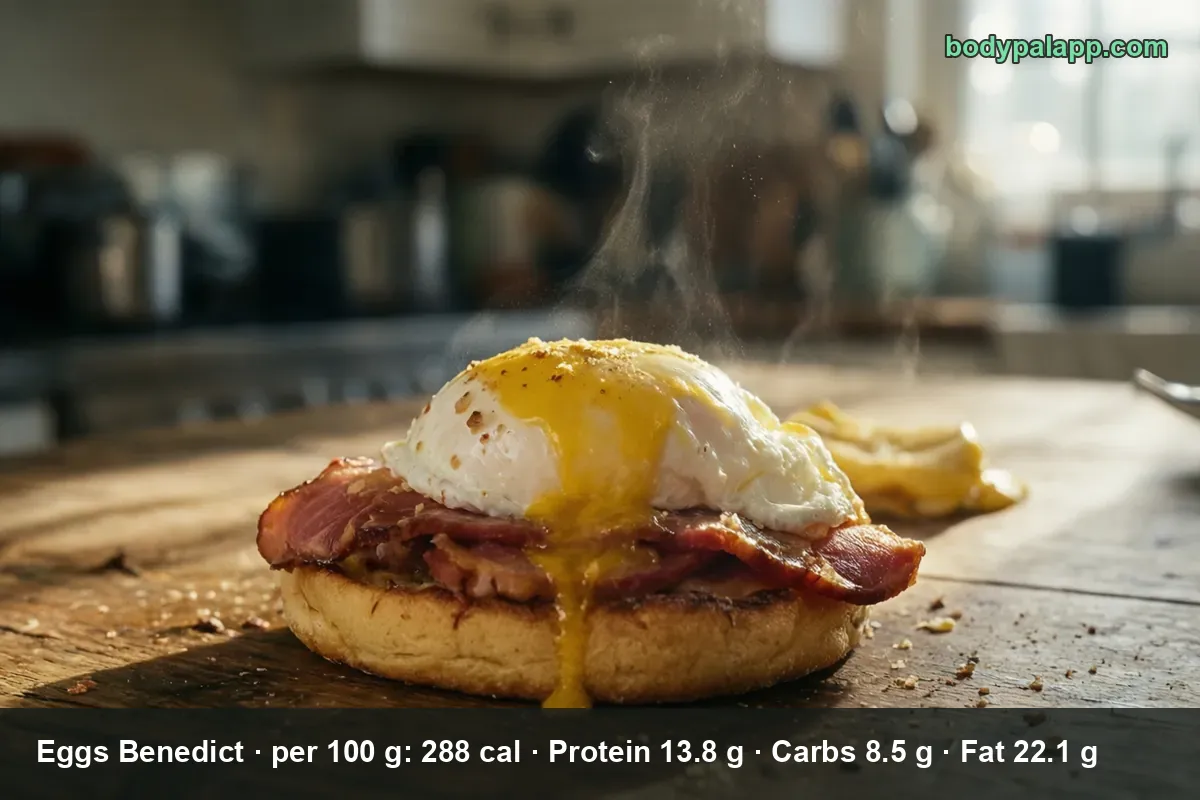
One eggs Benedict weighs 155 g and carries 446 calories. Per 100 g the assembled dish runs 288 calories, counting the poached egg, the ham, half an English muffin and the hollandaise poured over all of it. Order the usual two and the plate alone is 893 calories, before a single home fry.
On this page
- Eggs Benedict quick facts
- US servings from one ounce to a two-egg plate
- Eggs Benedict variants and nearby egg dishes
- Saturated fat and cholesterol are the rows to watch
- How does eggs Benedict compare?
- Most popular eggs benedict brands
- FAQ
Eggs Benedict quick facts
There is exactly one USDA record for the finished dish, and it is the one this page uses: FNDDS 2707180, "Egg, Benedict", from the 2021-2023 survey release. It describes what lands in front of you at brunch, sauce included, rather than an egg on its own. That matters more here than with most foods, because the hollandaise and the muffin are where the calories hide. The other egg records in the same USDA category describe an egg on its own - a yolk, an omelet, a duck egg - and none of them can stand in for a plated dish.
The USDA household portion for this record is "1 egg" at 155 g. That is one muffin half, one egg, one slice of ham and the sauce on top. Most restaurants serve two of those as an order, which is the arithmetic further down the page.
| Nutrient | Per 100 g | Per 1 egg Benedict (155 g) | % Daily Value |
|---|---|---|---|
| Calories | 288 | 446 | — |
| Total fat | 22.1 g | 34.3 g | 44% |
| Saturated fat | 10.25 g | 15.9 g | 79% |
| Carbohydrate | 8.48 g | 13.1 g | 5% |
| Dietary fiber | 0.6 g | 0.9 g | 3% |
| Total sugars | 1.17 g | 1.8 g | — |
| Protein | 13.81 g | 21.4 g | 43% |
| Sodium | 468 mg | 725 mg | 32% |
| Cholesterol | 271 mg | 420 mg | 140% |
| Potassium | 325 mg | 504 mg | 11% |
% Daily Value is based on a 2,000-calorie diet.
Verified nutrition data
Numbers on this page come from USDA FoodData Central, the U.S. Department of Agriculture’s food composition database, and from manufacturer labels where a branded product is named. Last verified September 2026. How we verify our data →
Two rows you would see on a packaged label are missing here on purpose. USDA does not publish added sugars or trans fat for this record, so those lines are left out rather than guessed. Everything else is reported straight from the record, including the cholesterol and potassium figures, which are the two most interesting numbers on the whole panel.
US servings from one ounce to a two-egg plate
| Serving | Weight | Calories |
|---|---|---|
| 1 oz | 28 g | 82 kcal |
| One egg Benedict, USDA household serving | 155 g | 446 kcal |
| Two eggs Benedict, a full restaurant order | 310 g | 893 kcal |
| Per 100 g | 100 g | 288 kcal |
Only the 155 g line is a USDA household measure. The two-egg plate and the ounce are our own arithmetic from the USDA 100 g figure, not USDA servings, which is why they are worth stating out loud: nothing about the sauce or the muffin changes when you double it, so doubling the number is honest here in a way it would not be for, say, a shared pizza.
That two-egg figure is the one worth remembering. A brunch menu almost never sells you a single eggs Benedict. If you log "eggs Benedict" and pick a single serving out of habit, you are 447 calories short of what you actually ate. Cups and ounces are not much use for this dish either. It is counted in eggs, so count it in eggs.
Eggs Benedict variants and nearby egg dishes
| Version | Per 100 g | Typical serving | Calories |
|---|---|---|---|
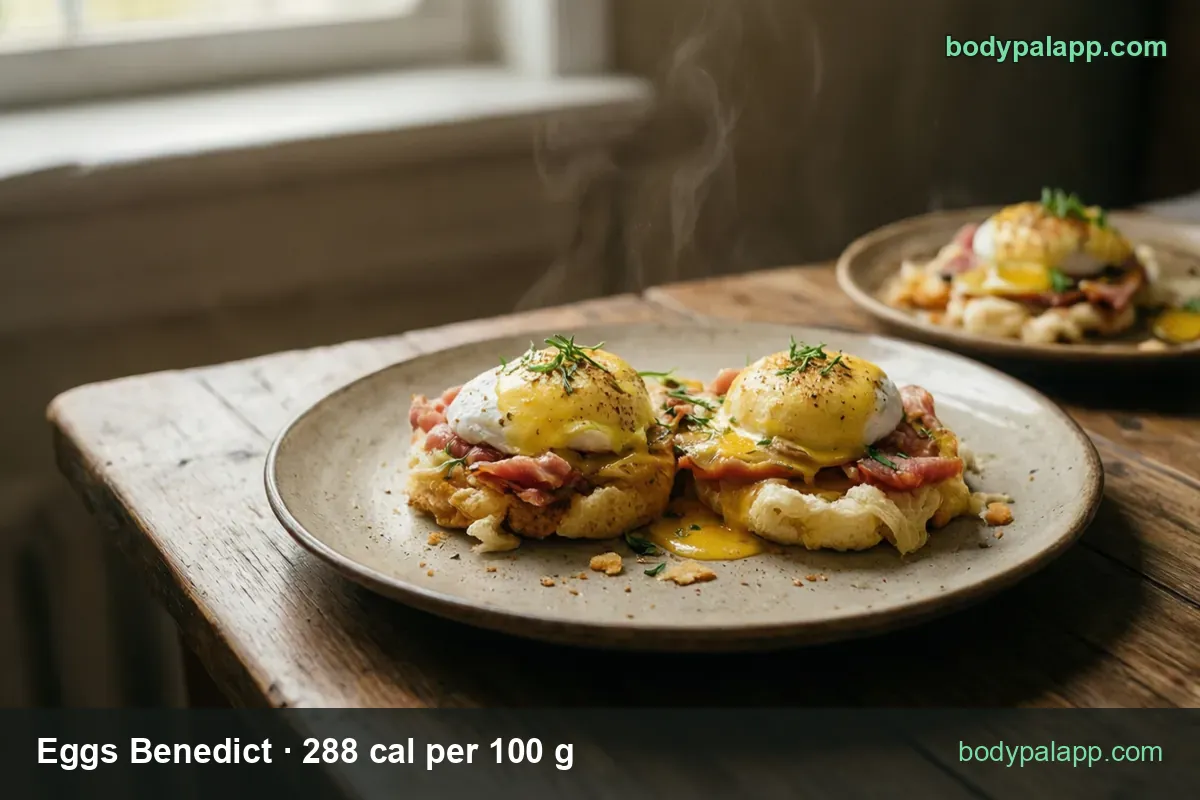
| Classic eggs Benedict, one egg | 288 kcal | one egg, 155 g | 446 kcal |
| Two-egg plate, restaurant order | 288 kcal | two eggs, 310 g | 893 kcal |
| Omelet with cheese and meat, made with oil | 215 kcal | 1 oz, 28 g | 61 kcal |
| Egg salad made with mayonnaise | 257 kcal | 1 oz, 28 g | 73 kcal |
| Cooked egg yolk, no added fat | 327 kcal | 1 oz, 28 g | 93 kcal |
The classic and the two-egg plate share the same USDA record and the same density of 288 calories per 100 g, so the only variable is how many eggs the kitchen puts down. USDA does not publish a separate record for a hollandaise-free version, or for a salmon or spinach swap, so this page does not invent numbers for them. What it can tell you is where the fat sits: the omelet, which is egg plus cheese plus meat cooked in oil, comes in at 215 calories per 100 g, a quarter lighter per gram than the Benedict even with cheese in it. The muffin and the butter-based sauce account for that gap.
Egg salad with mayonnaise lands at 257 calories per 100 g, still under the Benedict, and a cooked yolk on its own is the densest thing on the list at 327. That last one is a useful sanity check: yolks are calorie-dense, but a single yolk is small. A plated dish built around one is not.
Saturated fat and cholesterol are the rows to watch
The calorie count is not the interesting part of this breakfast. At 446 calories, one eggs Benedict is a perfectly ordinary meal, around 22% of a 2,000-calorie day. Look one row down instead. Saturated fat is 15.9 g in that single serving, or 79% of the FDA Daily Value of 20 g. Order two and you are at 31.8 g, which is 159% of a full day, at breakfast. The Dietary Guidelines for Americans suggest keeping saturated fat under 10% of daily calories, and a two-egg plate on its own passes that line for a 2,000-calorie day.
Cholesterol is the other standout: 420 mg in one serving, 140% of the 300 mg Daily Value, and 840 mg for two. Between the yolk and the egg yolks in the hollandaise, this is one of the highest cholesterol readings you will find in a normal restaurant breakfast.
Sodium is quieter but adds up the same way. One serving is 725 mg, 32% of the 2,300 mg Daily Value, roughly a third of a teaspoon of table salt. The ham and the sauce carry almost all of it, and a two-egg order is 1,450 mg, about 63% of the day, before anyone reaches for the shaker or the side of fries.
There is a genuine upside in the same column. Protein is 21.4 g per serving, 43% of the Daily Value, and 42.8 g for a two-egg plate. That is a strong showing for a breakfast, and MyPlate counts eggs among its protein foods for exactly this reason. If satiety is what you are buying, eggs Benedict delivers it. If you are watching saturated fat, the sauce is the part to ask them to go light on.
How does eggs Benedict compare?
| Dish | Per 100 g | US serving | Calories |
|---|---|---|---|
| Eggs Benedict | 288 kcal | one egg, 155 g | 446 kcal |
| Omelet with cheese and meat, made with oil | 215 kcal | 1 oz, 28 g | 61 kcal |
| Egg salad made with mayonnaise | 257 kcal | 1 oz, 28 g | 73 kcal |
| Cooked egg yolk, no added fat | 327 kcal | 1 oz, 28 g | 93 kcal |
Our take: of these four, only the plain cooked yolk is denser per gram than eggs Benedict, and nobody eats a plate of yolks. For a weight-loss breakfast, the omelet with cheese and meat is the better order at 215 calories per 100 g, and it gets you nearly the same protein per 100 g, 13.26 g against 13.81 g, without the muffin underneath. For a breakfast that has to hold you until 2 p.m., eggs Benedict is the one to pick and the price is the saturated fat, not the calories. Split the difference the way regulars do: one egg instead of two, sauce on the side, and you are at 446 calories with 21.4 g of protein, which is a defensible plate.
Most popular eggs benedict brands in the United States
Ranked by how widely each product appears among foods sold in the United States, from the BodyPal food database of over 3.3 million products. Calories are the figures printed on each Nutrition Facts label, checked against USDA FoodData Central.
| Product | Calories (per 100 g) |
|---|---|
| Urban Remedy Organic Benedict Brunch Cup | 150 cal |
| EVOL Smoked Uncured Ham Benedict | 127 cal |
| Urban Remedy The Benedict Brunch Bowl & Vegan Hollandaise | 127 cal |
| Kellogg's Chorizo Benedict Frozen Bowl | 125 cal |
Brand popularity: BodyPal food database. Nutrition: manufacturer labels / USDA FoodData Central.
Eggs Benedict FAQs
How many calories are in eggs Benedict?
446 calories for one eggs Benedict of 155 g, the USDA household serving for the assembled dish. Per 100 g it is 288 calories. That single portion is a poached egg, a slice of ham, half an English muffin and the hollandaise poured over the top.
How many calories in 2 eggs Benedict?
893 calories for two, the plate most diners actually order. That is 310 g at 288 calories per 100 g, our own arithmetic from the USDA figure rather than a listed USDA serving. Add hash browns or home fries and a 1,200-calorie breakfast arrives easily.
How much cholesterol is in eggs Benedict?
420 mg in one 155 g serving, which is 140% of the 300 mg Daily Value used on US labels. A two-egg plate carries 840 mg. The yolk and the hollandaise both contribute, and this is the highest percentage on the entire nutrition panel for this dish.
How much protein is in eggs Benedict?
21.4 g of protein in one serving, 43% of the 50 g Daily Value, from 13.81 g per 100 g. Two eggs Benedict give you 42.8 g, most of a day's Daily Value in a single breakfast. The egg and the ham do nearly all of that work.
How much sodium is in eggs Benedict?
725 mg in a single eggs Benedict, or 32% of the 2,300 mg Daily Value. The usual two-egg order is 1,450 mg, about 63% of the day. The ham and the salted sauce carry it, not the muffin. That works out to roughly a third of a teaspoon of table salt.
How many carbs are in eggs Benedict?
13.1 g of carbohydrate in one 155 g serving, only 5% of the Daily Value, from 8.48 g per 100 g. Almost all of it is the English muffin. Fiber is 0.9 g and total sugars are 1.8 g, so this is a low-carb breakfast by any normal standard.
Is eggs Benedict healthy?
One serving gives 21.4 g of protein for 446 calories, which is a genuinely good ratio. The rows to question are saturated fat at 15.9 g, 79% of the Daily Value, and cholesterol at 420 mg, 140%. If you are watching saturated fat, treat it as an occasional breakfast.
Eggs Benedict vs omelet: which has fewer calories?
Per 100 g the omelet with cheese and meat wins at 215 calories against 288 for eggs Benedict, roughly a quarter lighter per gram. The muffin and the butter-based hollandaise explain the gap. Per ounce that is 61 calories against 82, and the difference grows with plate size.
Similar foods
- Pancake — 423 cal for 3 medium pancakes
- Crepe — 179 cal per crepe
- Toast with butter — 100 cal per slice with butter
- Omelet — 305 cal for 3-egg omelet
- Egg — 72 cal per large egg
- Syrian Bread — 157 cal per medium pita
Count it without the math
Point the camera at the plate and BodyPal counts the eggs, the muffin and the sauce for you.


How long does it take to burn off eggs Benedict?
One egg Benedict (155 g) is 446 kcal. Enter your weight and the amount you ate to see how long it takes you to burn that off:
lb
| Activity | Time to burn 446 kcal |
|---|---|
| Walking, brisk | 1 hr 29 min |
| Cycling, moderate | 56 min |
| Swimming, moderate | 1 hr 4 min |
| Jogging | 52 min |
| Weight training, moderate | 1 hr 39 min |
Times are for a 155 lb adult at a steady pace; change the weight to see yours. The amount is set to the portion in the text (155 g); change it to what you actually ate. BodyPal works this out from your steps automatically.
One food is easy to picture; a whole day is harder. See how many calories you need a day and what a deficit actually looks like.