
How many calories are in egg casserole?
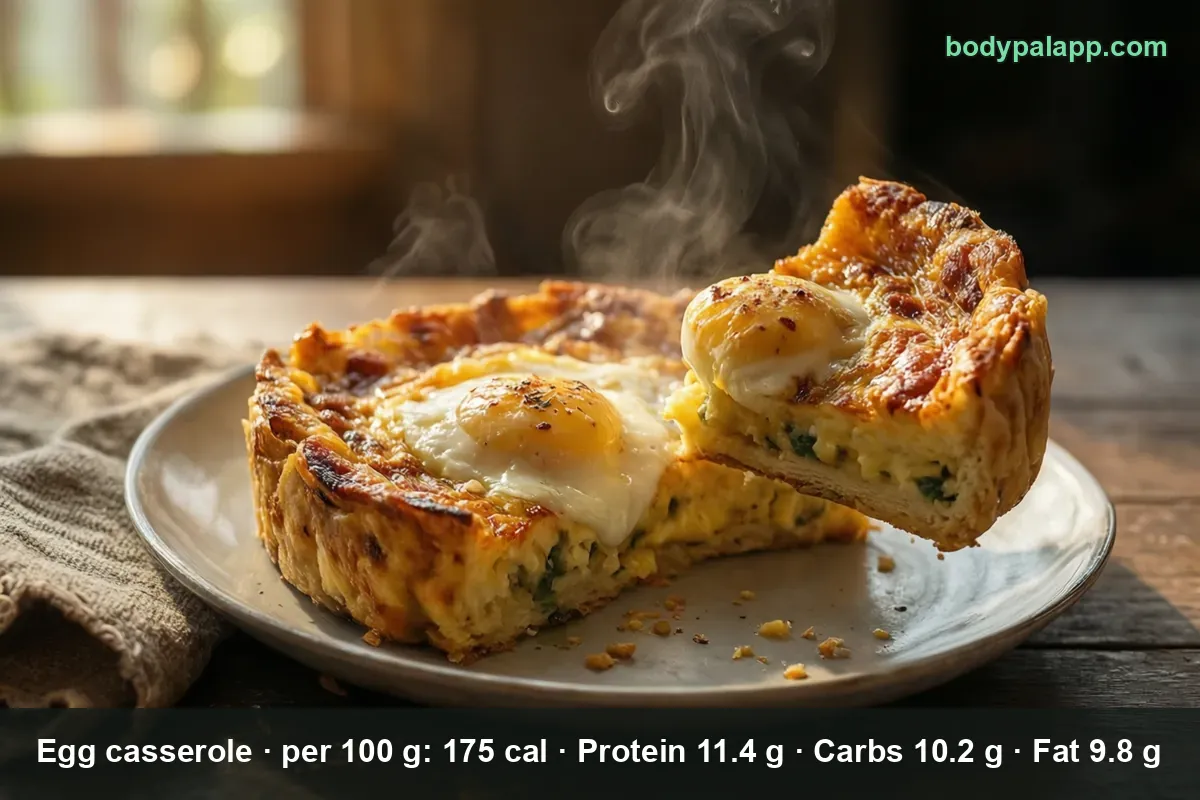
A 1-cup serving of egg casserole with bread, cheese, milk and meat weighs 164 g and carries 287 calories. Per 100 g the bake runs 175 calories, lighter per gram than most people guess for something built on cheese and sausage. The catch is not the calorie count. It is the 689 mg of sodium riding along.
On this page
- Egg casserole quick facts
- US servings from one cubic inch to a full cup
- Egg bake without bread and other close casseroles
- Sodium and cholesterol are the rows to watch
- How does egg casserole compare?
- Most popular egg casserole brands
- Egg casserole FAQs
Egg casserole quick facts
The record behind this page is FNDDS 2707192, "Egg casserole with bread, cheese, milk and meat", from the 2021–2023 survey release. It is the only USDA entry for the dish itself: eggs and milk poured over bread cubes, cheese and breakfast meat, then baked. Search FoodData Central for "egg casserole" and two eggplant casseroles surface as well, purely because of the letters they share with "egg." They are a different dinner and they sit further down this page.
Note what that description includes. The USDA row is already the meat version, so the numbers below are what a sausage or ham bake looks like, not a vegetarian one.
| Nutrient | Per 100 g | Per 1 cup (164 g) | % Daily Value |
|---|---|---|---|
| Calories | 175 | 287 | — |
| Total fat | 9.75 g | 16.0 g | 20% |
| Saturated fat | 3.9 g | 6.4 g | 32% |
| Carbohydrate | 10.22 g | 16.8 g | 6% |
| Dietary fiber | 0.4 g | 0.7 g | 2% |
| Total sugars | 2.77 g | 4.5 g | — |
| Protein | 11.43 g | 18.7 g | 37% |
| Sodium | 420 mg | 689 mg | 30% |
| Cholesterol | 114 mg | 187 mg | 62% |
| Potassium | 184 mg | 302 mg | 6% |
% Daily Value is based on a 2,000-calorie diet.
Verified nutrition data
Numbers on this page come from USDA FoodData Central, the U.S. Department of Agriculture’s food composition database, and from manufacturer labels where a branded product is named. Last verified September 2026. How we verify our data →
Two label rows are missing here on purpose. USDA does not publish added sugars or trans fat for this survey record, so those lines are left out rather than filled with a guess. The 4.5 g of total sugars in a cup is mostly lactose from the milk and cheese, and total sugars carry no Daily Value of their own — the FDA sets one only for added sugars.
US servings from one cubic inch to a full cup
| Serving | Weight | Calories |
|---|---|---|
| 1 cubic inch | 11.8 g | 21 kcal |
| 1 oz | 28.35 g | 50 kcal |
| 1 serving, USDA typical amount | 82 g | 144 kcal |
| 1 square piece, 3 x 3 x 1.5 in | 159 g | 278 kcal |
| 1 cup | 164 g | 287 kcal |
| Per 100 g | 100 g | 175 kcal |
The cup, the cubic inch and the 82 g typical amount are USDA household measures for this record. The ounce and the square piece are our own arithmetic from the USDA 100 g figure, not USDA servings.
That square is where most calorie counts go wrong. A piece cut 3 inches by 3 inches and 1.5 inches deep weighs about 159 g and lands at 278 calories — nine calories under a full packed cup. People log the cup as a real portion and the square as a modest one, and the pan does not agree. If you want a genuinely small serving, the USDA typical amount of 82 g at 144 calories is closer to half a square.
The other useful anchor is the ounce. At 50 calories per ounce, a casserole is roughly as dense as a scrambled egg, and every extra spoonful on the plate costs about what a bite of toast does.
Egg bake without bread and other close casseroles
| Version | Per 100 g | Typical cup | Calories |
|---|---|---|---|
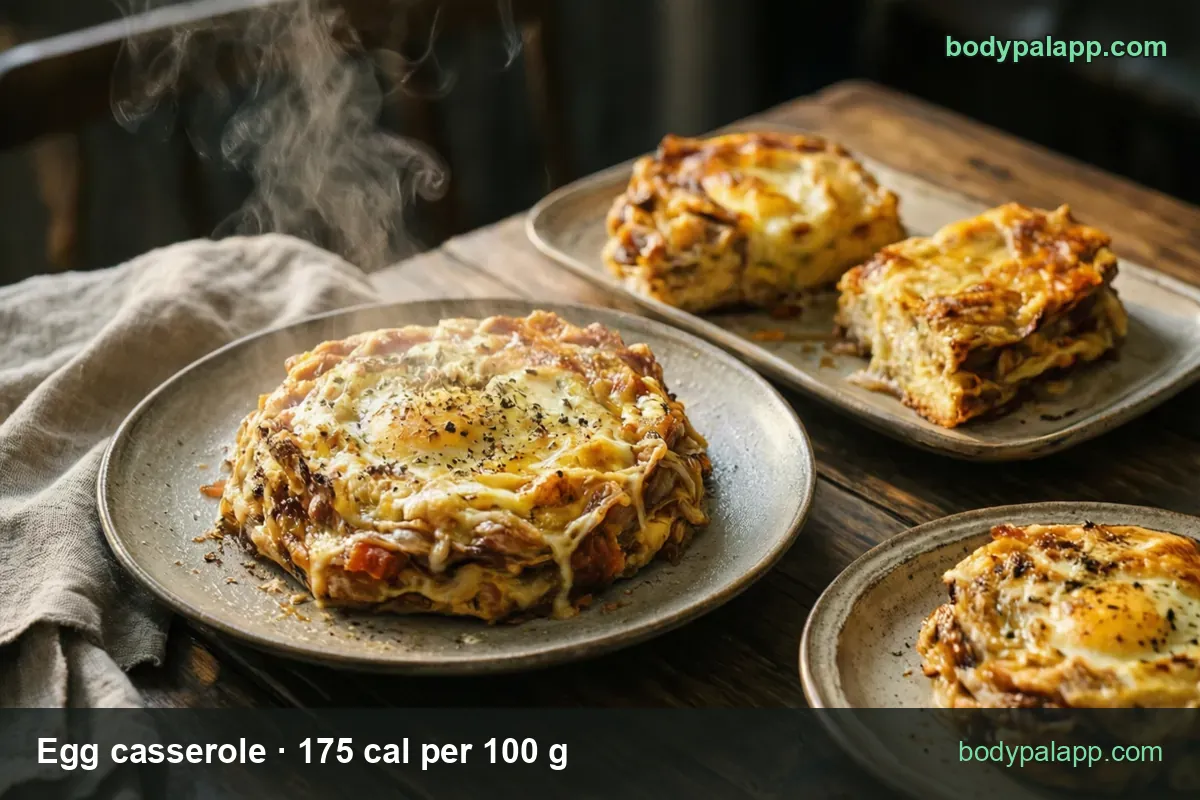
| Classic bake with bread, cheese, milk and meat | 175 kcal | 1 cup (164 g) | 287 kcal |
| Cheesy egg bake, no bread | 176 kcal | 1 cup (135 g) | 238 kcal |
| Plain baked eggs, no add-ins | 176 kcal | 1 cup (135 g) | 238 kcal |
| Eggplant parmesan casserole | 155 kcal | 1 cup (198 g) | 307 kcal |
| Eggplant and meat casserole | 96 kcal | 1 cup (203 g) | 195 kcal |
Skipping the bread does almost nothing per gram. The USDA row for baked egg with cheese is 176 calories per 100 g, one calorie above the bread version. What changes is how much a cup weighs: without the bread cubes holding air, a cup packs to about 135 g instead of 164 g, so it measures out at 238 calories.
The bread shows up in the carbohydrate row instead. Classic casserole runs 10.22 g of carbs per 100 g; plain cooked egg runs 0.92 g. Same energy, more than ten times the carbs, and 0.41 g less protein per 100 g. If you are cutting carbs at breakfast, the crustless egg bake is a real win. If you are cutting calories, it is not.
The two eggplant rows are a different dish entirely, filed near egg casserole only by alphabet. Eggplant parmesan casserole is 155 calories per 100 g but 307 per cup, because a cup of it weighs 198 g. The meat-and-eggplant version is the lightest thing in this table by a wide margin at 96 calories per 100 g — a vegetable base instead of an egg-and-cheese one.
Store-bought bakes sit right in the same band. Marie Callender's Comfort Bakes Egg, Cheese & Ham runs 147 calories per 100 g and Reser's Egg Carnitas Bake 150, both under the USDA homemade figure, while deli frittatas are denser: a Whole Foods Market Egg & Cheddar Frittata is 300 calories per 100 g, roughly 330 for a 110 g piece.
Sodium and cholesterol are the rows to watch
Calories are the least interesting number on this label. One cup delivers 689 mg of sodium, 30% of the 2,300 mg Daily Value, in a single breakfast serving. That is about a third of a teaspoon of table salt, and the Dietary Guidelines for Americans put most adults over the daily limit already. Two squares at the weekend brunch table and you are past 1,300 mg before lunch.
Cholesterol reads high too: 187 mg per cup, 62% of the 300 mg Daily Value. Neither number comes mainly from the eggs. The cheese and the breakfast meat supply the salt, and they push the saturated fat to 6.4 g per cup, a third of the 20 g Daily Value.
The upside is the protein column. A cup carries 18.7 g, 37% of the 50 g Daily Value, which is a genuinely strong breakfast number — MyPlate treats eggs and dairy as protein foods for exactly this reason. If you are watching sodium, a smaller square next to fruit keeps the protein and cuts the salt roughly in half.
How does egg casserole compare?
| Dish | Per 100 g | US serving | Calories |
|---|---|---|---|
| Egg casserole with bread, cheese and meat | 175 kcal | 1 cup, 164 g | 287 kcal |
| Whole egg, cooked | 176 kcal | 1 egg, 50 g | 88 kcal |
| Egg omelet with cheese | 176 kcal | 1 egg, 60 g | 106 kcal |
| Egg salad with mayo dressing | 174 kcal | 1 cup, 222 g | 386 kcal |
Our take: per gram these four are the same food. They span 174 to 176 calories per 100 g, a range of two calories, so nothing you add to eggs — bread, cheese, mayonnaise — moves the density much. Portion size does all the work. A single cooked egg is 88 calories, a cup of casserole is 287, and a cup of egg salad is 386 only because mayonnaise-bound salad packs to 222 g. Choose your egg dish for protein and sodium, then decide the serving; the per-gram figure will not save you either way.
Most popular egg casserole brands in the United States
Ranked by how widely each product appears among foods sold in the United States, from the BodyPal food database of over 3.3 million products. Calories are the figures printed on each Nutrition Facts label, checked against USDA FoodData Central.
| Product | Calories (per 100 g) |
|---|---|
| Reser's Egg Carnitas Bake | 150 cal |
| Marie Callender's Comfort Bakes Egg, Cheese & Ham Bake | 147 cal |
| Marie Callender's Cheddar, Egg & Bacon Bake | 161 cal |
| Whole Foods Market Egg & Cheddar Frittata | 300 cal |
| Signature Cafe Egg Frittata, Bacon, Tomato and Swiss | 230 cal |
| Bob Evans Breakfast Bakes Sausage, Egg, Cheese & Hash Browns | 162 cal |
Brand popularity: BodyPal food database. Nutrition: manufacturer labels / USDA FoodData Central.
Egg casserole FAQs
How many calories are in egg casserole?
A 1-cup serving weighs 164 g and holds 287 calories, based on the USDA record for egg casserole made with bread, cheese, milk and meat. Per 100 g that is 175 calories. The smaller USDA serving of 82 g comes to 144 calories, so scoop size decides nearly everything here.
How many calories are in one slice of egg casserole?
A square cut 3 inches across and 1.5 inches deep weighs about 159 g and lands at 278 calories, our own arithmetic from the USDA 100 g figure rather than a USDA serving. That is nine calories under a full cup, so cutting the pan into neat squares does not make the portion small.
How much protein is in egg casserole?
One cup gives 18.7 g of protein, 37% of the 50 g Daily Value, from 11.43 g per 100 g. That beats most breakfast pastries by volume, though it arrives with 6.4 g of saturated fat and 187 mg of cholesterol. In this dish the protein and the fat climb together.
Is egg casserole healthy for breakfast?
At 287 calories and 18.7 g of protein per cup, the calorie load is reasonable for a morning meal. The two rows worth checking are sodium at 689 mg, 30% of the Daily Value, and saturated fat at 6.4 g. If you are watching either one, a smaller square with fruit is the better plate.
How many calories in a cup of breakfast casserole?
287 calories for a 164 g cup of the classic bread, cheese, milk and meat version. A cup of crustless egg bake weighs less, about 135 g, and comes to 238 calories. A cup of eggplant parmesan casserole weighs 198 g and reaches 307, the highest cup among the casserole versions.
Does egg casserole without bread have fewer calories?
Not per gram. The USDA row for baked egg with cheese and no bread is 176 calories per 100 g against 175 for the bread version. A cup of it packs to roughly 135 g, so the cup reads 238 calories instead of 287, and carbohydrate falls from 10.22 g to 1.65 g per 100 g.
How much sodium is in egg casserole?
A 1-cup serving carries 689 mg of sodium, 30% of the 2,300 mg Daily Value, which is about a third of a teaspoon of table salt. Per 100 g it is 420 mg. The cheese and the breakfast meat supply most of it, far more than the eggs and milk do.
How many carbs are in egg casserole?
A cup holds 16.8 g of carbohydrate, 6% of the Daily Value, with 0.7 g of fiber and 4.5 g of total sugars. The bread cubes explain it: per 100 g this casserole has 10.22 g of carbohydrate against 0.92 g for plain cooked whole egg, at almost identical calories.
Similar foods
- Omelet — 305 cal for 3-egg omelet
- Egg — 72 cal per large egg
- Crepe — 179 cal per crepe
- Pancake — 423 cal for 3 medium pancakes
- Toast with butter — 100 cal per slice with butter
- Shrimp Tempura Roll — 432 cal per roll, 8 pieces
Count it without the math
Point the camera at the pan and BodyPal counts the square for you, sausage and all.


How long does it take to burn off egg casserole?
A 1-cup (164 g) serving is 287 kcal. Enter your weight and the amount you ate to see how long it takes you to burn that off:
lb
| Activity | Time to burn 287 kcal |
|---|---|
| Walking, brisk | 57 min |
| Cycling, moderate | 36 min |
| Swimming, moderate | 41 min |
| Jogging | 34 min |
| Weight training, moderate | 1 hr 4 min |
Times are for a 155 lb adult at a steady pace; change the weight to see yours. The amount is set to the portion in the text (164 g); change it to what you actually ate. BodyPal works this out from your steps automatically.
This table assumes you know your daily total. If you do not, the daily calorie calculator works it out from five numbers.