
How many calories are in an egg frittata?
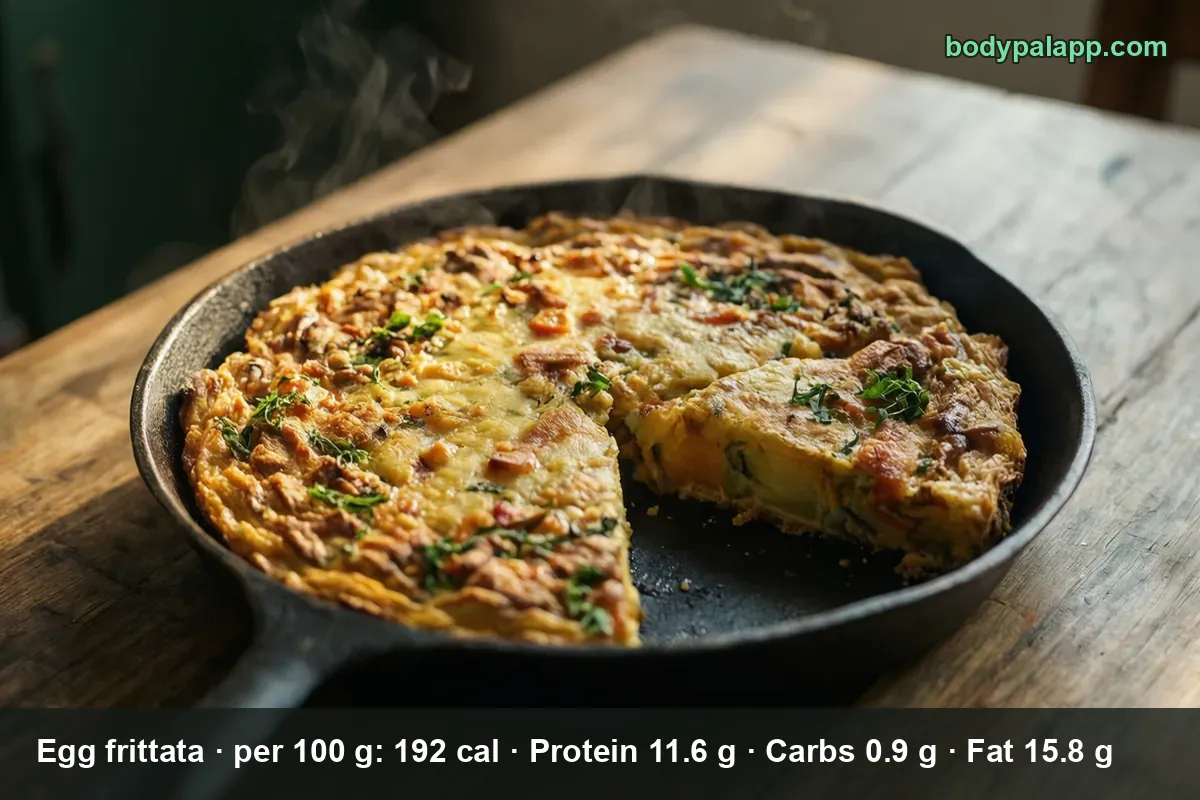
One wedge of a skillet frittata weighs 110 g and carries 211 calories. Per 100 g the number is 192 calories, because eggs, oil and a handful of vegetables make a dense mix with almost nothing in it that isn't protein or fat. Cut the pan into six and that wedge is your number.
On this page
- Egg frittata quick facts
- US servings from one ounce to a full cup
- What goes in the pan changes the wedge
- Fillings that actually move the number
- Cholesterol is the row that jumps
- How does an egg frittata compare?
- Most popular egg frittata brands
- Egg frittata FAQs
Egg frittata quick facts
USDA has no food called "frittata." What it has is the thing a frittata actually is: an open omelet finished in the pan, and the record that matches the skillet in the photo is FNDDS 2707200, "Egg omelet or scrambled egg, made with oil". Oil in the pan is the deciding detail. A frittata is not poached and it is not dry-scrambled, so the no-added-fat record would undercount almost every home version.
The wedge below is 110 g, which is what USDA treats as one unspecified serving of this record. Everything in the middle column is that 100 g figure scaled to 110 g.
| Nutrient | Per 100 g | Per 1 wedge (110 g) | % Daily Value |
|---|---|---|---|
| Calories | 192 | 211 | — |
| Total fat | 15.81 g | 17.4 g | 22% |
| Saturated fat | 3.85 g | 4.2 g | 21% |
| Carbohydrate | 0.9 g | 1.0 g | 0% |
| Dietary fiber | 0 g | 0 g | 0% |
| Total sugars | 0.19 g | 0.2 g | — |
| Protein | 11.56 g | 12.7 g | 25% |
| Sodium | 228 mg | 251 mg | 11% |
% Daily Value is based on a 2,000-calorie diet.
Verified nutrition data
Numbers on this page come from USDA FoodData Central, the U.S. Department of Agriculture’s food composition database, and from manufacturer labels where a branded product is named. Last verified September 2026. How we verify our data →
Two rows are missing on purpose. Added sugars and trans fat are not published in FNDDS for mixed egg dishes, so there is nothing honest to print in those cells. Cholesterol and potassium are published: 383 mg and 123 mg per 100 g, which comes to 421 mg of cholesterol and 135 mg of potassium in the wedge. Hold onto the cholesterol number, it is the one worth a section of its own.
The sodium is modest for a hot breakfast. 251 mg in a wedge is roughly a tenth of a teaspoon of table salt, and it is 11% of the FDA Daily Value of 2,300 mg.
US servings from one ounce to a full cup
| Serving | Weight | Calories |
|---|---|---|
| 1 oz | 28.35 g | 54 kcal |
| Cooked egg from 1 large egg | 55 g | 106 kcal |
| One wedge, skillet cut in six | 110 g | 211 kcal |
| One deli-style slice, 4 oz | 113 g | 217 kcal |
| 1 cup, chopped | 135 g | 259 kcal |
| Per 100 g | 100 g | 192 kcal |
Two of these are USDA household measures: the wedge and the cup. The ounce and the 4 oz deli slice are our own arithmetic from the USDA 100 g figure, not USDA servings, and the single-egg line is there because people cook frittatas by the egg and eat them by the slice.
That gap between the wedge and the cup is where logs go wrong. A cup of chopped frittata is 259 calories, 48 more than the wedge, and it looks like less food on the plate because chopping it collapses the airy middle. If you cut a wedge, log a wedge. If you scoop leftovers into a container, weigh them.
What goes in the pan changes the wedge
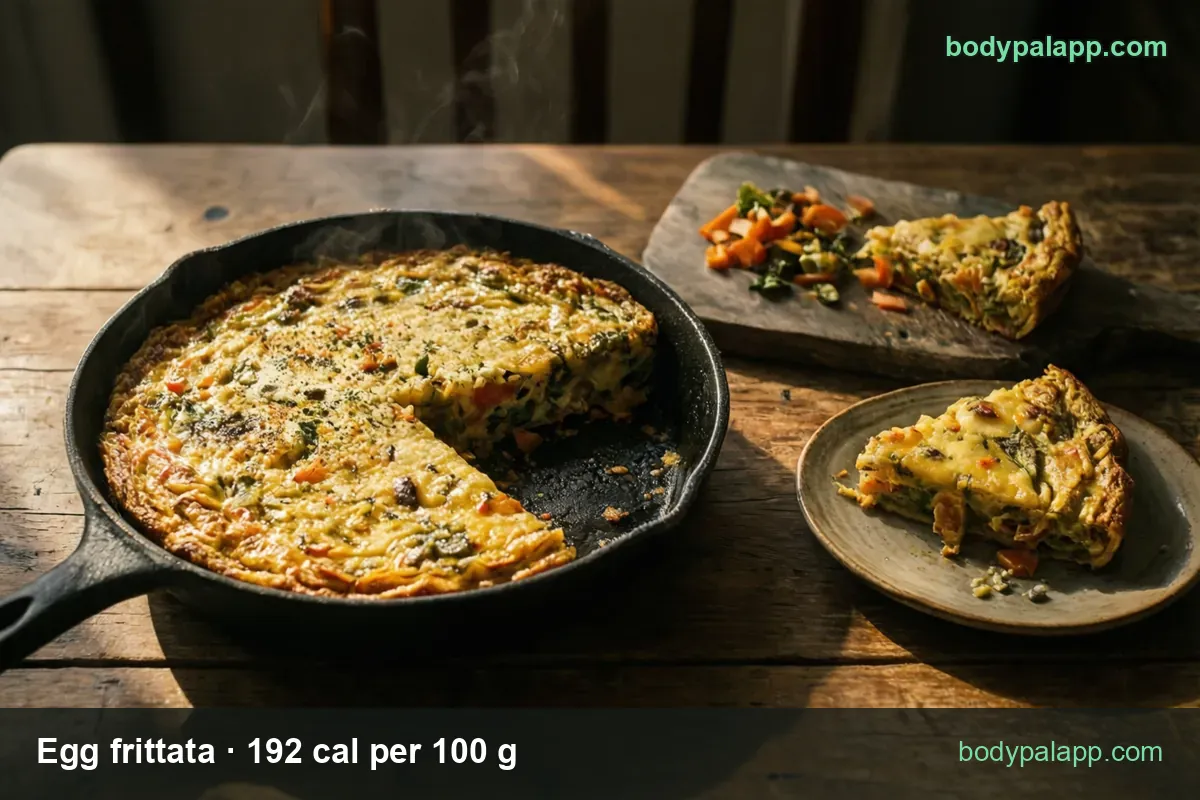
The eggs barely move. The fat you cook them in does almost all the work.
| Version | Per 100 g | Wedge (110 g) | Saturated fat per 100 g |
|---|---|---|---|
| No added fat | 143 kcal | 157 kcal | 3.19 g |
| Cooking spray instead of oil | 149 kcal | 164 kcal | 3.21 g |
| Made with butter | 182 kcal | 200 kcal | 5.96 g |
| Made with oil (our main record) | 192 kcal | 211 kcal | 3.85 g |
The three alternate wedge figures are our own arithmetic from each record's 100 g value, since USDA does not attach a wedge weight to them. The spread is 54 calories between the lightest and heaviest wedge, and it has nothing to do with the eggs.
Butter looks like the lighter choice at 182 per 100 g, and on calories it is, by 10 per 100 g. On saturated fat it is the worst row on the page: 5.96 g against 3.85 g for oil, more than half again as much. A butter frittata wedge is quietly a 33% Daily Value serving of saturated fat.
Fillings that actually move the number
| Filling | Per 100 g | Wedge (110 g) | Sodium per 100 g |
|---|---|---|---|
| Spinach or other dark greens | 166 kcal | 183 kcal | 229 mg |
| Potato and onion | 172 kcal | 189 kcal | — |
| Cheese and vegetables | 188 kcal | 207 kcal | 305 mg |
| Meat, such as bacon or ham | 193 kcal | 212 kcal | 353 mg |
Every wedge figure here is our own scaling of the USDA 100 g value. The sodium cell for the potato and onion version is blank because FNDDS does not publish a comparable figure for that record, and a guess would be worse than a gap.
Here is the surprise. Cheese does not blow up a frittata: the cheese-and-vegetable record is 188 calories per 100 g, lower than the plain oil version at 192. Vegetables carry water, water carries no calories, and the cheese pays for itself in volume. What cheese and meat do is bring salt. The meat version runs 353 mg of sodium per 100 g against 228 mg for the plain one, a 55% jump, which is a real difference if you are watching blood pressure.
The lightest filled version is spinach at 166 per 100 g. It is also the lowest in protein, 10.52 g per 100 g against 11.56 g, for the same reason it is lighter: greens are taking up space eggs used to occupy.
Cholesterol is the row that jumps
A 110 g wedge carries 421 mg of cholesterol, 140% of the 300 mg Daily Value on the Nutrition Facts label. Nothing else on this page comes close to a full day of anything. Protein, the reason most people eat a frittata, is 25% of its Daily Value in the same wedge.
Current federal advice does not set a numeric cholesterol cap. The Dietary Guidelines ask people to keep dietary cholesterol as low as possible while eating a healthy pattern, and eggs are explicitly listed among the protein foods on MyPlate. The Daily Value on the label is still 300 mg, though, so a frittata wedge reads as 140% on any tracker that follows the label. If that number matters for you, the lever is portion size and how often, not the pan.
The flip side is genuinely good. Carbohydrate is 1.0 g per wedge, 0% of a day, and there is no fiber to speak of. Very few hot breakfasts land 12.7 g of protein for 211 calories with a single gram of carbohydrate.
How does an egg frittata compare?
| Version | Per 100 g | US serving | Calories |
|---|---|---|---|
| Egg frittata, made with oil | 192 kcal | 1 cup chopped, 135 g | 259 kcal |
| Omelet, fat type unspecified | 185 kcal | 1 cup chopped, 135 g | 250 kcal |
| Frittata made with butter | 182 kcal | 1 cup chopped, 135 g | 246 kcal |
| Frittata with no added fat | 143 kcal | 1 cup chopped, 135 g | 193 kcal |
Our take: the frittata-versus-omelet argument is a false one. USDA files them as the same family of records, and the three fat-added versions sit within 10 calories per 100 g of each other, which is noise. The only row that separates from the pack is the dry-pan version at 143, the single line here under 150, and it saves 66 calories on a cup. So cook it in a nonstick pan with spray if you are counting, cook it in oil if you want it to taste like a frittata, and stop worrying about which country's name you put on it.
Most popular egg frittata brands in the United States
Ranked by how widely each product appears among foods sold in the United States, from the BodyPal food database of over 3.3 million products. Calories are the figures printed on each Nutrition Facts label, checked against USDA FoodData Central.
| Product | Calories (per 100 g) |
|---|---|
| Signature Cafe Egg Frittata | 168 cal |
| Signature Cafe Egg Frittata, 6-Serving Tray | 239 cal |
| Signature Cafe Bacon, Tomato and Swiss Frittata | 230 cal |
| Garden Lites Veggie Bacon, Potato & Egg Frittata | 140 cal |
Brand popularity: BodyPal food database. Nutrition: manufacturer labels / USDA FoodData Central.
Egg frittata FAQs
How many calories are in a slice of egg frittata?
A 110 g wedge is 211 calories, at 192 calories per 100 g for a frittata cooked in oil. Slices vary more than people expect. An 80 g sliver is 154 calories by our own arithmetic from the USDA 100 g figure, and a 135 g cup of chopped frittata comes to 259.
How many calories in a whole frittata?
About 1,267 calories for a six-wedge skillet weighing 660 g, cooked in oil. That is our own arithmetic from the USDA figure of 192 calories per 100 g, not a USDA serving. Cook the same pan with no added fat and it drops to roughly 944 calories, the biggest single saving available.
Is a frittata healthier than an omelette?
They are the same food to USDA: one FNDDS record at 192 calories per 100 g covers a frittata and a pan omelet made with oil. The fat decides it, not the shape. Butter reads 182 per 100 g but 5.96 g of saturated fat, against 3.85 g for oil.
How much protein is in an egg frittata?
12.7 g in a 110 g wedge, 25% of the 50 g Daily Value, from 11.56 g per 100 g. A 135 g cup of chopped frittata carries 15.6 g. Cooking with no added fat nudges protein up to 12.36 g per 100 g, because oil is no longer diluting the eggs.
Does adding cheese change frittata calories?
Barely: the USDA record for a frittata with cheese and vegetables is 188 calories per 100 g, or 207 for a 110 g wedge, against 211 for the plain oil version. The vegetables offset the cheese. Sodium is where it shows: 305 mg per 100 g against 228 mg.
How many calories in a spinach frittata?
166 calories per 100 g, or 183 for a 110 g wedge by our own arithmetic, making it the lightest of the filled versions. Dark greens displace egg and oil, so protein falls to 10.52 g per 100 g. Sodium stays flat at 229 mg, close to the plain version.
Can you eat frittata on a low-carb diet?
Yes, easily: carbohydrate is 0.9 g per 100 g and 1.0 g in a 110 g wedge, which rounds to 0% of the Daily Value. Even the cheese-and-vegetable version is only 1.89 g per 100 g. Total sugars are 0.19 g, essentially the trace amount that lives in eggs.
How many calories in a store-bought frittata slice?
Between 190 and 270 for a 113 g refrigerated slice, depending on the brand. USDA's branded database lists two Signature Cafe trays at 168 and 239 calories per 100 g. A single 57 g Garden Lites veggie frittata is 80. Read the container, because the wedge sizes differ.
Similar foods
- Omelet — 305 cal for 3-egg omelet
- Crepe — 179 cal per crepe
- Egg — 72 cal per large egg
- Pancake — 423 cal for 3 medium pancakes
- Toast with butter — 100 cal per slice with butter
- Shrimp Tempura Roll — 432 cal per roll, 8 pieces
Count it without the math
Point the camera at the skillet and BodyPal counts the wedge for you, oil and fillings included.


How long does it take to burn off egg frittata?
One wedge (110 g) is 211 kcal. Enter your weight and the amount you ate to see how long it takes you to burn that off:
lb
| Activity | Time to burn 211 kcal |
|---|---|
| Walking, brisk | 42 min |
| Cycling, moderate | 26 min |
| Swimming, moderate | 30 min |
| Jogging | 25 min |
| Weight training, moderate | 47 min |
Times are for a 155 lb adult at a steady pace; change the weight to see yours. The amount is set to the portion in the text (110 g); change it to what you actually ate. BodyPal works this out from your steps automatically.
Burning it off is one side of it. The other is knowing your number: work out how many calories you need a day, with macros and a goal date.