
How many calories are in an egg fried in olive oil?
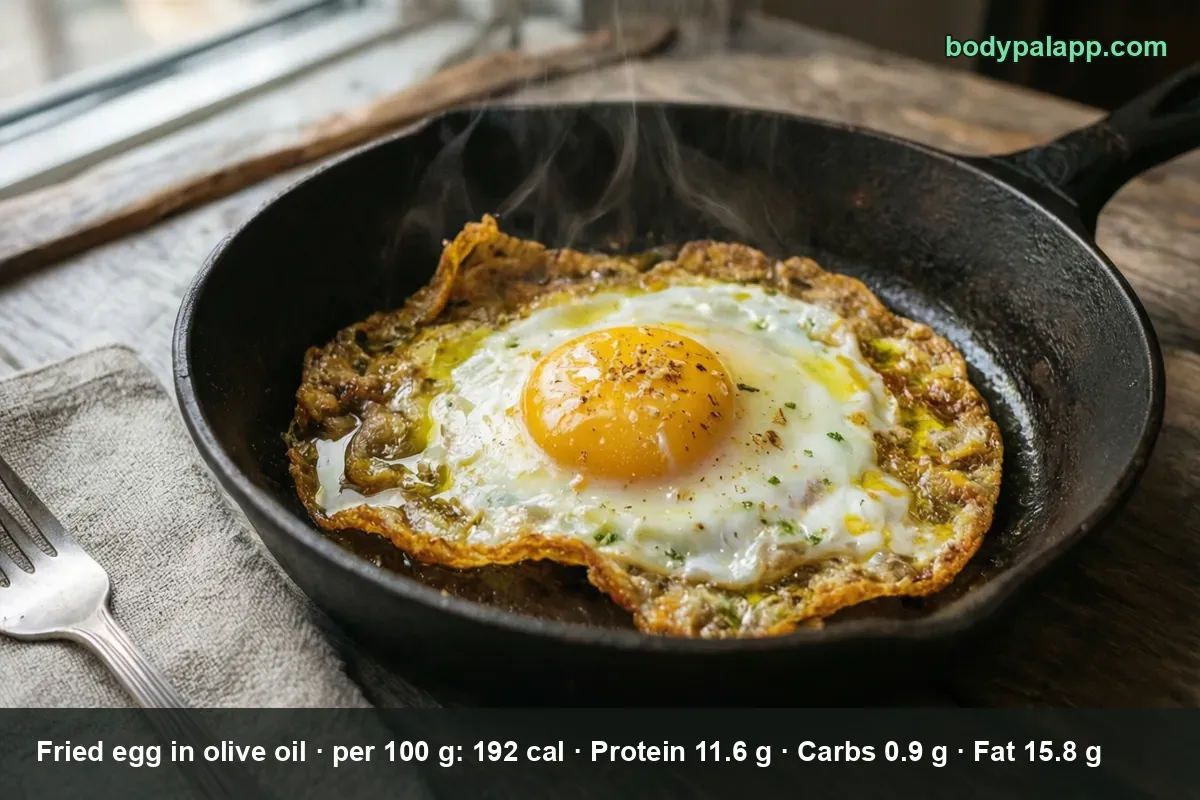
One large egg fried in olive oil carries 106 calories, or 192 calories per 100 g. The same egg cooked in a dry pan is 72, so the oil the white soaks up is worth roughly 34 calories. Protein lands at 6.4 g and cholesterol at 211 mg.
On this page
- Fried egg quick facts
- US servings, from one ounce to three eggs
- Olive oil, butter, margarine or a dry pan
- Cholesterol is the row that moves
- How does a fried egg in olive oil compare?
- Most popular fried egg in olive oil brands
- Fried egg in olive oil FAQs
Fried egg quick facts
There is one USDA record that matches what most people actually cook, and it is FNDDS 2707158, "Egg, whole, fried with oil". Olive oil is a vegetable oil, and FNDDS does not split its fried-egg records by which oil went into the skillet — extra virgin, light, canola or peanut all land on the same line, because all cooking oils sit at roughly the same calorie density. The record already accounts for the oil the egg absorbs, which is why it is heavier than a raw egg.
The other fried-egg rows in the database describe different pans, not different data sources. Butter, margarine, cooking spray and a bare nonstick surface each get their own record, and they are further down this page rather than averaged into the headline number.
| Nutrient | Per 100 g | Per 1 large egg (55 g) | % Daily Value |
|---|---|---|---|
| Calories | 192 | 106 | — |
| Total fat | 15.81 g | 8.7 g | 11% |
| Saturated fat | 3.85 g | 2.1 g | 11% |
| Carbohydrate | 0.9 g | 0.5 g | 0% |
| Dietary fiber | 0 g | 0 g | 0% |
| Total sugars | 0.19 g | 0.1 g | — |
| Protein | 11.56 g | 6.4 g | 13% |
| Sodium | 228 mg | 125 mg | 5% |
| Cholesterol | 383 mg | 211 mg | 70% |
| Potassium | 123 mg | 68 mg | 1% |
% Daily Value is based on a 2,000-calorie diet.
Verified nutrition data
Numbers on this page come from USDA FoodData Central, the U.S. Department of Agriculture’s food composition database, and from manufacturer labels where a branded product is named. Last verified September 2026. How we verify our data →
Two label rows are missing on purpose. Added sugars and trans fat do not appear in this FNDDS release for prepared dishes, so there is nothing to publish for either — the total sugars figure of 0.19 g per 100 g is all the sugar accounting available, and it is trivial. The 125 mg of sodium in one egg is about a twentieth of a teaspoon of table salt, most of it from the pinch cooks add at the pan rather than from the egg itself.
US servings, from one ounce to three eggs
| Serving | Weight | Calories |
|---|---|---|
| 1 oz | 28 g | 54 kcal |
| One large egg, fried | 55 g | 106 kcal |
| Two large eggs | 110 g | 211 kcal |
| Three large eggs | 165 g | 317 kcal |
| 1 cup, chopped | 135 g | 259 kcal |
| Per 100 g | 100 g | 192 kcal |
USDA publishes two of these household measures directly: the single fried large egg at 55 g and the cup of chopped fried egg at 135 g. The two-egg and three-egg lines, along with the ounce, are our own arithmetic from the USDA 100 g figure, not USDA servings.
The cup is where people get burned. A cup of chopped fried egg is 135 g, which is two and a half eggs, not one — so a recipe that says "one cup fried egg, chopped" over a salad is 259 calories, more than double what a single egg costs you. If you are logging by volume rather than by egg, that gap is the single most expensive mistake on this food.
A large egg out of the carton is about 50 g of edible egg. The fried record weighs 55 g because the white takes on oil in the pan. That 5 g of pickup is part of the 34-calorie difference between a fried egg and a dry-cooked one; the rest is the oil worked into every gram of the white.
Olive oil, butter, margarine or a dry pan
| Version | Per 100 g | Typical serving | Calories |
|---|---|---|---|
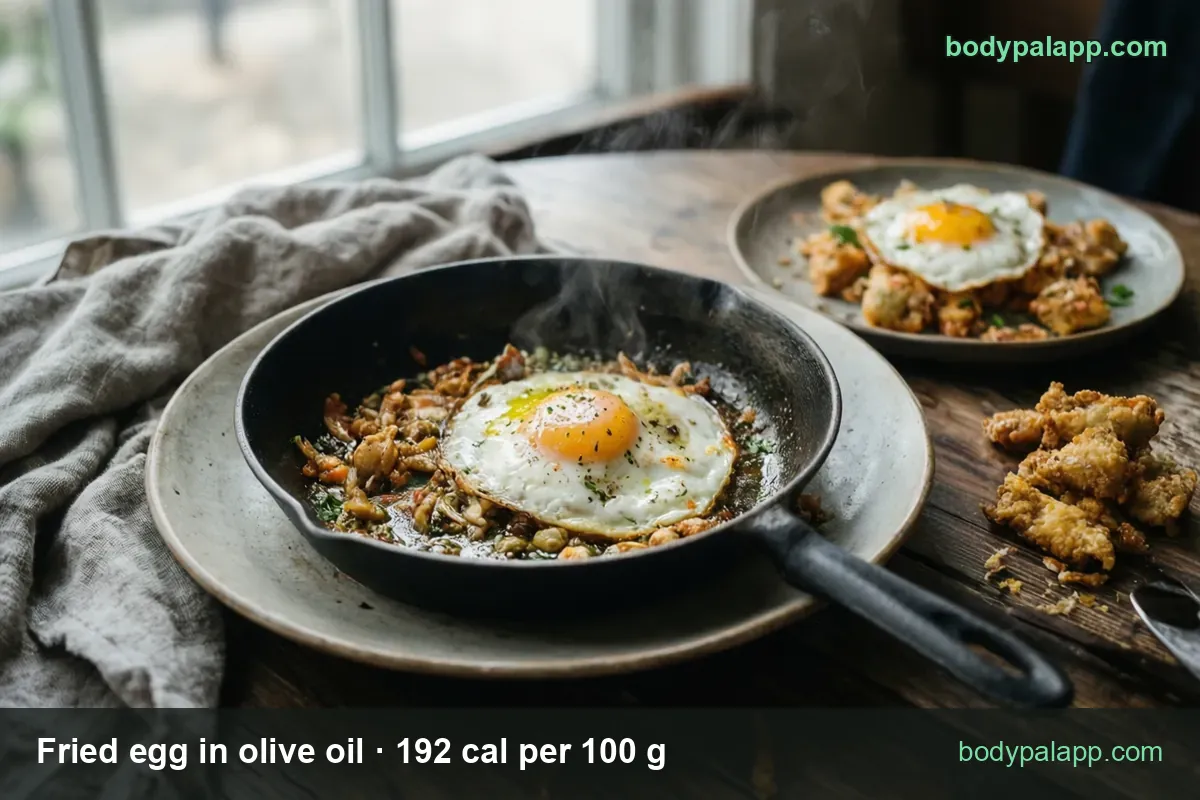
| Fried in oil, olive included | 192 kcal | 1 large egg, 55 g | 106 kcal |
| Fried, fat not specified | 185 kcal | 1 large egg, 55 g | 102 kcal |
| Fried in butter | 182 kcal | 1 large egg, 55 g | 100 kcal |
| Fried in margarine | 171 kcal | 1 large egg, 55 g | 94 kcal |
| Fried with cooking spray | 149 kcal | 100 g | 149 kcal |
| Fried with no added fat | 143 kcal | 1 large egg, 50 g | 72 kcal |
| Scrambled or omelet, made with oil | 192 kcal | 100 g | 192 kcal |
Only two rows come in under 150 calories per 100 g: cooking spray at 149 and the dry pan at 143. Everything else clusters between 171 and 192, which tells you something useful — swapping olive oil for butter or margarine barely moves the calorie count, while removing the fat entirely moves it a lot. Scaled to one 55 g egg, cooking spray works out to about 82 calories, which is our own arithmetic from the 100 g value rather than a USDA serving.
The scrambled record is the quiet surprise. Egg scrambled or made into an omelet with oil carries exactly the same 192 calories per 100 g as the fried version, so beating the egg changes nothing on the calorie line. What it does change is sodium: 123 mg per 100 g scrambled against 228 mg fried, because the fried record assumes the pan gets seasoned and the scrambled one does not.
The "fat not specified" row at 185 calories per 100 g exists for survey answers where nobody recorded the pan. It sits almost exactly between butter and oil, which is a fair default if you are logging someone else's cooking — a diner egg, a hotel buffet egg — and have no idea what was in the skillet.
Cholesterol is the row that moves
Calories are the boring part of this food. The line that actually stands out on the label is cholesterol: 211 mg in one fried egg, against the FDA Daily Value of 300 mg. That is 70% of the day from a single egg, and all of it comes from the yolk. Olive oil contributes none — plant oils carry no cholesterol at all.
Sodium runs the other way. At 125 mg per egg it is 5% of the 2,300 mg Daily Value, so two fried eggs are still a rounding error next to a strip of bacon or a slice of deli ham. If you are watching sodium, the eggs are not where the problem is.
Protein is the reason to keep them on the plate. One fried egg delivers 6.4 g, 13% of the Daily Value, in a package that costs 106 calories — a protein-per-calorie ratio that beats almost anything else on a breakfast plate, and eggs count toward the protein group in the MyPlate framework. Saturated fat sits at 2.1 g per egg, 11% of the 20 g Daily Value, which leaves room for whatever else is cooking.
How does a fried egg in olive oil compare?
| Egg | Per 100 g | US serving | Calories |
|---|---|---|---|
| Fried in olive oil | 192 kcal | 1 large egg, 55 g | 106 kcal |
| Fried in butter | 182 kcal | 1 large egg, 55 g | 100 kcal |
| Fried in margarine | 171 kcal | 1 large egg, 55 g | 94 kcal |
| Fried with no added fat | 143 kcal | 1 large egg, 50 g | 72 kcal |
Our take: the choice of fat is worth 6 to 12 calories an egg, and the choice of whether to use fat at all is worth 34. If you are cutting calories, skip the oil and use a nonstick pan — that single change saves more than switching oils ever will. If you are keeping the oil, keep the olive oil: it lands at 2.1 g of saturated fat per egg against roughly 3.3 g for butter, our own scaling from the USDA 100 g figures, which is 11% of the Daily Value against 17%. For satiety at breakfast, two eggs in olive oil at 211 calories and 12.8 g of protein is a better trade than one egg plus toast.
Most popular fried egg in olive oil brands in the United States
Ranked by how widely each product appears among foods sold in the United States, from the BodyPal food database of over 3.3 million products. Calories are the figures printed on each Nutrition Facts label, checked against USDA FoodData Central.
| Product | Calories (per 100 g) |
|---|---|
| Eggland's Best Large Brown Eggs | 120 cal |
| Organic Valley Omega-3 Organic Large Brown Eggs | 120 cal |
| Kirkland Signature Cage Free Large Eggs | 140 cal |
| Pete and Gerry's Fresh Large Brown Eggs | 140 cal |
| The Happy Egg Co Brown Eggs | 140 cal |
| Member's Mark Grade A Large Cage Free Brown Eggs | 140 cal |
Brand popularity: BodyPal food database. Nutrition: manufacturer labels / USDA FoodData Central.
Fried egg in olive oil FAQs
How many calories are in an egg fried in olive oil?
One large egg fried in olive oil is 106 calories, based on USDA's 192 calories per 100 g for egg fried with oil. That is the whole egg plus the oil it absorbs in the pan. Two eggs come to 211 calories, three to 317.
How many calories does olive oil add to a fried egg?
About 34 calories per egg. USDA puts a fried egg with oil at 106 calories and the same egg fried with no added fat at 72, a gap of 34. Per 100 g the difference is wider, 192 against 143, because the oil-fried egg carries oil in every gram.
How many calories in 2 eggs fried in olive oil?
211 calories for two large eggs fried in olive oil, 110 g on the plate. That is our own arithmetic from the USDA 100 g figure of 192, not a USDA serving. Add toast or bacon and the plate climbs fast; the eggs alone stay near 200.
Is it healthier to fry an egg in olive oil or butter?
For calories it is close: 106 in olive oil against 100 in butter. Saturated fat is the real split, 2.1 g per egg with oil and about 3.3 g with butter, 11% and 17% of the FDA Daily Value. If you watch saturated fat, olive oil is the better pan.
How much protein is in a fried egg?
6.4 g of protein in one large egg fried in olive oil, 13% of the Daily Value. Per 100 g the figure is 11.56 g. Frying does not add or remove protein, so a dry-pan egg lands in the same range; only the fat around it changes.
How much cholesterol is in an egg fried in olive oil?
211 mg, which is 70% of the FDA Daily Value of 300 mg. All of it sits in the yolk; olive oil contributes none. Per 100 g the record shows 383 mg. Two eggs on one plate would put you past the full day's value.
How many calories in a fried egg with no oil?
72 calories for a large egg fried in a dry pan with no added fat, at 143 calories per 100 g. USDA lists that egg at 50 g rather than 55 g, because there is no oil to soak up. It is the lightest fried-egg row on this page.
How many calories in 3 eggs fried in olive oil?
317 calories for three large eggs fried in olive oil, 165 g in the pan. That total is our arithmetic from the USDA 100 g value, not a USDA serving size. Three eggs also stack up 633 mg of cholesterol, more than twice the 300 mg Daily Value.
Similar foods
- Omelet — 305 cal for 3-egg omelet
- Crepe — 179 cal per crepe
- Egg — 72 cal per large egg
- Pancake — 423 cal for 3 medium pancakes
- Toast with butter — 100 cal per slice with butter
- Shrimp Tempura Roll — 432 cal per roll, 8 pieces
Count it without the math
Point the camera at the skillet and BodyPal counts the eggs and the oil for you.


How long does it take to burn off 106 kcal of egg in Olive oil?
One large egg (55 g) is 106 kcal. Enter your weight and the amount you ate to see how long it takes you to burn that off:
lb
| Activity | Time to burn 106 kcal |
|---|---|
| Walking, brisk | 21 min |
| Cycling, moderate | 13 min |
| Swimming, moderate | 15 min |
| Jogging | 12 min |
| Weight training, moderate | 24 min |
Times are for a 155 lb adult at a steady pace; change the weight to see yours. The amount is set to the portion in the text (55 g); change it to what you actually ate. BodyPal works this out from your steps automatically.
One food is easy to picture; a whole day is harder. See how many calories you need a day and what a deficit actually looks like.