
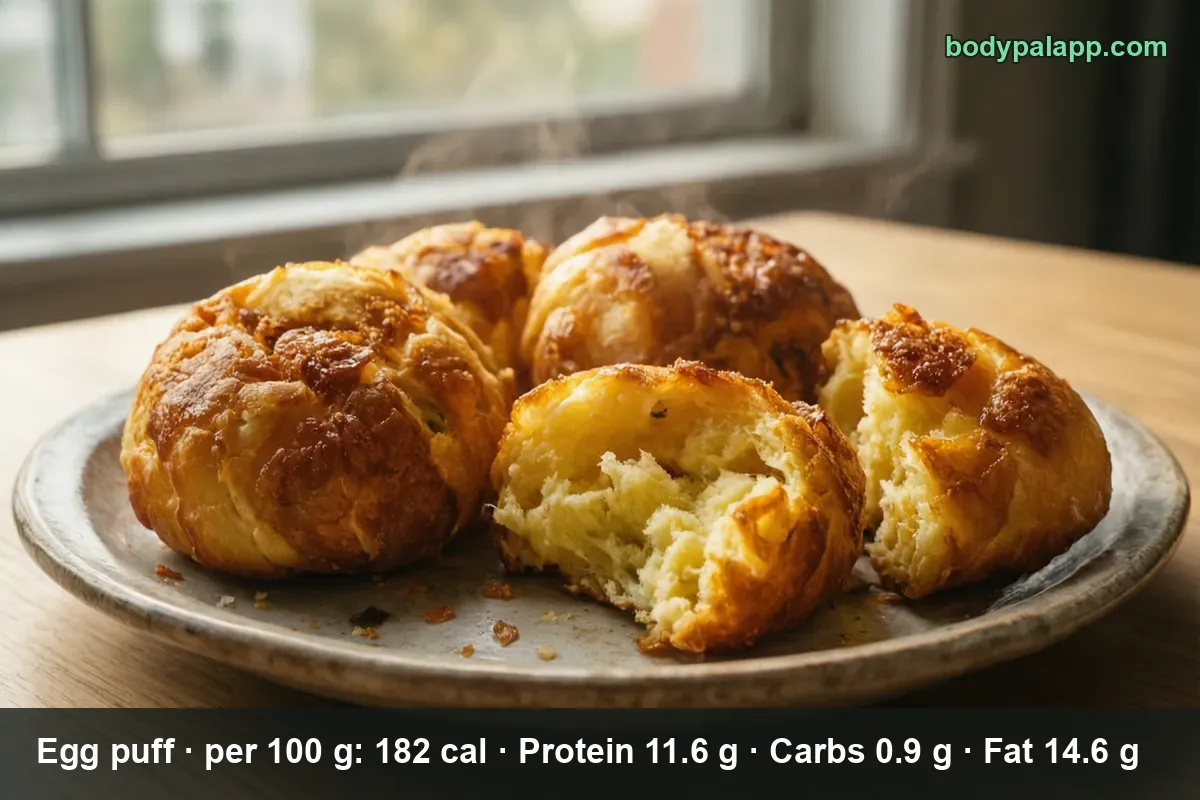
How many calories are in an egg puff?
One egg puff the size of a single egg weighs 55 g and carries 100 calories. Per 100 g the same beaten-and-baked egg runs 182 calories, and most of that is fat from the butter in the pan. Four puffs on a plate, the way they usually get eaten, come to 400.
On this page
- Egg puff quick facts
- US servings from one ounce to a plate of four
- What the pan adds to an egg puff
- Cheese and meat versions
- Cholesterol is the row to watch
- How does an egg puff compare?
- Most popular egg puff brands
- Egg puff FAQs
Egg puff quick facts
There is no USDA record called "egg puff." Searching the term returns nothing at all, and no US grocery label carries it either, so this page stands on the record that matches what is actually on the plate: beaten eggs cooked in a greased pan or mold until they rise. That is FNDDS 2707201, "Egg omelet or scrambled egg, made with butter", from the 2021-2023 Survey database.
The match is closer than it looks. USDA's own portion for that record is "1 egg," 55 g, which is exactly the weight of one puff out of the mold. Everything below scales from that single number.
| Nutrient | Per 100 g | Per one egg puff (55 g) | % Daily Value |
|---|---|---|---|
| Calories | 182 | 100 | — |
| Total fat | 14.64 g | 8.1 g | 10% |
| Saturated fat | 5.96 g | 3.3 g | 16% |
| Carbohydrate | 0.9 g | 0.5 g | 0% |
| Dietary fiber | 0 g | 0 g | 0% |
| Total sugars | 0.22 g | 0.1 g | — |
| Protein | 11.61 g | 6.4 g | 13% |
| Sodium | 263 mg | 145 mg | 6% |
| Cholesterol | 398 mg | 219 mg | 73% |
% Daily Value is based on a 2,000-calorie diet.
Verified nutrition data
Numbers on this page come from USDA FoodData Central, the U.S. Department of Agriculture’s food composition database, and from manufacturer labels where a branded product is named. Last verified September 2026. How we verify our data →
Two rows are missing on purpose. USDA does not publish added sugars or trans fat for Survey records like this one, so there is nothing honest to print in those cells. Potassium is small enough to leave in a sentence: 69 mg per puff, 1% of the Daily Value.
The shape of this food is unusual for a breakfast item. Fat carries about 73 calories of the 100, protein about 26, and carbohydrate barely registers at 2. That is why an egg puff feels heavier than its calorie count suggests, and why the fat you cook it in changes the total more than anything else you do.
US servings from one ounce to a plate of four
| Serving | Weight | Calories |
|---|---|---|
| 1 oz | 28 g | 51 kcal |
| One egg puff, USDA "1 egg" | 55 g | 100 kcal |
| Two egg puffs | 110 g | 200 kcal |
| Four egg puffs, one plate | 220 g | 400 kcal |
| One cup, chopped | 135 g | 246 kcal |
| Per 100 g | 100 g | 182 kcal |
Two of these are USDA household measures: the 55 g "1 egg" portion and the 135 g cup of chopped egg. The rest are our own arithmetic from the USDA 100 g figure, not USDA servings. The two-puff and four-puff rows are simply multiples of 55 g, and the ounce row is the 100 g value scaled down.
The cup is where logs go wrong. A USDA cup of chopped egg weighs 135 g and holds 246 calories, roughly two and a half puffs. Tap "1 cup" when you ate one puff and you have added 146 calories to the day without eating anything. If your app offers both, the piece is the safer unit for this food, because a puff has a fixed weight and a cup does not.
Four puffs at 400 calories put breakfast in normal territory. The same plate brings 32.2 g of fat, 25.5 g of protein, 579 mg of sodium and 876 mg of cholesterol, all scaled from the 100 g record.
What the pan adds to an egg puff
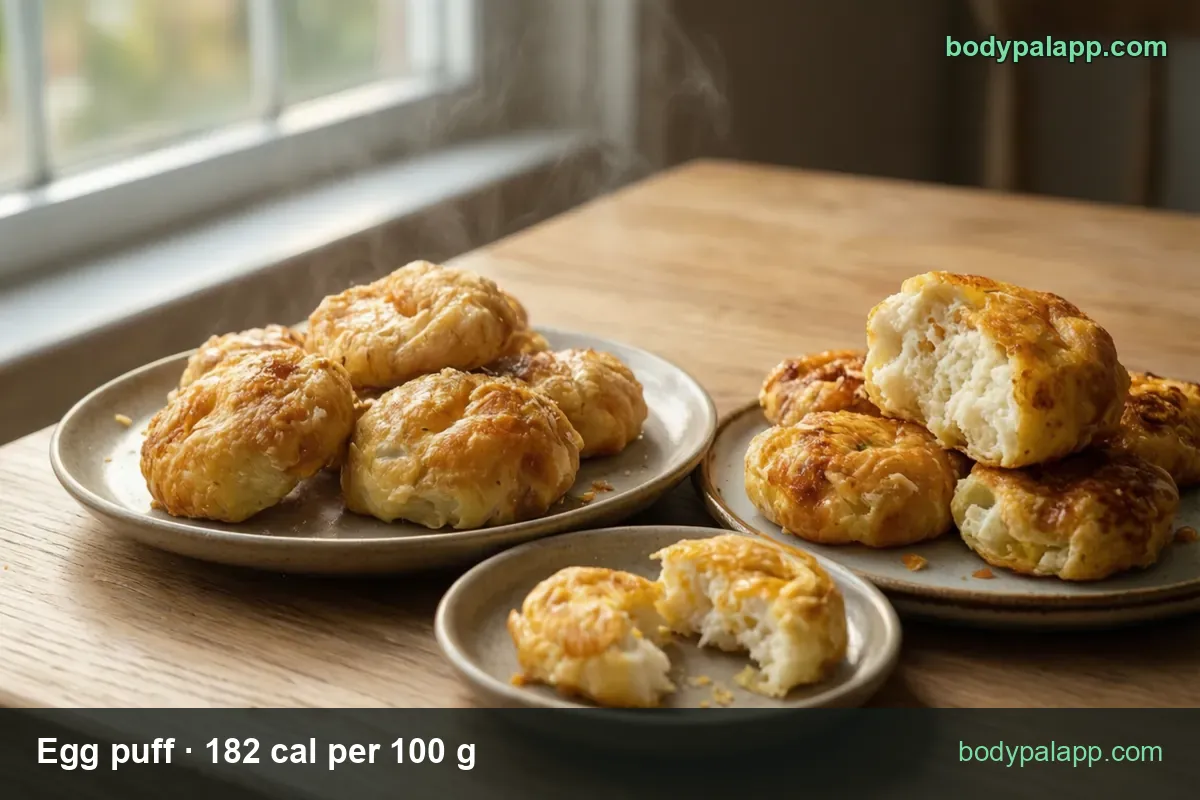
The eggs are the same in every version below. What changes is the grease in the mold, and it is worth more calories than most people expect.
| Version | Per 100 g | Typical piece | Calories |
|---|---|---|---|
| Made with butter | 182 kcal | 1 puff, 55 g | 100 kcal |
| No added fat | 143 kcal | 1 puff, 50 g | 72 kcal |
| Made with oil | 192 kcal | 1 puff, 55 g | 106 kcal |
| Made with cooking spray | 149 kcal | 100 g | 149 kcal |
| Fat type not recorded | 185 kcal | 1 puff, 55 g | 102 kcal |
Butter to nothing is a gap of 39 calories per 100 g. On a 220 g plate of four that is about 86 calories, the difference between a 400-calorie breakfast and a 315-calorie one, with no change to the eggs. Cooking spray sits at 149 per 100 g, closer to the bare pan than to the butter.
Oil is the surprise in the other direction. At 192 calories per 100 g it beats butter, because more of it stays in the food, though its saturated fat is lower: 3.85 g per 100 g against 5.96 g for butter. If the calorie number matters most, the bare pan wins at 143 per 100 g, with spray just behind at 149. If saturated fat is the concern, oil beats butter even while costing a few more calories.
The USDA record with no fat type recorded lands at 185, essentially where butter is. That is the row your restaurant egg puff most likely belongs to, since nobody tells you what greased the mold.
Cheese and meat versions
Bakery and diner egg puffs often hide something inside. USDA has records for both, and each one moves a different row.
| Version | Per 100 g | Protein per 100 g | Sodium per 100 g |
|---|---|---|---|
| With cheese, made with butter | 203 kcal | 12.69 g | 354 mg |
| With cheese, no added fat | 171 kcal | 13.41 g | 344 mg |
| With meat, made with butter | 190 kcal | 12.74 g | 366 mg |
| Plain, made with butter | 182 kcal | 11.61 g | 263 mg |
Cheese adds 21 calories per 100 g over the plain butter version and about 1 g of protein, but it adds 91 mg of sodium, a third more than the plain puff. Meat behaves the same way: 8 more calories, 103 more sodium. On a four-puff plate the cheese version reaches 779 mg of sodium, 34% of the Daily Value, before anything gets salted at the table.
Of the eight USDA records lined up for this page, the cheese-and-butter version is the heaviest per gram at 203 calories and the no-added-fat version the lightest at 143.
Cholesterol is the row to watch
Calories are not the interesting number here. One 55 g puff carries 219 mg of cholesterol, which is 73% of the 300 mg Daily Value the FDA uses on labels. Two puffs reach 438 mg, or 146%, and the calorie total is still only 200. Nothing else on a normal breakfast plate does that.
Saturated fat moves fast too. A single puff is 3.3 g, 16% of the 20 g Daily Value; four puffs are 13.1 g, or 66%. The Dietary Guidelines for Americans set saturated fat at under 10% of daily calories, which is about 22 g on a 2,000-calorie day, so a four-puff plate uses more than half of it. Switching to the no-added-fat version cuts the plate to 7.0 g.
The good news sits in the protein column. Two puffs give 12.8 g, about a quarter of the 50 g Daily Value, and eggs count as a protein food under MyPlate. If you are watching cholesterol, the practical move is fewer puffs rather than a different pan, since the fat you cook in barely touches that row.
How does an egg puff compare?
| Egg dish | Per 100 g | US serving | Calories |
|---|---|---|---|
| Egg puff, made with butter | 182 kcal | one puff, 55 g | 100 kcal |
| Egg cooked with no added fat | 143 kcal | one puff, 50 g | 72 kcal |
| Egg cooked with oil | 192 kcal | one puff, 55 g | 106 kcal |
| Egg, fat type not recorded | 185 kcal | one puff, 55 g | 102 kcal |
Our take: of these four, only the no-added-fat record is lighter per gram than the buttered puff, and the gap it opens is real but modest, 28 calories on a single piece. The oil version is the heaviest of the four per gram. For weight loss, two puffs at 200 calories with 12.8 g of protein is a good deal at breakfast; for staying full to lunch, four puffs at 400 with 25.5 g of protein does the job and still leaves room in a normal day. Everything else about this food, including the cholesterol, tracks the number of puffs and not the fat in the pan.
Most popular egg puff brands in the United States
Ranked by how widely each product appears among foods sold in the United States, from the BodyPal food database of over 3.3 million products. Calories are the figures printed on each Nutrition Facts label, checked against USDA FoodData Central.
| Product | Calories (per 100 g) |
|---|---|
| Three Bridges Spinach & Bell Pepper Egg Bites | 169 cal |
| Bob Evans Egg Bites | 177 cal |
| Nellie's Free Range Uncured Bacon + Pepper Jack Egg Bites | 220 cal |
| Great Value Turkey Sausage & Cheese Egg Bites | 208 cal |
| Signature Select Bacon & Three Cheese Egg Bites | 215 cal |
| Jimmy Dean Sausage & Three Cheese Egg Bites | 239 cal |
Brand popularity: BodyPal food database. Nutrition: manufacturer labels / USDA FoodData Central.
Egg puff FAQs
How many calories are in one egg puff?
One egg puff made with butter carries 100 calories at 55 g, the same weight USDA uses for one egg. That works out to 182 calories per 100 g. Fat supplies most of it: 8.1 g per puff, of which 3.3 g is saturated. Protein adds 6.4 g.
How many calories are in 4 egg puffs?
Four egg puffs weigh 220 g and come to 400 calories, our own arithmetic from the USDA 100 g figure rather than a listed USDA serving. That plate carries 32.2 g of fat, 25.5 g of protein and 876 mg of cholesterol, which is 292% of the Daily Value.
How much protein is in an egg puff?
One 55 g egg puff gives 6.4 g of protein, 13% of the 50 g Daily Value, and the record runs 11.61 g per 100 g. Two puffs bring breakfast to 12.8 g, roughly a quarter of the day's value, for 200 calories and half a gram of carbohydrate.
How many carbs are in an egg puff?
A 55 g egg puff has 0.5 g of carbohydrate, and 0.1 g of that is sugar, with no fiber at all. Per 100 g the figure is 0.9 g. Eggs beaten with butter hold almost no starch, so whatever you serve alongside decides the carb count of the meal.
How much cholesterol is in an egg puff?
219 mg per 55 g puff, which is 73% of the 300 mg Daily Value the FDA uses on labels. Two puffs reach 438 mg, or 146%, while the calorie count is still only 200. Cholesterol, not calories, is the number that moves fastest on this plate.
Do egg puffs made without butter have fewer calories?
Yes, by 39 calories per 100 g. The USDA record for egg cooked with no added fat is 143 calories per 100 g against 182 with butter, so a 220 g plate of four drops from 400 to about 315. Cooking spray lands in between at 149 per 100 g.
How many calories are in a cup of egg puffs?
One USDA cup of chopped egg weighs 135 g and holds 246 calories, about two and a half puffs. Logging a cup when you actually ate a single puff adds 146 calories to the day. With this food the piece is the more reliable unit than the cup.
Are egg puffs a good breakfast for weight loss?
Two puffs are 200 calories with 12.8 g of protein and half a gram of carbohydrate, which fits inside a 350 to 450 calorie breakfast with room to spare. If you are watching saturated fat, the no-added-fat version at 143 calories per 100 g is the better pick.
Similar foods
- Omelet — 305 cal for 3-egg omelet
- Egg — 72 cal per large egg
- Crepe — 179 cal per crepe
- Pancake — 423 cal for 3 medium pancakes
- Toast with butter — 100 cal per slice with butter
- Shrimp Tempura Roll — 432 cal per roll, 8 pieces
Count it without the math
Point the camera at the plate and BodyPal counts the puffs for you, butter and all.


How long does it take to burn off an egg puff?
One egg puff (55 g) is 100 kcal. Enter your weight and the amount you ate to see how long it takes you to burn that off:
lb
| Activity | Time to burn 100 kcal |
|---|---|
| Walking, brisk | 20 min |
| Cycling, moderate | 12 min |
| Swimming, moderate | 14 min |
| Jogging | 12 min |
| Weight training, moderate | 22 min |
Times are for a 155 lb adult at a steady pace; change the weight to see yours. The amount is set to the portion in the text (55 g); change it to what you actually ate. BodyPal works this out from your steps automatically.
This table assumes you know your daily total. If you do not, the daily calorie calculator works it out from five numbers.