
How many calories are in egg salad?
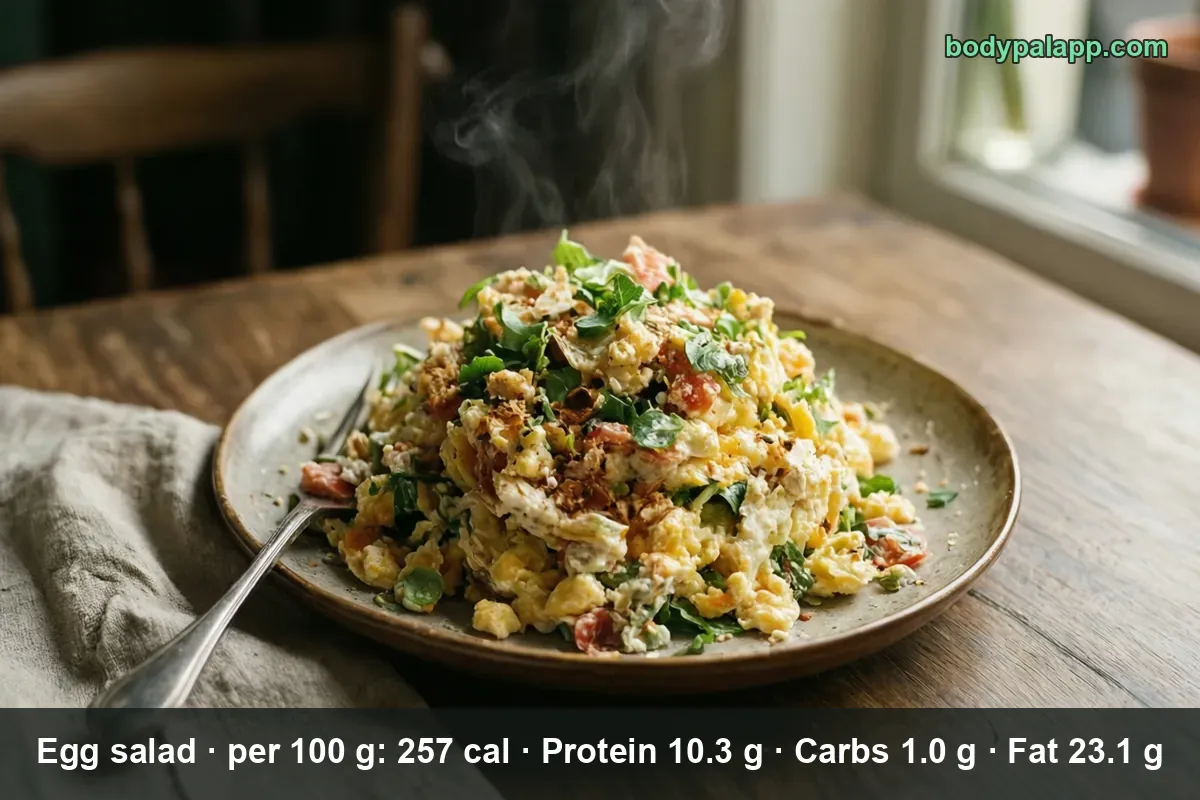
A half-cup scoop of classic egg salad, 111 g of chopped egg bound with real mayonnaise, is 285 calories. Per 100 g it runs 257 calories, and the dressing carries most of that: 23.14 g of fat per 100 g against 10.26 g of protein. Change the dressing and the whole number moves by a third.
On this page
- Egg salad quick facts
- US servings, from one ounce to a full cup
- Light mayo, Italian dressing and the fat-free version
- Cholesterol is the row that leaves the frame
- Egg salad on white bread
- How does egg salad compare?
- Most popular egg salad brands
- Egg salad FAQs
Egg salad quick facts
USDA files egg salad seven different ways, one for each dressing. The row that matches what most Americans actually make and what most delis actually sell is FNDDS 2707182, "Egg salad, made with mayonnaise": hard-cooked eggs, full-fat mayonnaise, a little seasoning. That is the record every number on this page starts from unless a section says otherwise.
The serving column below is a half cup at 111 g. That weight is our own arithmetic from the USDA 100 g figure rather than a USDA household serving, but it is the scoop size a deli container and a sandwich actually use.
| Nutrient | Per 100 g | Per 1/2 cup (111 g) | % Daily Value |
|---|---|---|---|
| Calories | 257 | 285 | — |
| Total fat | 23.14 g | 25.7 g | 33% |
| Saturated fat | 4.9 g | 5.4 g | 27% |
| Carbohydrate | 1.01 g | 1.1 g | 0% |
| Dietary fiber | 0 g | 0 g | 0% |
| Total sugars | 1.01 g | 1.1 g | — |
| Protein | 10.26 g | 11.4 g | 23% |
| Sodium | 378 mg | 420 mg | 18% |
| Cholesterol | 307 mg | 341 mg | 114% |
| Potassium | 105 mg | 117 mg | 2% |
% Daily Value is based on a 2,000-calorie diet.
Verified nutrition data
Numbers on this page come from USDA FoodData Central, the U.S. Department of Agriculture’s food composition database, and from manufacturer labels where a branded product is named. Last verified September 2026. How we verify our data →
Two label rows are missing on purpose. FNDDS does not publish added sugars or trans fat for this record, so we leave them out rather than guess; with eggs and mayonnaise there is no sweetener in the bowl anyway, and the 1.01 g of sugar per 100 g is what the egg itself brings. Potassium is modest at 117 mg a half cup, or 2% of the Daily Value.
That 420 mg of sodium is worth a plain translation: it is about a fifth of a teaspoon of table salt.
US servings, from one ounce to a full cup
| Serving | Weight | Calories |
|---|---|---|
| 1 oz | 28.3 g | 73 kcal |
| 1/4 cup, a light sandwich scoop | 55.5 g | 143 kcal |
| 1/2 cup, the standard scoop | 111 g | 285 kcal |
| Made from 1 large egg | 74 g | 190 kcal |
| 1 cup | 222 g | 571 kcal |
| Per 100 g | 100 g | 257 kcal |
The 1-cup measure is the USDA household portion. The half cup and the quarter cup are our own arithmetic from the USDA 100 g figure, not USDA servings, and so is the ounce.
The line that surprises people is the egg one. Take a single large egg, chop it, dress it the usual way, and you are holding about 74 g of egg salad worth 190 calories. The egg you started with was around 72 calories. Almost everything else on the fork is mayonnaise, which is why portioning the scoop matters more here than choosing large eggs over medium.
The cup-versus-scoop trap is the other one. Logging "a cup of egg salad" when you actually ate a deli half-cup doubles your entry, and doubling is a 286-calorie mistake in a single lunch.
Light mayo, Italian dressing and the fat-free version
| Version | Per 100 g | 1/2 cup (111 g) | Sodium per 100 g |
|---|---|---|---|
| Made with mayonnaise | 257 kcal | 285 kcal | 378 mg |
| Made with creamy dressing | 212 kcal | 235 kcal | 420 mg |
| Made with mayonnaise-type salad dressing | 174 kcal | 193 kcal | 385 mg |
| Made with light mayonnaise | 172 kcal | 191 kcal | 423 mg |
| Made with Italian dressing | 172 kcal | 191 kcal | 456 mg |
| Made with light creamy dressing | 155 kcal | 172 kcal | 426 mg |
| Made with fat free dressing | 139 kcal | 154 kcal | 420 mg |
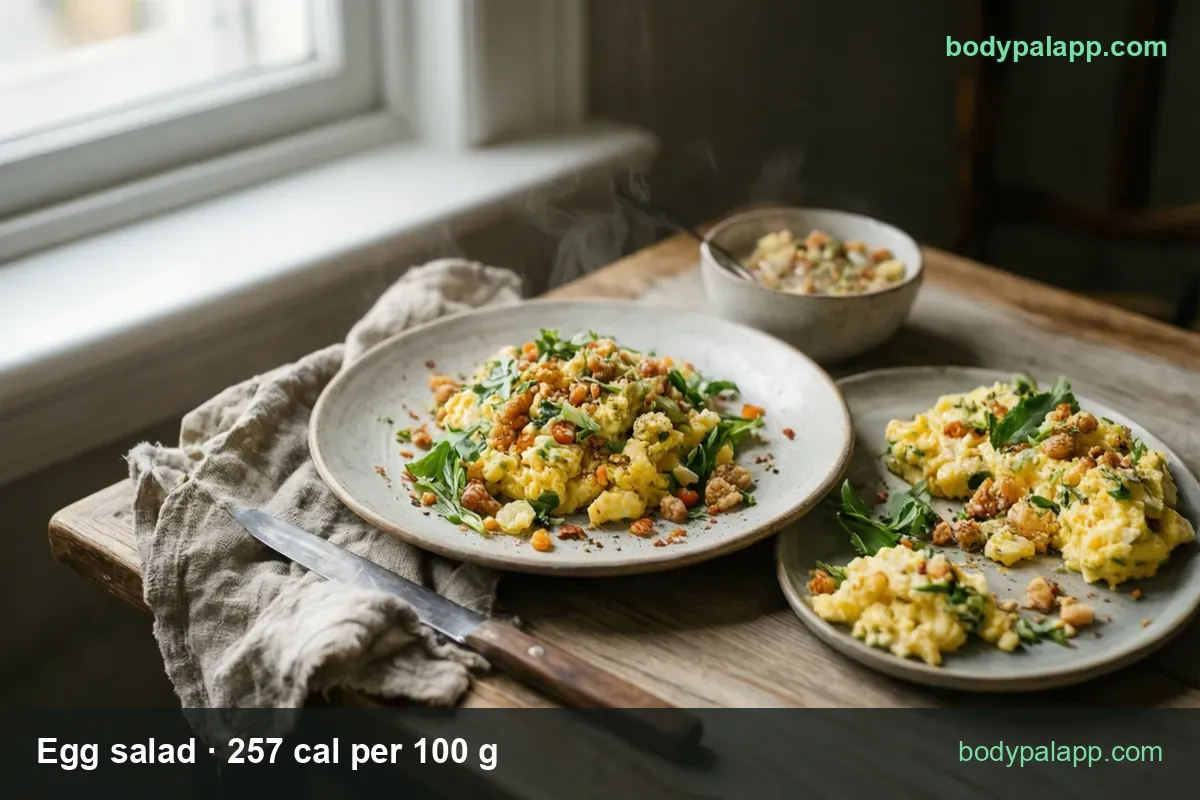
From top to bottom the spread is 118 calories per 100 g, or 131 calories on a half-cup scoop. That is the biggest lever on this page and it has nothing to do with the eggs.
Light mayonnaise is the swap most people reach for, and it works: 257 down to 172 per 100 g, a drop of a third. But look at the last column. Every one of the six alternatives is saltier than the full-fat original, which is the lowest-sodium version in the whole set at 378 mg per 100 g. Italian dressing is the extreme, at 456 mg. Cutting fat out of a dressing usually means putting flavor back with salt, and USDA's own rows show it.
The mayonnaise-type salad dressing row is the sweet-tangy jar most people know by name. It lands at 174 calories per 100 g with 2.95 g of sugar, roughly triple the sugar of the mayonnaise version, and still saves 83 calories per 100 g.
Store tubs sit inside that same range. USDA's Branded records put Gunnoe's at 164 calories per 100 g and Price Chopper at 296, with Taylor Farms 220, Schnucks 230, Good and Gather 240 and Wegmans 280 in between. Brand to brand, the swing is wider than the gap between two dressings, so the tub is worth reading.
Cholesterol is the row that leaves the frame
Most people looking up egg salad expect fat to be the problem. It is 33% of the Daily Value for a half cup, which is high but not remarkable for a mayonnaise-based dish. Cholesterol is the row that actually breaks out: 341 mg in that same half cup, or 114% of the 300 mg Daily Value the FDA uses on nutrition labels. A full cup reaches 682 mg, 227% of the DV.
Saturated fat behaves differently again. At 5.4 g a half cup it is 27% of the DV, and the light versions barely touch it: even the fat-free dressing record still carries 2.67 g per 100 g, because that fat is coming out of the yolks rather than the jar.
The protein side is genuinely good. A half cup delivers 11.4 g, 23% of the Daily Value, and protein hardly moves across the seven records, from 10.26 g down to 9.8 g per 100 g. Eggs count toward the protein foods group in MyPlate, and this is one of the cheaper ways to hit that group at lunch. If you are watching cholesterol or sodium, the quarter-cup scoop on toast with extra greens is the better build; if you are eating for fullness, the half cup with its 11.4 g of protein does more work than a 285-calorie sandwich of almost anything else.
Egg salad on white bread
USDA also files the assembled sandwich as FNDDS 2707280, "Egg salad sandwich on white", at 260 calories per 100 g. That is the number that catches people out, because it is essentially the same density as the filling on its own, 257.
Bread does not dilute egg salad the way you would expect. What it changes is the shape of the calories: 17.07 g of carbohydrate per 100 g against 1.01 g in the plain salad, with fat falling from 23.14 g to 16.62 g and fiber rising from zero to 0.8 g. The record does not give a finished sandwich weight, so we are not going to invent one; weigh yours, or count the filling and the bread separately.
How does egg salad compare?
| Dish | Per 100 g | Portion | Calories |
|---|---|---|---|
| Egg salad, mayonnaise | 257 kcal | 1/2 cup, 111 g | 285 kcal |
| Eggs Benedict | 288 kcal | 100 g plated | 288 kcal |
| Duck egg, cooked | 224 kcal | 100 g | 224 kcal |
| Omelet with cheese and meat, made with oil | 215 kcal | 100 g | 215 kcal |
Our take: gram for gram, egg salad is the second-densest dish here, beaten only by Eggs Benedict and its hollandaise. What separates it from the omelet is not the eggs but the ratio, 23.14 g of fat to 10.26 g of protein, where the cheese-and-meat omelet manages 13.26 g of protein on 17.39 g of fat. For a lunch built around fullness per calorie, the omelet is the better trade. For a cold lunch you can make on Sunday and eat all week, keep the egg salad and control the scoop: a quarter cup at 143 calories on real bread beats a half cup at 285 on a lettuce wrap.
Most popular egg salad brands in the United States
Ranked by how widely each product appears among foods sold in the United States, from the BodyPal food database of over 3.3 million products. Calories are the figures printed on each Nutrition Facts label, checked against USDA FoodData Central.
| Product | Calories (per 100 g) |
|---|---|
| Taylor Farms Egg Salad | 220 cal |
| Gunnoe's Egg Salad | 164 cal |
| Price Chopper Egg Salad | 296 cal |
| Good & Gather Egg Salad | 240 cal |
| Wegmans Egg Salad | 280 cal |
| Schnucks Egg Salad | 230 cal |
Brand popularity: BodyPal food database. Nutrition: manufacturer labels / USDA FoodData Central.
Egg salad FAQs
How many calories are in a half cup of egg salad?
A half cup weighs 111 g and carries 285 calories when it is made with real mayonnaise, at 257 calories per 100 g. That half cup also brings 11.4 g of protein, 25.7 g of fat and 420 mg of sodium, so it lands closer to an entree than a side.
How many calories are in a cup of egg salad?
One cup is 222 g and 571 calories, double the half-cup number. A full cup also carries 682 mg of cholesterol, more than twice the 300 mg Daily Value used on the label. The half-cup and quarter-cup weights on this page are our own arithmetic from the USDA 100 g figure.
How much protein is in egg salad?
Egg salad made with mayonnaise has 10.26 g of protein per 100 g, so a half cup gives 11.4 g and a full cup 22.8 g. That half cup covers 23 percent of the 50 g Daily Value. Protein barely moves between versions: even the fat-free dressing record holds 9.8 g per 100 g.
Is egg salad high in cholesterol?
A half cup carries 341 mg of cholesterol, which is 114 percent of the 300 mg Daily Value the FDA uses on nutrition labels. The yolks drive it, so the number stays high whichever dressing you pick. If that is a figure you track, a quarter-cup scoop keeps it near 170 mg.
How many calories in an egg salad sandwich?
USDA lists an egg salad sandwich on white bread at 260 calories per 100 g, almost the same density as the filling alone at 257. The difference is the carbohydrate: 17.07 g per 100 g against 1.01 g. The record does not give a finished sandwich weight, so we do not guess one.
Does light mayo really cut egg salad calories?
Yes, by about a third. Light mayonnaise takes the salad from 257 to 172 calories per 100 g, so a half cup falls from 285 to 191. Sodium goes the other way, rising from 378 to 423 mg per 100 g. Protein is untouched at roughly 10 g per 100 g.
How many calories in store-bought egg salad?
Retail tubs in the USDA Branded database run from 164 to 296 calories per 100 g. Taylor Farms lists 220, Good and Gather 240, Schnucks 230, Wegmans 280 and Price Chopper 296. Four of those six sit under the 257 of the classic homemade record, so the tub is worth reading.
Is egg salad keto friendly?
A half cup has 1.1 g of carbohydrate against 25.7 g of fat, so carbohydrate is not the number you would be counting here. Watch the dressing swaps though: the fat-free version climbs to 4.29 g of carbohydrate per 100 g, more than four times the 1.01 g in the mayonnaise original.
Similar foods
- Bacon, Egg And Cheese Bagel — 536 cal per sandwich
- Egg Roll — 174 cal per egg roll
- Egg Bagel — 292 cal per medium bagel
- Egg Bagel With Cream Cheese — 292 cal per medium bagel
- Pancake — 423 cal for 3 medium pancakes
- Pancake With Syrup — 141 cal per medium pancake
Count it without the math
Point the camera at the plate and BodyPal counts the scoop for you, dressing and all.


How long does it take to burn off egg salad?
A 1/2-cup (111 g) serving is 285 kcal. Enter your weight and the amount you ate to see how long it takes you to burn that off:
lb
| Activity | Time to burn 285 kcal |
|---|---|
| Walking, brisk | 57 min |
| Cycling, moderate | 36 min |
| Swimming, moderate | 41 min |
| Jogging | 34 min |
| Weight training, moderate | 1 hr 3 min |
Times are for a 155 lb adult at a steady pace; change the weight to see yours. The amount is set to the portion in the text (111 g); change it to what you actually ate. BodyPal works this out from your steps automatically.
One food is easy to picture; a whole day is harder. See how many calories you need a day and what a deficit actually looks like.