
How many calories are in an egg roll?
One restaurant-style egg roll weighs about 64 g and carries 174 calories. Per 100 g the fried roll runs 272 calories, which puts it in the same range as a bao bun and well above a fried wonton. Order two with fried rice and the appetizer alone is 348 calories.
On this page
- Egg roll quick facts
- US servings from one mini roll to a full cup
- Fillings and how much they change the count
- Frozen and refrigerated rolls
- Sodium is the row to watch
- How does an egg roll compare?
- Most popular egg roll brands
- Egg roll FAQs
Egg roll quick facts
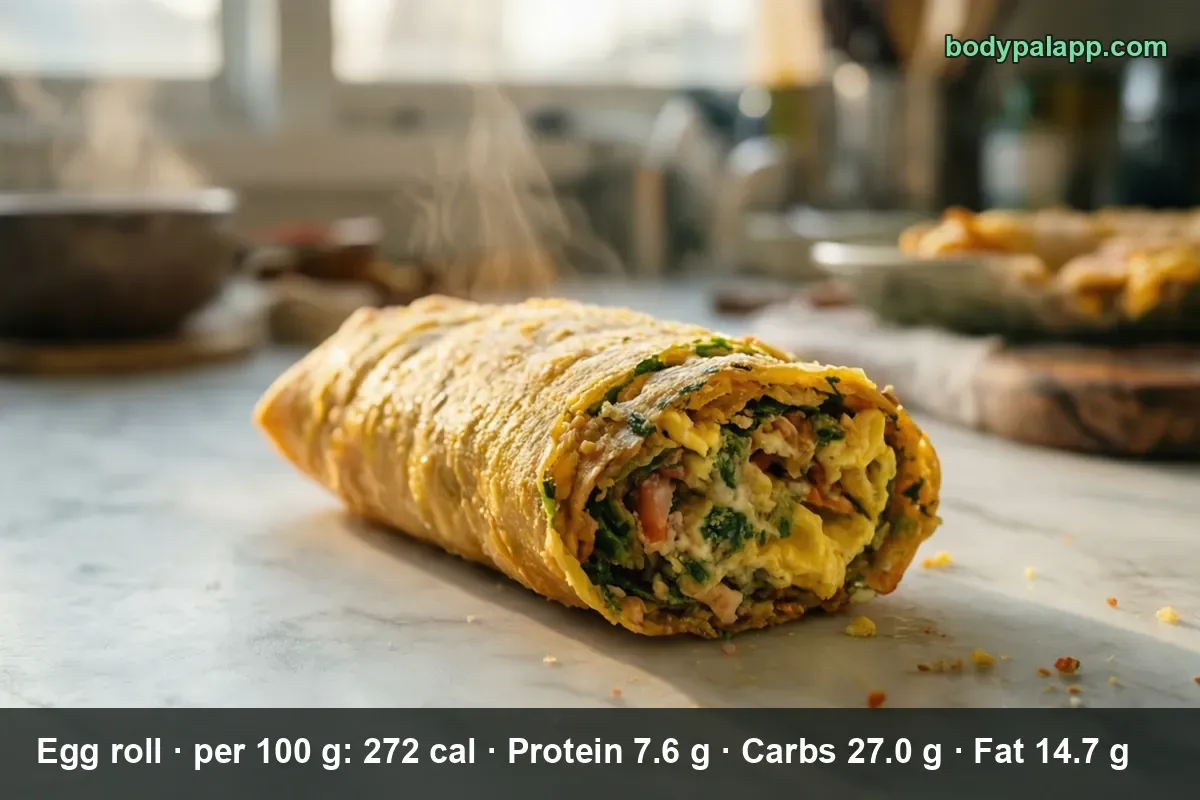
The record that matches what most Americans actually pick up is FNDDS 2708702, "Egg roll, with beef and/or pork" — a wheat wrapper around cabbage and ground meat, deep-fried, the standard takeout and food-court appetizer. USDA attaches a household measure to it, "1 egg roll" at 64 g, so the per-roll column below is a published portion rather than a guess.
A soft, omelet-style rolled egg is a different dish that shares the name in some kitchens, and USDA has no separate entry for it, so every number on this page describes the fried version.
| Nutrient | Per 100 g | Per 1 egg roll (64 g) | % Daily Value |
|---|---|---|---|
| Calories | 272 | 174 | — |
| Total fat | 14.7 g | 9.4 g | 12% |
| Saturated fat | 2.44 g | 1.6 g | 8% |
| Carbohydrate | 27.02 g | 17.3 g | 6% |
| Dietary fiber | 2 g | 1.3 g | 5% |
| Total sugars | 5.07 g | 3.2 g | — |
| Protein | 7.58 g | 4.9 g | 10% |
| Sodium | 447 mg | 286 mg | 12% |
% Daily Value is based on a 2,000-calorie diet.
Verified nutrition data
Numbers on this page come from USDA FoodData Central, the U.S. Department of Agriculture’s food composition database, and from manufacturer labels where a branded product is named. Last verified September 2026. How we verify our data →
There is no added sugars row and no trans fat row here, because this FNDDS release does not publish either value for the dish. Cholesterol is modest at 9 mg per 100 g, or 6 mg in a roll — 2% of the Daily Value — and potassium comes to 141 mg per roll, roughly 3%.
US servings from one mini roll to a full cup
| Serving | Weight | Calories |
|---|---|---|
| 1 miniature roll | 13 g | 35 kcal |
| 1 oz | 28 g | 77 kcal |
| One egg roll, standard size | 64 g | 174 kcal |
| 1 cup of small or cut rolls | 125 g | 340 kcal |
| Two egg rolls | 128 g | 348 kcal |
| Per 100 g | 100 g | 272 kcal |
The miniature roll, the ounce, the full roll and the cup are all USDA household measures for this record. The two-roll line is our own arithmetic from the USDA 100 g figure, not a USDA serving, and it exists because takeout orders rarely arrive as one.
Watch the cup. It is the single most misleading measure on this food: a cup of cocktail-size rolls packs 125 g, so it lands at 340 calories — almost double one full-size roll, even though both get logged with the word "serving." If you are eating from a party tray, count pieces instead. Ten miniature rolls, at 13 g each, come to about the same as two dinner-size ones.
Fillings and how much they change the count
| Version | Per 100 g | Typical piece | Calories |
|---|---|---|---|
| With beef or pork | 272 kcal | 1 egg roll (64 g) | 174 kcal |
| With chicken or turkey | 266 kcal | 1 egg roll (64 g) | 170 kcal |
| Meatless | 270 kcal | 1 egg roll (64 g) | 173 kcal |
| With shrimp | 258 kcal | 1 egg roll (64 g) | 165 kcal |
| Restaurant assorted | 250 kcal | 1 egg roll (64 g) | 160 kcal |
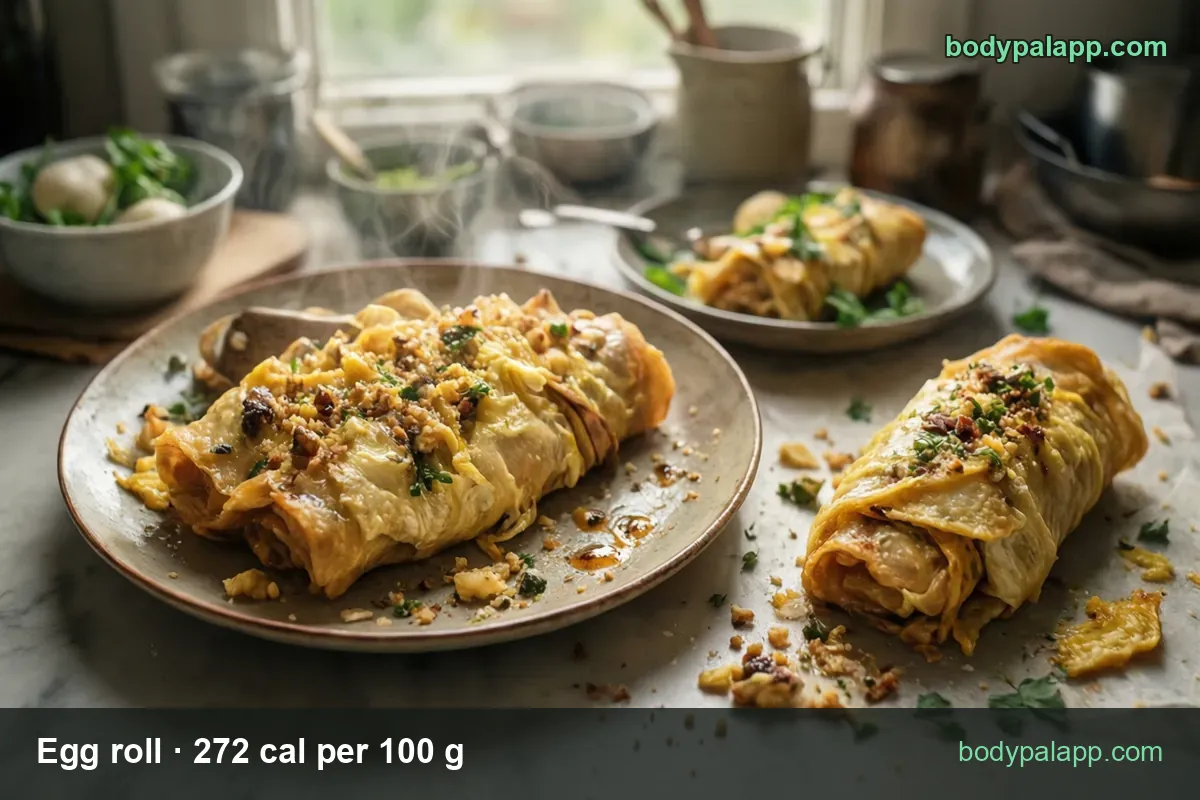
Nine calories separate the heaviest of the four named fillings from the lightest. That is the useful finding here: the choice at the counter between pork, chicken and shrimp is close to meaningless for calories, because the wrapper and the fryer set the number before the filling gets a vote.
The meatless roll makes the point clearly. At 173 calories it is one calorie under the pork roll, but the composition shifts — 30.02 g of carbohydrate per 100 g instead of 27.02 g, and 5.62 g of protein instead of 7.58 g. Ordering vegetable to eat lighter buys nothing; ordering it to eat less meat is a fair reason.
The restaurant assorted line comes from SR Legacy 167667, a mixed sample of Chinese-restaurant rolls, and its 160-calorie piece is our own arithmetic scaled to 64 g rather than a USDA serving. It sits lowest of the fried group at 250 calories per 100 g, with the most fiber, 2.6 g.
Frozen and refrigerated rolls
The freezer aisle is where the number really moves.
| Version | Per 100 g | Typical piece | Calories |
|---|---|---|---|
| Frozen vegetable roll, prepared | 214 kcal | 1 roll (68 g) | 146 kcal |
| Refrigerated pork roll, heated | 227 kcal | 1 roll (85 g) | 193 kcal |
| Refrigerated chicken roll, heated | 197 kcal | 1 roll (85 g) | 167 kcal |
Frying is the whole story. The refrigerated pork roll heated in an oven runs 227 calories per 100 g against 272 for the fried takeout roll — scale that to a 64 g piece by our own arithmetic and you get about 145 calories, roughly 29 fewer than the fried one, with 9.94 g of protein per 100 g instead of 7.58 g and 8.18 g of fat instead of 14.7 g. The refrigerated chicken roll is leaner still at 197 calories per 100 g and only 4.51 g of fat; its 85 g piece in the table is our own arithmetic from that 100 g figure.
Package labels track this closely. Pagoda lists 150 calories for a 71 g roll and 180 for its 78 g pork roll, Tai Pei 140 for a 71 g vegetable roll, and Chung's 330 calories for two shrimp rolls with sauce in a 170 g serving. Only the 78 g Pagoda pork roll, at 180, tops the 174 of a single takeout roll, mostly because frozen rolls are baked or air-fried at home rather than dropped in oil.
Sodium is the row to watch
Fat gets the attention and salt does the damage. One roll is 286 mg of sodium — 12% of the 2,300 mg Daily Value, about an eighth of a teaspoon of table salt — while total fat sits at the same 12% and saturated fat at only 8%. Two rolls and you are at 572 mg, a quarter of the day, before any duck sauce or soy.
The counterintuitive part: the vegetable rolls are the salty ones. The frozen vegetable record carries 490 mg of sodium per 100 g and the meatless fried roll 463 mg, both above the pork roll's 447 mg. Cabbage-and-carrot filling needs seasoning that meat brings on its own. If you are watching sodium rather than calories, the meat rolls are the better pick, which reverses the usual assumption.
Protein is the weak spot. At 4.9 g per roll, 10% of the Daily Value, an egg roll is mostly wrapper — a grain food wearing a protein-food costume, in MyPlate terms. Two rolls give just 9.8 g of protein for about 350 calories, which is why they work better beside a main dish than as one.
How does an egg roll compare?
| Appetizer | Per 100 g | US serving | Calories |
|---|---|---|---|
| Egg roll, beef or pork | 272 kcal | one roll (64 g) | 174 kcal |
| Fried wonton or pot sticker | 192 kcal | 1 oz (28 g) | 54 kcal |
| Crab and cream cheese puff | 314 kcal | 1 oz (28 g) | 89 kcal |
| Bao bun | 273 kcal | one ounce (28 g) | 77 kcal |
Our take: per gram the egg roll is unremarkable — only the fried wonton is lighter among these four, and the bao bun matches it within a single calorie. What makes an egg roll expensive is size. It arrives as a 64 g log, while wontons and crab puffs arrive in ounces you can stop at. If you want the fried appetizer and the smaller number, order the wontons and take three; if you want the egg roll, take one and treat the 174 calories as part of the meal rather than a preamble to it. For a lighter version of the same craving, a frozen vegetable roll heated at home is 146.
Most popular egg roll brands in the United States
Ranked by how widely each product appears among foods sold in the United States, from the BodyPal food database of over 3.3 million products. Calories are the figures printed on each Nutrition Facts label, checked against USDA FoodData Central.
| Product | Calories (per 100 g) |
|---|---|
| Tai Pei Vegetable Egg Rolls | 197 cal |
| Pagoda Egg Rolls | 211 cal |
| Pagoda Pork Egg Rolls | 231 cal |
| Pagoda Chicken Egg Rolls | 192 cal |
| Pagoda Vegetable Egg Rolls | 161 cal |
| Chung's Shrimp Egg Roll | 194 cal |
Brand popularity: BodyPal food database. Nutrition: manufacturer labels / USDA FoodData Central.
Egg roll FAQs
How many calories are in one egg roll?
174 calories for a standard 64 g egg roll with beef or pork, the USDA household portion. That works out to 272 calories per 100 g. Two rolls, the way most takeout orders arrive, come to 348 calories, and a 1-cup serving of smaller rolls reaches 340.
How many calories in a pork egg roll?
A 64 g pork egg roll is 174 calories, since USDA files beef and pork under one record at 272 calories per 100 g. A larger refrigerated pork roll that you heat instead of deep-fry weighs 85 g and lands at 193 calories, with more protein and noticeably less fat per gram.
How many calories in a chicken egg roll?
170 calories in a 64 g chicken or turkey egg roll, four fewer than the pork version. Per 100 g it is 266 calories against 272, so the filling barely moves the total. The wrapper and the fryer oil, not the meat, decide most of the number here.
How many calories in a shrimp egg roll?
165 calories for a 64 g shrimp egg roll, the lightest of the four fried fillings USDA lists. It runs 258 calories per 100 g with 13.61 g of fat, against 14.7 g in the pork roll. Chung's frozen shrimp rolls are labeled 330 calories for two rolls with sauce.
How many calories in a vegetable egg roll?
173 calories in a 64 g meatless egg roll, essentially the same as the pork version at 174. Skipping the meat trades protein for carbohydrate rather than cutting calories. A frozen vegetable egg roll prepared at home is the lighter choice: 68 g and 146 calories, or 214 per 100 g.
Are frozen egg rolls lower in calories than takeout?
Yes, by roughly 21 percent per gram. A prepared frozen vegetable egg roll is 214 calories per 100 g against 272 for the fried takeout roll with meat. Frozen rolls also land lower: Pagoda lists 150 calories for a 71 g roll, Tai Pei 140 for 71 g.
How much sodium is in an egg roll?
286 mg in one 64 g egg roll, 12 percent of the 2,300 mg Daily Value and about an eighth of a teaspoon of table salt. Two rolls put you at 572 mg before the soy sauce. Frozen vegetable rolls are saltier per gram than pork ones: 490 mg against 447.
How many carbs are in an egg roll?
17.3 g of carbohydrate in one 64 g egg roll, 6 percent of the Daily Value, with 1.3 g of that as fiber and 3.2 g as sugars. Most of it is the wrapper. A meatless roll carries more, 30.02 g per 100 g against 27.02 g in the pork one.
Similar foods
- Pancake — 423 cal for 3 medium pancakes
- Crepe — 179 cal per crepe
- Omelet — 305 cal for 3-egg omelet
- Toast with butter — 100 cal per slice with butter
- Egg — 72 cal per large egg
- French Bread — 174 cal per medium slice
Count it without the math
Point the camera at the plate and BodyPal counts the egg rolls for you, wrapper and filling together.


How long does it take to burn off an egg roll?
One egg roll (64 g) is 174 kcal. Enter your weight and the amount you ate to see how long it takes you to burn that off:
lb
| Activity | Time to burn 174 kcal |
|---|---|
| Walking, brisk | 35 min |
| Cycling, moderate | 22 min |
| Swimming, moderate | 25 min |
| Jogging | 20 min |
| Weight training, moderate | 39 min |
Times are for a 155 lb adult at a steady pace; change the weight to see yours. The amount is set to the portion in the text (64 g); change it to what you actually ate. BodyPal works this out from your steps automatically.
This table assumes you know your daily total. If you do not, the daily calorie calculator works it out from five numbers.