
How many calories are in a bacon, egg and cheese bagel?
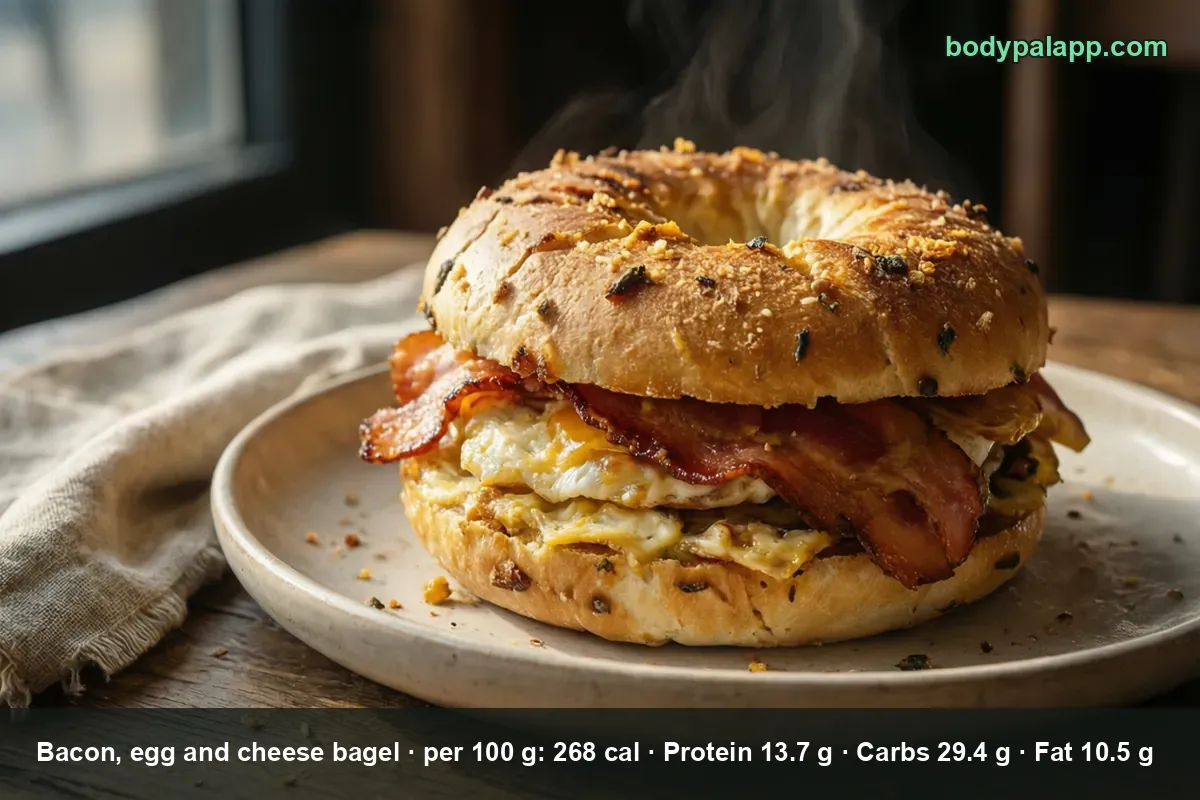
A regular bacon, egg and cheese bagel weighs 200 g and carries 536 calories. Per 100 g the sandwich runs 268 calories, which is modest for a breakfast sandwich. The weight is what gets you. The bagel alone accounts for more than half the grams, and the bacon plus melted cheese do the rest.
On this page
- Bacon egg and cheese bagel quick facts
- US servings from one ounce to a large deli bagel
- Swap the bacon and the number moves
- Sodium and cholesterol are the rows to watch
- How does a bacon egg and cheese bagel compare
- Most popular bacon, egg and cheese bagel brands
- FAQ
Bacon egg and cheese bagel quick facts
The number on this page comes from the USDA record FNDDS 2707330, "Egg sandwich on bagel, with bacon". The current FNDDS release does not publish a separate line for "bagel with bacon and cheese", and that trips up a lot of calorie counters. This row is the one to use anyway: its calcium runs 145 mg per 100 g, far above what egg and bread alone would give, which is the fingerprint of cheese already sitting in the mix. It also ships with a real US household portion, one regular sandwich at 200 g, so nothing has to be invented.
The other candidates are the same filling on a different bread. Biscuit, croissant and English muffin versions each get their own USDA line, and they behave differently because the bread carries its own fat. Those stay in the comparison table below, not in this one.
| Nutrient | Per 100 g | Per one sandwich (200 g) | % Daily Value |
|---|---|---|---|
| Calories | 268 | 536 | — |
| Total fat | 10.54 g | 21.1 g | 27% |
| Saturated fat | 4.063 g | 8.1 g | 41% |
| Carbohydrate | 29.43 g | 58.9 g | 21% |
| Dietary fiber | 0.9 g | 1.8 g | 6% |
| Total sugars | 4.93 g | 9.9 g | — |
| Protein | 13.71 g | 27.4 g | 55% |
| Sodium | 536 mg | 1072 mg | 47% |
| Cholesterol | 123 mg | 246 mg | 82% |
| Potassium | 147 mg | 294 mg | 6% |
% Daily Value is based on a 2,000-calorie diet.
Verified nutrition data
Numbers on this page come from USDA FoodData Central, the U.S. Department of Agriculture’s food composition database, and from manufacturer labels where a branded product is named. Last verified September 2026. How we verify our data →
Two rows you would see on a wrapper are missing here: added sugars and trans fat. USDA does not publish either value for prepared breakfast dishes in this dataset, so guessing them would be worse than leaving them out. The 9.9 g of total sugars in a sandwich is mostly what the bagel dough and the cheese bring, not syrup, and total sugars have no Daily Value to compare against.
US servings from one ounce to a large deli bagel
| Serving | Weight | Calories |
|---|---|---|
| 1 oz | 28.4 g | 76 kcal |
| One miniature or slider sandwich | 100 g | 268 kcal |
| One regular sandwich | 200 g | 536 kcal |
| One large deli sandwich | 300 g | 804 kcal |
| Per 100 g | 100 g | 268 kcal |
Three of those are USDA household measures: the miniature, the regular and the large. The ounce row is our own arithmetic from the USDA 100 g figure, not a USDA serving, and it is only useful if you are weighing a piece of one.
Here is the part worth remembering. Between a slider and a large deli sandwich the recipe never changes — same bagel dough, same bacon, same cheese, same egg — and the calories still triple, from 268 to 804. A 536-calorie answer is only correct for a 200 g sandwich. A hand-formed bagel from a New York-style deli often clears 300 g on its own before anything goes inside it, while a drive-through sandwich is usually closer to the 200 g line. If you log this breakfast often, one trip to a kitchen scale is worth more than any calorie chart.
Half a sandwich is 268 calories, since half of 200 g is 100 g. Half of the large one is 402. Both are our own scaling from the USDA 100 g value.
Swap the bacon and the number moves

Each version below is its own USDA record, not an estimate scaled off the bacon row.
| Version | Per 100 g | Typical serving | Calories |
|---|---|---|---|
| Bacon, egg and cheese bagel | 268 kcal | 1 sandwich, 200 g | 536 kcal |
| Sausage, egg and cheese bagel | 274 kcal | 1 sandwich, 230 g | 630 kcal |
| Ham, egg and cheese bagel | 238 kcal | 1 sandwich, 205 g | 488 kcal |
| Egg and cheese bagel, no meat | 251 kcal | 1 sandwich, 185 g | 464 kcal |
| Steak, egg and cheese bagel | 282 kcal | 1 item, 254 g | 716 kcal |
| Plain egg bagel, no filling | 278 kcal | 1 medium bagel, 105 g | 292 kcal |
Per 100 g these six sit in a narrow band, from 238 to 282. Per sandwich they spread from 292 to 716, and the reason is grams, not richness. Sausage adds a patty; a breakfast steak adds even more. Ham is the leanest meat of the group at 238 calories per 100 g, and skipping meat entirely lands you at 464 for a smaller 185 g sandwich.
The plain egg bagel row is the one that surprises people: the bread by itself is 278 calories per 100 g, denser than the finished bacon sandwich at 268, because egg and cheese are wetter than dough. A medium egg bagel with nothing on it is already 292 calories.
Packaged versions vary just as much. USDA Branded lists Bagel Bites mini bagels topped with bacon, egg and cheese at 216 calories per 100 g (190 for a 4-piece, 88 g serving) and Bantam Bagels bacon bagel bites at 256 per 100 g. A frozen Raise The Roost bacon, egg and cheese bagel runs 326 calories per 100 g, so its 184.3 g sandwich reaches 601 calories — more than the USDA reference sandwich despite weighing less.
Sodium and cholesterol are the rows to watch
The calorie count is unremarkable for a breakfast sandwich. Two other rows are not.
Sodium first: 1,072 mg in one regular sandwich, 47% of the 2,300 mg Daily Value the FDA uses. That is roughly half a teaspoon of table salt, before coffee, before a hash brown, before anything else in the day. Cured bacon, cheese and salted bagel dough each contribute, which is why the meatless version still lands at 437 mg per 100 g. For scale, the biscuit-with-bacon-and-cheese record carries 804 mg per 100 g against 536 mg here — the biscuit is saltier gram for gram, and the bagel simply gives you more grams.
Cholesterol quietly outranks protein on the label: 246 mg per sandwich is 82% of the Daily Value, while 27.4 g of protein is 55%. Saturated fat sits at 8.1 g, or 41% of a day's 20 g, and the Dietary Guidelines for Americans suggest keeping saturated fat under 10% of daily calories.
The protein is genuinely good, though. At 27.4 g this beats most breakfast pastries and most cereal bowls, and MyPlate counts egg, cheese and bacon toward the protein group. If you are watching sodium, the ham or plain egg-and-cheese build is the better pick; if you are chasing protein per calorie, the steak version delivers 15.95 g per 100 g, the highest of any row on this page.
How does a bacon egg and cheese bagel compare
| Sandwich | Per 100 g | US serving | Calories | Protein |
|---|---|---|---|---|
| Bacon, egg and cheese bagel | 268 kcal | 1 regular, 200 g | 536 kcal | 13.71 g/100 g |
| Egg and cheese bagel, no meat | 251 kcal | 1 regular, 185 g | 464 kcal | 11.97 g/100 g |
| Sausage, egg and cheese bagel | 274 kcal | 1 regular, 230 g | 630 kcal | 12.83 g/100 g |
| Fast-food bagel with egg, sausage patty and cheese | 295 kcal | 1 item, 219 g | 646 kcal | 12.98 g/100 g |
Our take: the bacon build is the middle of this group and the best deal on it. It is the second lightest per 100 g of the four, the second lightest per serving, and it carries the most protein per 100 g of any of them. The restaurant sausage sandwich costs 110 calories more than the bacon one for less protein per gram, which is a bad trade unless you want the sausage. Dropping meat altogether saves 72 calories on a smaller sandwich — real, but smaller than most people expect, because the bagel was never the part you were negotiating with.
Most popular bacon, egg and cheese bagel brands in the United States
Ranked by how widely each product appears among foods sold in the United States, from the BodyPal food database of over 3.3 million products. Calories are the figures printed on each Nutrition Facts label, checked against USDA FoodData Central.
| Product | Calories (per 100 g) |
|---|---|
| Bagel Bites Mini Bagels Topped With Bacon, Eggs and Cheese | 216 cal |
| Bantam Bagels Bacon Bagel Bite Stuffed With Bacon, Egg and Cheese | 256 cal |
| Raise The Roost Bacon, Egg and Cheese Bagel | 326 cal |
Brand popularity: BodyPal food database. Nutrition: manufacturer labels / USDA FoodData Central.
Bacon egg and cheese bagel FAQs
How many calories are in a bacon, egg and cheese bagel?
536 calories in one regular sandwich weighing 200 g, which works out to 268 calories per 100 g. A large deli-size version at 300 g reaches 804. The bagel carries most of the carbohydrate, while the bacon and cheese supply the fat that pushes the total past 500.
How much protein is in a bacon, egg and cheese bagel?
27.4 g of protein in a 200 g sandwich, 55% of the Daily Value. That is more than most breakfast pastries deliver, and it arrives from three places at once: the egg, the cheese in the mix, and the bacon. Per 100 g the figure is 13.71 g.
How many carbs are in a bacon, egg and cheese bagel?
58.9 g of carbohydrate per 200 g sandwich, 21% of the Daily Value, with only 1.8 g of fiber and 9.9 g of total sugars alongside it. Nearly all of that is the bagel. A plain egg bagel with no filling already carries 53 g of carbohydrate per 100 g.
Is a bacon, egg and cheese bagel healthy?
It lands at 536 calories, 8.1 g of saturated fat (41% of the Daily Value) and 1,072 mg of sodium (47%), which is a lot for one breakfast, though it also brings 27.4 g of protein. If you are watching sodium or saturated fat, the egg and cheese version without meat is the lighter pick at 464 calories.
How much sodium is in a bacon, egg and cheese bagel?
1,072 mg of sodium in one 200 g sandwich, 47% of the 2,300 mg Daily Value the FDA uses. That is roughly half a teaspoon of table salt before you add anything else. Cured bacon and cheese carry most of it, and the ham version is barely lower at 510 mg per 100 g.
Which has more calories, the bacon or the sausage version?
Sausage wins by 94 calories: 630 for a 230 g sausage, egg and cheese bagel against 536 for the 200 g bacon version. Per 100 g the two are close, 274 against 268. The gap is mostly serving weight, since a sausage patty adds more grams than two strips of bacon.
How many calories are in half a bacon, egg and cheese bagel?
268 calories for half a regular sandwich, because half of 200 g is 100 g and the food runs 268 calories per 100 g. That is our own arithmetic from the USDA 100 g figure, not a USDA serving. Half of a large 300 g sandwich would be 402 calories.
How many calories are in a bagel with just egg and cheese?
464 calories for a 185 g egg and cheese bagel with no meat, at 251 calories per 100 g. That is 72 calories under the bacon sandwich, though it is also a smaller serving. Sodium falls from 536 mg to 437 mg per 100 g and fat from 10.54 g to 8.43 g.
Similar foods
- Pancake — 423 cal for 3 medium pancakes
- Crepe — 179 cal per crepe
- Omelet — 305 cal for 3-egg omelet
- Toast with butter — 100 cal per slice with butter
- Egg — 72 cal per large egg
- Bread — 75 cal per medium slice
Count it without the math
Point the camera at the plate and BodyPal counts the bagel, the bacon and the cheese for you.


How long does it take to burn off 536 kcal of bacon egg cheese bagel?
One sandwich (200 g) is 536 kcal. Enter your weight and the amount you ate to see how long it takes you to burn that off:
lb
| Activity | Time to burn 536 kcal |
|---|---|
| Walking, brisk | 1 hr 47 min |
| Cycling, moderate | 1 hr 7 min |
| Swimming, moderate | 1 hr 17 min |
| Jogging | 1 hr 3 min |
| Weight training, moderate | 1 hr 59 min |
Times are for a 155 lb adult at a steady pace; change the weight to see yours. The amount is set to the portion in the text (200 g); change it to what you actually ate. BodyPal works this out from your steps automatically.
Burning it off is one side of it. The other is knowing your number: work out how many calories you need a day, with macros and a goal date.