
How many calories are in an egg yolk?
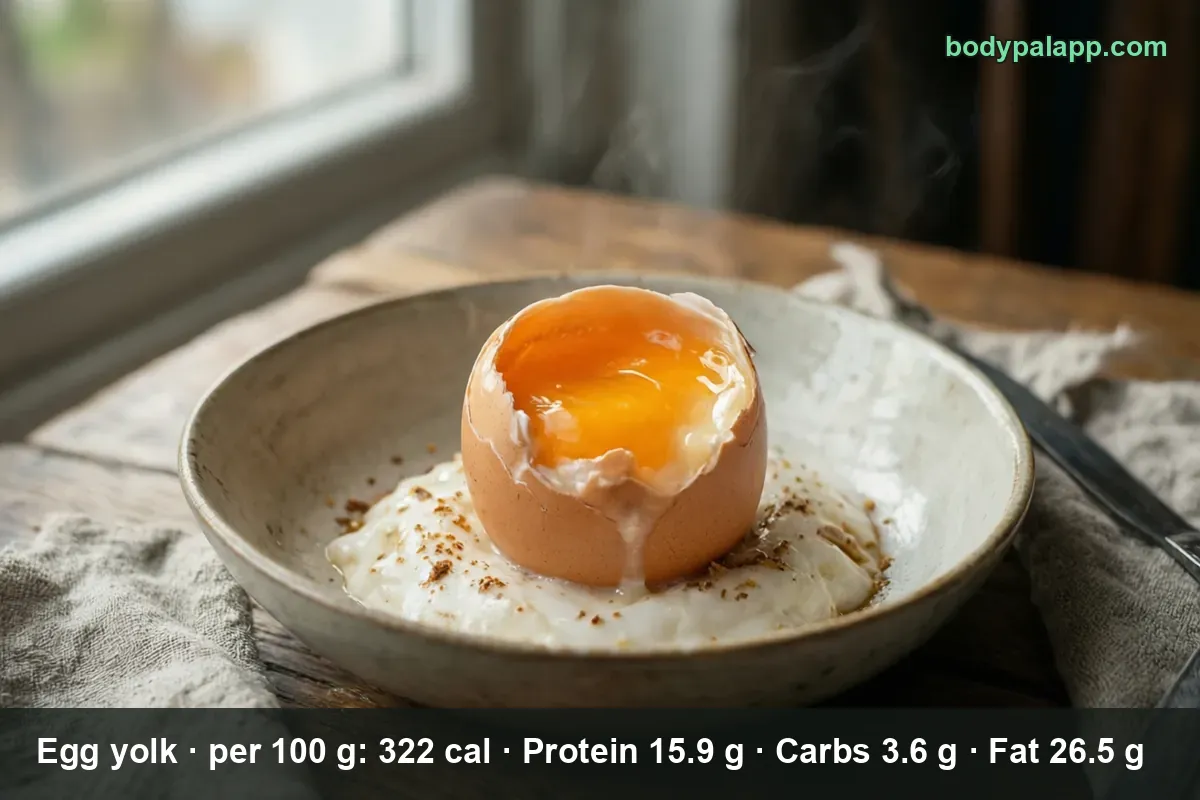
One large egg yolk weighs 17 grams and carries 55 calories. Per 100 grams raw yolk runs 322 calories, denser than most people expect from something that fits in a spoon. Nearly all of it is fat: 4.5 g in that single yolk, against just 2.7 g of protein.
On this page
- Egg yolk quick facts
- US servings, from one yolk to a full cup
- Raw, cooked, liquid and dried yolks
- Cholesterol is the row that moves
- How does an egg yolk compare?
- Most popular egg yolk brands
- Egg yolk FAQs
Egg yolk quick facts
The row this page is built on is SR Legacy 172184, "Egg, yolk, raw, fresh". It is the record for the thing you actually crack open, and it is the only yolk entry with a complete label profile plus a household measure of one large yolk at 17 grams. A newer Foundation analysis of the same food (748236) puts raw yolk slightly higher at 334 calories per 100 grams, but it reports no saturated fat, sugars, sodium or cholesterol, so it cannot carry a nutrition table on its own.
| Nutrient | Per 100 g | Per 1 large yolk (17 g) | % Daily Value |
|---|---|---|---|
| Calories | 322 | 55 | — |
| Total fat | 26.54 g | 4.5 g | 6% |
| Saturated fat | 9.55 g | 1.6 g | 8% |
| Carbohydrate | 3.59 g | 0.6 g | 0% |
| Dietary fiber | 0 g | 0 g | 0% |
| Total sugars | 0.56 g | 0.1 g | — |
| Protein | 15.86 g | 2.7 g | 5% |
| Sodium | 48 mg | 8 mg | 0% |
| Cholesterol | 1085 mg | 184 mg | 61% |
| Potassium | 109 mg | 19 mg | 0% |
% Daily Value is based on a 2,000-calorie diet.
Verified nutrition data
Numbers on this page come from USDA FoodData Central, the U.S. Department of Agriculture’s food composition database, and from manufacturer labels where a branded product is named. Last verified September 2026. How we verify our data →
Two rows you would see on a package are missing here on purpose: added sugars and trans fat. USDA does not publish either value for fresh raw yolk in this record, so guessing them would be worse than leaving them out.
The shape of the table is the story. A yolk is a fat with some protein dissolved in it, not a protein food with fat attached. Carbohydrate is a rounding error at 0.6 g, fiber is flat zero, and sodium is 8 mg, which is nothing at all until somebody salts the pan.
US servings, from one yolk to a full cup
| Serving | Weight | Calories |
|---|---|---|
| One large yolk | 17 g | 55 kcal |
| 1 oz | 28.35 g | 91 kcal |
| Two large yolks | 34 g | 109 kcal |
| Three large yolks | 51 g | 164 kcal |
| Per 100 g | 100 g | 322 kcal |
| One cup of yolks | 243 g | 782 kcal |
Only two of those are USDA household measures: one large yolk at 17 grams, and one cup at 243 grams. The two-yolk, three-yolk and one-ounce lines are our own arithmetic from the USDA 100 gram figure, not USDA servings, though the math is simple enough that it holds.
The cup is where people get caught. A cup of yolks holds roughly 14 of them and lands at 782 calories with about 64 grams of fat, so a custard or a hollandaise built on yolks starts out heavy before a drop of cream or butter joins it. If you cook by count rather than by cup, the running total is easy: 55 calories a yolk, and six yolks in a recipe is 330 calories of yolk alone.
USDA fixes "1 large" at 17 grams. Medium and jumbo eggs shift that a gram or two in either direction, and USDA does not publish separate yolk weights by egg size, so treat 55 calories as the number for a standard large egg rather than a universal constant.
Raw, cooked, liquid and dried yolks
| Version | Per 100 g | Typical piece | Calories |
|---|---|---|---|
| Raw fresh yolk | 322 kcal | 1 large yolk, 17 g | 55 kcal |
| Cooked yolk, no added fat | 327 kcal | 1 large yolk, 17 g | 56 kcal |
| Cooked yolk, fat added | 357 kcal | 1 large yolk, 17 g | 61 kcal |
| Liquid pasteurized yolk | 296 kcal | 1 oz, 28.35 g | 84 kcal |
| Salted pasteurized yolk | 275 kcal | 1 oz, 28.35 g | 78 kcal |
| Dried yolk powder | 669 kcal | 1 tbsp, 4 g | 27 kcal |
Cooking a yolk with no added fat moves it from 322 to 327 calories per 100 grams. That is water leaving, not calories arriving, and on a single yolk it is the difference between 55 and 56. Sodium is the row that actually changes: the cooked record shows 164 mg per 100 grams against 48 mg raw, which is the salt of the cooking, not the egg.
Fry it and USDA's "cooked, fat added" record reaches 357 calories per 100 grams, or 61 calories for one yolk. Five calories. Whatever you pour into the pan is the real cost, since a tablespoon of butter or oil outweighs the yolk's own increase several times over.
The two carton products go the other way. Liquid pasteurized yolk sits at 296 and salted pasteurized yolk at 275 calories per 100 grams, the only two versions here lighter per gram than fresh. Both carry more water, and the salted one trades fat for salt in a way worth watching: 3,487 mg of sodium per 100 grams, more than 70 times the fresh yolk. An ounce of it would be 989 mg of sodium, 43% of the Daily Value, though that ounce is our own arithmetic from the USDA 100 gram figure rather than a USDA serving. It is an industrial ingredient, and it behaves like one.
Dried yolk powder is a different animal at 669 calories per 100 grams, more than double raw, because there is no water left. Judge it by the tablespoon: 4 grams, 27 calories. Comparing powder to fresh yolk gram for gram tells you nothing useful.
USDA Branded holds no packaged product that is plain egg yolk. A search returns mayonnaise, nougat, moon cakes, egg noodles and meat bars with "yolk" in the ingredient list, none of which is the food on this page.
Cholesterol is the row that moves
One yolk is 55 calories and 184 mg of cholesterol. That is 61% of the FDA Daily Value of 300 mg from a food you can eat in two bites. Two yolks reach 368 mg, 123% of the Daily Value, and a three-yolk omelet filling hits 552 mg. Nothing else on the label comes close to that percentage: saturated fat is 8% per yolk, protein 5%, sodium and carbohydrate round to zero.
The Dietary Guidelines for Americans no longer set a numeric cap on dietary cholesterol; they advise keeping it as low as possible while eating a healthy pattern, which leaves the arithmetic above as the practical guide rather than a hard limit.
The protein assumption is the other thing to unlearn. A yolk gives 2.7 g of protein, 5% of the Daily Value, next to 4.5 g of fat. If you are chasing protein, MyPlate's protein foods page points at whole eggs, poultry, fish and beans for a reason: yolk-only recipes are rich, not high in protein. If you are watching saturated fat, three yolks put you at 4.8 g, roughly a quarter of the day's 20 g.
How does an egg yolk compare?
| Food | Per 100 g | US serving | Calories |
|---|---|---|---|
| Egg yolk, raw | 322 kcal | 1 oz (28.35 g) | 91 kcal |
| Dried whole egg | 592 kcal | 1 oz (28.35 g) | 168 kcal |
| Dried whole egg, glucose reduced | 615 kcal | 1 oz (28.35 g) | 174 kcal |
| Butter, salted | 717 kcal | 1 oz (28.35 g) | 203 kcal |
Every ounce in that table is our own arithmetic from the USDA 100 gram figures, since none of these foods carries a one-ounce USDA serving.
Our take: fresh yolk is the lightest per gram of the four, at less than half the density of butter, and the comparison shows why the yolk gets a worse reputation than it earns on calories. The problem is never the 55 calories. It is that yolks arrive in threes and sixes, in sauces and custards, alongside the butter they are being whisked into. Count the yolks by the piece and the number stays small; count them by the cup and it is 782.
Most popular egg yolk brands in the United States
Ranked by how widely each product appears among foods sold in the United States, from the BodyPal food database of over 3.3 million products. Calories are the figures printed on each Nutrition Facts label, checked against USDA FoodData Central.
| Product | Calories (per 100 g) |
|---|---|
| Eggland's Best Large Brown Eggs | 120 cal |
| Kirkland Signature Cage Free Large Eggs | 140 cal |
| Pete and Gerry's Fresh Large Brown Eggs | 140 cal |
| The Happy Egg Co Brown Eggs | 140 cal |
| Organic Valley Omega-3 Organic Large Brown Eggs | 120 cal |
| Member's Mark Grade A Large Cage Free Brown Eggs | 140 cal |
Brand popularity: BodyPal food database. Nutrition: manufacturer labels / USDA FoodData Central.
Egg yolk FAQs
How many calories are in one egg yolk?
55 calories for one large yolk of 17 grams, based on USDA's raw fresh yolk at 322 calories per 100 grams. Almost all of that is fat, 4.5 grams of it, with 2.7 grams of protein alongside. Yolk size tracks egg size, so a jumbo egg lands a little higher.
How many calories are in 2 egg yolks?
109 calories for two large yolks, 34 grams together. That is our own arithmetic from the USDA 100 gram figure of 322 calories, not a USDA serving. Two yolks also bring 368 milligrams of cholesterol, which is 123 percent of the FDA Daily Value, and 9 grams of fat.
How much protein is in an egg yolk?
2.7 grams per large yolk, which is 5 percent of the Daily Value. Per 100 grams the yolk carries 15.86 grams of protein, but you rarely eat 100 grams of it. Compare that with 4.5 grams of fat in the same yolk: this is a fat food with protein attached.
How much cholesterol is in one egg yolk?
184 milligrams in a single 17 gram yolk, or 61 percent of the FDA Daily Value of 300 milligrams. The raw yolk holds 1,085 milligrams per 100 grams. Essentially all of an egg's cholesterol sits in the yolk, which is why yolk free omelets exist at all.
How many calories in a cooked egg yolk?
56 calories for one large yolk cooked without added fat, against 55 raw. USDA lists the cooked yolk at 327 calories per 100 grams because water cooks off. Sodium is the bigger change: 164 milligrams per 100 grams cooked versus 48 raw, from salt used in cooking.
Does frying a yolk add calories?
About 5 calories per yolk at USDA's level of added fat: 61 calories instead of 56, or 357 per 100 grams instead of 327. The fat you actually pour in the pan decides the rest, since a tablespoon of oil or butter dwarfs the yolk's own increase.
How many calories in a cup of egg yolks?
782 calories for one cup of raw yolks, 243 grams, which is a USDA household measure. That cup holds roughly 14 yolks and 64 grams of fat. Baking recipes that call for six or eight yolks are working with 330 to 440 calories before anything else goes in the bowl.
Are egg yolks bad for cholesterol?
One yolk supplies 184 milligrams of cholesterol, 61 percent of the FDA Daily Value. The Dietary Guidelines for Americans no longer set a numeric cap but advise keeping dietary cholesterol as low as possible within a healthy eating pattern. Two yolks a day already passes the old 300 milligram mark.
Similar foods
- Pancake — 423 cal for 3 medium pancakes
- Toast with butter — 100 cal per slice with butter
- Crepe — 179 cal per crepe
- Omelet — 305 cal for 3-egg omelet
- Egg — 72 cal per large egg
- Bolillo — 372 cal per medium roll
Count it without the math
Point the camera at the plate and BodyPal counts the yolks for you, fried or folded into the batter.


How long does it take to burn off egg yolk?
One large yolk (17 g) is 55 kcal. Enter your weight and the amount you ate to see how long it takes you to burn that off:
lb
| Activity | Time to burn 55 kcal |
|---|---|
| Walking, brisk | 11 min |
| Cycling, moderate | 7 min |
| Swimming, moderate | 8 min |
| Jogging | 6 min |
| Weight training, moderate | 12 min |
Times are for a 155 lb adult at a steady pace; change the weight to see yours. The amount is set to the portion in the text (17 g); change it to what you actually ate. BodyPal works this out from your steps automatically.
Want the bigger picture? Calculate your daily calorie needs — your maintenance figure, a target for losing or gaining, and the date you get there.