
How many calories are in garlic powder?
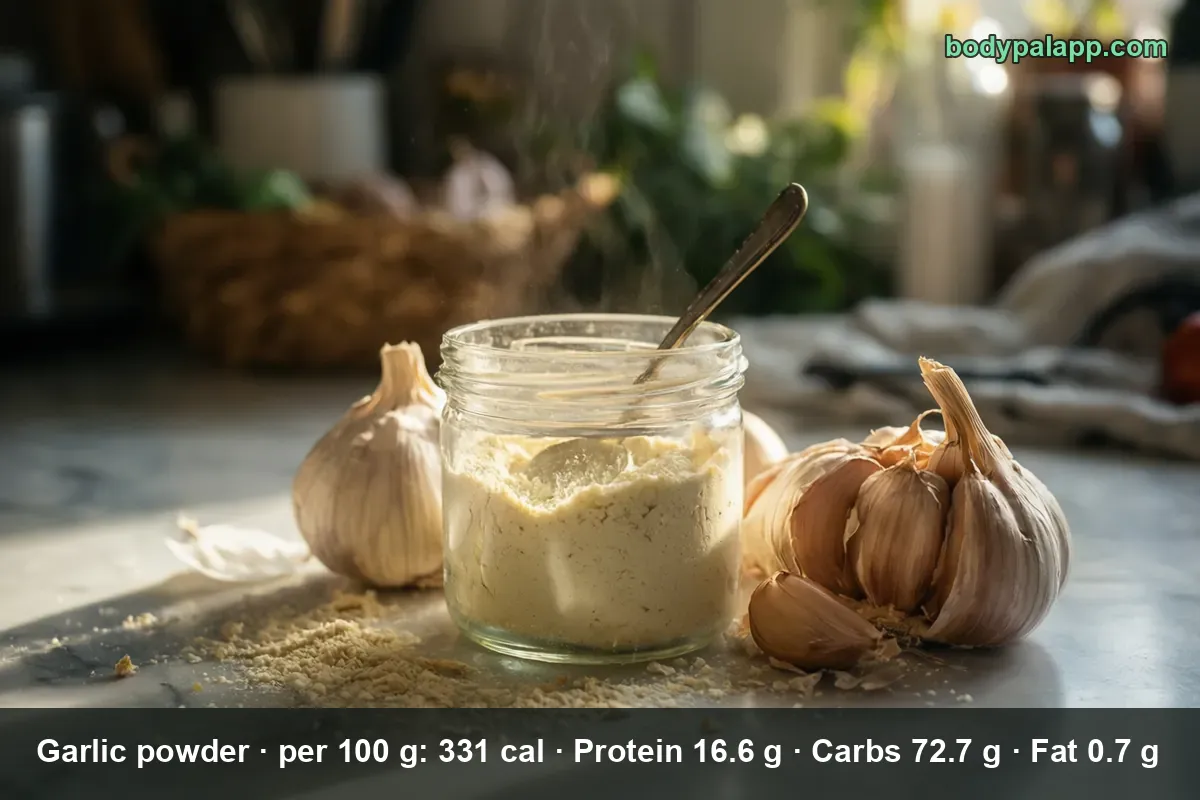
A level teaspoon of garlic powder weighs 3.1 g and carries 10 calories. Per 100 g the jar runs 331 calories, which is the number that scares people off the spice rack for no reason. Nobody eats 100 g of garlic powder. A tablespoon, the most anyone shakes into a pot of chili, is 32.
On this page
- Garlic powder quick facts
- US servings from a quarter teaspoon to an ounce
- Garlic powder against the rest of the spice rack
- Where the carbs and the sodium actually land
- How does garlic powder compare?
- Most popular garlic powder brands
- FAQ
Garlic powder quick facts
The row behind every number here is SR Legacy 171325, "Spices, garlic powder" — dried, ground garlic with nothing added. That is the jar in the cabinet door: no salt, no anti-caking blend worth counting, no parsley. It is also the only USDA record for the spice itself rather than for a seasoning mix built around it.
The Daily Value column below is calculated on the teaspoon, because that is the unit that goes into food. On 100 g every one of these rows would look dramatic, and none of it would be true of a meal.
| Nutrient | Per 100 g | Per 1 tsp (3.1 g) | % Daily Value |
|---|---|---|---|
| Calories | 331 | 10 | — |
| Total fat | 0.73 g | 0.0 g | 0% |
| Saturated fat | 0.25 g | 0.0 g | 0% |
| Carbohydrate | 72.73 g | 2.3 g | 1% |
| Dietary fiber | 9 g | 0.3 g | 1% |
| Total sugars | 2.43 g | 0.1 g | — |
| Protein | 16.55 g | 0.5 g | 1% |
| Sodium | 60 mg | 2 mg | 0% |
% Daily Value is based on a 2,000-calorie diet.
Verified nutrition data
Numbers on this page come from USDA FoodData Central, the U.S. Department of Agriculture’s food composition database, and from manufacturer labels where a branded product is named. Last verified September 2026. How we verify our data →
There is no added sugars row above because the SR Legacy edition of this record does not carry that field at all — dried garlic has no sugar added to it in the first place. Cholesterol is 0 mg, as it is in every plant spice. Potassium is the one mineral with a real number: 1,193 mg per 100 g, which still comes out to 37 mg and 1% of the Daily Value in a teaspoon. The FDA's Daily Value table is the reference for all of those percentages.
US servings from a quarter teaspoon to an ounce
| Serving | Weight | Calories |
|---|---|---|
| 1/4 tsp | 0.8 g | 3 kcal |
| 1 tsp | 3.1 g | 10 kcal |
| 2 tsp | 6.2 g | 21 kcal |
| 1 tbsp | 9.7 g | 32 kcal |
| 1 oz | 28.3 g | 94 kcal |
| Per 100 g | 100 g | 331 kcal |
The teaspoon and the tablespoon are USDA household measures attached to record 171325, so their gram weights come straight from the database. The quarter teaspoon, the two teaspoons and the ounce are our own arithmetic from the USDA 100 g figure, not USDA servings — useful because those are the amounts recipes actually call for.
The gap between the top and bottom of that table is the whole story. A quarter teaspoon dusted over roast potatoes is 3 calories; the headline 331 is 32 teaspoons of powder, roughly a full spice jar. If you are logging a dish, log the spoon, not the jar.
Store brands land close. Target's Archer Farms garlic powder lists 375 calories per 100 g and 15 per its 4 g teaspoon; Rouses Markets lists 333 per 100 g and 2 for a quarter-teaspoon serving. The spread between those labels and the USDA row is rounding on a very small serving, not a different product.
Garlic powder against the rest of the spice rack
Dried spices all cluster at roughly the same calorie density, because drying anything down to a powder concentrates it to about the same place. Across these seven USDA records the entire spread is 12 calories per 100 g.
| Version | Per 100 g | Typical piece | Calories |
|---|---|---|---|
| Garlic powder | 331 kcal | 1 oz (28.3 g) | 94 kcal |
| Curry powder | 325 kcal | 1 oz (28.3 g) | 92 kcal |
| Ground ginger | 335 kcal | 1 oz (28.3 g) | 95 kcal |
| Dried rosemary | 331 kcal | 1 oz (28.3 g) | 94 kcal |
| Caraway seed | 333 kcal | 1 oz (28.3 g) | 94 kcal |
| Fenugreek seed | 323 kcal | 1 oz (28.3 g) | 91 kcal |
| Chili seasoning mix | 335 kcal | 1 oz (28.3 g) | 95 kcal |
What differs is where those calories come from. Garlic powder is 72.73 g of carbohydrate and 0.73 g of fat per 100 g — the most carbohydrate and the least fat of the seven. Dried rosemary matches it calorie for calorie at 331, but gets there through 15.22 g of fat. Caraway is 14.59 g of fat, curry powder 14.01 g. On protein, only fenugreek at 23 g and caraway at 19.77 g beat garlic powder's 16.55 g.
One row is not really a spice: the chili seasoning mix at 335 calories per 100 g is a blended product that usually arrives salted. That is worth knowing if you swap it in for garlic powder and then wonder why dinner tastes different.
Where the carbs and the sodium actually land
Two rows on this record get misread more than the rest.
The first is carbohydrate. At 72.73 g per 100 g, garlic powder looks like bread on paper. It is not eaten like bread. A teaspoon is 2.3 g of carbohydrate, 1% of the Daily Value, and a tablespoon is roughly 7.1 g scaled from the same 100 g figure. Nine of those 100 g are fiber, which is why a tablespoon quietly contributes about 0.9 g of fiber, or 3% of the 28 g Daily Value, on top of the seasoning job it was doing anyway.
The second is sodium, and it goes the other way: people assume garlic powder is salty. It is not. Sixty milligrams per 100 g works out to 2 mg in a teaspoon — 0% of the 2,300 mg Daily Value, less than a rounding error in a day. If a dish tastes salty, the salt came from somewhere else. Garlic salt is a different product entirely, and USDA has no single clean record for it in this set, so no sodium figure for garlic salt appears on this page.
That combination is the practical case for the jar. If you are trying to cut sodium the way the Dietary Guidelines for Americans suggest, seasoning with garlic powder instead of salt costs you 10 calories a teaspoon and 2 mg of sodium. MyPlate makes the same swap its standard flavor advice.
How does garlic powder compare?
| Spice | Per 100 g | US serving | Calories | Protein | Carbs | Fat |
|---|---|---|---|---|---|---|
| Garlic powder | 331 kcal | 1 oz (28.3 g) | 94 kcal | 16.55 g | 72.73 g | 0.73 g |
| Ground ginger | 335 kcal | 1 oz (28.3 g) | 95 kcal | 8.98 g | 71.62 g | 4.24 g |
| Dried rosemary | 331 kcal | 1 oz (28.3 g) | 94 kcal | 4.88 g | 64.06 g | 15.22 g |
| Curry powder | 325 kcal | 1 oz (28.3 g) | 92 kcal | 14.29 g | 55.83 g | 14.01 g |
Macros per 100 g; calories per ounce are our arithmetic from those 100 g figures.
Our take: stop comparing spices by calorie density, because these four sit within 10 calories per 100 g of one another and the difference never survives contact with a real serving. Choose on sodium and on flavor instead. Garlic powder wins the sodium argument outright against any pre-blended seasoning, and its calories come from starch and fiber rather than oil, which is why it is the one jar you can be genuinely careless with. Be careful with the blends instead — that is where salt hides.
Most popular garlic powder brands in the United States
Ranked by how widely each product appears among foods sold in the United States, from the BodyPal food database of over 3.3 million products. Calories are the figures printed on each Nutrition Facts label, checked against USDA FoodData Central.
| Product | Calories (per 100 g) |
|---|---|
| Archer Farms Garlic Powder | 375 cal |
| Rouses Markets Garlic Powder | 333 cal |
Brand popularity: BodyPal food database. Nutrition: manufacturer labels / USDA FoodData Central.
Garlic powder FAQs
How many calories are in 1 teaspoon of garlic powder?
A level teaspoon is 3.1 g and 10 calories, scaled from the USDA figure of 331 calories per 100 g. It brings 2.3 g of carbohydrate, 0.5 g of protein and 2 mg of sodium, so on a Nutrition Facts label every row except calories would round to about 1% of the Daily Value.
How many calories are in 1 tablespoon of garlic powder?
One tablespoon is 9.7 g and 32 calories, a little over three teaspoons' worth. Scaled from the USDA 100 g row it carries about 7.1 g of carbohydrate, 1.6 g of protein and 6 mg of sodium. Even a heavy hand in a marinade barely moves a day's calorie total.
Does garlic powder have carbs?
Yes, 2.3 g per teaspoon, which is 1% of the Daily Value. Garlic powder is 72.73 g of carbohydrate per 100 g because drying strips the water out and leaves starch and fiber behind. Of that 100 g, 9 g is fiber and only 2.43 g is sugar, so the jar is not sweet.
Is garlic powder high in sodium?
No: a teaspoon has 2 mg of sodium, 0% of the 2,300 mg Daily Value, and 100 g holds only 60 mg. Plain garlic powder is not a salt product at all. Garlic salt is, so check which jar you own before you blame the seasoning for a salty dish.
Does garlic powder have protein?
Per 100 g garlic powder is 16.55 g of protein, which sounds impressive until you scale it: a teaspoon delivers 0.5 g, or 1% of the Daily Value. It seasons food, it does not feed you protein. Treat the 16.55 g as a per-100 g curiosity rather than a reason to reach for the jar.
Is garlic powder healthy?
A teaspoon costs 10 calories, 0.0 g of fat and 2 mg of sodium, so it adds flavor at almost no nutritional price. That is the honest answer: it is a cheap way to make food taste like something. Federal guidance points to herbs and spices instead of salt when you want more flavor.
Is garlic powder keto-friendly?
A teaspoon holds 2.3 g of carbohydrate, 0.3 g of it fiber, so it fits low-carb cooking at the amounts people actually use. A tablespoon is closer to 7.1 g of carbohydrate, which is a real dent in a 20 g day. Measure it into the pan rather than pouring from the jar.
Garlic powder vs garlic salt - what is the difference?
Garlic powder is 60 mg of sodium per 100 g and 2 mg per teaspoon. Garlic salt is garlic powder cut with table salt, and USDA has no single clean record for it in this data set, so no figure for it appears here. The calories are close; the sodium is not comparable.
Similar foods
- Falafel — 170 cal for 3 patties
- Brie — 95 cal per oz
- Sausage Link — 75 cal per link
- Coconut Shrimp — 250 cal for 4 shrimp
- Italian sub — 610 cal per regular sub
- Sausage — 210 cal per link
Count it without the math
Point the camera at the plate and BodyPal counts it for you, seasoning and all.


This table assumes you know your daily total. If you do not, the daily calorie calculator works it out from five numbers.