
How many calories are in a granola bar?
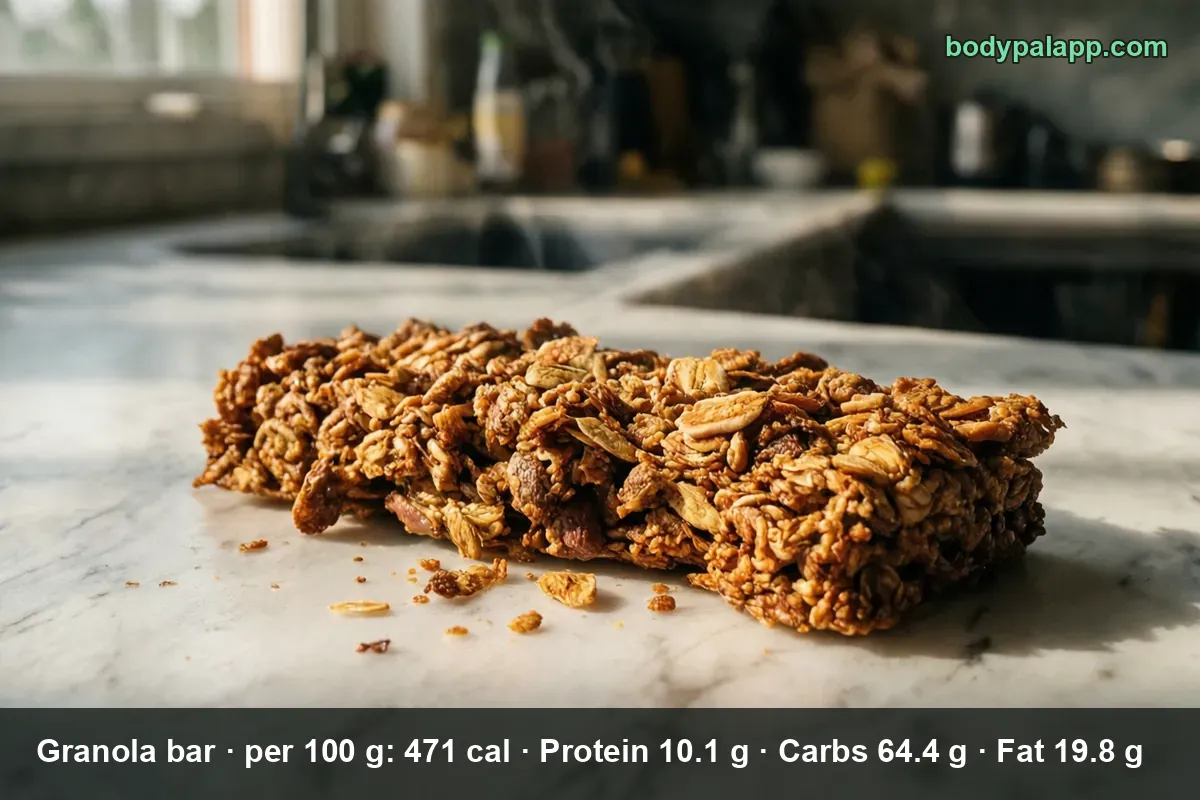
A standard hard granola bar weighs 28 g and carries 132 calories. Per 100 g the same bar runs 471 calories, which puts it among the densest things in a lunchbox by weight. The bar is small, though, and that is the whole trick: the portion, not the density, keeps the number low.
On this page
- Granola bar quick facts
- US servings from a small bar to a two bar pouch
- Chewy crunchy and coated bars
- The sugar line and the saturated fat line
- How does a granola bar compare
- Most popular granola bar brands
- Granola bar FAQs
Granola bar quick facts
The row behind every number on this page is SR Legacy 167542, "Snacks, granola bars, hard, plain" — the crunchy oat bar that snaps in two when you open the wrapper. It was chosen because it is the format most Americans actually hold in their hand, and because it is the only record that comes with real per-bar weights instead of a bare 100 g column. The FNDDS entry "Cereal or Granola bar, NFS" (2708101) carries the same profile, so this is also what USDA falls back on when nobody says which kind of bar was eaten.
| Nutrient | Per 100 g | Per 1 bar (28 g) | % Daily Value |
|---|---|---|---|
| Calories | 471 | 132 | — |
| Total fat | 19.8 g | 5.5 g | 7% |
| Saturated fat | 2.37 g | 0.7 g | 3% |
| Carbohydrate | 64.4 g | 18.0 g | 7% |
| Dietary fiber | 5.3 g | 1.5 g | 5% |
| Total sugars | 28.57 g | 8.0 g | — |
| Protein | 10.1 g | 2.8 g | 6% |
| Sodium | 294 mg | 82 mg | 4% |
% Daily Value is based on a 2,000-calorie diet.
Verified nutrition data
Numbers on this page come from USDA FoodData Central, the U.S. Department of Agriculture’s food composition database, and from manufacturer labels where a branded product is named. Last verified September 2026. How we verify our data →
Two rows you would see on a wrapper are missing here on purpose. USDA does not publish added sugars or trans fat for this record, so both lines are left off rather than guessed; the added sugars split is only readable on the box in your hand. Cholesterol is 0 mg, as you would expect from an oat-and-oil bar, and potassium comes to 94 mg per bar, about 2% of the Daily Value. The Daily Values used in that last column are FDA's, set against a 2,000-calorie day.
US servings from a small bar to a two bar pouch
| Serving | Weight | Calories |
|---|---|---|
| 1 bar, small | 21 g | 99 kcal |
| 1 bar, large | 25 g | 118 kcal |
| 1 bar, 1 oz size | 28 g | 132 kcal |
| 1 oz | 28.35 g | 134 kcal |
| 2 bars, one pouch | 42 g | 198 kcal |
| Per 100 g | 100 g | 471 kcal |
The first three lines are USDA's own household measures, and they hide a small oddity: the record lists a "small" bar at 21 g and a "large" bar at 25 g, then a separate 1 oz bar at 28 g that is heavier than the large one. Bar sizes simply drifted over the years, which is why the same phrase on two boxes can mean a 33-calorie difference.
The two-bar pouch line is our own arithmetic from the USDA 100 g figure, not a USDA serving — most pouches hold two bars of 21 g each, and that is how the 42 g comes about. It matters because almost nobody opens a pouch and eats one. If you log a pouch as "a granola bar" you are under-counting by 66 calories every time.
Brand labels widen the range further. USDA's branded file puts a Quaker granola bar at 100 calories for a 24 g bar, Purely Elizabeth's ancient grain bar at 130 for 30 g, and Autumn's Gold cinnamon almond grain-free bar at 210 for a 35 g bar. Same shelf, same shape, more than double the calories from one end to the other.
Chewy crunchy and coated bars
| Version | Per 100 g | Typical piece | Calories |
|---|---|---|---|
| Chocolate chip, crunchy | 438 kcal | 1 bar (24 g) | 105 kcal |
| Peanut butter, crunchy | 483 kcal | 1 bar (24 g) | 116 kcal |
| Chewy chocolate chip | 418 kcal | 1 bar (28 g) | 117 kcal |
| Chewy raisin | 448 kcal | 1 bar (1.5 oz, 43 g) | 193 kcal |
| Chocolate-coated peanut butter | 536 kcal | 1 oz (28.35 g) | 152 kcal |
| Fruit-filled, nonfat | 342 kcal | 1 oz (28.35 g) | 97 kcal |
Two of those piece figures — the 117 for a chewy chocolate chip bar and the 97 for the fruit-filled one — are our own scaling from the USDA 100 g values rather than USDA servings. The rest are USDA household measures.
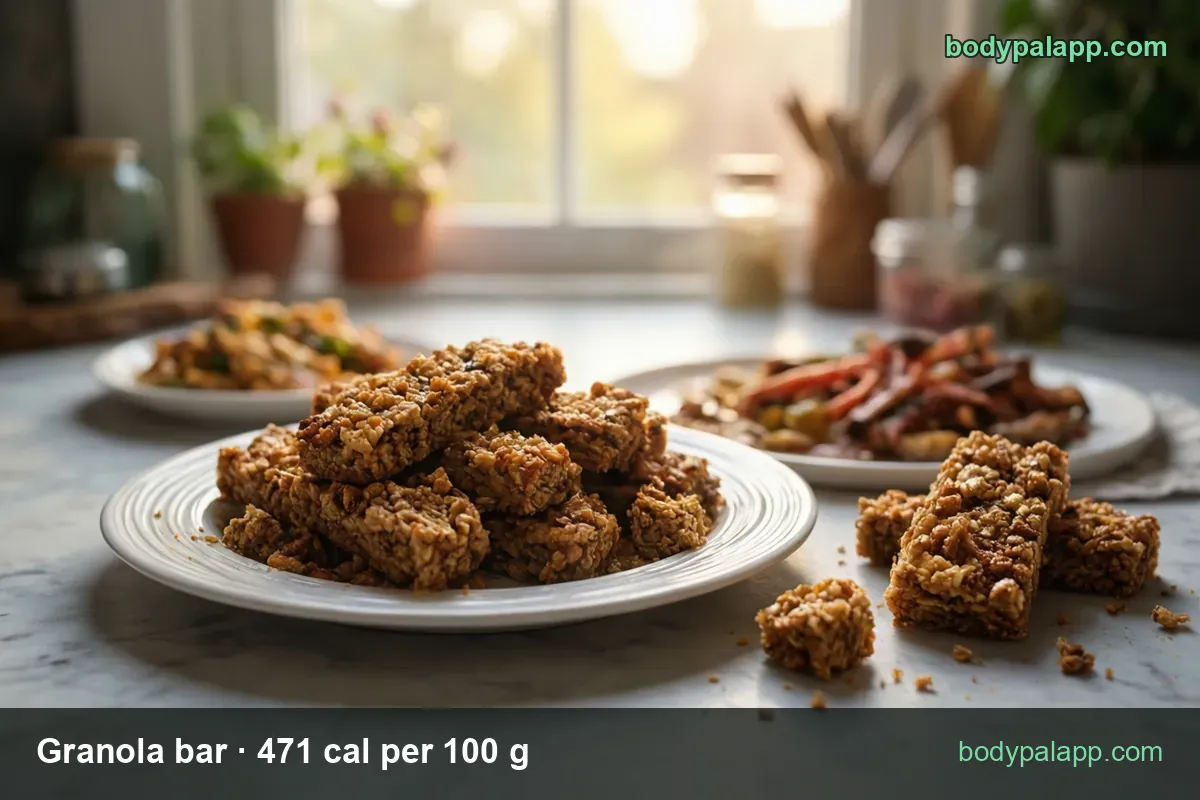
Here is the part the packaging never says out loud. Per gram, the plain chewy bar is the lighter one at 443 calories per 100 g against 471 for the plain crunchy bar, because chewy bars carry more moisture and less oil. Per bar it reverses completely: a crunchy bar is 21 to 28 g, while a chewy raisin bar is a 1.5 oz slab of 43 g. That is 132 calories against 193 for the version that reads "softer" and feels lighter in the hand. Weight decides, not texture.
The fruit-filled nonfat bar is the lowest per gram of anything in this group at 342 calories per 100 g, and it is the only one that would let you eat two ounces for under 200 calories. The chocolate-coated peanut butter bar sits at the other end at 536 per 100 g, higher than potato chips, because the coating is essentially a layer of fat wrapped around a snack that already had plenty.
The sugar line and the saturated fat line
A plain bar puts 8.0 g of total sugars on your day. That number alone is unremarkable; the problem is what USDA cannot tell you. The added sugars figure is absent from this record, and added sugars are the one the Dietary Guidelines for Americans cap at under 10% of daily calories. On a 2,000-calorie day that is 50 g, and a granola bar can eat a sixth of it or almost none of it depending on whether the sweetness comes from raisins or from corn syrup. The wrapper answers that; the database does not.
Saturated fat is where the coating shows up. A plain 28 g bar delivers 0.7 g, roughly 3% of the Daily Value — genuinely low. The chocolate-coated peanut butter bar runs 17.07 g per 100 g, so a single ounce of it lands at 24% of the day's saturated fat, seven times the plain bar for the same weight. If saturated fat is what you are watching, the coating is the only line item that really moves.
Fiber is the quiet win: 1.5 g per bar, 5% of the Daily Value, and 5.3 g per 100 g. That is oats doing their job, and it is a fair reason to pick a bar over chips when both cost about the same. It is still a long way from a bowl of oatmeal, and MyPlate's grains guidance asks for half your grains to be whole — a bar helps, but it does not carry the day by itself.
How does a granola bar compare
| Snack | Per 100 g | US serving | Calories |
|---|---|---|---|
| Granola bar, hard plain | 471 kcal | 1 oz (28.35 g) | 134 kcal |
| Potato chips, plain salted | 532 kcal | 1 oz (28.35 g) | 151 kcal |
| Microwave popcorn, butter flavor | 535 kcal | 1 oz (28.35 g) | 152 kcal |
| Corn chips, plain | 539 kcal | 1 oz (28.35 g) | 153 kcal |
Our take: ounce for ounce the granola bar is the lightest of these four, by 17 to 19 calories, and it is the only one that brings 10.1 g of protein and 5.3 g of fiber per 100 g to the table. It also has an advantage the others cannot match — it comes pre-portioned, and a wrapper is a better stopping cue than the bottom of a chip bag. For weight loss, one plain bar at 132 calories is a clean snack. For staying full, it is weak: 2.8 g of protein will not hold you to dinner, and a hard-boiled egg with a piece of fruit does that job for a similar count.
Most popular granola bar brands in the United States
Ranked by how widely each product appears among foods sold in the United States, from the BodyPal food database of over 3.3 million products. Calories are the figures printed on each Nutrition Facts label, checked against USDA FoodData Central.
| Product | Calories (per 100 g) |
|---|---|
| Purely Elizabeth Original Ancient Grain Granola Bar | 433 cal |
| Purely Elizabeth Blueberry Hemp Granola Bar | 433 cal |
| Autumn's Gold Cinnamon Almond Grain Free Bar | 600 cal |
| Quaker Granola Bar | 417 cal |
| Quaker Granola Bars, 1.5 oz bar | 429 cal |
| Quaker Granola Bars, 31 g bar | 452 cal |
Brand popularity: BodyPal food database. Nutrition: manufacturer labels / USDA FoodData Central.
Granola bar FAQs
How many calories are in a granola bar?
A standard 28 g hard granola bar has 132 calories, from USDA's plain hard granola bar record at 471 calories per 100 g. USDA also lists smaller bars at 21 g and 25 g, worth 99 and 118 calories. Chewy bars weigh more per piece, so they land higher.
How many calories in 2 granola bars?
Two bars from a standard pouch weigh about 42 g together and come to 198 calories, our own arithmetic from the USDA 100 g figure rather than a USDA serving. Two of the larger 1 oz bars would be 264 calories instead. Both counts assume plain bars with no chocolate coating.
How much sugar is in a granola bar?
A 28 g plain bar has 8.0 g of total sugars, from 28.57 g per 100 g. The fruit-filled nonfat kind is the sugar leader at 45.24 g per 100 g. USDA does not publish added sugars for these records, so the label on the box is the only place to read that split.
How many carbs are in a granola bar?
One 28 g bar holds 18.0 g of carbohydrate, 7% of the Daily Value, with 1.5 g of that as fiber. Per 100 g the figure is 64.4 g. Chewy chocolate chip bars are higher per gram at 70.2 g, and the fruit-filled nonfat bar tops the list at 77.6 g.
How much protein is in a granola bar?
2.8 g in a 28 g bar, which is 6% of the Daily Value and not much for a snack that costs 132 calories. Per 100 g the plain hard bar carries 10.1 g, the best of the group; the chewy chocolate chip version drops to 5.65 g per 100 g.
Chewy or crunchy granola bar: which has fewer calories?
Per 100 g the chewy bar is lighter: 443 calories against 471 for the crunchy one. Per bar it flips, because chewy bars are bigger. A 28 g crunchy bar is 132 calories, while a 43 g chewy raisin bar is 193. Compare whole pieces, not densities.
Are granola bars healthy?
One 28 g bar gives 1.5 g of fiber, 5% of the Daily Value, and 8.0 g of sugars, so it sits closer to a cookie than to oatmeal. Sodium is low at 82 mg, 4% of the Daily Value. Treat it as a snack with some whole grain, not a health food.
Are granola bars good for weight loss?
At 132 calories a 28 g bar fits most snack budgets, and it beats an ounce of potato chips at 151. The catch is that 2.8 g of protein and 1.5 g of fiber leave little staying power. If you are counting, one bar works; the two-bar pouch at 198 is the trap.
Similar foods
- Toast with butter — 100 cal per slice with butter
- Pancake — 423 cal for 3 medium pancakes
- Crepe — 179 cal per crepe
- Omelet — 305 cal for 3-egg omelet
- Egg — 72 cal per large egg
- Chocolate glazed donut — 303 cal per donut
Count it without the math
Point the camera at the wrapper or the bar itself and BodyPal counts it for you, pouch and all.


How long does it take to burn off a granola bar?
One bar (28 g) is 132 kcal. Enter your weight and the amount you ate to see how long it takes you to burn that off:
lb
| Activity | Time to burn 132 kcal |
|---|---|
| Walking, brisk | 26 min |
| Cycling, moderate | 16 min |
| Swimming, moderate | 19 min |
| Jogging | 16 min |
| Weight training, moderate | 29 min |
Times are for a 155 lb adult at a steady pace; change the weight to see yours. The amount is set to the portion in the text (28 g); change it to what you actually ate. BodyPal works this out from your steps automatically.
Burning it off is one side of it. The other is knowing your number: work out how many calories you need a day, with macros and a goal date.