
How many calories are in granola?
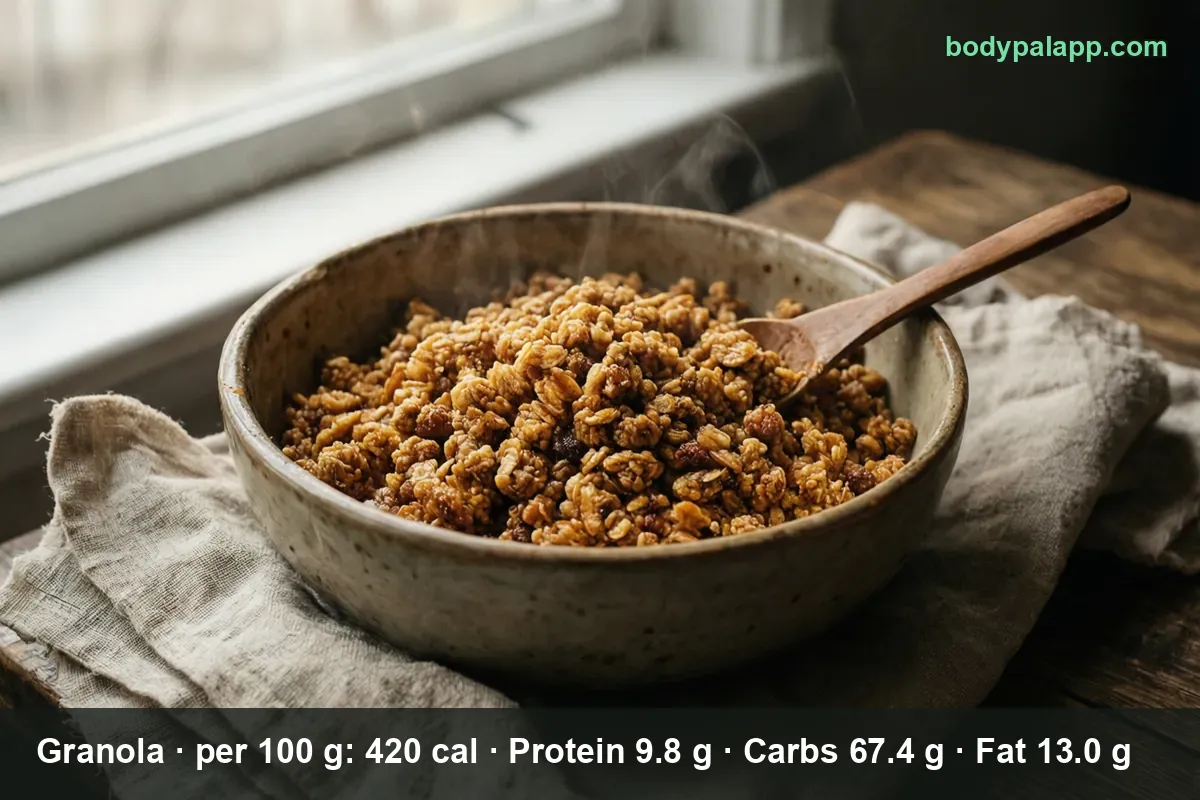
A half-cup serving of granola weighs 55 g and delivers 231 calories. Per 100 g, granola runs 420 calories, which puts it among the densest foods in the cereal aisle. The number that trips people up is the pour: a full cup is 110 g and 462 calories, exactly double the label serving.
On this page
- Granola quick facts
- US servings from a quarter cup to a full cup
- Homemade low-fat and store-bought granola
- Granola vs granola bar vs trail mix
- Fiber and sugar in a half cup
- How does granola compare?
- Most popular granola brands
- FAQ
Granola quick facts
The row behind every number here is FNDDS 2708461, "Cereal, granola". It is the generic ready-to-eat granola an American actually buys in a bag or a tub, which is what people mean when they type the question. USDA also carries a homemade record (171646), but that one is mixed with oil and nuts at home and lands 69 calories higher per 100 g, so it belongs in the variants section rather than at the top of the page.
The serving column is the FDA reference amount for granola, 1/2 cup at 55 g. That is the size printed on most bags, and it is smaller than the scoop most people pour.
| Nutrient | Per 100 g | Per 1/2 cup (55 g) | % Daily Value |
|---|---|---|---|
| Calories | 420 | 231 | — |
| Total fat | 13.01 g | 7.2 g | 9% |
| Saturated fat | 1.33 g | 0.7 g | 4% |
| Carbohydrate | 67.35 g | 37.0 g | 13% |
| Dietary fiber | 7.4 g | 4.1 g | 15% |
| Total sugars | 22.24 g | 12.2 g | — |
| Protein | 9.82 g | 5.4 g | 11% |
| Sodium | 161 mg | 89 mg | 4% |
% Daily Value is based on a 2,000-calorie diet.
Verified nutrition data
Numbers on this page come from USDA FoodData Central, the U.S. Department of Agriculture’s food composition database, and from manufacturer labels where a branded product is named. Last verified September 2026. How we verify our data →
Two rows are missing on purpose. USDA does not publish added sugars or trans fat for this generic granola record, so there is nothing honest to put in those cells. Cholesterol is 0 mg, since nothing in plain granola comes from an animal, and potassium is 310 mg per 100 g, or 171 mg in the half cup, about 4% of the Daily Value. The %DV column follows the FDA reference values for a 2,000-calorie day.
US servings from a quarter cup to a full cup
| Serving | Weight | Calories |
|---|---|---|
| 1/4 cup | 28 g | 118 kcal |
| 1/3 cup | 30 g | 126 kcal |
| 1 oz | 28.35 g | 119 kcal |
| 1/2 cup, label serving | 55 g | 231 kcal |
| 1 cup | 110 g | 462 kcal |
| Per 100 g | 100 g | 420 kcal |
Only the 1/2-cup line is a USDA and FDA serving. The quarter cup, the third cup, the ounce and the full cup are our own arithmetic from the USDA 100 g figure, not USDA servings, scaled straight off 420 calories per 100 g.
Here is the part worth remembering. Granola is heavy for its volume, so a cup weighs 110 g where a cup of flaked cereal weighs a fraction of that. Pouring by eye until the bowl looks full gets you to 462 calories in about two seconds, and that is before milk or yogurt. Weighing the bag once, or scooping with a measured 1/3-cup (126 calories), fixes the problem permanently.
The ounce line is useful for a different reason: an ounce of granola is 119 calories, almost the same as a 1/4 cup, because 28 g and 28.35 g are practically the same scoop. If a recipe or a trail-mix bag talks in ounces, you can read the two rows interchangeably.
Homemade low-fat and store-bought granola
| Version | Per 100 g | Typical serving | Calories |
|---|---|---|---|
| Granola, generic store-bought | 420 kcal | 1/2 cup (55 g) | 231 kcal |
| Homemade granola | 489 kcal | 1/2 cup (55 g) | 269 kcal |
| Quaker 100% Natural, oats, wheat and honey | 421 kcal | 1/2 cup (55 g) | 232 kcal |
| Low-fat granola with raisins | 388 kcal | 1/2 cup (55 g) | 213 kcal |
| Nature's Path Flax Plus pumpkin granola | 467 kcal | 1/2 cup (55 g) | 257 kcal |
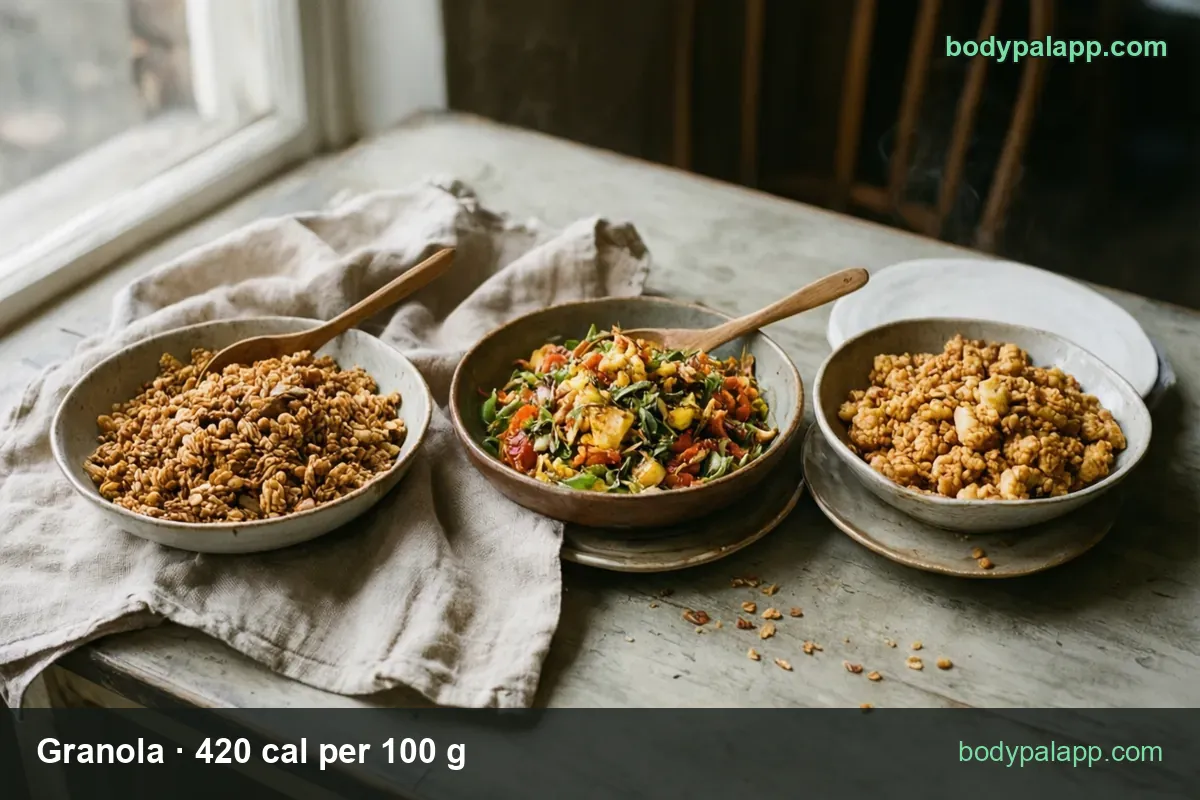
Homemade is the surprise. Baking your own does not make it lighter: USDA's homemade record runs 489 calories per 100 g against 420 for the bagged stuff, because home recipes are generous with oil, nut butter and chopped nuts. Fat is 24.31 g per 100 g versus 13.01 g. The upside is sodium, 26 mg per 100 g against 161 mg, and fiber, 8.9 g against 7.4 g.
Low-fat granola is the other trap. Cutting fat from 13.01 g to 5.52 g per 100 g does drop the calories, but only to 388 per 100 g, an 18-calorie saving on a half cup. What replaces the oil is sugar and salt: total sugars climb from 22.24 g to 25.65 g per 100 g, and sodium jumps from 161 mg to 234 mg. If the reason you reach for low-fat is the calorie count, you are paying a lot of sweetness for very little.
Flavored versions move the sugar more than the calories. The raisin version of Quaker's 100% Natural sits at 412 calories per 100 g with 24.63 g sugars, and the apple-cranberry-almond version at 418 calories with 27.43 g sugars — dried fruit is sugar with the water taken out.
Brand bags land in the same band and mostly a bit above it, from 418 calories per 100 g for Quaker Strawberry Granola to 481 for Bear Naked Honey Almond Soft Baked. What actually varies is the label serving, which runs from 1/3 cup (30 g) on Purely Elizabeth to 2/3 cup (63 g) on Cascadian Farm Organic Fruit and Nut. That is 140 calories on the Purely Elizabeth label against 277 on the Cascadian Farm one, for what is essentially the same food.
Granola vs granola bar vs trail mix
| Format | Per 100 g | Typical serving | Calories |
|---|---|---|---|
| Loose granola | 420 kcal | 1/2 cup (55 g) | 231 kcal |
| Granola bar | 471 kcal | 1 bar (28 g) | 132 kcal |
| Trail mix with granola | 476 kcal | 1 oz (28.35 g) | 135 kcal |
A granola bar is denser than loose granola, not lighter: 471 calories per 100 g against 420, because the oats are glued together with syrup and oil. It only "wins" because a bar is a small, fixed 28 g, so you eat 132 calories instead of 231. Sodium tells the same story, 294 mg per 100 g in the bar against 161 mg in the loose cereal.
Trail mix built on granola is the heaviest of the three per gram at 476 calories per 100 g, and the ounce that feels like a handful is 135 calories. Three handfuls out of a shared bag and you are past the half-cup breakfast.
Fiber and sugar in a half cup
The best number on granola's label is fiber. A half cup carries 4.1 g, which is 15% of the 28 g Daily Value in a single small serving, and 7.4 g per 100 g puts it well ahead of most sweetened breakfast cereals. The Dietary Guidelines for Americans flag fiber as a nutrient most people fall short on, and whole-grain oats are the reason granola scores here; MyPlate counts a half cup as a whole-grain serving toward the grains group.
Protein is decent but not the headline: 5.4 g per half cup, 11% of the Daily Value. Add a cup of plain yogurt and the meal crosses into breakfast-that-holds territory without touching the granola quantity.
Sugar is where you have to look at the bag rather than this page. The generic record shows 22.24 g total sugars per 100 g, or 12.2 g in a half cup, and that figure mixes the honey or syrup in the recipe with whatever sugar came in the dried fruit. USDA does not publish added sugars for this record, so we cannot split it, and total sugars are not comparable to the 50 g Daily Value for added sugars. The practical move is to read the added-sugars line on the actual bag, since that is the number the manufacturer is required to print.
Saturated fat is a non-issue: 0.7 g per half cup, 4% of the Daily Value, unless the granola is coconut-heavy. Sodium is 89 mg, also 4%, which is about a twenty-fifth of a teaspoon of table salt.
How does granola compare?
| Food | Per 100 g | US serving | Calories |
|---|---|---|---|
| Granola | 420 kcal | 1/2 cup (55 g) | 231 kcal |
| Homemade granola | 489 kcal | 1/2 cup (55 g) | 269 kcal |
| Granola bar | 471 kcal | 1 bar (28 g) | 132 kcal |
| Trail mix with granola | 476 kcal | 1 oz (28.35 g) | 135 kcal |
Our take: bagged granola is the lightest of these four per gram, at 420 calories per 100 g, and the homemade version is the heaviest at 489. If you are counting calories, the winning move is not switching products, it is measuring — a 1/3 cup at 126 calories and a 1 cup at 462 are the same food. For staying full, the half cup with yogurt beats the bar: 231 calories with 4.1 g of fiber and 5.4 g of protein does more for a morning than a 132-calorie bar that is gone in four bites. For a snack you cannot re-pour, the pre-portioned bar is genuinely the safer format.
Most popular granola brands in the United States
Ranked by how widely each product appears among foods sold in the United States, from the BodyPal food database of over 3.3 million products. Calories are the figures printed on each Nutrition Facts label, checked against USDA FoodData Central.
| Product | Calories (per 100 g) |
|---|---|
| Mom's Best Oats & Honey Granola with Almonds | 453 cal |
| Purely Elizabeth Original Ancient Grain Granola | 467 cal |
| Bear Naked Honey Almond Soft Baked Granola | 481 cal |
| Quaker Strawberry Granola | 418 cal |
| Cascadian Farm Organic Fruit and Nut Granola | 440 cal |
| Nature's Path Pumpkin Seed + Flax Granola | 473 cal |
Brand popularity: BodyPal food database. Nutrition: manufacturer labels / USDA FoodData Central.
Granola FAQs
How many calories are in 1/2 cup of granola?
231 calories in a 1/2-cup serving of 55 g, based on USDA's generic granola record at 420 calories per 100 g. That half cup also carries 7.2 g of fat, 37.0 g of carbohydrate, 4.1 g of fiber and 5.4 g of protein. It is the serving size printed on most bags.
How many calories are in 1 cup of granola?
462 calories, since a cup of granola weighs about 110 g and granola runs 420 calories per 100 g. That is exactly double the 55 g label serving, and it is our own arithmetic from the USDA 100 g figure rather than a USDA serving. A cup is easy to pour by accident.
What is a normal serving size of granola?
1/2 cup, or 55 g, which is the FDA reference amount and 231 calories. Brand bags vary more than you would expect: label servings run from 1/3 cup (30 g) on Purely Elizabeth to 2/3 cup (63 g) on Cascadian Farm, so two front-of-pack numbers rarely describe the same amount of food.
How much sugar is in granola?
12.2 g of total sugars in a half cup, or 22.24 g per 100 g, mixing recipe syrup with sugar from any dried fruit. USDA does not publish added sugars for this record, so check the bag's added-sugars line. Raisin and dried-fruit versions run higher, up to 27.43 g per 100 g.
Granola vs granola bar calories?
132 calories for a 28 g granola bar against 231 for a half cup of loose granola. Per gram the bar is heavier, 471 calories per 100 g versus 420, because syrup binds it together. The bar also carries 294 mg of sodium per 100 g against 161 mg. Portion size, not density, decides it.
How many calories in homemade granola?
269 calories per half cup (55 g), from USDA's homemade record at 489 calories per 100 g. Home recipes use more oil and nuts, so fat reaches 24.31 g per 100 g against 13.01 g in store-bought. Homemade does win on sodium, 26 mg per 100 g versus 161 mg, and on fiber at 8.9 g.
Is low-fat granola lower in calories?
213 calories per half cup against 231, so yes, but only by 18. Low-fat granola with raisins drops fat from 13.01 g to 5.52 g per 100 g, then adds sugar and salt back: total sugars rise from 22.24 g to 25.65 g and sodium from 161 mg to 234 mg per 100 g.
How much fiber is in granola?
4.1 g of fiber in a half cup, which is 15% of the 28 g Daily Value, and 7.4 g per 100 g. That is granola's strongest nutrition number and it comes from the whole-grain oats. The homemade version is higher at 8.9 g per 100 g, and Quaker's oats-wheat-honey recipe reaches 10.2 g.
Similar foods
- Toast with butter — 100 cal per slice with butter
- Pancake — 423 cal for 3 medium pancakes
- Crepe — 179 cal per crepe
- Omelet — 305 cal for 3-egg omelet
- Egg — 72 cal per large egg
- Honey Bun — 358 cal per 3 oz bun
Count it without the math
Point the camera at the bowl and BodyPal counts the granola for you, pour size and all.


How long does it take to burn off granola?
A 1/2-cup (55 g) serving is 231 kcal. Enter your weight and the amount you ate to see how long it takes you to burn that off:
lb
| Activity | Time to burn 231 kcal |
|---|---|
| Walking, brisk | 46 min |
| Cycling, moderate | 29 min |
| Swimming, moderate | 33 min |
| Jogging | 27 min |
| Weight training, moderate | 51 min |
Times are for a 155 lb adult at a steady pace; change the weight to see yours. The amount is set to the portion in the text (55 g); change it to what you actually ate. BodyPal works this out from your steps automatically.
One food is easy to picture; a whole day is harder. See how many calories you need a day and what a deficit actually looks like.