
How many calories are in Grape-Nuts?
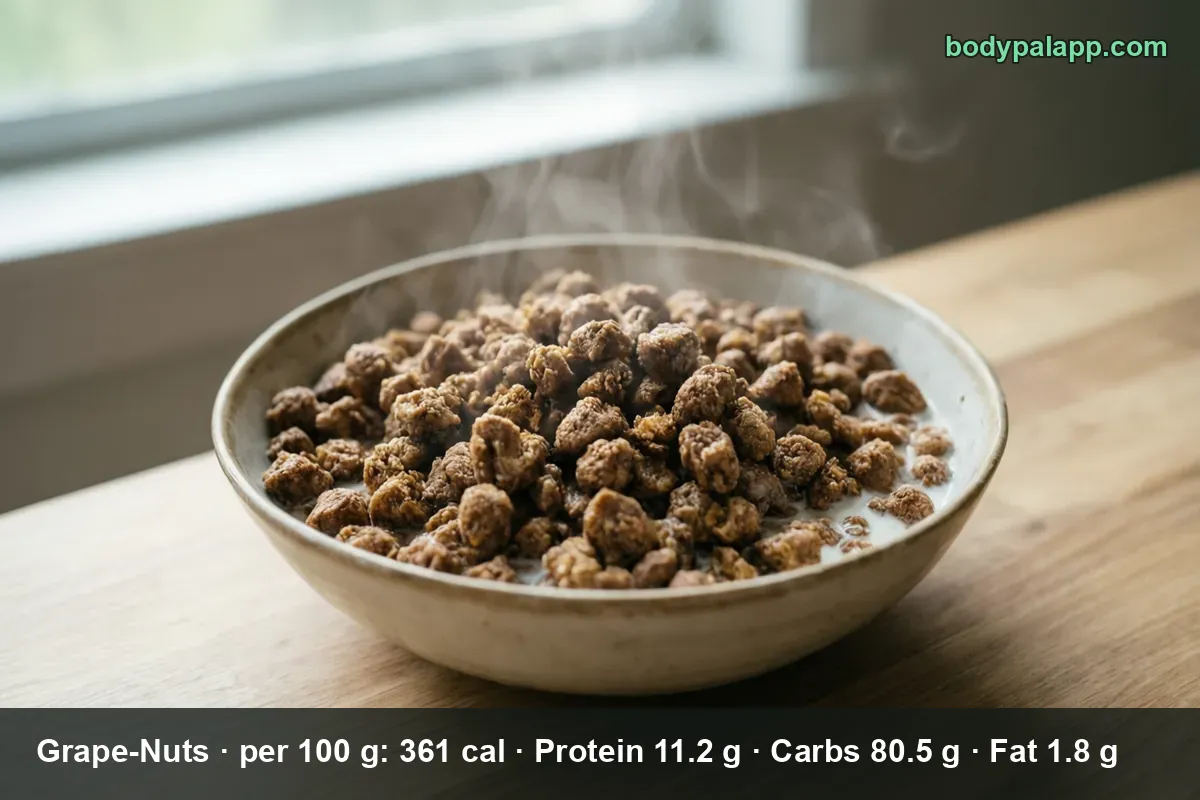
A 1/2-cup serving of Grape-Nuts weighs 58 g and carries 209 calories. Per 100 g the nuggets run 361 calories, which sounds steep for a cereal until you see the volume. Half a cup barely covers the bottom of a bowl. Fiber is where the nuggets earn their keep: 7.5 g in that one serving.
On this page
- Grape-Nuts quick facts
- US servings from a quarter cup to a full bowl
- Grape-Nuts Flakes are a different cereal
- Fiber and sodium are the two rows that move
- How does Grape-Nuts compare to other dry cereals?
- Most popular Post Grape-Nuts products
- FAQ
Grape-Nuts quick facts
The row below is SR Legacy 171647, "Cereals ready-to-eat, POST, GRAPE-NUTS Cereal". It is the classic box of hard little nuggets, the product most people actually have in the cupboard, and it is the only Grape-Nuts record with an official NLEA serving of 1/2 cup. Grape-Nuts Flakes is a separate product with its own numbers, and it gets its own section further down.
| Nutrient | Per 100 g | Per 1/2 cup (58 g) | % Daily Value |
|---|---|---|---|
| Calories | 361 | 209 | — |
| Total fat | 1.81 g | 1.0 g | 1% |
| Saturated fat | 0.34 g | 0.2 g | 1% |
| Carbohydrate | 80.49 g | 46.7 g | 17% |
| Dietary fiber | 13 g | 7.5 g | 27% |
| Total sugars | 8.86 g | 5.1 g | — |
| Protein | 11.22 g | 6.5 g | 13% |
| Sodium | 465 mg | 270 mg | 12% |
% Daily Value is based on a 2,000-calorie diet.
Verified nutrition data
Numbers on this page come from USDA FoodData Central, the U.S. Department of Agriculture’s food composition database, and from manufacturer labels where a branded product is named. Last verified September 2026. How we verify our data →
There is no added sugars line in the table because USDA does not publish added sugars for this SR Legacy record. Cholesterol is 0 mg, as you would expect from a wheat and barley cereal, and potassium comes in at 400 mg per 100 g, or 232 mg per serving, which is 5% of the Daily Value.
The other thing worth flagging: these are the numbers for dry cereal. Nothing here includes milk.
US servings from a quarter cup to a full bowl
| Serving | Weight | Calories |
|---|---|---|
| 1/4 cup | 29 g | 105 kcal |
| 1 oz | 28.3 g | 102 kcal |
| 1/2 cup, the USDA serving | 58 g | 209 kcal |
| 1 cup | 116 g | 419 kcal |
| Per 100 g | 100 g | 361 kcal |
Only the 1/2-cup row is a USDA household measure. The quarter cup, the ounce and the full cup are our own arithmetic from the USDA 100 g figure, not USDA servings.
That full-cup row is the one that catches people. Grape-Nuts pour fast and settle dense, so a casual pour that looks like a modest bowl is a full cup, 116 g and 419 calories before the milk goes in. If you are logging by eye rather than by scale, you will underestimate this cereal more often than almost any other. A kitchen scale or a dry measuring cup fixes it in about four seconds.
An ounce, at 28.3 g and 102 calories, is close enough to the quarter cup that you can treat them as the same portion in practice.
Grape-Nuts Flakes are a different cereal
Same brand, same box art family, completely different food. Flakes are rolled and toasted, so they take up far more space per gram.
| Version | Per 100 g | Typical serving | Calories |
|---|---|---|---|
| Grape-Nuts nuggets | 361 kcal | 1/2 cup (58 g) | 209 kcal |
| Grape-Nuts Flakes | 376 kcal | 3/4 cup (29 g) | 109 kcal |
Per gram the flakes are actually the heavier of the two, 376 against 361. Per serving they are not close, because a serving of flakes weighs half what a serving of nuggets weighs.
Here is the trap in plain terms. Half a cup of nuggets is 58 g and 209 calories. Half a cup of flakes is roughly 19 g and about 73 calories, our own arithmetic scaled down from the 29 g flake serving. Same cup, same line in your log, nearly three times the calories on one side. If you switch between the two boxes and keep logging "half a cup of Grape-Nuts," you are off by well over 100 calories.
The composition differs too. Flakes carry 15.2 g of total sugars per 100 g against 8.86 g in the nuggets, and 3.7 g of fat against 1.81 g. The nuggets hold more fiber, 13 g per 100 g against 10.2 g, and more protein, 11.22 g against 9.4 g. Sodium is a wash: 470 mg against 465 mg per 100 g.
Fiber and sodium are the two rows that move
Grape-Nuts is a genuinely high-fiber cereal, and not by a small margin. One 1/2-cup serving delivers 7.5 g, which is 27% of the FDA Daily Value of 28 g. Most Americans fall short of that target, as the Dietary Guidelines note about dietary fiber in general, and one small bowl covering better than a quarter of it is unusual. It is also a whole-grain option in the terms MyPlate uses for the grains group.
Sodium is the row that surprises people the other way. Plain cereal reads as unsalted in most heads, but Grape-Nuts is 465 mg per 100 g, so a 1/2-cup serving brings 270 mg. That is 12% of the 2,300 mg Daily Value from a food nobody thinks of as salty. Pour a full cup and you are at 539 mg, 23% of the day, in one bowl. If you are watching sodium, that is worth knowing before the second helping rather than after.
Sugar, meanwhile, is a non-issue: 5.1 g of total sugars in a serving, and USDA does not break out how much of that is added.
How does Grape-Nuts compare to other dry cereals?
All four of these are weighed dry. The difference is that Grape-Nuts is eaten dry from the box, while oats, grits and farina are dry mixes that you cook with water, so an ounce of those swells into a much bigger bowl than an ounce of Grape-Nuts.
| Cereal (dry) | Per 100 g | US serving | Calories | Fiber per 100 g | Sodium per 100 g |
|---|---|---|---|---|---|
| Grape-Nuts | 361 kcal | 1/2 cup (58 g) | 209 kcal | 13 g | 465 mg |
| Instant oats, plain, fortified | 362 kcal | 1 oz (28.3 g) | 103 kcal | 10.1 g | 6 mg |
| Hominy grits, white, regular | 361 kcal | 1 oz (28.3 g) | 102 kcal | 2.1 g | 1 mg |
| Farina, quick, enriched | 360 kcal | 1 oz (28.3 g) | 102 kcal | 2.4 g | 6 mg |
Our take: per gram these four are effectively identical, spread across a range of two calories from 360 to 362, so calorie density is not what separates them. What separates them is fiber and sodium. Grape-Nuts has the most fiber of the four at 13 g per 100 g and by far the most sodium at 465 mg, where the other three sit between 1 mg and 6 mg. For fiber in the smallest possible bowl, Grape-Nuts wins outright. For a low-sodium breakfast, plain oats or grits win just as clearly, and they also give you a bigger finished bowl per gram because they absorb water. Choose on that axis, not on calories.
Most popular Post Grape-Nuts products in the United States
Ranked by how widely each product appears among foods sold in the United States, from the BodyPal food database of over 3.3 million products. Calories are the figures printed on each Nutrition Facts label, checked against USDA FoodData Central.
| Product | Calories (per 100 g) |
|---|---|
| Post The Original Grape-Nuts Cereal | 345 cal |
Brand popularity: BodyPal food database. Nutrition: manufacturer labels / USDA FoodData Central.
Grape-Nuts FAQs
How many calories are in a serving of Grape-Nuts?
209 calories in the USDA serving of 1/2 cup, which weighs 58 g. That is the NLEA serving printed on the box, and it covers dry cereal only. The same half cup brings 7.5 g of fiber, 6.5 g of protein and 270 mg of sodium.
How much is one serving of Grape-Nuts in cups?
One serving is 1/2 cup, which is 58 g on a scale. Grape-Nuts are unusually dense, so that half cup looks small next to a bowl of flakes or puffed cereal. A quarter cup is 29 g and 105 calories, our own arithmetic from the USDA 100 g figure.
How many calories in 1 cup of Grape-Nuts?
419 calories in a full cup, which weighs 116 g. USDA lists only the 1/2-cup serving, so the cup figure is our own arithmetic from the 361 calories per 100 g. A full cup also carries 15.1 g of fiber and 539 mg of sodium, about 23% of the Daily Value.
How much fiber is in Grape-Nuts?
13 g per 100 g, which is 7.5 g in the 1/2-cup serving. That single half cup covers 27% of the 28 g Daily Value, and it does it in a bowl small enough to disappear under milk. Dry instant oats, by comparison, hold 10.1 g per 100 g.
How much protein does Grape-Nuts have?
11.22 g per 100 g, which works out to 6.5 g in a 1/2-cup serving, or 13% of the Daily Value. Milk pushes that higher. Among the dry cereals in the USDA table, instant oats at 11.92 g and farina at 11.6 g per 100 g edge it out.
Are Grape-Nuts high in sodium?
465 mg per 100 g, so a 1/2-cup serving carries 270 mg, or 12% of the 2,300 mg Daily Value. For a plain cereal that is high: dry oats hold 6 mg per 100 g and regular grits 1 mg. If you are watching sodium, log the bowl rather than guessing.
Grape-Nuts vs Grape-Nuts Flakes: which has fewer calories?
The flakes are 376 calories per 100 g against 361 for the nuggets, so per gram the flakes are slightly higher. Per serving it flips: the 3/4-cup flake serving is 29 g and 109 calories, while 1/2 cup of nuggets is 58 g and 209 calories.
Is Grape-Nuts good for weight loss?
209 calories per half cup fits comfortably inside a 350 to 450 calorie breakfast, and 7.5 g of fiber is a lot for a bowl that size. The catch is volume rather than the food: a casually poured cup is 116 g and 419 calories, so measure it once and learn the look.
Similar foods
- Lentils Dry — 676 cal per cup
- Corn Nuts — 126 cal per oz
- Hummus Cup — 140 cal per cup
- Chia Seeds — 138 cal per oz
- Sesame sticks — 151 cal per oz
- Watermelon Seed — 156 cal per ounce
Count it without the math
Point the camera at the bowl and BodyPal counts the cereal for you, nuggets or flakes.


How long does it take to burn off Grape-Nuts?
A 1/2-cup (58 g) serving is 209 kcal. Enter your weight and the amount you ate to see how long it takes you to burn that off:
lb
| Activity | Time to burn 209 kcal |
|---|---|
| Walking, brisk | 42 min |
| Cycling, moderate | 26 min |
| Swimming, moderate | 30 min |
| Jogging | 25 min |
| Weight training, moderate | 46 min |
Times are for a 155 lb adult at a steady pace; change the weight to see yours. The amount is set to the portion in the text (58 g); change it to what you actually ate. BodyPal works this out from your steps automatically.
Burning it off is one side of it. The other is knowing your number: work out how many calories you need a day, with macros and a goal date.