
How many calories are in a guava?
A cup of chopped guava, 165 g on the USDA scale, is 112 calories, and the fruit runs 68 calories per 100 g. One whole guava, seeds and skin included, is only 37. That puts it in the same calorie band as grapes and bosc pears, while carrying more protein than either of them.
On this page
- Guava quick facts
- US servings from one ounce to a full cup
- Strawberry guava is a different fruit
- From guava sauce to guava paste
- Fiber is the row that earns guava its place
- How does guava compare?
- Most popular guava brands
- FAQ
Guava quick facts
The number most people want belongs to the fruit sitting on the counter: a common guava, raw, eaten skin, seeds and all. That record is SR Legacy 173044, "Guavas, common, raw", at 68 calories per 100 g. FNDDS 2709238 lists the same profile down to the decimal, but the SR Legacy entry ships the household measures Americans actually reach for, a cup of chopped fruit and one whole guava, so it is the one costed on this page.
| Nutrient | Per 100 g | Per 1 cup, chopped (165 g) | % Daily Value |
|---|---|---|---|
| Calories | 68 | 112 | — |
| Total fat | 0.95 g | 1.6 g | 2% |
| Saturated fat | 0.27 g | 0.4 g | 2% |
| Carbohydrate | 14.32 g | 23.6 g | 9% |
| Dietary fiber | 5.4 g | 8.9 g | 32% |
| Total sugars | 8.92 g | 14.7 g | — |
| Protein | 2.55 g | 4.2 g | 8% |
| Sodium | 2 mg | 3 mg | 0% |
% Daily Value is based on a 2,000-calorie diet.
Verified nutrition data
Numbers on this page come from USDA FoodData Central, the U.S. Department of Agriculture’s food composition database, and from manufacturer labels where a branded product is named. Last verified September 2026. How we verify our data →
There is no added sugars row here, because the SR Legacy edition does not publish added sugars for raw fruit. Nothing is lost: every gram of sugar in a fresh guava belongs to the guava. Cholesterol is 0 mg, as it is in all plant food. Potassium is the quiet win at 417 mg per 100 g, which works out to 688 mg in a cup, or 15% of the Daily Value. Sodium barely registers at 3 mg per cup, far under a tenth of a teaspoon of table salt.
US servings from one ounce to a full cup
| Serving | Weight | Calories |
|---|---|---|
| 1 oz | 28 g | 19 kcal |
| One guava, whole | 55 g | 37 kcal |
| 1 cup, chopped | 165 g | 112 kcal |
| Per 100 g | 100 g | 68 kcal |
Two of those are USDA household measures: the cup of chopped fruit at 165 g and the single guava at 55 g, weighed without the stem. The ounce is our own arithmetic from the USDA 100 g figure, not a USDA serving, and it is useful mostly as a kitchen-scale checkpoint.
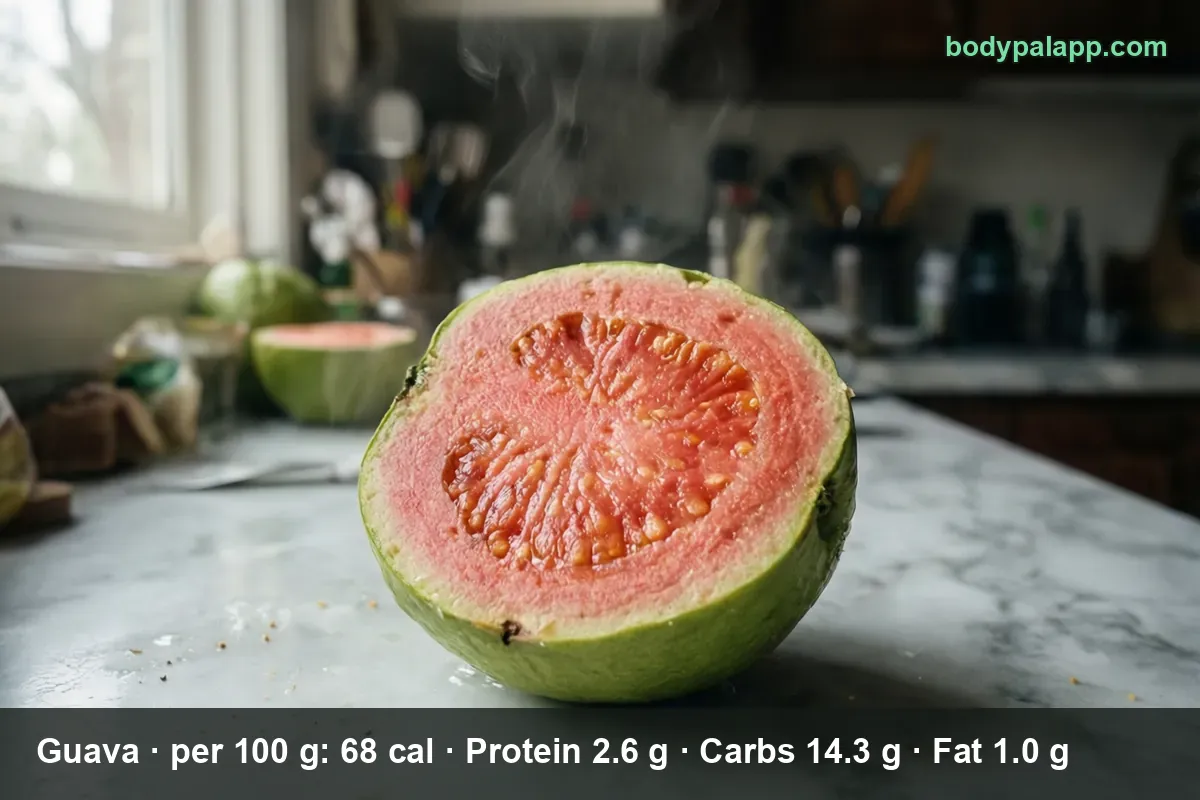
Half a guava, the cut face in the photo above, comes to roughly 27.5 g and 19 calories, again our own scaling rather than a published portion. That happens to be the same as an ounce, which tells you how small a fresh guava is: three of them, eaten whole, still land under 115 calories. The gap between "one guava" and "a cup of guava" is the trap. Chopping fills the cup with three fruits' worth, so the cup costs three times what a single fruit does.
Strawberry guava is a different fruit
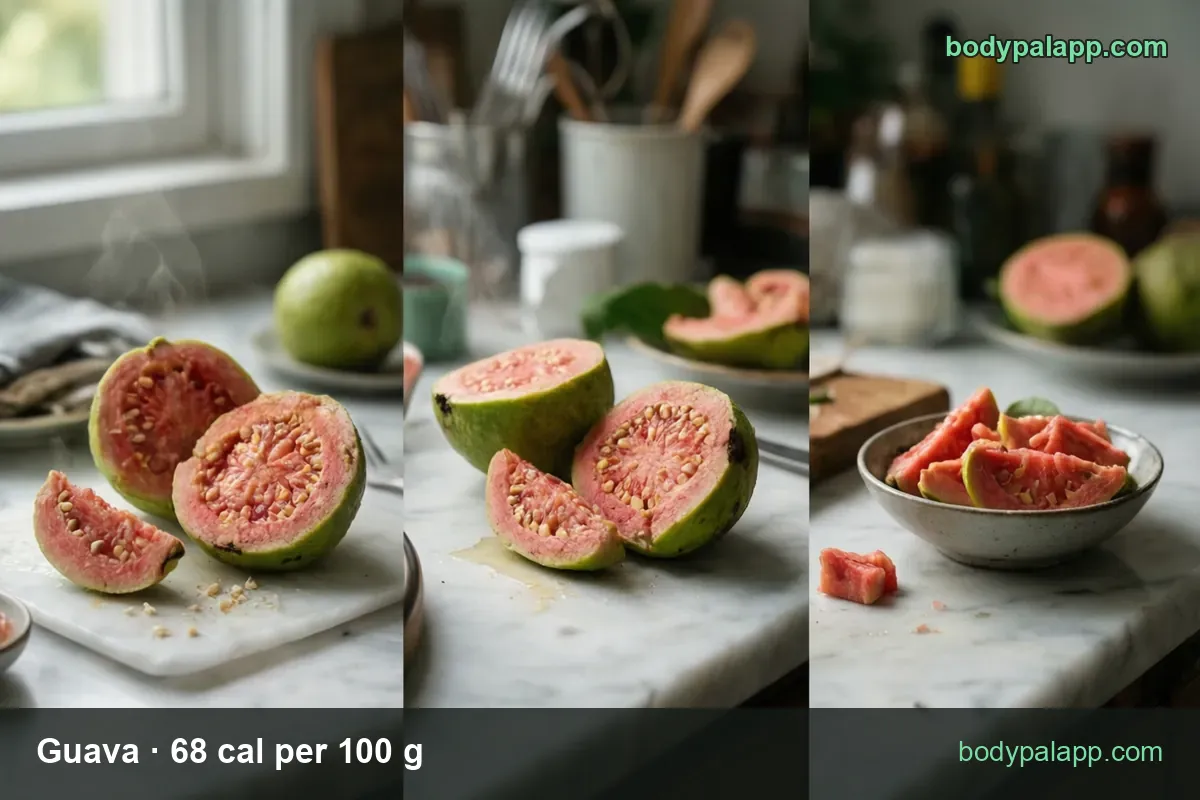
Strawberry guava, the small red-skinned fruit sold at farmers markets in Hawaii and Florida, sits at 69 calories per 100 g. One calorie above common guava. Underneath, the two records look nothing alike.
Protein collapses from 2.55 g to 0.58 g per 100 g, more than four times less. Carbohydrate climbs from 14.32 g to 17.36 g. Sodium goes from 2 mg to 37 mg, over eighteen times higher, though at that scale it is still nothing against the 2,300 mg Daily Value. Fiber holds steady at 5.4 g. USDA does not publish a total sugars figure for the strawberry guava record, so that line is left out here instead of guessed at.
The calorie difference people actually feel is the cup weight. USDA measures a cup of strawberry guava at 244 g against 165 g for common guava, which is why the same cup reads 168 calories instead of 112. Same fruit family, denser packing, half again the calories.
From guava sauce to guava paste
| Version | Per 100 g | Typical serving | Calories |
|---|---|---|---|
| Guava, raw | 68 kcal | 1 cup, chopped (165 g) | 112 kcal |
| Guava sauce, cooked | 36 kcal | 1 cup (238 g) | 86 kcal |
| Guava nectar, canned | 63 kcal | 1 cup (251 g) | 158 kcal |
| Guava nectar with sucralose | 48 kcal | 11.3 fl oz (335 g) | 161 kcal |
| Guava paste | 292 kcal | 1 Tbsp (20 g) | 58 kcal |
Cooked guava sauce reads 36 calories per 100 g, close to half the raw fruit, and that number fools people. The sauce is not a lighter food. It is guava simmered with water, so every 100 g holds less guava. Fiber tracks it down to 3.6 g. A whole cup of the sauce still costs 86 calories, less than a cup of fresh chopped fruit, but you are eating a diluted version of the same thing.
Canned nectar moves the other way. At 63 calories per 100 g it looks almost identical to the fruit, until you notice the cup is 251 g of liquid rather than 165 g of solids, so it lands at 158 calories, and the fiber has been strained down to 1 g per 100 g from 5.4. The sucralose version cuts the density to 48 calories per 100 g, but the standard can is 335 g, which brings it right back to 161. Store shelves match this: Jumex Guava Nectar labels 8 fl oz at 101 calories, and Rubicon Exotic Guava Juice lists 110 for a cup.
Guava paste is the real trap, and it is the one people log wrong. The block is guava boiled down with sugar until it slices with a knife: 292 calories per 100 g, with 71.62 g of that as sugar. A single 20 g tablespoon is 58 calories, more than one and a half fresh guavas, from something you spread rather than eat as a fruit. Goya's label for its guava paste puts a 19 g tablespoon at 60 calories, which is the same story in brand form. Pastelitos de guayaba, the pastry built around it, are a separate food entirely at 379 calories per 100 g.
Fiber is the row that earns guava its place
Look back at the quick facts table and the standout is not the calorie count. It is 8.9 g of fiber in a 112-calorie cup, which is 32% of the 28 g Daily Value the FDA sets for a 2,000-calorie diet. Very few foods hand over a third of a day's fiber for a hundred-odd calories, and almost no fruit does it.
Protein is the second surprise. Fruit usually contributes nothing here, yet guava carries 2.55 g per 100 g, which becomes 4.2 g and 8% of the Daily Value in a cup. That is not a protein food, but among fruit it is unusual enough to notice on a food log.
The catch worth knowing: most of that fiber lives in the seeds and skin. Scoop only the pink flesh and you leave a good part of the 5.4 g behind. MyPlate counts a cup of chopped guava as one cup-equivalent of fruit either way, but the nutrition table assumes you ate the whole thing. If you are watching sodium, fresh guava at 2 mg per 100 g is about as low as food gets.
How does guava compare?
| Food | Per 100 g | US serving | Calories |
|---|---|---|---|
| Guava, raw | 68 kcal | 1 oz (28 g) | 19 kcal |
| Grapes, red or green | 69 kcal | 1 oz (28 g) | 19 kcal |
| Pears, bosc | 67 kcal | 1 oz (28 g) | 19 kcal |
| Applesauce, canned, sweetened | 68 kcal | 1 oz (28 g) | 19 kcal |
Our take: by weight these four are indistinguishable, spanning 67 to 69 calories per 100 g, so calorie counting alone will never separate them. Protein does. Guava's 2.55 g per 100 g stands against 0.72 g for grapes, 0.36 g for bosc pears and 0.16 g for sweetened applesauce, making it the only one of the four above 1 g. If you want fruit that holds you until the next meal, guava is the pick. If you want the easiest hundred calories to eat while walking around, grapes still win.
Most popular guava brands in the United States
Ranked by how widely each product appears among foods sold in the United States, from the BodyPal food database of over 3.3 million products. Calories are the figures printed on each Nutrition Facts label, checked against USDA FoodData Central.
| Product | Calories (per 100 g) |
|---|---|
| Rubicon Exotic Guava Juice | 44 cal |
| Calypso Pink Guava Limeade | 46 cal |
| Jumex Guava Nectar | 42 cal |
| Jumex Guava Nectar from Concentrate | 50 cal |
| Goya Guava Paste | 316 cal |
| Goya Guava Paste 16 oz | 267 cal |
Brand popularity: BodyPal food database. Nutrition: manufacturer labels / USDA FoodData Central.
Guava FAQs
How many calories are in one guava?
One common guava without the stem weighs 55 g and carries 37 calories. That is a USDA household portion, not our estimate. The same fruit brings about 3.0 g of fiber and 1.4 g of protein, which we scaled from the 100 g figure of 68 calories, 5.4 g fiber and 2.55 g protein.
How many calories in a cup of guava?
A cup of chopped guava, 165 g on the USDA scale, is 112 calories. It also delivers 8.9 g of fiber, which is 32% of the Daily Value, plus 4.2 g of protein and 688 mg of potassium. Sodium is 3 mg, effectively nothing.
Is guava good for weight loss?
At 68 calories per 100 g, guava is a cheap way to hit fiber: one cup is 112 calories and 8.9 g, or 32% of the Daily Value. A whole fruit costs 37 calories. Keep it fresh, though, since a 20 g tablespoon of guava paste is 58 calories.
How much fiber is in a guava?
One 55 g guava holds about 3.0 g of fiber, our own arithmetic from the USDA figure of 5.4 g per 100 g. A cup of chopped fruit reaches 8.9 g, or 32% of the 28 g Daily Value the FDA sets, which is more fiber than most single foods deliver.
How much sugar does guava have?
Guava carries 8.92 g of total sugars per 100 g, so a cup is 14.7 g and one 55 g fruit about 4.9 g. None of it is added sugar; SR Legacy does not publish an added sugars figure for raw fruit, and everything sweet here comes from the guava itself.
Is guava high in protein?
For a fruit, yes: 2.55 g per 100 g, which is 4.2 g in a cup and 8% of the Daily Value. Grapes sit at 0.72 g per 100 g and bosc pears at 0.36 g. It is still fruit, not a protein source, but it beats its neighbors on the shelf.
How many calories in guava paste?
A 20 g tablespoon of guava paste is 58 calories, because the paste runs 292 calories per 100 g against 68 for the fresh fruit. That single spoon costs about the same as one and a half guavas, and the fiber drops to 1.1 g per 100 g.
How many calories in guava juice?
Canned guava nectar is 63 calories per 100 g, so a 251 g cup is 158 calories, more than a whole cup of chopped fruit at 112. The sucralose version drops to 48 per 100 g. Straining also cuts fiber to 1 g per 100 g from 5.4.
Similar foods
- Dragon Fruit — 122 cal per cup
- Fruit — 126 cal per piece
- Bosc Pear — 120 cal per medium pear
- Grapes — 104 cal per cup
- Grapes Black — 104 cal per cup
- Green Grapes — 104 cal per cup
Count it without the math
Point the camera at the plate and BodyPal counts the guava for you, cup or whole fruit.


How long does it take to burn off guava?
A 1-cup (165 g) serving is 112 kcal. Enter your weight and the amount you ate to see how long it takes you to burn that off:
lb
| Activity | Time to burn 112 kcal |
|---|---|
| Walking, brisk | 22 min |
| Cycling, moderate | 14 min |
| Swimming, moderate | 16 min |
| Jogging | 13 min |
| Weight training, moderate | 25 min |
Times are for a 155 lb adult at a steady pace; change the weight to see yours. The amount is set to the portion in the text (165 g); change it to what you actually ate. BodyPal works this out from your steps automatically.
Burning it off is one side of it. The other is knowing your number: work out how many calories you need a day, with macros and a goal date.