
How many calories are in a Guinness Extra Stout?
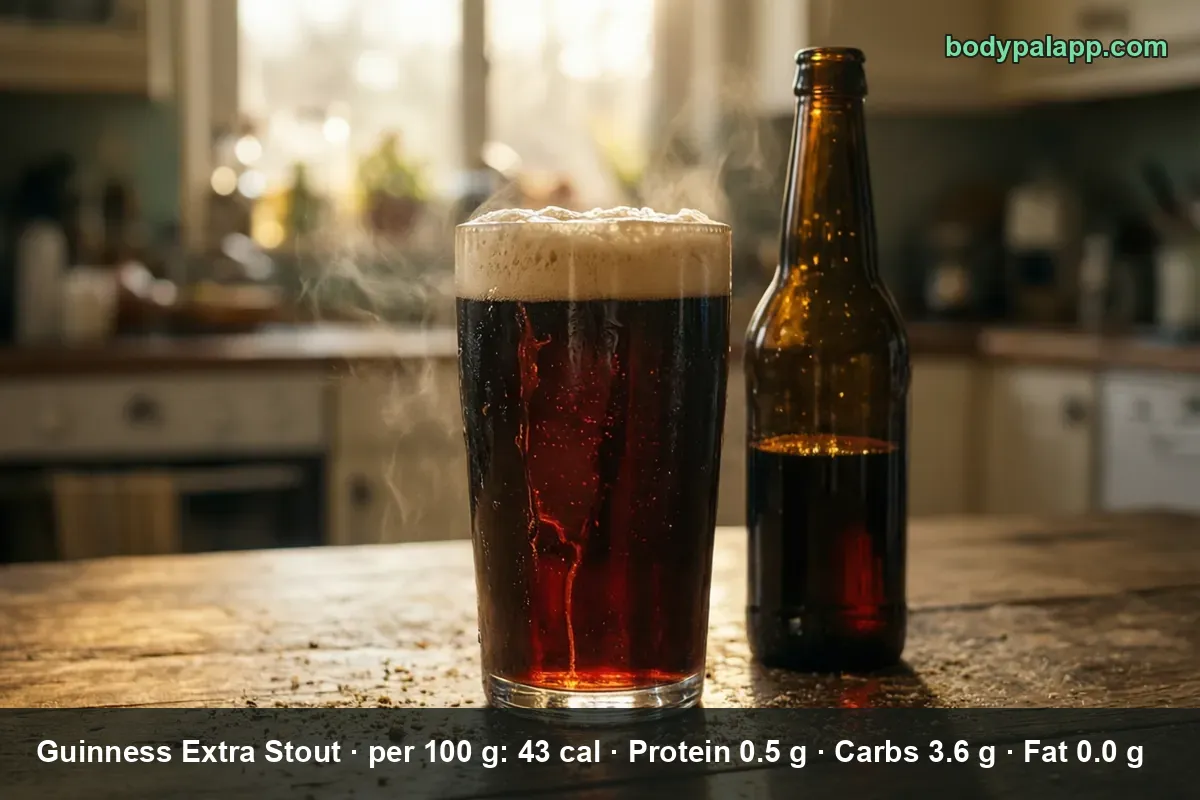
A 12 fl oz bottle of Guinness Extra Stout carries 153 calories, and per 100 g the beer itself runs only 43 calories. That gap is the whole story. The liquid is light, the glass is big, and 12 fl oz of beer weighs 356 g. Pour the same stout as a US pint and it lands at 204.
On this page
- Guinness Extra Stout quick facts
- US servings, from an 11.2 oz bottle to a full pint
- Stout, lager and light beer side by side
- Carbs are the only row with any weight
- How does Guinness Extra Stout compare?
- FAQ
Guinness Extra Stout quick facts
USDA does not publish a record for Guinness, or for stout as a style. What it does publish is SR Legacy 168746, "Alcoholic beverage, beer, regular, all", the only full-strength beer record that carries every macro plus a real household serving of one can or bottle. The only other full-strength entry is one brand, Budweiser; every remaining beer in the set is a light beer, a different product with a thinner wort behind it. So that regular-beer row is the honest baseline for a dark, full-strength stout, and it is the one used everywhere on this page.
Color is the thing people get wrong here. A stout looks heavy because the roasted malt turns it near-black, but the roast contributes flavor, not calories. What is actually in the glass is water, a little residual carbohydrate and alcohol.
| Nutrient | Per 100 g | Per 12 fl oz bottle (356 g) | % Daily Value |
|---|---|---|---|
| Calories | 43 | 153 | — |
| Total fat | 0 g | 0 g | 0% |
| Saturated fat | 0 g | 0 g | 0% |
| Carbohydrate | 3.55 g | 12.6 g | 5% |
| Dietary fiber | 0 g | 0 g | 0% |
| Total sugars | 0 g | 0 g | — |
| Protein | 0.46 g | 1.6 g | 3% |
| Sodium | 4 mg | 14 mg | 1% |
% Daily Value is based on a 2,000-calorie diet.
Verified nutrition data
Numbers on this page come from USDA FoodData Central, the U.S. Department of Agriculture’s food composition database, and from manufacturer labels where a branded product is named. Last verified September 2026. How we verify our data →
There is no added-sugars row in the table because the SR Legacy edition does not carry that nutrient for beer at all. Cholesterol is 0 mg, as you would expect from a plant-based drink. Potassium is the one mineral worth naming: 27 mg per 100 g, so 96 mg in the bottle, which is 2% of the Daily Value and not a reason to drink one. The %DV percentages come from the FDA reference amounts on the Nutrition Facts label.
US servings, from an 11.2 oz bottle to a full pint
| Serving | Weight | Calories |
|---|---|---|
| 1 fl oz | 29.7 g | 13 kcal |
| 1 oz | 28.4 g | 12 kcal |
| One bottle, 11.2 fl oz | 332.6 g | 143 kcal |
| One can or bottle, 12 fl oz | 356 g | 153 kcal |
| One US pint, 16 fl oz | 475 g | 204 kcal |
| Per 100 g | 100 g | 43 kcal |
The 12 fl oz line is the USDA household measure, straight from the record. The 11.2 fl oz bottle and the 16 fl oz pint are our own arithmetic from the USDA 100 g figure, not USDA servings, which matters because 11.2 fl oz is exactly how Guinness Extra Stout is sold in most American stores: the imported four-pack is 11.2 fl oz per bottle, not 12.
That single ounce of difference is worth 10 calories. The jump from that bottle to a bar pint is worth a lot more. A US pint is 475 g of beer against 332.6 g in the bottle, which turns 143 calories into 204 — an extra 61 calories for pouring the same beer into a bigger glass. Two pints out with friends is 408 calories before anyone touches the fries.
One warning on pints. A US pint is 16 fl oz; an imperial pint, which is what you get in Ireland and the UK, is 20 fl oz. Every number on this page is the US measure.
Stout, lager and light beer side by side
| Version | Per 100 g | Typical serving | Calories |
|---|---|---|---|
| Regular beer, the stout baseline | 43 kcal | 12 fl oz (356 g) | 153 kcal |
| Budweiser lager | 41 kcal | 12 fl oz (357 g) | 146 kcal |
| Light beer, generic | 29 kcal | 12 fl oz (354 g) | 103 kcal |
| Bud Light | 29 kcal | 12 fl oz (354 g) | 103 kcal |
| Budweiser Select | 28 kcal | 12 fl oz (355 g) | 99 kcal |
| Low-carb light beer | 27 kcal | 12 fl oz (354 g) | 96 kcal |
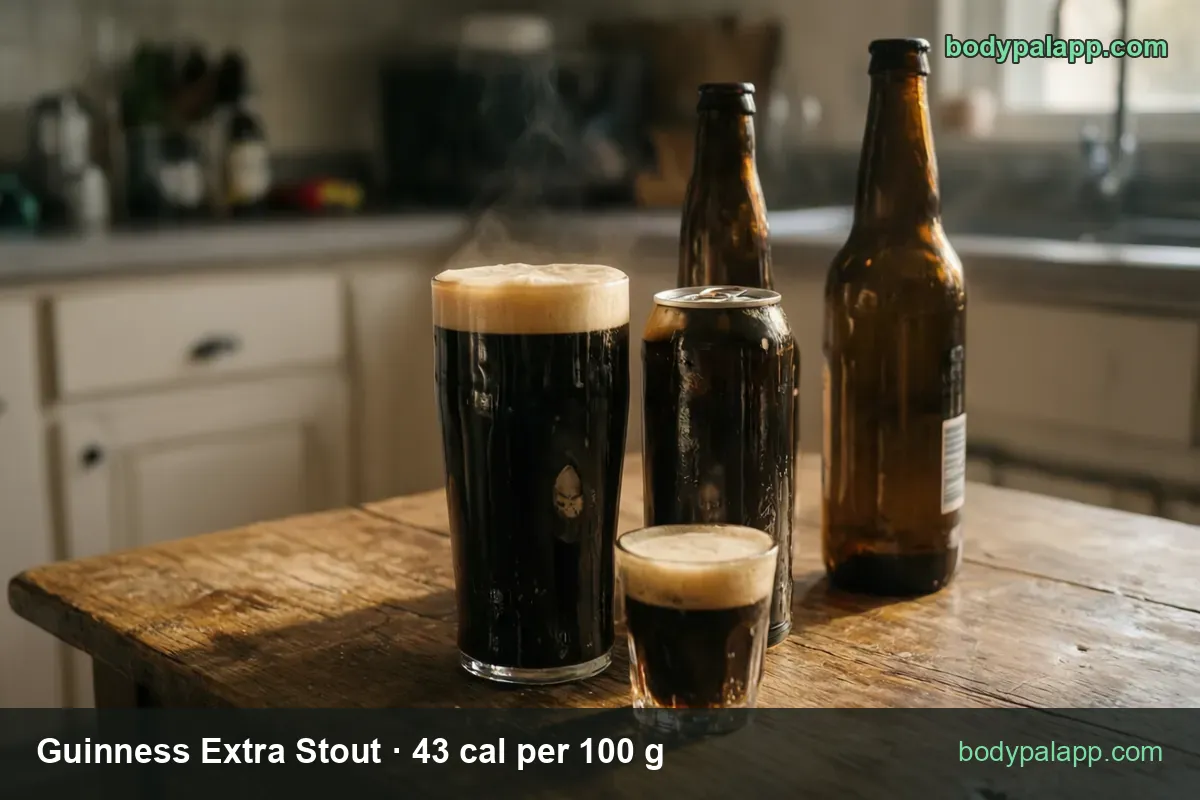
Read that column and the ranking most people carry around falls apart. A dark stout at 43 calories per 100 g sits 2 above a pale Budweiser lager at 41 — a 7-calorie gap across a full bottle, which is nothing. The real split is not dark against pale. It is full-strength against light, and it is worth about 50 calories a can.
There is one more record in USDA's beer set that never gets quoted, and it is the most useful of the seven: "beer, light, higher alcohol" comes in at 46 calories per 100 g. That is higher than the regular beer this page is built on, from a can labeled light, with only 0.77 g of carbohydrate per 100 g against 3.55 g in regular beer. Fewer carbs, more calories. Alcohol is doing the work, which is exactly why a strong stout is not a diet drink even though it holds almost no sugar.
Carbs are the only row with any weight
Go down the Nutrition Facts column for a 12 fl oz serving and almost every line is a zero: no fat, no saturated fat, no fiber, no sugar, 14 mg of sodium, which is 1% of the Daily Value and less than most people get from a slice of bread. Protein is 1.6 g, or 3% DV — technically present, not worth counting.
Carbohydrate is the only entry that registers at all: 12.6 g, or 5% of the Daily Value. Against a light beer's 5.8 g per can, the stout is carrying roughly 7 g more, and that difference plus the alcohol is the whole 50-calorie spread between the two.
Note that the calories in this row do not add up the usual way. Multiply out 12.6 g of carbohydrate with no fat and almost no protein and you get nowhere near 153. The missing chunk is alcohol, which carries calories but has no line on the Nutrition Facts label. That is why beer looks impossibly light on paper and behaves like a snack in practice. If you are tracking a night out, the Dietary Guidelines chapter on alcoholic beverages is the standard American reference, and CDC treats a 12 fl oz regular beer as one standard drink — the exact serving in the table above.
How does Guinness Extra Stout compare?
| Beer | Per 100 g | US serving | Calories |
|---|---|---|---|
| Guinness Extra Stout, regular beer row | 43 kcal | 12 fl oz (356 g) | 153 kcal |
| Budweiser lager | 41 kcal | 12 fl oz (357 g) | 146 kcal |
| Light beer | 29 kcal | 12 fl oz (354 g) | 103 kcal |
| Low-carb light beer | 27 kcal | 12 fl oz (354 g) | 96 kcal |
Our take: if you are cutting calories, the switch that pays is full-strength to light, not dark to pale — 153 down to 103 per can, and down to 96 for a low-carb recipe. Trading a stout for a Budweiser saves 7 calories and costs you the beer you actually wanted, so don't bother. The bigger lever is the glass. Drink your stout from an 11.2 oz bottle rather than a 16 oz pint and you save 61 calories per serving without changing a thing about what you are drinking.
Guinness Extra Stout FAQs
How many calories are in a Guinness Extra Stout?
153 calories in a 12 fl oz serving, based on the USDA regular beer record at 43 calories per 100 g. The American import is usually sold in 11.2 fl oz bottles instead, which works out to 143 calories. USDA publishes no separate record for Guinness itself.
How many calories in an 11.2 oz bottle of Guinness?
143 calories. That bottle holds 332.6 g of beer, and at the USDA figure of 43 calories per 100 g it comes to 143 — our own arithmetic from the 100 g number, not a USDA serving. It is 10 calories less than a standard 12 fl oz can.
How many calories in a pint of stout?
204 calories for a US pint, which is 16 fl oz or 475 g of beer, scaled by us from the USDA 43 calories per 100 g. That is 61 calories more than an 11.2 oz bottle. An imperial pint is 20 fl oz and would come out higher again.
How many carbs are in Guinness Extra Stout?
12.6 g of carbohydrate in a 12 fl oz serving, or 5% of the Daily Value, from 3.55 g per 100 g. An 11.2 fl oz bottle works out to 11.8 g. There is no fiber in the record, so those carbs count in full toward a net-carb total.
Does Guinness Extra Stout have sugar?
0 g of total sugars in the USDA record, per 100 g and per bottle alike. Brewing yeast ferments the sugar out of the wort, leaving longer carbohydrates behind. The SR Legacy edition does not carry an added-sugars figure for beer, so that line is absent rather than zero.
Is Guinness Extra Stout keto friendly?
12.6 g of carbohydrate per 12 fl oz makes it a hard fit for a strict keto day, where the whole allowance is often near that. A low-carb light beer runs 2.6 g per can at 27 calories per 100 g. If you want a beer on keto, that is the record to shop by.
Guinness Extra Stout vs Guinness Draught: which has more calories?
Both fall under the same USDA row: 43 calories per 100 g, 153 per 12 fl oz. USDA publishes no separate record for either one, so there is no honest number-to-number split to give you. Draught is the lower-alcohol pour of the two, and in beer, alcohol drives the calories.
Is dark beer higher in calories than light beer?
43 calories per 100 g for regular beer against 29 for light: 153 versus 103 per 12 fl oz can. The color has nothing to do with it. One USDA light beer with higher alcohol reaches 46 per 100 g, above regular beer, which shows what is really being measured.
Similar foods
- Beer — 155 cal for 12 fl oz can
- Beer (Lager) — 153 cal per can
- Corona Beer — 153 cal per bottle
- Guinness Stout Beer — 153 cal per bottle
- Heineken Beer — 153 cal per bottle
- Beer Pint — 206 cal per pint
Count it without the math
Point the camera at the glass and BodyPal counts it for you, pint or bottle.


How long does it take to burn off 153 kcal of Guinness Extra stout?
A 12 fl oz bottle (356 g) is 153 kcal. Enter your weight and the amount you ate to see how long it takes you to burn that off:
lb
| Activity | Time to burn 153 kcal |
|---|---|
| Walking, brisk | 31 min |
| Cycling, moderate | 19 min |
| Swimming, moderate | 22 min |
| Jogging | 18 min |
| Weight training, moderate | 34 min |
Times are for a 155 lb adult at a steady pace; change the weight to see yours. The amount is set to the portion in the text (356 g); change it to what you actually ate. BodyPal works this out from your steps automatically.
This table assumes you know your daily total. If you do not, the daily calorie calculator works it out from five numbers.