
How Many Calories Are in a Guinness?
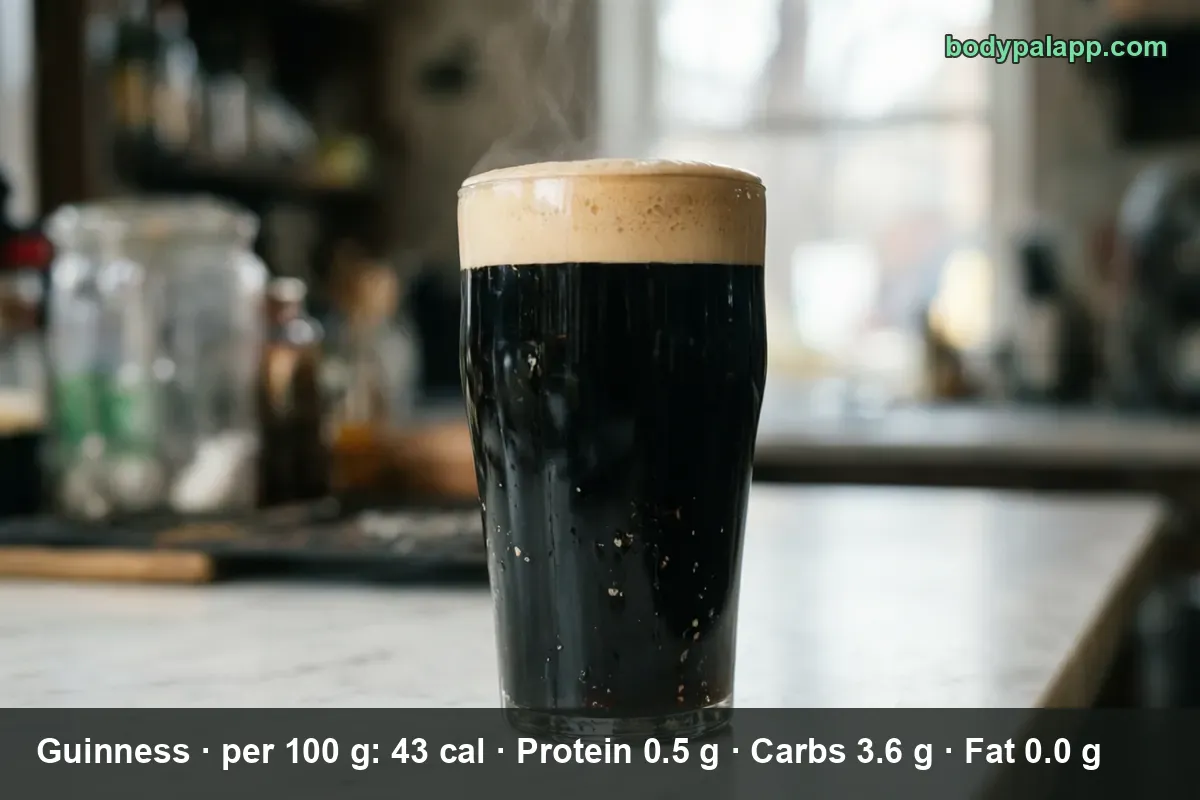
A 16 fl oz pint of stout carries 206 calories, and per 100 g beer runs 43 calories. The 12 fl oz bottle comes to 155. USDA publishes no Guinness-specific record, so the numbers here are the FNDDS generic beer entry — the closest as-consumed match to what is actually in the glass.
On this page
- Guinness quick facts
- US servings, from one ounce to a 40 oz bottle
- Pint, bottle and the stout-strength pour
- Light beer, low-carb and nonalcoholic
- Where the calories actually come from
- How does Guinness compare?
- Most popular guinness brands
- FAQ
Guinness quick facts
There is no Guinness row in USDA FoodData Central, and there is no way around that. Alcoholic drinks are regulated by the TTB rather than the FDA, so they carry no mandatory Nutrition Facts panel and none of them get a branded USDA entry. What USDA does publish is FNDDS 2710616, "Beer" — an as-consumed record with US household measures at 12 and 16 fl oz, which is exactly how a stout arrives at a table here.
SR Legacy 168746 carries identical values from a different source, but it has no pint-sized portion attached, so the FNDDS row is the one used below. The two are not averaged; they are the same numbers.
| Nutrient | Per 100 g | Per 1 pint, 16 fl oz (480 g) | % Daily Value |
|---|---|---|---|
| Calories | 43 | 206 | — |
| Total fat | 0 g | 0 g | 0% |
| Saturated fat | 0 g | 0 g | 0% |
| Carbohydrate | 3.55 g | 17.0 g | 6% |
| Dietary fiber | 0 g | 0 g | 0% |
| Total sugars | 0 g | 0 g | — |
| Protein | 0.46 g | 2.2 g | 4% |
| Sodium | 4 mg | 19 mg | 1% |
| Cholesterol | 0 mg | 0 mg | 0% |
| Potassium | 27 mg | 130 mg | 3% |
% Daily Value is based on a 2,000-calorie diet.
Verified nutrition data
Numbers on this page come from USDA FoodData Central, the U.S. Department of Agriculture’s food composition database, and from manufacturer labels where a branded product is named. Last verified September 2026. How we verify our data →
Two rows you would expect on a label are missing here: added sugars and trans fat. FNDDS does not publish either value for this beer record, so neither gets a line rather than a guess. Cholesterol is 0 mg. Potassium is 27 mg per 100 g, which works out to 130 mg in a 16 fl oz pour, 3% of the Daily Value. Sodium is negligible — 19 mg in a full pour is a rounding error next to the 2,300 mg Daily Value set by the FDA, just under a hundredth of a teaspoon of table salt.
US servings, from one ounce to a 40 oz bottle
| Serving | Weight | Calories |
|---|---|---|
| 1 fl oz | 30 g | 13 kcal |
| Per 100 g | 100 g | 43 kcal |
| 1 can or bottle, 12 fl oz | 360 g | 155 kcal |
| 1 pint, 16 fl oz | 480 g | 206 kcal |
| 1 large bottle, 40 fl oz | 1200 g | 516 kcal |
The 1 fl oz, 12 fl oz, 16 fl oz and 40 fl oz measures are USDA household portions on the beer record. A weight ounce is a different animal: 1 oz of beer is 28.4 g and about 12 calories, which is our own arithmetic from the USDA 100 g figure, not a USDA serving. Beer is ordered by volume, so fluid ounces are the useful unit and the weight ounce mostly shows up when someone logs a taste.
Here is the trap worth remembering. A bar pint in the US is 16 fl oz, not the 20 fl oz Irish pour, and the difference is 51 calories a glass against the 12 fl oz bottle you would drink at home. Three draft pours put away 618 calories; three bottles, 465. Same beer, same night, a 153-calorie gap created entirely by glassware.
Pint, bottle and the stout-strength pour
| Version | Per 100 g | Typical pour | Calories |
|---|---|---|---|
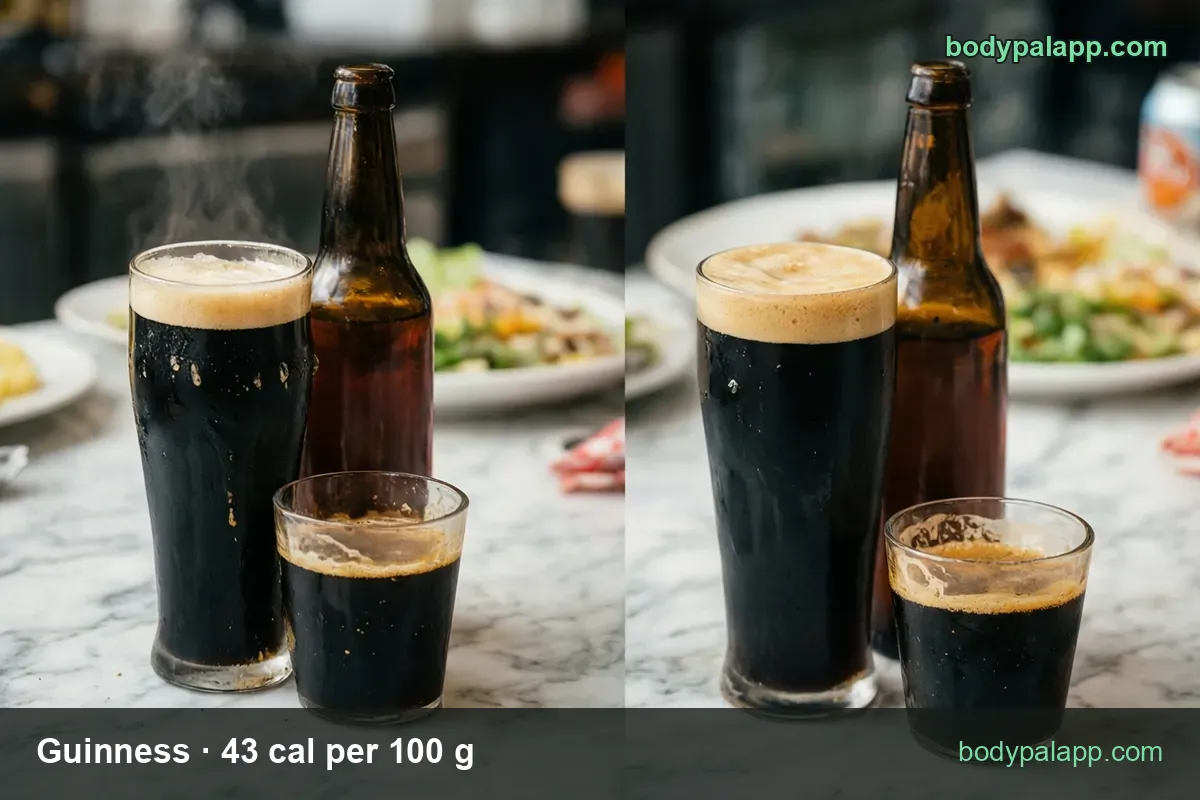
| Regular beer, US pint | 43 kcal | 16 fl oz (480 g) | 206 kcal |
| Regular beer, bottle or can | 43 kcal | 12 fl oz (360 g) | 155 kcal |
| Higher-alcohol beer | 58 kcal | 16 fl oz (480 g) | 278 kcal |
| Light beer | 29 kcal | 16 fl oz (480 g) | 139 kcal |
Strength moves the number more than style does. USDA's higher-alcohol beer record runs 58 calories per 100 g — 278 in a 16 fl oz pour — while listing only 0.27 g of carbohydrate per 100 g, about 1.3 g in the whole glass. It is denser in calories and lighter in carbs at the same time, which only makes sense once you accept that the alcohol is doing the work.
That matters for stout specifically, because dark color reads as heavy. Roasted barley supplies the color and the burnt-coffee edge without supplying calories, so a black beer at standard strength lands on the same 43 per 100 g row as a pale lager. USDA's Budweiser entry, a light-colored lager, is 41 calories per 100 g, or about 148 in a 12 fl oz bottle by our own arithmetic — within a rounding error of the generic row and, per gram, slightly under it. Color is not the variable. Alcohol content and glass size are.
Light beer, low-carb and nonalcoholic
| Version | Per 100 g | Typical pour | Calories |
|---|---|---|---|
| Light beer | 29 kcal | 16 fl oz (480 g) | 139 kcal |
| Light beer, low carb | 27 kcal | 12 fl oz (360 g) | 97 kcal |
| Nonalcoholic beer | 37 kcal | 12 fl oz (360 g) | 133 kcal |
Light beer at 29 calories per 100 g gives you 139 in a 16 fl oz pour — exactly half the 278 of the higher-alcohol row, and 67 under the regular pint. The low-carb version drops to 27 per 100 g, or 97 calories in a 12 fl oz bottle, and 0.73 g of carbohydrate per 100 g means about 2.6 g in the bottle. Both of those bottle figures are our own arithmetic from the USDA 100 g values rather than listed USDA servings.
Nonalcoholic beer is the surprise. At 37 calories per 100 g it is only 6 under regular beer, so a 12 fl oz bottle comes to 133 calories against 155 — a saving of 22, not the wipeout most people expect. And the composition flips completely: 8.05 g of sugars per 100 g, roughly 29 g in a bottle, where the regular beer record lists 0 g total sugars. Take out the alcohol and the calories have to come from somewhere, and here they come from sugar.
One more line item that catches people out at the checkout. The Guinness name is licensed to a shelf of US grocery foods that are far denser than the beer: a Guinness luxury dark chocolate bar is 578 calories per 100 g, 260 for a 45 g half bar, and Guinness cheddar is 400 per 100 g, 120 in a 30 g cube. A single square of that chocolate outweighs a mouthful of the stout it is named after.
Where the calories actually come from
The panel above does not add up, and that is the most useful thing on this page. A 16 fl oz pour lists 17.0 g of carbohydrate, 2.2 g of protein, 0 g of fat and 0 g of sugar — nowhere near enough to explain 206 calories. The remainder is ethanol, and USDA does not carry alcohol as a nutrient row on this record, so it never appears on the label you are reading.
That is why carb-counting alone misleads with beer. Someone tracking macros sees 17.0 g of carbohydrate, 6% of the Daily Value, decides the glass is cheap, and logs a third of the actual number. The higher-alcohol row makes the point sharper: 1.3 g of carbohydrate in a 16 fl oz pour, 278 calories.
For context on what a serving even means, the CDC defines one standard drink as 12 fl oz of regular beer at about 5% alcohol — the bottle, not the pint. A 16 fl oz draft is closer to one and a third standard drinks, which is worth knowing if you are counting drinks and calories at the same time. The Dietary Guidelines for Americans hold that adults who do not drink should not start, and that adults of legal drinking age who do can keep it to two drinks or fewer a day for men and one or fewer for women.
How does Guinness compare?
| Drink | Per 100 g | US serving | Calories |
|---|---|---|---|
| Beer, regular | 43 kcal | 12 fl oz (360 g) | 155 kcal |
| Hard cider | 56 kcal | 12 fl oz (360 g) | 202 kcal |
| Alcoholic malt beverage | 58 kcal | 12 fl oz (360 g) | 209 kcal |
| Hard seltzer | 24 kcal | 12 fl oz (360 g) | 86 kcal |
The 12 fl oz servings for cider, malt beverage and seltzer are our own arithmetic from each record's 100 g figure, scaled to match the beer bottle so the four sit on the same footing.
Our take: for calorie counting, a bottle of stout is a middle-of-the-road choice and a better one than the sweet options next to it — 155 against 202 for cider and 209 for a malt beverage, and the USDA beer record lists 0 g of sugar. Hard seltzer is the honest winner at 86 a can, roughly half the beer, and if the evening is going to run long that is where the math favors you. If it is one drink and you want it to taste like something, take the 12 fl oz bottle over the 16 fl oz draft and bank the 51 calories. The glass you pick decides more than the beer you pick.
Most popular guinness brands in the United States
Ranked by how widely each product appears among foods sold in the United States, from the BodyPal food database of over 3.3 million products. Calories are the figures printed on each Nutrition Facts label, checked against USDA FoodData Central.
| Product | Calories (per 100 g) |
|---|---|
| Guinness Luxury Dark Chocolate Solid Bar | 578 cal |
| Guinness Luxury Milk Chocolate Solid Bar | 556 cal |
| Guinness Luxury Milk & Dark Chocolate Truffles | 505 cal |
| Guinness Chocolate Stout Flavored Donuts | 421 cal |
| Guinness Cheddar | 400 cal |
Brand popularity: BodyPal food database. Nutrition: manufacturer labels / USDA FoodData Central.
Guinness FAQs
How many calories are in a pint of Guinness?
A 16 fl oz pint comes to 206 calories, from the USDA generic beer record at 43 calories per 100 g. USDA publishes no Guinness-specific entry, because alcoholic drinks sit outside Nutrition Facts labeling. That 480 g pour also carries 17.0 g of carbohydrate, 2.2 g of protein and no fat.
How many calories are in a 12 oz Guinness?
A 12 fl oz bottle or can weighs 360 g and works out to 155 calories, 51 fewer than a 16 fl oz pour of the same beer. Carbohydrate drops to 12.8 g and protein to 1.7 g. Two bottles land at 310 calories, still well under one 40 fl oz bottle at 516.
How many carbs are in Guinness?
A 16 fl oz pour has 17.0 g of carbohydrate, 6% of the Daily Value, and a 12 fl oz bottle has 12.8 g. None of it is sugar — the USDA beer record lists 0 g total sugars. Fiber is 0 g as well, so every gram counts as available carbohydrate.
Is Guinness lower in calories than other beers?
At 43 calories per 100 g the generic beer record sits below hard cider at 56 and malt beverages at 58, and above light beer at 29. A dark stout looks heavier than it is, because roasted barley supplies color rather than calories. Higher-alcohol beer, at 58 per 100 g, is the real jump.
Does Guinness have any protein?
A 16 fl oz pour has 2.2 g of protein, 4% of the Daily Value, and a 12 fl oz bottle has 1.7 g. It is real but small, and beer is not a protein source in any practical sense. The same USDA record lists 0 g of fat and 0 mg of cholesterol.
How many calories are in nonalcoholic Guinness?
The USDA nonalcoholic beer record is 37 calories per 100 g, so a 12 fl oz bottle is 133 calories by our own arithmetic — only 22 below the regular bottle. The reason is sugar: 8.05 g per 100 g, about 29 g a bottle, where regular beer lists 0 g total sugars.
Guinness vs light beer - which has fewer calories?
Light beer wins by a wide margin: 29 calories per 100 g against 43. Poured at 16 fl oz that is 139 calories versus 206, and the light beer figure is exactly half the 278 of a higher-alcohol beer. Low-carb light is lower still, 97 calories in a 12 fl oz bottle.
Is Guinness a good source of iron or fiber?
Fiber is 0 g on the USDA beer record, so no. Iron is a different matter: the FNDDS beer entry does not publish an iron value, so there is no number to quote here. What the record does show is 130 mg of potassium in a 16 fl oz pour, 3% of the Daily Value.
Similar foods
- Beer — 155 cal for 12 fl oz can
- Beer (Lager) — 153 cal per can
- Corona Beer — 153 cal per bottle
- Guinness Stout Beer — 153 cal per bottle
- Heineken Beer — 153 cal per bottle
- Beer Pint — 206 cal per pint
Count it without the math
Point the camera at the glass and BodyPal counts the pour for you, bottle or draft.


How long does it take to burn off Guinness?
A 16 fl oz pint (480 g) is 206 kcal. Enter your weight and the amount you ate to see how long it takes you to burn that off:
lb
| Activity | Time to burn 206 kcal |
|---|---|
| Walking, brisk | 41 min |
| Cycling, moderate | 26 min |
| Swimming, moderate | 29 min |
| Jogging | 24 min |
| Weight training, moderate | 46 min |
Times are for a 155 lb adult at a steady pace; change the weight to see yours. The amount is set to the portion in the text (480 g); change it to what you actually ate. BodyPal works this out from your steps automatically.
This table assumes you know your daily total. If you do not, the daily calorie calculator works it out from five numbers.