
How many calories are in halloumi?
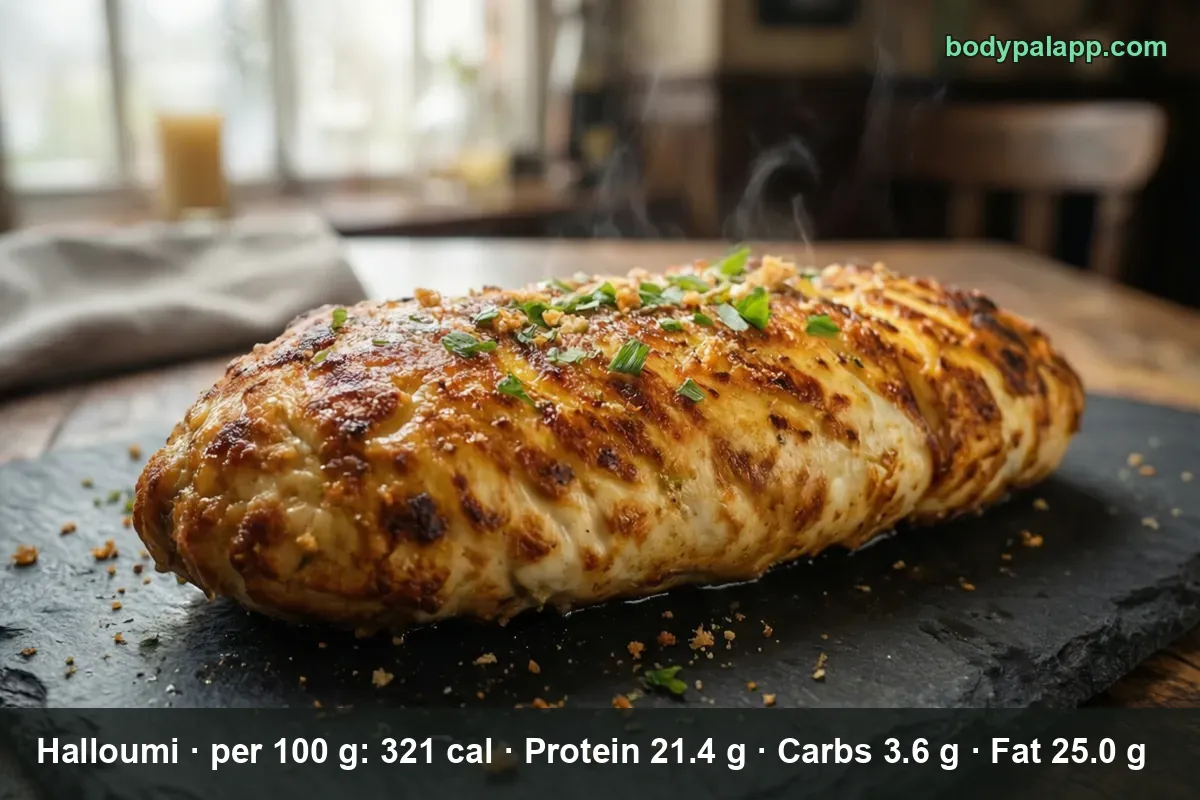
Two grilled slices of halloumi weigh 56 g and come to 180 calories. Per 100 g the cheese runs 321 calories, most of it fat, with 12 g of protein in those two slices. The squeaky texture hides how dense it is: halloumi lands closer to provolone than to feta.
On this page
- Halloumi quick facts
- US servings, from one cube to a plate of four slices
- Grilled slices, cubes and the brands on the shelf
- Sodium is the row to watch, not fat
- How does halloumi compare?
- Most popular halloumi brands
- FAQ
Halloumi quick facts
Halloumi is one of the few common supermarket foods with no reference entry in USDA's research databases. There is no halloumi row in Foundation Foods, no row in SR Legacy, and none in FNDDS. Every US number for it is a manufacturer label. The figures below come from FoodData Central record 2472184, "Halloumi Cheese, Halloumi" from DODONI, the most-logged halloumi label in the United States and a block that sits in the middle of the 286-to-393-calorie label range.
The main column is two grilled slices, 56 g, because that is what ends up on a plate next to a salad. It is our own arithmetic from the USDA 100 g figure, not a USDA serving: the label serving is a single one-inch cube of 28 g.
| Nutrient | Per 100 g | Per 2 grilled slices (56 g) | % Daily Value |
|---|---|---|---|
| Calories | 321 | 180 | — |
| Total fat | 25 g | 14.0 g | 18% |
| Saturated fat | 14.29 g | 8.0 g | 40% |
| Carbohydrate | 3.57 g | 2.0 g | 1% |
| Dietary fiber | 0 g | 0 g | 0% |
| Total sugars | 3.57 g | 2.0 g | — |
| Protein | 21.43 g | 12.0 g | 24% |
| Sodium | 1250 mg | 700 mg | 30% |
% Daily Value is based on a 2,000-calorie diet.
Verified nutrition data
Numbers on this page come from USDA FoodData Central, the U.S. Department of Agriculture’s food composition database, and from manufacturer labels where a branded product is named. Last verified September 2026. How we verify our data →
There is no added sugars row because this record does not publish the field, and there is nothing to publish: the 3.57 g of total sugars per 100 g is lactose from the milk, not sugar anyone stirred in. Cholesterol is 71 mg per 100 g, so 40 mg in two slices, 13% of the Daily Value. Potassium is modest at 214 mg per 100 g, 120 mg in a two-slice serving, about 3%.
US servings, from one cube to a plate of four slices
| Serving | Weight | Calories |
|---|---|---|
| One 1-inch cube, label serving | 28 g | 90 kcal |
| Two grilled slices | 56 g | 180 kcal |
| 3 oz plate | 85 g | 273 kcal |
| Four grilled slices | 112 g | 360 kcal |
| Per 100 g | 100 g | 321 kcal |
Only the 28 g cube is a USDA household measure. The 56 g, 85 g and 112 g rows are our own arithmetic scaled from the USDA 100 g figure, because nobody grills a single cube.
That scaling is where halloumi catches people out. A restaurant-style plate of four grilled slices is 112 g, which is four label servings stacked on one plate. At 360 calories it is a main course, not a side, and it arrives looking like an appetizer. Slice thickness is the other variable: supermarket blocks get cut anywhere from 25 g to 40 g a slice, so two slices off a thick-cut block can outweigh our 56 g column by a third.
Grilled slices, cubes and the brands on the shelf
| Version | Per 100 g | Typical piece | Calories |
|---|---|---|---|
| Grilled halloumi slices (DODONI) | 321 kcal | 2 slices, 56 g | 180 kcal |
| Halloumi cubes in a salad (DODONI) | 321 kcal | one 1-inch cube, 28 g | 90 kcal |
| Yanni grilling cheese | 286 kcal | 1 oz, 28 g | 80 kcal |
| Shepherds of Cyprus halloumi | 393 kcal | 1 oz, 28 g | 110 kcal |
| Christis halloumi | 296 kcal | 1 slice, 25 g | 74 kcal |
| Narragansett Creamery grilling cheese | 321 kcal | 1 oz, 28 g | 90 kcal |
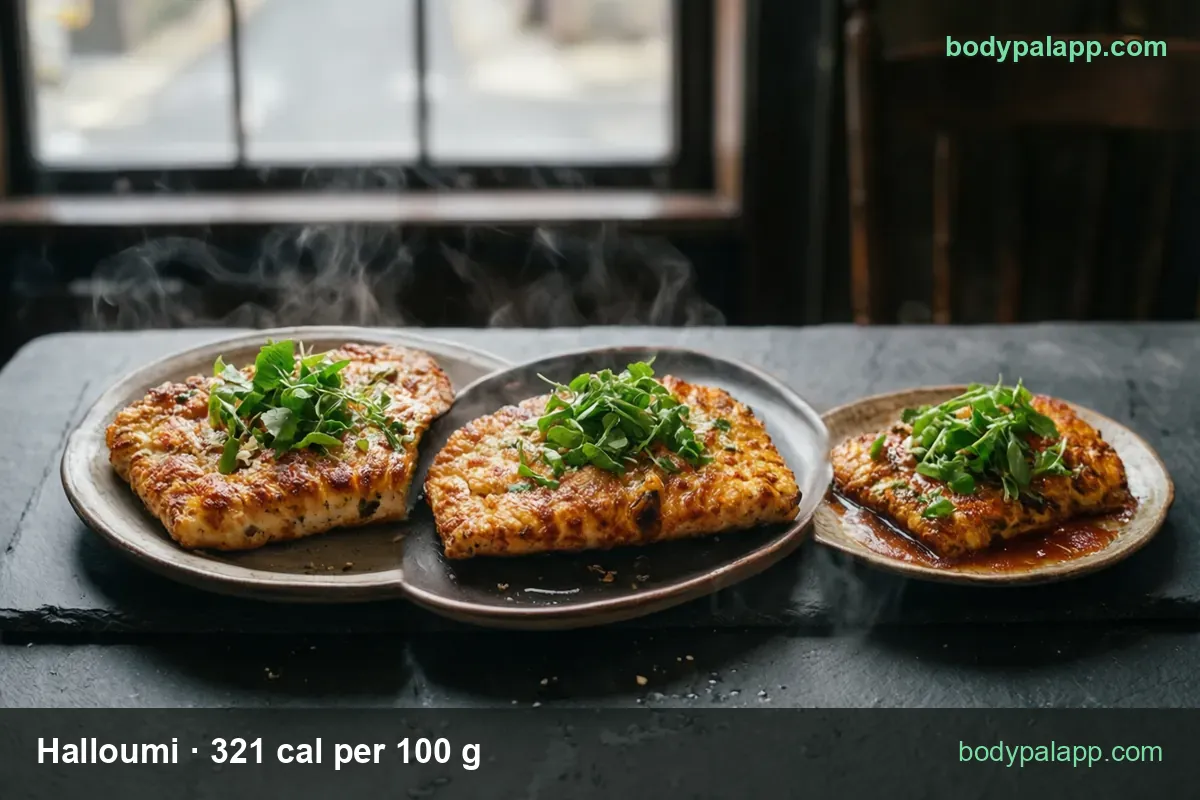
Grilling itself adds nothing. Heat drives off water and firms the crust, so the two slices you put in the pan are the two slices you eat, at the same 180 calories. USDA publishes no separate grilled record, and any oil or butter in the pan is a second line in your log, not part of the cheese. A dry nonstick pan or a hot grill pan keeps the number at 180.
The brand spread matters more than the cooking. Across the eight US records for halloumi and grilling cheese, calories run from 286 per 100 g at the leanest labels to 393 at Shepherds of Cyprus, made with a richer sheep and goat milk blend. The same two slices, 56 g, are 160 calories at the low end and 220 at the high end. That is a 60-calorie swing on identical-looking cheese, which is why the block in your fridge beats any generic figure.
American-made grilling cheese, sold under names like Yanni and Narragansett Creamery, is the same idea with a US recipe. It grills the same way and squeaks the same way, but it is often milder and, as the next section shows, considerably less salty.
Sodium is the row to watch, not fat
Two grilled slices carry 700 mg of sodium, 30% of the FDA Daily Value of 2,300 mg. That is the real headline on this cheese. Halloumi is brined so it holds its shape in a pan, and the brine follows it onto the plate: 1,250 mg per 100 g, against 323 mg in an ounce of feta.
Put the plate of four slices on the table and you are at 1,400 mg before anything else on it, roughly 60% of a day's limit from one component of one meal. The CDC notes most Americans already take in more sodium than recommended, so if that is your constraint, the useful move is not a smaller portion but a different block: Narragansett Creamery grilling cheese is 536 mg per 100 g, the lowest of the eight records and less than half the DODONI figure, and Yanni is 643 mg.
Saturated fat is the second row. Two slices bring 8.0 g, 40% of the 20 g Daily Value, packed into only 180 calories. Very few 180-calorie foods spend that much of the day's saturated fat budget. The trade is 12 g of protein for those calories, 24% of the Daily Value, which is a genuinely good ratio and the reason halloumi works as the protein on a vegetable plate rather than as something you graze on.
How does halloumi compare?
| Cheese | Per 100 g | US serving | Calories |
|---|---|---|---|
| Halloumi | 321 kcal | 2 grilled slices, 56 g | 180 kcal |
| Feta | 265 kcal | 1 oz, 28.35 g | 75 kcal |
| Mozzarella, whole milk | 299 kcal | 1 oz, 28.35 g | 85 kcal |
| Provolone | 351 kcal | 1 slice, 28 g | 98 kcal |
Matched ounce for ounce, halloumi's 28 g cube is 90 calories: heavier than feta at 75 and whole-milk mozzarella at 85, lighter than provolone at 98. Provolone is the only cheese here that is denser than halloumi per 100 g.
Our take: for weight loss, feta is the better crumble — it is the lightest of the four per gram and a little goes far because it is sharp. For satiety, halloumi is the one worth the calories, because 21.43 g of protein per 100 g arrives in a form you can grill and eat as the center of a plate rather than a garnish. Keep it to two slices, pair it with something bulky, and pick a lower-sodium block if salt is on your radar.
Most popular halloumi brands in the United States
Ranked by how widely each product appears among foods sold in the United States, from the BodyPal food database of over 3.3 million products. Calories are the figures printed on each Nutrition Facts label, checked against USDA FoodData Central.
| Product | Calories (per 100 g) |
|---|---|
| DODONI Halloumi Cheese | 321 cal |
| DODONI Authentic Cyprus Halloumi | 321 cal |
| Yanni Grilling Cheese | 286 cal |
| Shepherds of Cyprus Halloumi | 393 cal |
| Christis Halloumi Cheese | 296 cal |
| Narragansett Creamery Grilling Cheese | 321 cal |
Brand popularity: BodyPal food database. Nutrition: manufacturer labels / USDA FoodData Central.
Halloumi FAQs
How many calories are in halloumi?
Two grilled slices weigh 56 g and carry 180 calories, and 100 g of halloumi is 321 calories. The label serving, a one-inch cube of 28 g, is 90 calories. Those figures come from the DODONI record in USDA FoodData Central, the most-logged halloumi label in the US.
How many calories are in grilled halloumi?
Grilled halloumi is 180 calories for two slices, the same as before it hit the pan, because heat only drives off water and firms the outside. USDA publishes no separate grilled record. If you grill it in oil or butter, count that fat on its own line; a dry pan adds nothing.
How many calories are in a slice of halloumi?
One grilled slice of 28 g is 90 calories, half of the 180 in a two-slice serving. Thickness moves it, since blocks get cut anywhere from 25 g to 40 g a slice. A 1 oz slice of the richest US label, Shepherds of Cyprus, is 110 calories instead.
How many calories are in halloumi per 100 g?
Halloumi is 321 calories per 100 g on the DODONI label, with 25 g of fat, 21.43 g of protein and 1,250 mg of sodium. US labels for halloumi run from 286 to 393 calories per 100 g, so check your own block; there is no single USDA reference figure for this cheese.
How much protein is in halloumi?
Two grilled slices give 12 g of protein, 24% of the 50 g Daily Value, and 100 g gives 21.43 g. That is close to whole-milk mozzarella at 22.17 g per 100 g and well above feta at 14.21 g. For a cheese you can grill whole, halloumi is protein-dense.
Is halloumi high in sodium?
Yes. Two slices carry 700 mg of sodium, 30% of the 2,300 mg Daily Value, and 100 g carries 1,250 mg against 323 mg in an ounce of feta. Brands differ sharply: Narragansett Creamery grilling cheese is 536 mg per 100 g, less than half the DODONI figure.
Is halloumi healthy?
Two grilled slices are 180 calories, 8 g of saturated fat at 40% of the Daily Value, 700 mg of sodium at 30%, and 12 g of protein at 24%. It earns its place as the protein on a vegetable-heavy plate. As a snack you eat by the handful, the saturated fat and salt add up fast.
Halloumi vs feta: which has fewer calories?
Feta is lighter, at 265 calories per 100 g against halloumi's 321, and a 1 oz serving of feta is 75 calories versus 90 for a 28 g cube of halloumi. Halloumi wins on protein, 21.43 g per 100 g against 14.21 g. Pick feta when calories are the constraint.
Similar foods
- Coconut Shrimp — 250 cal for 4 shrimp
- Sausage Link — 75 cal per link
- Italian sub — 610 cal per regular sub
- Falafel — 170 cal for 3 patties
- Sausage — 210 cal per link
- Brie — 95 cal per oz
Count it without the math
Point the camera at the plate and BodyPal counts the halloumi for you, slice by slice.


How long does it take to burn off halloumi?
Two grilled slices (56 g) is 180 kcal. Enter your weight and the amount you ate to see how long it takes you to burn that off:
lb
| Activity | Time to burn 180 kcal |
|---|---|
| Walking, brisk | 36 min |
| Cycling, moderate | 22 min |
| Swimming, moderate | 26 min |
| Jogging | 21 min |
| Weight training, moderate | 40 min |
Times are for a 155 lb adult at a steady pace; change the weight to see yours. The amount is set to the portion in the text (56 g); change it to what you actually ate. BodyPal works this out from your steps automatically.
This table assumes you know your daily total. If you do not, the daily calorie calculator works it out from five numbers.