
How many calories are in Hamburger Helper?
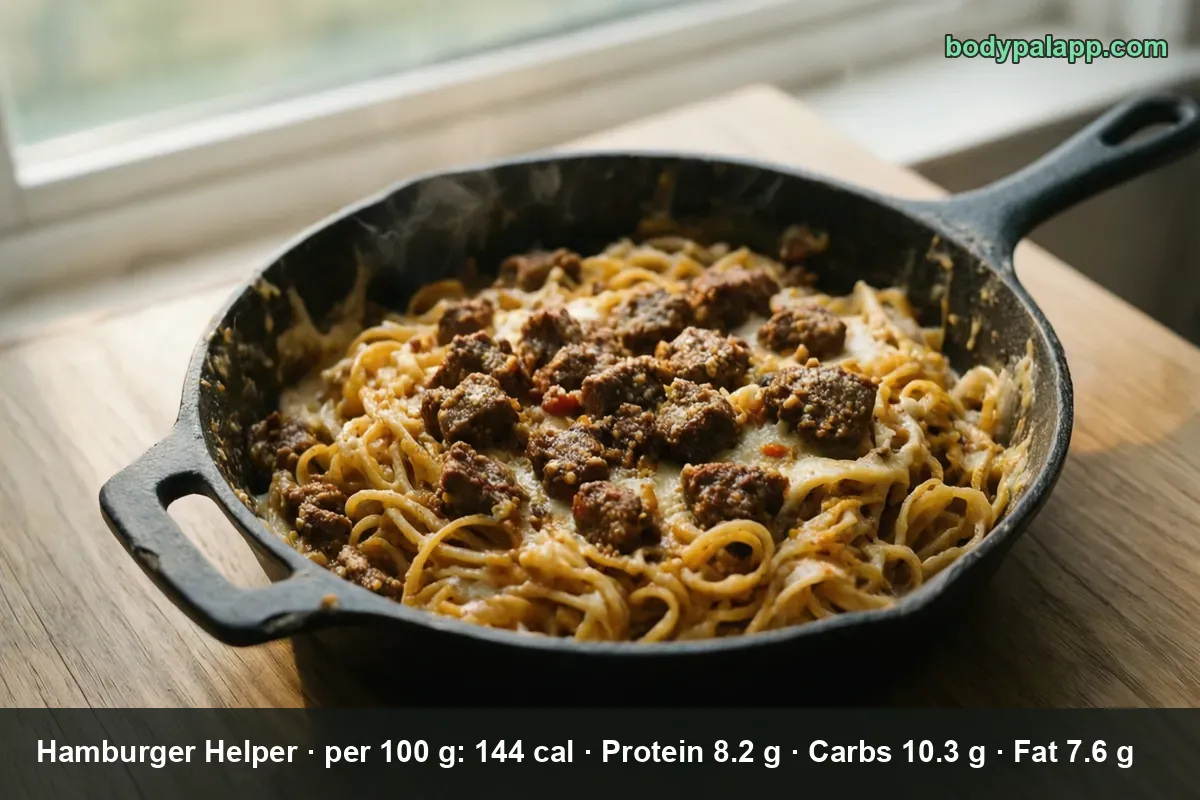
A 1-cup serving of prepared Hamburger Helper weighs 230 g and carries 331 calories. Per 100 g the finished skillet runs 144 calories, which is light for a beef-and-pasta dinner. The number on the box is not this number: that one counts dry mix only, before the pound of ground beef goes in.
On this page
- Hamburger Helper quick facts
- US servings, from an ounce to a microwave pouch
- Box flavors and what the dry mix actually weighs
- Sodium is the row that bites, not calories
- How does Hamburger Helper compare?
- Most popular hamburger helper brands
- FAQ
Hamburger Helper quick facts
The record behind every number here is FNDDS 2708819, "Macaroni or noodles with cheese and meat, prepared from Hamburger Helper mix". It is the only USDA entry that describes the dish as it reaches the table: pasta, sauce packet, milk and browned ground beef, all cooked together in one pan. The branded entries in USDA cover the dry mix sitting in the box, which is a different food with a different weight.
That distinction is the whole story of this page. A third of a cup of Cheeseburger Macaroni mix is 118 calories on the label. The skillet it turns into is 144 calories per 100 g, and a cup of that skillet is 331.
| Nutrient | Per 100 g | Per 1 cup (230 g) | % Daily Value |
|---|---|---|---|
| Calories | 144 | 331 | — |
| Total fat | 7.59 g | 17.5 g | 22% |
| Saturated fat | 2.99 g | 6.9 g | 34% |
| Carbohydrate | 10.27 g | 23.6 g | 9% |
| Dietary fiber | 0.3 g | 0.7 g | 2% |
| Total sugars | 2.33 g | 5.4 g | — |
| Protein | 8.24 g | 19.0 g | 38% |
| Sodium | 284 mg | 653 mg | 28% |
% Daily Value is based on a 2,000-calorie diet.
Verified nutrition data
Numbers on this page come from USDA FoodData Central, the U.S. Department of Agriculture’s food composition database, and from manufacturer labels where a branded product is named. Last verified September 2026. How we verify our data →
Two label rows are missing on purpose. USDA does not publish added sugars or trans fat for this FNDDS record, so guessing them would be worse than leaving them out. Cholesterol and potassium are published: a cup gives 62 mg of cholesterol, 21% of the Daily Value, and 297 mg of potassium, only 6%. Daily Values come from the FDA nutrition label reference.
US servings, from an ounce to a microwave pouch
| Serving | Weight | Calories |
|---|---|---|
| 1 oz | 28 g | 41 kcal |
| Half a cup | 115 g | 166 kcal |
| One cup, the USDA serving | 230 g | 331 kcal |
| One microwave singles package, prepared | 288 g | 415 kcal |
| Per 100 g | 100 g | 144 kcal |
The 1-cup and microwave-package weights are USDA household measures for this record. The half cup and the ounce are our own arithmetic from the USDA 100 g figure, not USDA servings.
The microwave line is worth a second look. USDA puts the prepared singles portion at 288 g and 415 calories, while the Betty Crocker Microwave Singles pouch is labeled 210 calories for its 52 g of dry mix. Both numbers are right; they count different objects, one before water and one after cooking.
Most people do not stop at a cup. Ladle a second one and dinner is 662 calories, 1,306 mg of sodium and 38 g of protein, which is our own arithmetic doubling the USDA cup rather than a separate USDA serving.
Box flavors and what the dry mix actually weighs
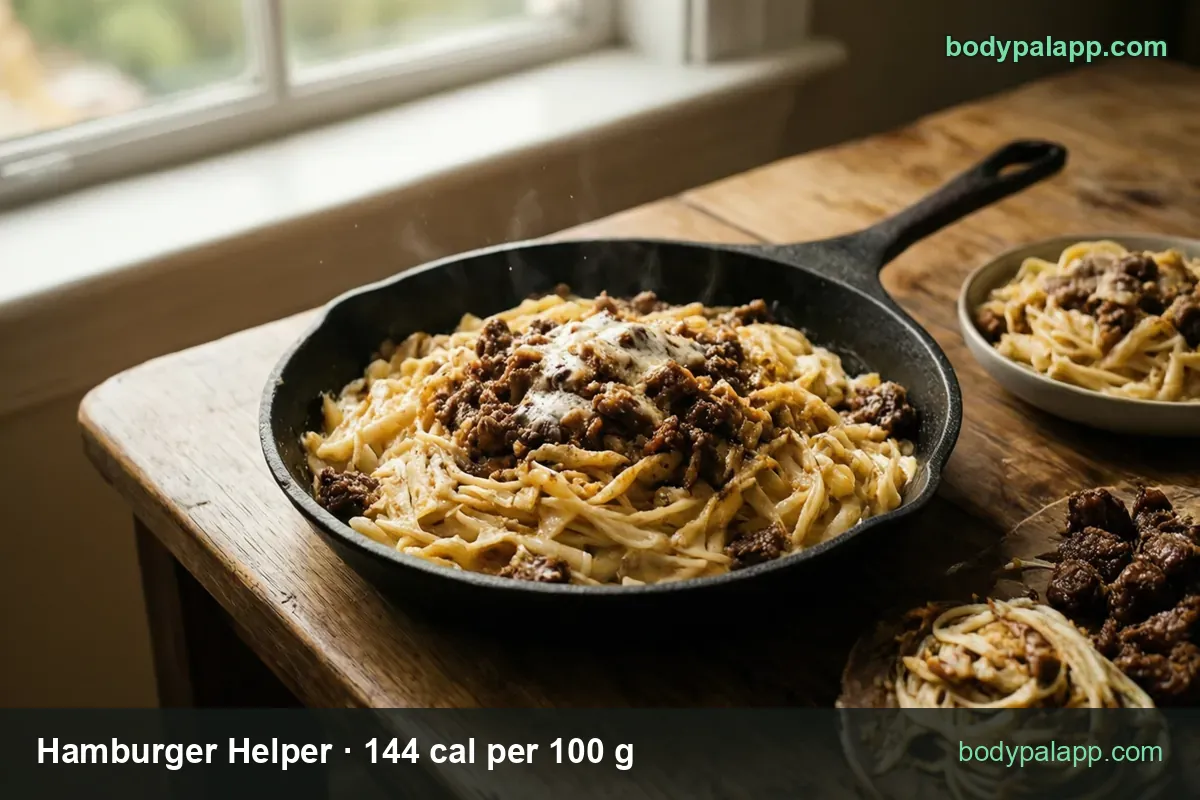
Every flavor on the shelf is measured dry, as packaged, which is why the label serving is a third of a cup of powder and pasta rather than a bowl of food. Cheeseburger Macaroni is the benchmark at 348 calories per 100 g of mix.
| Flavor | Per 100 g, dry mix | Label serving | Calories |
|---|---|---|---|
| Cheeseburger Macaroni | 348 kcal | 1/3 cup as packaged, 34 g | 118 kcal |
| Double Cheeseburger Macaroni | 350 kcal | 1/3 cup as packaged, 32 g | 112 kcal |
| Deluxe Cheeseburger Macaroni | 346 kcal | 1/4 cup as packaged, 30 g | 104 kcal |
| Lasagna | 359 kcal | 1/3 cup as packaged, 38 g | 136 kcal |
| Four Cheese Lasagna | 356 kcal | 1/3 cup as packaged, 31 g | 110 kcal |
| Beef Stroganoff Deluxe | 356 kcal | 1/3 cup as packaged, 31 g | 110 kcal |
| Salisbury | 352 kcal | 1/3 cup as packaged, 35 g | 123 kcal |
| Spaghetti | 353 kcal | 1/3 cup as packaged, 37 g | 131 kcal |
| Microwave Singles Cheeseburger Macaroni | 404 kcal | 1 pouch, 52 g | 210 kcal |
The boxed mixes barely move: 346 to 359 calories per 100 g across eight flavors, a spread of 13 calories. Only the microwave pouch breaks out, at 404 per 100 g, because it is built to cook with water alone.
So the flavor you pick is almost irrelevant to the calorie count. What moves the number is the gram weight of the serving on the box, which swings from 30 g for Deluxe Cheeseburger Macaroni to 38 g for Lasagna, and then the beef and milk you add at home. Choose by taste and log the cooked dish, not the box.
USDA has no record for the same skillet made with 93% lean ground beef, so the fat and calorie savings from leaner meat cannot be quantified here without inventing a number. Expect the direction to be down, not the size of the drop.
Sodium is the row that bites, not calories
At 331 calories, a cup of this is a modest dinner component. At 653 mg of sodium, it is 28% of the 2,300 mg Daily Value, which is a little more than a quarter teaspoon of table salt in one bowl. Two cups put you at 1,306 mg and 57% of the day before the side dish, the drink or anything else. The CDC's sodium pages put most US adults well over the limit already, and packaged mixes are one of the reasons.
Saturated fat is the second row to watch: 6.9 g in a cup is 34% of the Daily Value, mostly from the ground beef and the cheese sauce. The Dietary Guidelines for Americans hold saturated fat under 10% of calories, and a single cup uses up a third of that allowance.
The good news sits in the protein line. A cup delivers 19.0 g, 38% of the Daily Value, which works out to 5.7 g of protein per 100 calories by our own arithmetic from the USDA figures. For a boxed pasta dinner, that ratio is genuinely strong, and it comes entirely from the pound of beef the recipe demands. If you want the calories lower without losing that, serve a half cup, 166 calories, next to a plate of vegetables instead of a second scoop.
How does Hamburger Helper compare?
| Dish | Per 100 g | Protein per 100 g | Fat per 100 g |
|---|---|---|---|
| Hamburger Helper, prepared with beef | 144 kcal | 8.24 g | 7.59 g |
| Macaroni and cheese, reduced fat mix | 131 kcal | 4.57 g | 4.82 g |
| Macaroni and cheese, Easy Mac type | 110 kcal | 3.26 g | 1.86 g |
| Macaroni with cheese and chicken or turkey | 178 kcal | 12.53 g | 7.61 g |
USDA measures these three neighbors by the cup as well, but the release we pulled carries no gram weight for their cup, so the per-cup calories are omitted here rather than guessed.
Our take: two of the three are lighter per gram than Hamburger Helper, and both get there by dropping the meat, which costs them roughly half their protein. Easy Mac style macaroni and cheese is the lightest at 110 calories per 100 g but the weakest plate, at 3.26 g of protein per 100 g. The chicken-and-turkey version is the densest at 178 and the highest in protein at 12.53 g. If you are counting calories alone, boxed mac wins; if you want the meal to hold you until bedtime, the beef version earns its extra 34 calories per 100 g.
Most popular hamburger helper brands in the United States
Ranked by how widely each product appears among foods sold in the United States, from the BodyPal food database of over 3.3 million products. Calories are the figures printed on each Nutrition Facts label, checked against USDA FoodData Central.
| Product | Calories (per 100 g) |
|---|---|
| Betty Crocker Hamburger Helper Microwave Singles Cheeseburger Macaroni | 404 cal |
| Hamburger Helper Double Cheeseburger Macaroni | 350 cal |
| Hamburger Helper Cheeseburger Macaroni | 348 cal |
| Hamburger Helper Lasagna | 359 cal |
| Hamburger Helper Four Cheese Lasagna | 356 cal |
| Hamburger Helper Deluxe Cheeseburger Macaroni | 346 cal |
Brand popularity: BodyPal food database. Nutrition: manufacturer labels / USDA FoodData Central.
Hamburger Helper FAQs
How many calories are in a cup of Hamburger Helper?
331 calories in a 1-cup (230 g) serving of the prepared skillet, based on the USDA FNDDS record for macaroni or noodles with cheese and meat made from a Hamburger Helper mix. That same cup carries 19.0 g of protein, 17.5 g of fat and 653 mg of sodium.
Are the box calories before or after you add the beef?
Before: the 118 calories printed for a third of a cup of Cheeseburger Macaroni cover dry mix only, as packaged. Once the ground beef, the milk and the water go in, USDA puts the finished dish at 144 calories per 100 g, which is 331 calories for a full cup.
Is Hamburger Helper high in sodium?
One cup carries 653 mg of sodium, 28% of the 2,300 mg Daily Value, which is a lot for a single 331-calorie serving. Two cups, an ordinary dinner plate for an adult, reach 1,306 mg and 57% of the day's limit before any side dish is counted.
How much protein is in Hamburger Helper?
19.0 g of protein in a 1-cup serving, 38% of the Daily Value, and 8.24 g per 100 g. The ground beef does that work. An Easy Mac style macaroni and cheese has 3.26 g per 100 g, roughly two and a half times less, at similar calories per gram.
What is a serving size of Hamburger Helper?
USDA uses 1 cup of the prepared dish, 230 g, at 331 calories. The box measures the other way, in a third of a cup of dry mix weighing 31 to 38 g depending on flavor. The two are not the same food, so a serving off the label is not a serving in your bowl.
How many carbs are in Hamburger Helper?
23.6 g of carbohydrate in a 1-cup serving, 9% of the Daily Value, and 10.27 g per 100 g. Fiber is negligible at 0.7 g a cup, and total sugars come to 5.4 g. USDA does not publish added sugars for this record, so that row is absent from the table above.
How many calories are in Hamburger Helper Microwave Singles?
210 calories in one 52 g pouch as packaged, per the USDA Branded entry for Betty Crocker Microwave Singles Cheeseburger Macaroni, which is 404 calories per 100 g of dry mix. USDA also lists a prepared microwave-singles portion of 288 g under the cooked record, at 415 calories.
Is Hamburger Helper healthier than boxed mac and cheese?
On protein, yes: 8.24 g per 100 g against 3.26 g for an Easy Mac style macaroni and cheese, thanks to the beef. On calories the plain boxed mac is lighter, 110 per 100 g against 144. On sodium, at 653 mg a cup, neither one is a light choice.
Similar foods
- Chicken Dumpling — 351 cal per cup
- Quinoa Salad — 248 cal per cup
- Steak Dinner — 456 cal per meal
- Beef Bulgogi — 200 cal for 5 oz
- Chicken Shawarma Plate — 200 cal per cup
- Steak Stir Fry — 319 cal per cup
Count it without the math
Point the camera at the skillet and BodyPal counts the cup for you, beef and sauce included.


How long does it take to burn off 331 kcal of Hamburger Helper?
A 1-cup (230 g) serving is 331 kcal. Enter your weight and the amount you ate to see how long it takes you to burn that off:
lb
| Activity | Time to burn 331 kcal |
|---|---|
| Walking, brisk | 1 hr 6 min |
| Cycling, moderate | 41 min |
| Swimming, moderate | 47 min |
| Jogging | 39 min |
| Weight training, moderate | 1 hr 14 min |
Times are for a 155 lb adult at a steady pace; change the weight to see yours. The amount is set to the portion in the text (230 g); change it to what you actually ate. BodyPal works this out from your steps automatically.
One food is easy to picture; a whole day is harder. See how many calories you need a day and what a deficit actually looks like.