
How many calories are in kettle corn?
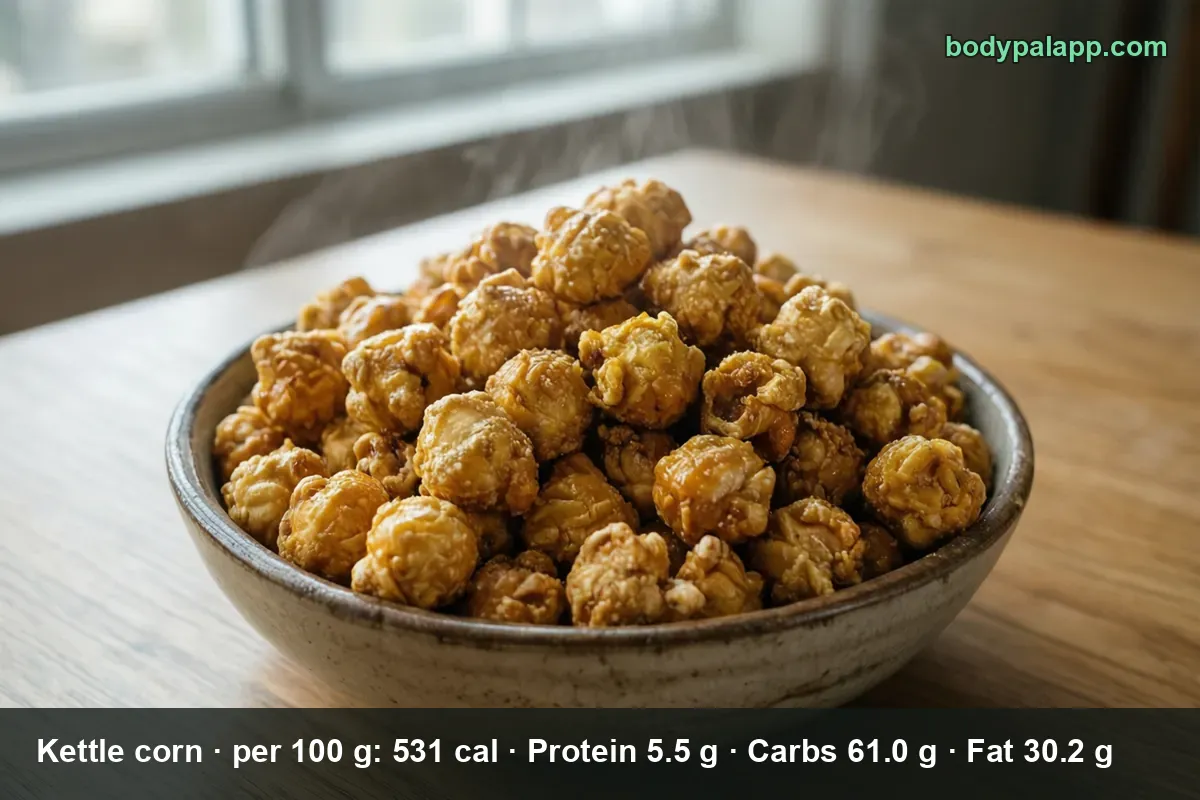
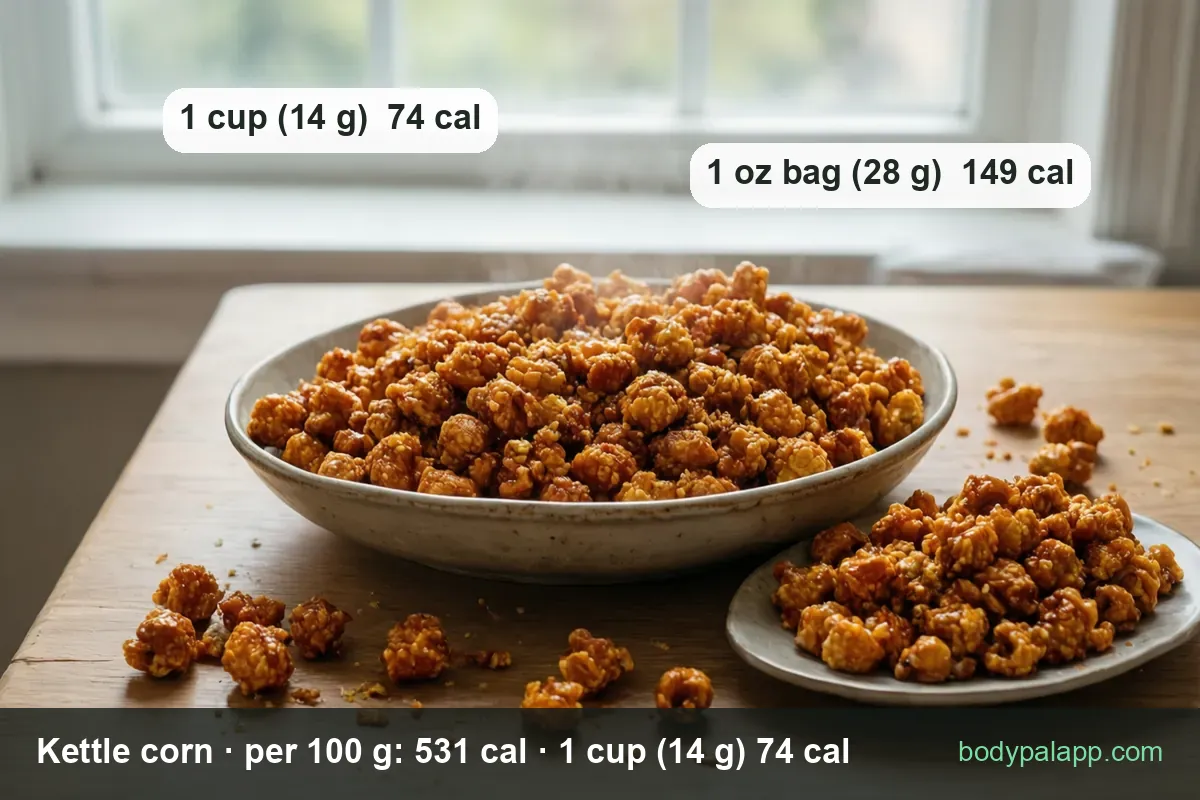
One cup of kettle corn is 74 calories, and 100 g of it is 531. That per-100-gram figure is higher than caramel corn, which almost nobody expects, because caramel corn is the one that looks and tastes heavier. A 1 oz bag comes to 149 calories; the large single-serving bag sold at fairs and ballgames is 451.
On this page
- Kettle corn quick facts
- The fat, not the sugar, does the work
- US servings, from one cup to a fair bag
- The cup trap
- Microwave kettle corn is a different food
- Sodium is lower than you would guess
- How does kettle corn compare?
- Most popular kettle corn brands
- FAQ
Kettle corn quick facts
Every number in this table comes off one record: FNDDS 2708238, "Popcorn, ready-to-eat, kettle". That is the finished sweet-and-salty snack — already popped, already coated, sitting in a bag or a paper sack. It is the thing you are holding when you look this up.
| Nutrient | Per 100 g | Per 1 cup (14 g) | % Daily Value |
|---|---|---|---|
| Calories | 531 | 74 | — |
| Total fat | 30.22 g | 4.2 g | 5% |
| Saturated fat | 4.05 g | 0.6 g | 3% |
| Carbohydrate | 61.01 g | 8.5 g | 3% |
| Dietary fiber | 6.1 g | 0.9 g | 3% |
| Total sugars | 28.52 g | 4.0 g | — |
| Protein | 5.48 g | 0.8 g | 2% |
| Sodium | 495 mg | 69 mg | 3% |
% Daily Value is based on a 2,000-calorie diet.
Verified nutrition data
Numbers on this page come from USDA FoodData Central, the U.S. Department of Agriculture’s food composition database, and from manufacturer labels where a branded product is named. Last verified September 2026. How we verify our data →
Two rows a packaged label would print are missing here, and leaving them out is deliberate. USDA's survey release carries no added-sugars value and no trans fat value for any of its popcorn records, so printing a zero would be inventing a figure rather than reporting one. Total sugars carry no Daily Value on an American label either, which is why that cell holds a dash instead of a percentage.
Two more numbers ride along on the same record and rarely reach a calorie chart: 0 mg of cholesterol and 140 mg of potassium per 100 g. Popped corn is a plant seed, so the cholesterol column was always going to read zero, no matter how much oil and sugar go into the kettle.
The fat, not the sugar, does the work
Here is the finding that reorders how most people think about this snack.
Kettle corn is 531 calories per 100 g. Caramel corn is 428. The sweeter, stickier, more obviously indulgent product is the lighter one by a hundred calories per 100 g, and the gap is not small change.
Now look at where the two foods differ. Caramel corn holds 52.77 g of sugar per 100 g against kettle corn's 28.52 g — nearly double. Kettle corn should be miles behind on that basis alone. It is ahead anyway, because of one row:
- Fat: kettle corn 30.22 g per 100 g, caramel corn 12.7 g
- Sugar: kettle corn 28.52 g, caramel corn 52.77 g
- Calories: kettle corn 531, caramel corn 428
Sugar carries 4 calories a gram. Fat carries 9. Kettle corn is popped in oil and then tossed with sugar and salt, so it wears both coats; caramel corn is largely a sugar shell over a lighter kernel. Take the 17.5 g of extra fat, multiply it out, and the fat difference alone more than pays for the 24 g of sugar caramel corn has in hand.
The practical version: sweetness is a terrible guide to calorie density in popcorn. If you have been choosing kettle corn over caramel corn because it tastes less sweet, you have been choosing the heavier one.
US servings, from one cup to a fair bag
| Serving | Weight | Calories |
|---|---|---|
| 1 cup | 14 g | 74 |
| 1 oz, or a small single-serving bag | 28 g | 149 |
| 3 cups, a modest bowl | 42 g | 223 |
| 1 medium single-serving bag | 57 g | 303 |
| 1 large single-serving bag | 85 g | 451 |
| 100 g | 100 g | 531 |
The bag weights come from USDA's own household measures for this record, not from a guess about packaging. The three-cup row is our own multiple of the 14 g cup rather than a separate USDA measure. Small, medium and large are 28, 57 and 85 g — a neat doubling and tripling that makes the calorie ladder easy to hold in your head: roughly 150, 300, 450.
That ladder is the useful part, because the cup is not how anyone eats this. A cup of kettle corn is a small handful. The large bag is over six cups, which is why it reaches 451 calories while still feeling like air. Nobody counts to six while eating popcorn at a county fair.
Raw against cooked does not apply to kettle corn, but a related split does: unpopped against popped. Every figure above describes popped, ready-to-eat kettle corn. Bags of unpopped kernels for the microwave declare their numbers on the raw kernels — typically 2 tablespoons, around 30 to 35 g, which expand into five or six cups. Those per-100-gram numbers are not comparable to the 531 here, and swapping one for the other is the single most common logging error with any popcorn.
The cup trap
A cup is a volume, and popcorn is mostly not there. That makes "one cup" the least trustworthy measure on any popcorn label, and USDA's own gram weights prove it.
| What a cup weighs | Grams | Calories |
|---|---|---|
| 1 cup plain ready-to-eat popcorn | 11 g | 53 |
| 1 cup kettle corn | 14 g | 74 |
| 1 cup caramel corn | 35 g | 150 |
Three cups. Three different foods. One of them holds three times the mass of another and nearly three times its calories, and they all look the same going into the bowl.
The reason is the coating. Sugar syrup fills the crevices in a caramel-coated kernel and glues the pieces into clusters, so a cup of caramel corn packs together; a plain popped kernel is a fragile bubble with air in the middle, so a cup of it weighs almost nothing. Kettle corn sits between the two — coated, but thinly.
So the honest advice for logging popcorn is: measure the bag, not the bowl. If you pour from a package with a weight on it, count grams or count servings from the label. A cup entry chosen off a dropdown list can be wrong by a factor of two before you eat a single piece.
Microwave kettle corn is a different food
| Version | Per 100 g | Serving | Calories |
|---|---|---|---|
| Kettle corn, ready-to-eat (this page) | 531 | 1 cup (14 g) | 74 |
| Microwave kettle corn | 504 | 1 oz (28 g) | 141 |
| Caramel corn | 428 | 1 cup (35 g) | 150 |
| Plain ready-to-eat popcorn | 482 | 1 cup (11 g) | 53 |
| Oil-popped, no butter | 498 | 1 oz (28 g) | 139 |
| Air-popped, no butter | 385 | 1 oz (28 g) | 108 |
The microwave row is the strange one, and it deserves its own paragraph. USDA's microwave kettle corn runs 504 calories per 100 g, close enough to the 531 of the ready-to-eat bag that you would call them the same food. Then look at the sugar: 2.2 g per 100 g against 28.52 g. That is not a rounding difference. That is a flavoring designed to taste like kettle corn without much sugar in it.
The fiber moves the other way and moves a long distance: 10.5 g per 100 g in the microwave version against 6.1 g in the ready-to-eat bag, plus 9.35 g of protein against 5.48 g. Less sugar, more fiber, more protein, nearly the same calories. If you like the sweet-salty flavor and want the better nutrient sheet, the microwave bag wins on three rows out of four.
Air-popped is the floor of this whole category, at 385 calories per 100 g with 4.52 g of fat and 14.4 g of fiber. Skipping the kettle takes about a quarter of the calories out and more than doubles the fiber. MyPlate counts popcorn as a whole grain, and air-popped is the version that behaves like one.
Oil-popped with no butter is the interesting middle: 498 calories per 100 g, so almost as heavy as kettle corn, with 10 g of fiber and 0.54 g of sugar. Most of what the kettle adds in calories is oil, not sugar. Take away the sugar and you have barely moved the number.
Sodium is lower than you would guess
Kettle corn tastes salty. It is the lowest-sodium popcorn on this page apart from the ones with no seasoning at all.
- Kettle corn: 495 mg per 100 g, or 69 mg per cup — 3% of the Daily Value
- Microwave kettle corn: 601 mg per 100 g
- Plain ready-to-eat popcorn: 616 mg per 100 g
- Caramel corn: 512 mg per 100 g
- Air-popped, no butter: 162 mg per 100 g
The plain bag carries a quarter more sodium than the sweet-and-salty one. That reads backward until you remember what sweet-and-salty means in production: part of the seasoning budget went to sugar, so there was less room for salt. Salt in kettle corn is there to sharpen the sweetness, not to carry the flavor by itself.
Even the large 85 g bag comes to 421 mg of sodium, about 18% of the 2,300 mg FDA Daily Value. The Dietary Guidelines for Americans list sodium among the nutrients Americans consistently overconsume, and popcorn is not where the problem lives. The calories are the row to watch here; the sodium is fine.
Fiber deserves a mention on the credit side. The large bag holds 5.2 g of fiber, 19% of the 28 g Daily Value, which is more than most snacks of any kind deliver. The protein is thin at 5.48 g per 100 g, so this is a carbohydrate-and-fat snack with a useful fiber bonus, not a food that will hold you until dinner.
How does kettle corn compare?
| Item | Per 100 g | Serving | Calories | Protein / Carbs / Fat |
|---|---|---|---|---|
| Kettle corn, ready-to-eat | 531 | 1 cup (14 g) | 74 | 5.5 / 61.0 / 30.2 g |
| Microwave kettle corn | 504 | 1 oz (28 g) | 141 | 9.4 / 58.0 / 27.5 g |
| Caramel corn | 428 | 1 cup (35 g) | 150 | 3.8 / 78.5 / 12.7 g |
| Plain ready-to-eat popcorn | 482 | 1 cup (11 g) | 53 | 10.2 / 61.2 / 23.3 g |
| Air-popped popcorn, no butter | 385 | 1 oz (28 g) | 108 | 12.9 / 77.5 / 4.5 g |
Every row is a USDA popcorn record, so this is one food category argued against itself rather than a lineup of unrelated snacks. Per 100 g they run from 385 to 531, a spread of nearly 40%. Per serving the order scrambles completely, because a cup of one weighs three times what a cup of another does.
Our take: if you want the sweet-salty flavor with the best numbers behind it, the microwave kettle bag is the pick — 2.2 g of sugar instead of 28.52 g, nearly double the fiber and nearly double the protein for roughly the same calories per gram. If you are eating from a fairground bag, treat 149 calories per ounce as the working figure and decide the bag size before you start, because that decision is worth 300 calories. And if calories are the only thing you are counting, air-popped at 385 per 100 g with 14.4 g of fiber wins outright, and no coated popcorn comes near it.
Most popular kettle corn brands in the United States
Ranked by how widely each product appears among foods sold in the United States, from the BodyPal food database of over 3.3 million products. Calories are the figures printed on each Nutrition Facts label, checked against USDA FoodData Central.
| Product | Calories (per 100 g) |
|---|---|
| Kettle Corn Sweet & Salty Popcorn | 464 cal |
| Orville Redenbacher's Kettle Corn Popping Corn | 467 cal |
| Orville Redenbacher's Salty + Sweet Kettle Corn | 500 cal |
| Popsalot Vietnamese Cinnamon Kettle Corn | 464 cal |
| Pop-Secret Kettle Corn Popcorn | 536 cal |
| Pop Weaver Kettle Corn Microwave Popcorn | 455 cal |
Brand popularity: BodyPal food database. Nutrition: manufacturer labels / USDA FoodData Central.
Kettle corn FAQs
How many calories are in kettle corn?
74 calories in one cup, which USDA weighs at 14 g, and 531 calories per 100 g. A 1 oz bag is 149 calories, a medium single-serving bag 303, and a large one 451. The cup carries 4.2 g of fat, 8.5 g of carbohydrate and 69 mg of sodium.
How many calories are in 1 cup of kettle corn?
74 calories, because a cup of kettle corn weighs only 14 g. Three cups, a modest bowl, come to 223 calories. Cup weights vary wildly across popcorn: a cup of plain popped corn is 11 g and 53 calories, while a cup of caramel corn is 35 g and 150.
How many calories are in a bag of kettle corn?
149 calories for a small 28 g bag, 303 for a medium 57 g bag and 451 for a large 85 g one. The large bag is over six cups of popcorn, which is why the number climbs so fast for something that feels like air. Those weights are USDA household measures, not estimates.
Kettle corn or caramel corn: which has fewer calories?
Caramel corn, by a wide margin per 100 g: 428 calories against 531 for kettle corn. Caramel corn holds almost double the sugar at 52.77 g per 100 g, but kettle corn holds 30.22 g of fat against 12.7 g, and fat costs more than twice as much per gram.
Is kettle corn a healthy snack?
One cup is 74 calories with 0.9 g of fiber and 69 mg of sodium, 3% of the Daily Value. Sodium is genuinely low for a salty snack, and the fiber is real. The weak points are 30.22 g of fat and 28.52 g of sugar per 100 g, so portion size decides this one rather than the ingredient list.
How much sugar is in kettle corn?
28.52 g per 100 g, which works out at 4.0 g in a 14 g cup and about 24 g in a large 85 g bag. Caramel corn holds far more at 52.77 g per 100 g. Microwave kettle corn is the outlier at 2.2 g, because the flavoring imitates the taste without the sugar.
How many carbs are in kettle corn?
61.01 g per 100 g, or 8.5 g in a one-cup serving, which is 3% of the 275 g Daily Value. Of that 100 g total, 28.52 g is sugar and 6.1 g is fiber. Caramel corn is higher at 78.47 g of carbohydrate per 100 g and plain popped corn is almost identical at 61.24 g.
How many calories are in microwave kettle corn?
504 calories per 100 g of popped corn, or 141 for a 1 oz serving. That is close to the 531 of a ready-to-eat bag, but the composition differs sharply: 2.2 g of sugar instead of 28.52 g, 10.5 g of fiber instead of 6.1 g and 9.35 g of protein instead of 5.48 g.
Similar foods
- Sesame sticks — 151 cal per oz
- Popcorn — 73 cal per cup popped
- Peanuts — 164 cal per ounce
- Peanut Butter — 191 cal for 2 tbsp
- Churro — 189 cal each
- Fudge — 70 cal per piece
Count it without the math
Point the camera at the bag and BodyPal works out the cups for you.


How long does it take to burn off kettle corn?
A 1-cup (14 g) serving is 74 kcal. Enter your weight and the amount you ate to see how long it takes you to burn that off:
lb
| Activity | Time to burn 74 kcal |
|---|---|
| Walking, brisk | 15 min |
| Cycling, moderate | 9 min |
| Swimming, moderate | 11 min |
| Jogging | 9 min |
| Weight training, moderate | 16 min |
Times are for a 155 lb adult at a steady pace; change the weight to see yours. The amount is set to the portion in the text (14 g); change it to what you actually ate. BodyPal works this out from your steps automatically.
This table assumes you know your daily total. If you do not, the daily calorie calculator works it out from five numbers.