
How many calories are in a Miller High Life?
A 12 fl oz bottle of Miller High Life comes to 153 calories, from a beer that runs 43 calories per 100 g. That density looks harmless. The bottle is 356 g, though, and a pint is 475 g, which is how a light-tasting lager quietly turns into 204 calories a glass.
On this page
- Miller High Life quick facts
- US servings, from one ounce to a 40
- Bottle, pint, tallboy and the 40
- Where the 153 calories actually come from
- How does Miller High Life compare?
- Most popular miller high life brands
- Miller High Life FAQs
Miller High Life quick facts
There is no Miller-specific entry in the federal database, and there is a good reason for that: alcohol labeling sits with the TTB rather than the FDA, so American beer is not required to carry a Nutrition Facts panel the way a soda is. The row that fits what you are actually holding is SR Legacy 168746, "Alcoholic beverage, beer, regular, all" - the pooled figure for standard American lager, which is exactly the category High Life belongs to.
The one branded lager record in the database, Budweiser, is incomplete: it has calories and carbohydrate but no sugar or saturated fat values. Using the pooled row keeps every line in the table filled from a single source instead of stitching two records together.
| Nutrient | Per 100 g | Per 12 fl oz (356 g) | % Daily Value |
|---|---|---|---|
| Calories | 43 | 153 | — |
| Total fat | 0 g | 0 g | 0% |
| Saturated fat | 0 g | 0 g | 0% |
| Carbohydrate | 3.55 g | 12.6 g | 5% |
| Dietary fiber | 0 g | 0 g | 0% |
| Total sugars | 0 g | 0 g | — |
| Protein | 0.46 g | 1.6 g | 3% |
| Sodium | 4 mg | 14 mg | 1% |
% Daily Value is based on a 2,000-calorie diet.
Verified nutrition data
Numbers on this page come from USDA FoodData Central, the U.S. Department of Agriculture’s food composition database, and from manufacturer labels where a branded product is named. Last verified September 2026. How we verify our data →
There is no added-sugars line here because the SR Legacy edition does not carry that field at all, and beer has no sugar added after fermentation in any case. Cholesterol is 0 mg per bottle. Potassium is 96 mg, or 2% of the FDA Daily Value of 4,700 mg. The sodium is trivial - 14 mg is a rounding error next to the 2,300 mg daily limit, less than a hundredth of a teaspoon of table salt.
US servings, from one ounce to a 40
| Serving | Weight | Calories |
|---|---|---|
| 1 fl oz | 29.7 g | 13 kcal |
| 1 oz by weight | 28.4 g | 12 kcal |
| 12 fl oz bottle or can | 356 g | 153 kcal |
| 1 pint, 16 fl oz | 475 g | 204 kcal |
| 24 fl oz tallboy | 713 g | 307 kcal |
| 40 oz bottle | 1188 g | 511 kcal |
| Per 100 g | 100 g | 43 kcal |
The 12 fl oz can is the standard USDA household measure, and it is the number worth memorizing. Everything below and above it - the ounce, the pint, the tallboy, the 40 - is our own arithmetic from the USDA 100 g figure rather than a USDA serving, scaled by weight at 43 calories per 100 g.
Two traps hide in that list. The first is fluid ounces versus ounces by weight: a fluid ounce of beer weighs 29.7 g, slightly more than the 28.4 g avoirdupois ounce, so logging "1 oz" when you poured 1 fl oz undercounts by a calorie a time. The second is the bar pint. A pint is only four fluid ounces bigger than a bottle, and it does not feel like a different drink, but it costs 51 calories more.
Bottle, pint, tallboy and the 40
| Format | Per 100 g | Weight | Calories |
|---|---|---|---|
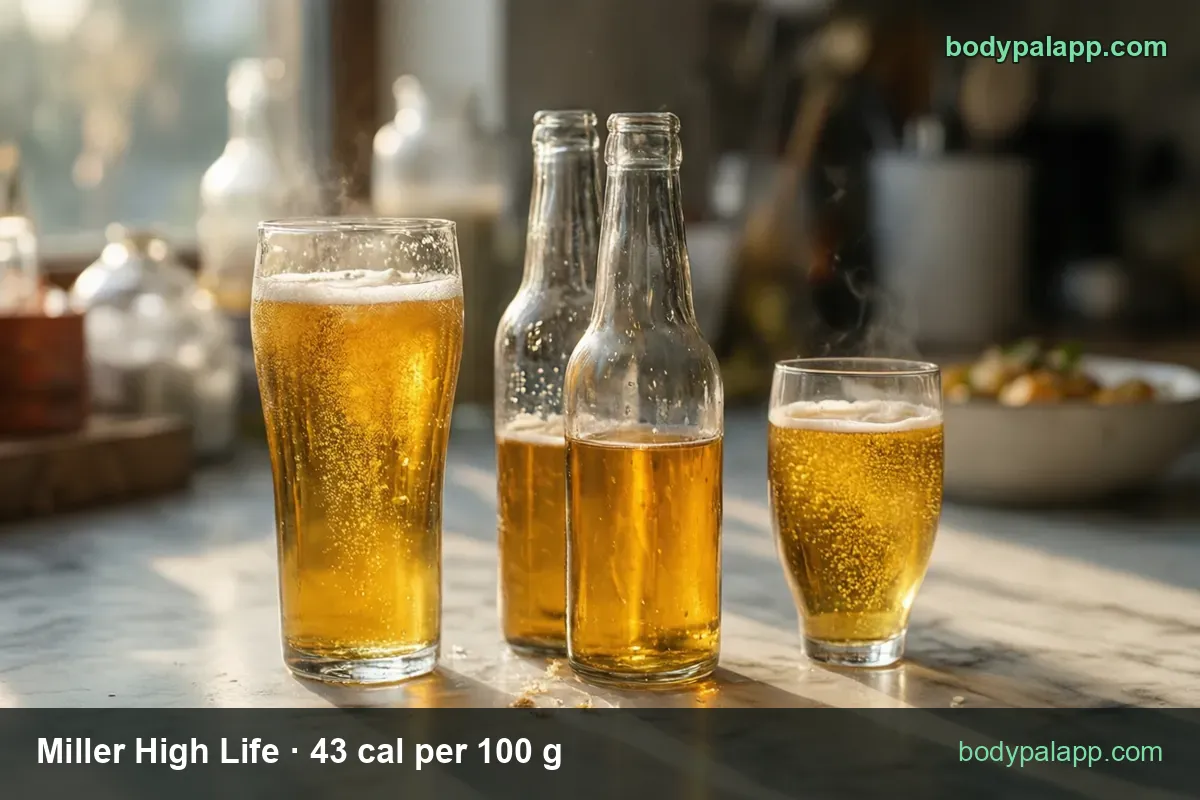
| 12 oz bottle or can | 43 kcal | 356 g | 153 kcal |
| Pint, 16 fl oz draft | 43 kcal | 475 g | 204 kcal |
| 24 oz tallboy | 43 kcal | 713 g | 307 kcal |
| 40 oz bottle | 43 kcal | 1188 g | 511 kcal |
| Budweiser, 12 fl oz | 41 kcal | 357 g | 146 kcal |
The four High Life formats all pour the same liquid at the same 43 calories per 100 g, so the container is doing the entire job. A tallboy is exactly two bottles plus a splash: 307 calories against 153. A 40 is three and a third bottles in one hand, 511 calories, which is dinner-sized before dinner.
Carbohydrate scales the same way, all of it our arithmetic from the 3.55 g per 100 g figure: about 16.9 g in a pint, 25.3 g in a tallboy, 42.2 g in a 40. Sugar stays at zero in every one of them, because fermentation eats the malt sugars on the way to alcohol.
Budweiser is in the table as the only other lager the database describes by name, and it makes the point better than any argument: Budweiser, record 168747, runs 41 calories per 100 g against 43, which is 146 calories a bottle against 153. Seven calories. Choosing a different brand of standard lager moves your day less than choosing a slightly bigger glass of the same one.
Where the 153 calories actually come from
Add up the macros on the label and they do not reach the total. Carbohydrate contributes 12.6 g and protein 1.6 g in a 12 fl oz serving, which together account for roughly 57 calories. The bottle holds 153. The missing 96 calories are alcohol, which carries energy but is not a carbohydrate, a fat or a protein, so it never appears as a row in a nutrition table.
That is the single most useful thing to know about logging beer. Nearly two thirds of what you drink is invisible to a carb count. A drinker scanning the panel for sugar and carbs sees a near-zero-sugar, 5%-DV-carbohydrate beverage and concludes it is a cheap drink, when the alcohol column - the one that is not printed - is the expensive part.
The protein line is worth a second of honesty too. At 1.6 g per bottle, 3% of the Daily Value, beer is not a protein source in any meaningful sense, whatever the old malt-tonic marketing implied. And because the total is 153 calories with essentially no fiber, no fat and nothing to chew, it does very little for fullness compared with 153 calories of food.
If you are pacing yourself rather than counting, the Dietary Guidelines for Americans define moderate drinking as 2 drinks or fewer a day for men and 1 or fewer for women, and the CDC's alcohol pages treat a 12 fl oz regular beer as one standard drink. On calories alone, two bottles is 306 and two pints is 408 - the difference between a snack and a second lunch.
How does Miller High Life compare?
| Drink | Per 100 g | US serving | Calories |
|---|---|---|---|
| Miller High Life, regular lager | 43 kcal | 12 fl oz bottle, 356 g | 153 kcal |
| Budweiser | 41 kcal | 12 fl oz, 357 g | 146 kcal |
| Cola, regular | 42 kcal | 12 fl oz, 370 g | 155 kcal |
| Red Bull | 43 kcal | 8.4 fl oz can, 248 g | 107 kcal |
Our take: per 100 g these four are almost indistinguishable - 41 to 43 calories, a two-point spread - and that is precisely why per-100-g comparisons mislead people about drinks. What separates them is how much liquid the container holds. A 12 oz cola weighs 370 g and lands at 155 calories, two above the beer, with 10.36 g of carbohydrate per 100 g against the beer's 3.55 g; the beer makes up the difference with alcohol instead of sugar. Red Bull matches the beer exactly per 100 g but comes in an 8.4 fl oz can, so it costs 107 - that figure and the cola's 155 are our own scaling from each record's USDA 100 g number. If you want the lightest evening, the answer is not a different brand - it is a 12 oz bottle instead of a pint, and stopping at two.
Most popular miller high life brands in the United States
Ranked by how widely each product appears among foods sold in the United States, from the BodyPal food database of over 3.3 million products. Calories are the figures printed on each Nutrition Facts label, checked against USDA FoodData Central.
| Product | Calories (per 100 g) |
|---|---|
| Budweiser Regular Lager | 41 cal |
Brand popularity: BodyPal food database. Nutrition: manufacturer labels / USDA FoodData Central.
Miller High Life FAQs
How many calories are in a 12 oz Miller High Life?
A 12 fl oz bottle or can weighs 356 g and carries 153 calories, from the USDA record for regular American lager at 43 calories per 100 g. That comes with 12.6 g of carbohydrate, no fat and no sugar. Two bottles put you at 306 calories before anything on the table.
How many calories are in a pint of Miller High Life?
A 16 fl oz pint weighs 475 g and works out to 204 calories, our own arithmetic from the USDA 100 g figure rather than a USDA serving. That is 51 calories more than a bottle, with 16.9 g of carbohydrate instead of 12.6 g. Two pints reach 408 calories.
How many carbs are in Miller High Life?
12.6 g of carbohydrate in a 12 fl oz serving, which is 5% of the 275 g Daily Value. Per 100 g the beer holds 3.55 g. A pint takes you to 16.9 g and a 24 oz tallboy to 25.3 g. None of it is sugar - it is leftover carbohydrate from the grain.
Does Miller High Life have sugar?
Zero grams of sugar in a 12 fl oz serving, and zero per 100 g in the USDA record for regular beer. Fermentation turns the malt sugars into alcohol, so essentially nothing is left in the glass. Total sugars carry no Daily Value, which is why that cell shows a dash.
Miller High Life vs Budweiser: which has fewer calories?
Budweiser is lighter by 7 calories: 146 per 12 fl oz against 153, or 41 calories per 100 g against 43. USDA publishes no Miller-specific record, so the pooled regular-lager row stands in. Either way, going from a bottle to a pint costs more than switching between the two brands.
How many calories are in a 40 oz Miller High Life?
511 calories in a 40 oz bottle, which holds 1,188 g - our own arithmetic from the USDA 100 g figure, not a USDA serving. That is three and a third 12 oz bottles, with roughly 42.2 g of carbohydrate. Finish one over an evening and it is a meal's worth of calories with no food.
Is Miller High Life keto friendly?
12.6 g of carbohydrate per 12 fl oz bottle is the number that decides it, and none of that is sugar. It is only 5% of the 275 g Daily Value, but a strict low-carb day leaves little room, and a pint at 16.9 g leaves less. The alcohol carries about 96 of the 153 calories.
What is the alcohol content of Miller High Life?
About 96 of the 153 calories in a 12 fl oz serving come from alcohol rather than carbohydrate or protein. The USDA record does not publish an ABV percentage, so we do not quote one here. Beer labels rarely help either: alcohol sits with the TTB, not the FDA, so a Nutrition Facts panel is optional.
Similar foods
- Beer — 155 cal for 12 fl oz can
- Beer (Lager) — 153 cal per can
- Corona Beer — 153 cal per bottle
- Guinness Stout Beer — 153 cal per bottle
- Heineken Beer — 153 cal per bottle
- Beer Pint — 206 cal per pint
Count it without the math
Point the camera at the glass and BodyPal counts the beer for you, bottle or pint.


How long does it take to burn off 153 kcal of Miller High Life?
A 12 fl oz bottle (356 g) is 153 kcal. Enter your weight and the amount you ate to see how long it takes you to burn that off:
lb
| Activity | Time to burn 153 kcal |
|---|---|
| Walking, brisk | 31 min |
| Cycling, moderate | 19 min |
| Swimming, moderate | 22 min |
| Jogging | 18 min |
| Weight training, moderate | 34 min |
Times are for a 155 lb adult at a steady pace; change the weight to see yours. The amount is set to the portion in the text (356 g); change it to what you actually ate. BodyPal works this out from your steps automatically.
This table assumes you know your daily total. If you do not, the daily calorie calculator works it out from five numbers.