
How many calories are in nutritional yeast?
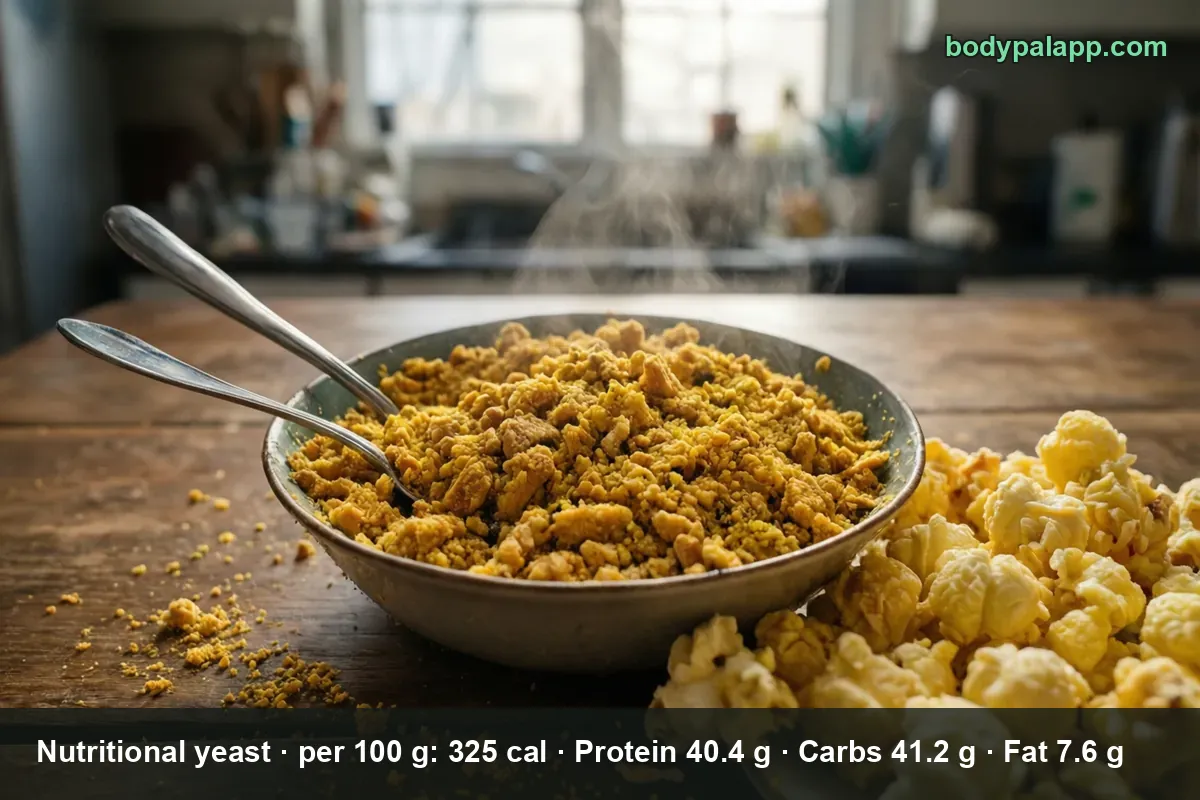
A 2-tablespoon shower of nutritional yeast weighs 24 g and costs 78 calories. Per 100 g the dry yeast runs 325 calories, which is dense for something you shake over food rather than eat by the bowl. Almost nobody eats 100 g, though: two tablespoons over popcorn or pasta is the real dose, and it lands under 80.
On this page
- Nutritional yeast quick facts
- US servings, from a teaspoon to a quarter cup
- Flakes, dry yeast and yeast extract
- Fiber is the row that surprises people
- How does nutritional yeast compare?
- Most popular nutritional yeast brands
- FAQ
Nutritional yeast quick facts
USDA has no record filed under the words "nutritional yeast." The closest generic entry is FNDDS 2710005, "Yeast", which carries dry deactivated and active yeast on one profile and is numerically identical to the older SR Legacy record 175043 for active dry baker's yeast. It is the only generic dry-yeast row with a full nutrient panel and a household measure attached, so it anchors this page.
That choice matters, because the jar in your cabinet is probably not this row. Branded flakes are milled lighter and fortified, and their panels read 350 to 400 calories per 100 g with 50 to 55 g of protein. Those numbers live further down, in the variants table. Use the generic row when you are logging loose yeast from a bulk bin, and use your own label when you have one.
| Nutrient | Per 100 g | Per 2 tbsp (24 g) | % Daily Value |
|---|---|---|---|
| Calories | 325 | 78 | — |
| Total fat | 7.61 g | 1.8 g | 2% |
| Saturated fat | 1 g | 0.2 g | 1% |
| Carbohydrate | 41.22 g | 9.9 g | 4% |
| Dietary fiber | 26.9 g | 6.5 g | 23% |
| Total sugars | 0 g | 0 g | — |
| Protein | 40.44 g | 9.7 g | 19% |
| Sodium | 51 mg | 12 mg | 1% |
% Daily Value is based on a 2,000-calorie diet.
Verified nutrition data
Numbers on this page come from USDA FoodData Central, the U.S. Department of Agriculture’s food composition database, and from manufacturer labels where a branded product is named. Last verified September 2026. How we verify our data →
Two rows you would see on a US package are missing here: USDA does not publish added sugars or trans fat for this record, so we leave them out rather than guess. Cholesterol is zero, and potassium is 955 mg per 100 g, which works out to 229 mg in a 2-tablespoon serving, or 5% of the Daily Value. Total sugars are a flat zero, which is unusual for anything with 41 g of carbohydrate on the same line — the carbohydrate here is overwhelmingly fiber and cell-wall material, not sugar.
US servings, from a teaspoon to a quarter cup
| Serving | Weight | Calories |
|---|---|---|
| 1 tsp | 4 g | 13 kcal |
| 1 tbsp, USDA household measure | 12 g | 39 kcal |
| 2 tbsp, a normal dusting | 24 g | 78 kcal |
| 1 oz | 28.3 g | 92 kcal |
| 1/4 cup, dense granules | 48 g | 156 kcal |
| Per 100 g | 100 g | 325 kcal |
Only the 12 g tablespoon is a USDA household measure. The teaspoon, the 2-tablespoon serving, the ounce and the quarter cup are our own arithmetic from the USDA 100 g figure, not USDA servings.
Here is the trap, and it is the single most useful thing on this page. A tablespoon of the dense granules USDA describes weighs 12 g and costs 39 calories. A tablespoon of the airy large flakes sold in jars weighs about 5 g — USDA's branded record for one supermarket flake product puts a tablespoon at 5 g and 20 calories. Same spoon, well under half the food. If you log "1 tbsp nutritional yeast" from a generic search and you are actually eating flakes, you are double-counting.
The quarter cup shows the same gap even harder. Dense granules fill a quarter cup at 48 g. Light flakes fill it at 11 to 15 g, depending on brand. That is a 156-calorie entry versus a 40-to-60-calorie one for the same visual scoop.
Flakes, dry yeast and yeast extract
| Version | Per 100 g | Typical serving | Calories |
|---|---|---|---|
| Nutritional yeast flakes, label | 400 kcal | 1/4 cup (15 g) | 60 kcal |
| Savory flakes, Red Star | 375 kcal | 1 1/2 tbsp (16 g) | 60 kcal |
| Smoky BBQ nutritional yeast | 350 kcal | 2 tbsp (10 g) | 35 kcal |
| Active dry baker's yeast | 325 kcal | 1 oz (28.3 g) | 92 kcal |
| Fresh compressed baker's yeast | 105 kcal | 1 oz (28.3 g) | 30 kcal |
| Yeast extract spread | 185 kcal | 1 tsp (6 g) | 11 kcal |
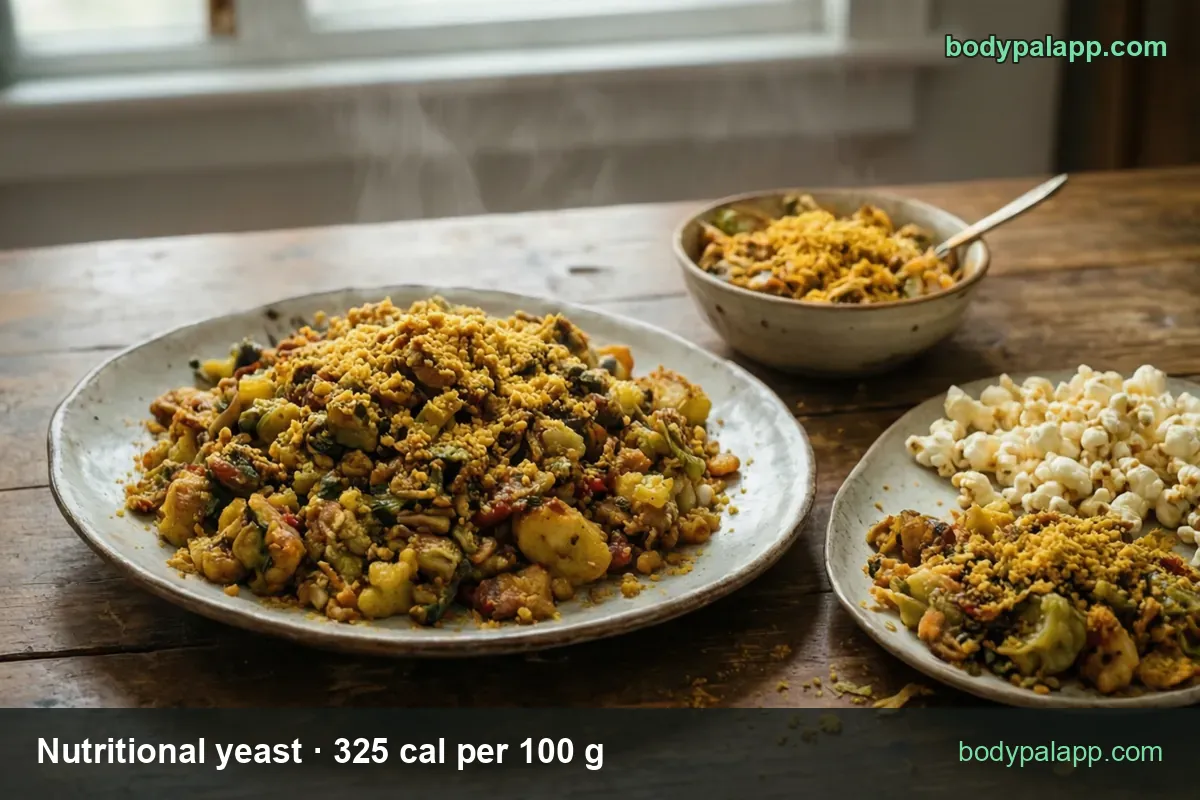
The branded flakes sit 25 to 75 calories per 100 g above the USDA generic row. That is not a data error. Flake products are deactivated and fortified, which lifts both the calorie figure and the protein figure — 50 to 55 g per 100 g on a typical jar, against 40.44 g on the generic record. Bob's Red Mill, Bragg and Frontier Co-op all land in that band; NOW's flakes read 389 per 100 g. Their serving calories still come out small, because their label servings are 9 to 16 g.
Baker's yeast is where the numbers split hardest. Active dry is the same 325 per 100 g, since it is literally the same USDA profile. Fresh compressed yeast is 105 per 100 g — about a third the calories, and only because it is roughly 70% water rather than any nutritional difference. Nothing changes in the dough for your log; a cube of fresh yeast in a loaf is a rounding error either way.
Yeast extract spread is the odd one out. At 185 calories per 100 g it looks light, and a teaspoon is 11 calories, but it is a salted paste rather than a dry flake and belongs in a different mental category — see the sodium note below.
Fiber is the row that surprises people
Nutritional yeast is one of the few things where the fiber line outruns the calorie line. At 26.9 g per 100 g, it hits 96% of the FDA Daily Value of 28 g. Nobody eats 100 g, so the honest number is the one for a real dusting: 6.5 g in 2 tablespoons, or 23% of a day. That is a quarter of your fiber target from a garnish, which is not a claim many toppings can make.
Protein does something similar. The generic row is 40.44 g per 100 g — 81% DV — and a 2-tablespoon dusting delivers 9.7 g, or 19% DV. MyPlate counts yeast as a plant protein contributor rather than a protein food in its own right, and that is the right framing: it tops up a bowl, it does not build one.
Sodium runs the other way from what people assume. Plain nutritional yeast is nearly sodium-free at 51 mg per 100 g, or 12 mg in a serving — 1% DV, less than a pinch. Flavored versions break that completely. USDA's record for one roasted garlic flake product reads 2,000 mg of sodium per 100 g, and yeast extract spread reads 3,380 mg. If you are watching sodium, the plain flakes are the pick and the spread is the one to portion carefully.
How does nutritional yeast compare?
| Food | Per 100 g | US serving | Calories |
|---|---|---|---|
| Nutritional yeast | 325 kcal | 2 tbsp (24 g) | 78 kcal |
| Dried seaweed | 298 kcal | 1 oz (28.3 g) | 84 kcal |
| Yeast extract spread | 185 kcal | 1 tsp (6 g) | 11 kcal |
| Fresh compressed yeast | 105 kcal | 1 oz (28.3 g) | 30 kcal |
Our take: on a per-100-g basis nutritional yeast is the heaviest thing in this table, and that scares people off for no reason. What matters is the serving column, where the realistic 24 g dusting costs 78 calories and buys 9.7 g of protein — more protein per 100 g than any other row here, including seaweed at 31.84 g and the extract spread at 23.88 g. If you want savory flavor for almost nothing, the extract spread wins on calories alone at 11 per teaspoon, but it drags 3,380 mg of sodium per 100 g behind it. For weight loss, keep nutritional yeast to a measured tablespoon or two and treat it as food, not seasoning. For appetite control, the fiber makes the heavier hand worth it.
Most popular nutritional yeast brands in the United States
Ranked by how widely each product appears among foods sold in the United States, from the BodyPal food database of over 3.3 million products. Calories are the figures printed on each Nutrition Facts label, checked against USDA FoodData Central.
| Product | Calories (per 100 g) |
|---|---|
| Bob's Red Mill Large Flake Nutritional Yeast | 400 cal |
| Red Star Savory Nutritional Yeast Flakes | 375 cal |
| Bragg Nutritional Yeast | 400 cal |
| NOW Nutritional Yeast Super Food Flakes | 389 cal |
| Bragg Smoky BBQ Nutritional Yeast | 350 cal |
| Frontier Co-op Nutritional Yeast Flakes | 364 cal |
Brand popularity: BodyPal food database. Nutrition: manufacturer labels / USDA FoodData Central.
Nutritional yeast FAQs
How many calories are in 2 tablespoons of nutritional yeast?
Two tablespoons weigh 24 g and carry 78 calories, based on USDA's 325 per 100 g. That same 24 g brings 9.7 g of protein and 6.5 g of fiber. Light label flakes are lighter per spoon, so a 2-tablespoon serving on a Bragg jar is 10 g and 40 calories.
How many calories are in 1/4 cup of nutritional yeast?
A quarter cup of dense granules is 48 g and 156 calories, by our own arithmetic from the USDA 100 g figure. Light flakes fill the same cup with far less weight: Bob's Red Mill calls a quarter cup 15 g and 60 calories, and Frontier Co-op calls it 11 g and 40 calories.
How much protein is in nutritional yeast?
Nutritional yeast carries 40.44 g of protein per 100 g, which is 81% of the Daily Value. A realistic 2-tablespoon dusting gives 9.7 g, or 19% DV, more than most people expect from a garnish. Fortified label flakes run higher still, at 50 to 55 g per 100 g.
Is nutritional yeast high in fiber?
Yes — 26.9 g of fiber per 100 g works out to 96% of the Daily Value, the highest row in the whole panel. Two tablespoons deliver 6.5 g, or 23% DV. That is real fiber from a garnish, and it is why a heavy hand can feel filling out of proportion to the 78 calories.
Does nutritional yeast have sodium?
Barely — two tablespoons carry 12 mg of sodium, 1% of the Daily Value, and 100 g holds only 51 mg. Flavored versions are a different story: USDA lists one roasted garlic flake product at 2,000 mg per 100 g. If you are watching sodium, plain flakes are the safer pick.
Is nutritional yeast the same as baker's yeast?
They overlap more than you would think: USDA's active dry baker's yeast is 325 calories per 100 g, the same record that backs this page. Fresh compressed baker's yeast is only 105 per 100 g, because it is roughly 70% water. Nutritional yeast is deactivated, so it will not raise dough.
Is nutritional yeast the same as brewer's yeast?
At 325 calories per 100 g, the USDA record behind this page covers dry yeast broadly; USDA publishes no separate generic entry for brewer's yeast, so there is no number to quote for it here. In practice brewer's yeast is a bitter brewing byproduct, while nutritional yeast is grown to be eaten.
Is nutritional yeast keto friendly?
Two tablespoons hold 9.9 g of carbohydrate, but 6.5 g of that is fiber, leaving about 3.4 g of net carbs by our own subtraction. That fits most low-carb budgets as a topping. A quarter cup of granules at 48 g is a different matter: about 6.9 g of net carbs by the same math.
Similar foods
- Curry Powder — 7 cal per teaspoon
- Rice Paper — 48 cal per sheet
- Taco Seasoning — 18 cal per 2 tsp
- Beer Cheese — 90 cal per 2 Tbsp
- Sweetened Condensed Milk — 982 cal per cup
- Coconut Cream — 792 cal per cup
Count it without the math
Point the camera at the bowl and BodyPal counts the yeast along with everything under it.


How long does it take to burn off 78 kcal of nutritional yeast?
A 2 tbsp (24 g) serving is 78 kcal. Enter your weight and the amount you ate to see how long it takes you to burn that off:
lb
| Activity | Time to burn 78 kcal |
|---|---|
| Walking, brisk | 16 min |
| Cycling, moderate | 10 min |
| Swimming, moderate | 11 min |
| Jogging | 9 min |
| Weight training, moderate | 17 min |
Times are for a 155 lb adult at a steady pace; change the weight to see yours. The amount is set to the portion in the text (24 g); change it to what you actually ate. BodyPal works this out from your steps automatically.
One food is easy to picture; a whole day is harder. See how many calories you need a day and what a deficit actually looks like.