
How many calories are in oats?
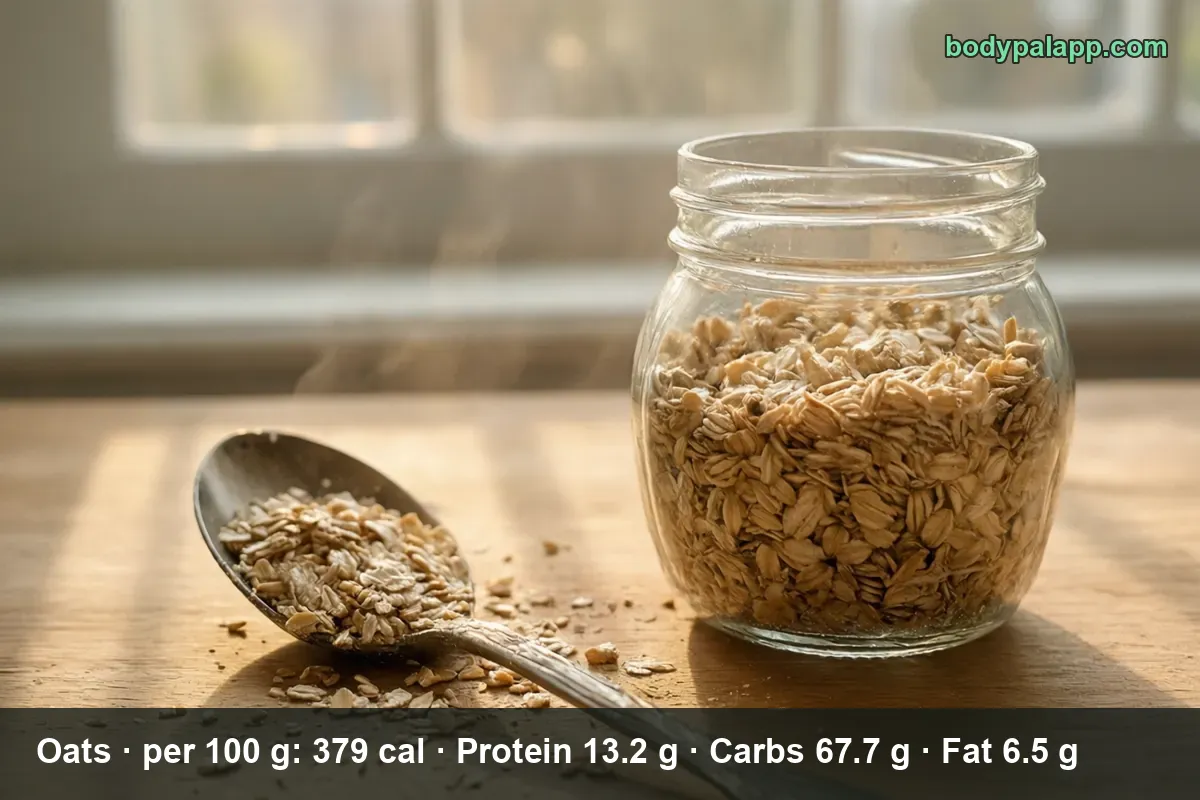
Half a cup of dry rolled oats weighs 40 g and carries 152 calories. Per 100 g, dry oats run 379 calories, which sounds steep until you remember how small the scoop is and how much water goes into the pot. Cooked in plain water, those same oats land near 64 calories per 100 g.
On this page
- Oats quick facts
- US servings, from a quarter cup to a full cup
- Rolled, steel-cut, instant and cooked
- Fiber is the row that earns its keep
- How do oats compare?
- Most popular oats brands
- Oat FAQs
Oats quick facts
The record behind every number here is SR Legacy 173904, "Cereals, oats, regular and quick, not fortified, dry". That is the plain canister of rolled oats sitting in most American pantries — the flakes you scoop dry, before any water, milk or brown sugar touches them. A newer FNDDS entry (2708489, "Oats, raw") carries identical values, so nothing is lost by staying with the older, better-documented record.
The serving below is half a cup, 40 g, because that is the scoop printed on the side of the canister and the one people actually measure. Everything in the middle column is that 40 g, scaled from the 100 g figures.
| Nutrient | Per 100 g | Per 1/2 cup dry (40 g) | % Daily Value |
|---|---|---|---|
| Calories | 379 | 152 | — |
| Total fat | 6.52 g | 2.6 g | 3% |
| Saturated fat | 1.11 g | 0.4 g | 2% |
| Carbohydrate | 67.7 g | 27.1 g | 10% |
| Dietary fiber | 10.1 g | 4.0 g | 14% |
| Total sugars | 0.99 g | 0.4 g | — |
| Protein | 13.15 g | 5.3 g | 11% |
| Sodium | 6 mg | 2 mg | 0% |
% Daily Value is based on a 2,000-calorie diet.
Verified nutrition data
Numbers on this page come from USDA FoodData Central, the U.S. Department of Agriculture’s food composition database, and from manufacturer labels where a branded product is named. Last verified September 2026. How we verify our data →
Two rows you would see on a box are missing here: added sugars and trans fat. This edition of the record does not publish either, and plain rolled oats have no added sugar to publish — sweetness shows up later, in the topping or the flavored packet. Cholesterol is zero, as it is in every plant grain, and potassium comes in at 362 mg per 100 g, so the 40 g scoop carries 145 mg, about 3% of the FDA Daily Value.
US servings, from a quarter cup to a full cup
| Serving | Weight | Calories |
|---|---|---|
| 1/4 cup dry | 20 g | 76 kcal |
| 1/2 cup dry | 40 g | 152 kcal |
| 1 cup dry | 81 g | 307 kcal |
| 1 oz | 28.35 g | 107 kcal |
| Per 100 g | 100 g | 379 kcal |
None of those cup weights is a USDA household measure. They are our own arithmetic from the USDA 100 g figure, using the standard 81 g cup of rolled oats that the canister labels assume. The 1 oz line is the same arithmetic in US units, and it is handy at the store, where oat prices are quoted per ounce and per pound.
The cup is where most calorie counts go wrong, and it goes wrong in a way that flatters nobody. A cup of dry oats is 307 calories. A cup of cooked oatmeal, made from roughly half that dry volume plus water, is about 154. Same grain, same bowl, half the number — because in the cooked cup, water is most of the 240 g. If you log "1 cup of oats" without saying dry or cooked, you can be off by 150 calories in either direction. Measure dry, before the pot, and the ambiguity disappears.
Rolled, steel-cut, instant and cooked
| Version | Per 100 g | Typical serving | Calories |
|---|---|---|---|
| Rolled oats, dry | 379 kcal | 1/2 cup, 40 g | 152 kcal |
| Steel-cut oats, dry | 381 kcal | 1 oz, 28.35 g | 108 kcal |
| Oatmeal cooked with water | 64 kcal | 1 cup, 240 g | 154 kcal |
| Oatmeal cooked with milk | 116 kcal | 1 cup, 240 g | 278 kcal |
| Instant oatmeal, plain, with water | 68 kcal | 1 cup, 240 g | 163 kcal |
| Oat bran, raw | 246 kcal | 1 oz, 28.35 g | 70 kcal |
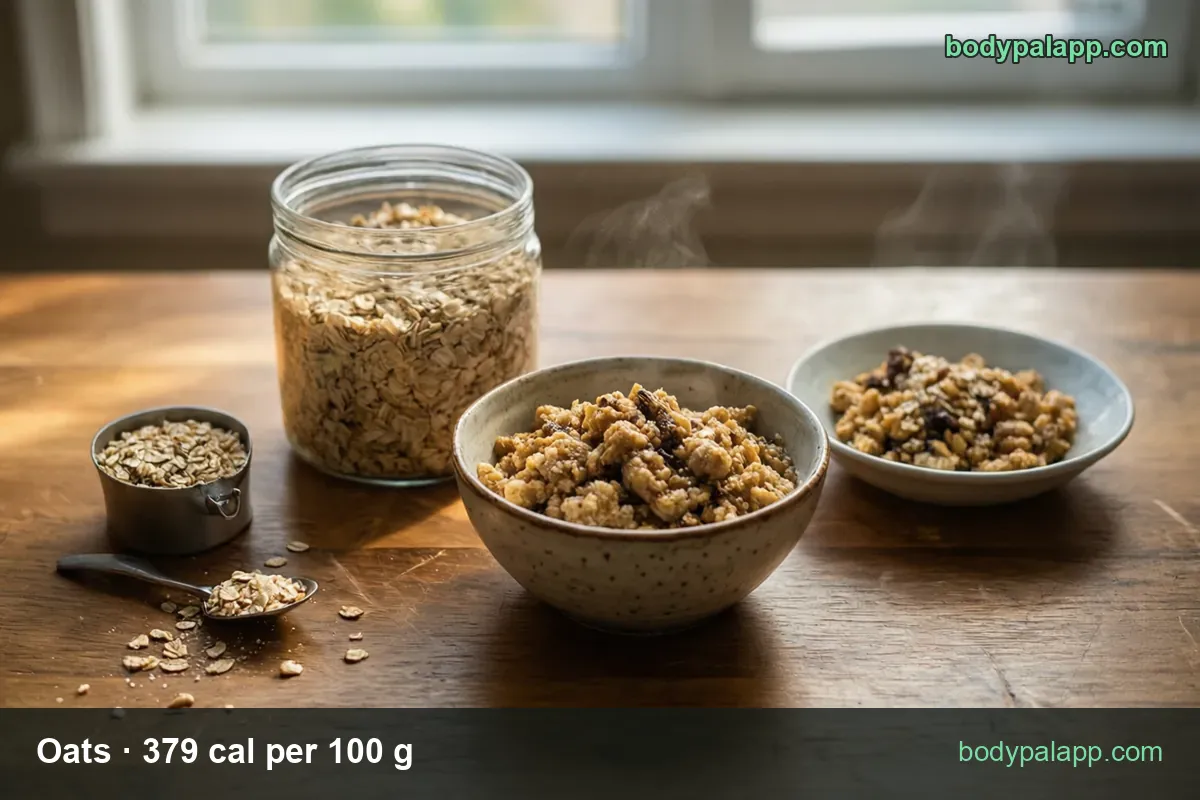
Steel-cut and rolled are the same grain cut two ways, and the calorie gap says so: 381 against 379 per 100 g, a difference of 2 calories that no breakfast decision should hang on. Steel-cut takes longer to cook and stays chewier; that is a texture and time choice, not a calorie choice.
Milk is the real lever. A cup of oatmeal made with water is 154 calories; the same cup made with milk is 278. That single swap adds more than a tablespoon of peanut butter would, and it happens before anyone reaches for honey or banana. Instant plain oatmeal sits in between at 163 per cooked cup, close enough to the stovetop version that convenience costs almost nothing — as long as the packet is plain.
Flavored packets are a different story. USDA's branded data lists Quaker Original Instant Oatmeal at 100 calories for a 28 g packet, Chocolate at 130 for 35 g, and Banana Nut at 240 for a 61 g packet. The per-100 g numbers barely move between them; the packet size and the sugar do. Two Banana Nut packets are 480 calories, more than a cup and a half of dry rolled oats.
One thing this page does not cover: baked granola clusters, the crunchy oat-and-raisin kind. Those are a separate USDA food with oil and sweetener added, and their numbers have no business being scaled from a dry-oat record.
Fiber is the row that earns its keep
Look back at the table and one line stands out. That 40 g scoop covers 14% of the Daily Value for fiber while spending only 3% of the fat allowance and 0% of the sodium allowance. Two milligrams of sodium — not two hundred, two — in a whole serving. For a breakfast starch, that combination is rare.
The Dietary Guidelines for Americans point most adults toward more whole grains and more fiber than they currently eat, and MyPlate counts rolled oats as a whole grain with nothing to qualify. A half-cup scoop is roughly one and a half ounce-equivalents of grain, so it does real work against that target for 152 calories.
There is a sodium twist worth knowing. Dry oats are 6 mg per 100 g. USDA's cooked oatmeal record is 70 mg per 100 g, which makes a 240 g cup about 168 mg, or 7% of the Daily Value. The grain did not change — the cooking water did, and salted water is baked into that record. If you cook unsalted, your bowl stays near zero.
How do oats compare?
| Food | Per 100 g | US serving | Calories |
|---|---|---|---|
| Rolled oats, dry | 379 kcal | 1/2 cup, 40 g | 152 kcal |
| Oatmeal, cooked with water | 64 kcal | 1 cup, 240 g | 154 kcal |
| Steel-cut oats, dry | 381 kcal | 1 oz, 28.35 g | 108 kcal |
| Oat bran, raw | 246 kcal | 1 oz, 28.35 g | 70 kcal |
Our take: for calorie control, cook with water and measure the oats dry — 40 g gives you a full bowl for 152 calories, and the pot does the rest of the work by adding weight, not calories. For staying power, oat bran is the sleeper in this table: the lowest per 100 g of the three dry rows at 246 calories, the highest protein at 17.3 g, and 15.4 g of fiber per 100 g, which beats plain oats outright. Stir a spoonful of bran into a smaller scoop of rolled oats and you get more fiber for fewer calories than either alone. Skip the ranking of rolled against steel-cut entirely; two calories per 100 g is noise.
Most popular oats brands in the United States
Ranked by how widely each product appears among foods sold in the United States, from the BodyPal food database of over 3.3 million products. Calories are the figures printed on each Nutrition Facts label, checked against USDA FoodData Central.
| Product | Calories (per 100 g) |
|---|---|
| Quaker Original Instant Oatmeal | 357 cal |
| Quaker Chocolate Instant Oatmeal | 371 cal |
| Quaker Banana Nut Instant Oatmeal | 393 cal |
Brand popularity: BodyPal food database. Nutrition: manufacturer labels / USDA FoodData Central.
Oat FAQs
How many calories are in 1/2 cup of dry oats?
152 calories for 40 g of dry rolled oats, the standard half-cup scoop most people pour. That same half cup carries 5.3 g of protein, 4.0 g of fiber and 27.1 g of carbohydrate. The gram weight is our own arithmetic from the USDA 100 g figure of 379 calories, not a USDA serving.
How many calories are in 1 cup of cooked oatmeal?
154 calories for a 240 g cup cooked in water with no added fat, which is 64 calories per 100 g because water makes up most of the weight. Cook the same oats in milk and the cup climbs to 278 calories. Plain instant oatmeal with water lands close by at 163.
Are oats high in fiber?
Yes: 10.1 g per 100 g, so a 40 g half cup delivers 4.0 g, or 14% of the FDA Daily Value of 28 g. That is a strong showing for a grain carrying only 2 mg of sodium and 2.6 g of fat. Oat bran goes higher still, at 15.4 g per 100 g.
How much protein is in oats?
13.15 g per 100 g of dry oats, which works out to 5.3 g in a 40 g half cup, or 11% of the 50 g Daily Value. That is high for a grain but not a protein food on its own. Oat bran is denser at 17.3 g per 100 g.
Do oats have sugar?
Barely: 0.99 g of total sugars per 100 g, which is 0.4 g in a 40 g half cup. USDA does not publish added sugars for this record, and plain rolled oats have none to publish. Sugar arrives with the toppings or with flavored instant packets, like the 61 g Banana Nut packet at 240 calories.
Steel-cut vs rolled oats: is there a calorie difference?
Almost none: 381 calories per 100 g for steel-cut against 379 for rolled, a gap of 2 calories. A 1 oz serving is 108 calories steel-cut and 107 rolled. They are the same whole grain cut differently, so the choice is about cooking time and chew, not about the calorie count.
How many calories are in a packet of instant oatmeal?
100 calories for a 28 g packet of Quaker Original, but flavored packets run much bigger: Banana Nut is 61 g and 240 calories, Chocolate 35 g and 130. Plain instant oatmeal prepared with water is 68 calories per 100 g, so a full 240 g cup of it comes to 163 calories.
Are oats good for weight loss?
A 40 g half cup is 152 calories and covers 14% of the fiber Daily Value, so it fits a normal breakfast budget with room left for fruit. If you are watching calories, measure the oats dry, cook them in water rather than milk, and skip the flavored packets — the oats stay flat while the extras move the number.
Similar foods
- Bacon Sandwich — 401 cal per sandwich
- Tonkotsu Ramen — 270 cal per 70 g
- Quiche — 743 cal per slice
- MRE — 260 cal per bar
- Cheese Calzone — 1,649 cal per calzone
- Peanut Butter And Jelly Sandwich — 404 cal per sandwich
Count it without the math
Point the camera at the bowl and BodyPal counts the oats for you, milk and toppings included.


How long does it take to burn off oats?
Half a cup (40 g) of dry oats is 152 kcal. Enter your weight and the amount you ate to see how long it takes you to burn that off:
lb
| Activity | Time to burn 152 kcal |
|---|---|
| Walking, brisk | 30 min |
| Cycling, moderate | 19 min |
| Swimming, moderate | 22 min |
| Jogging | 18 min |
| Weight training, moderate | 34 min |
Times are for a 155 lb adult at a steady pace; change the weight to see yours. The amount is set to the portion in the text (40 g); change it to what you actually ate. BodyPal works this out from your steps automatically.
This table assumes you know your daily total. If you do not, the daily calorie calculator works it out from five numbers.