
How many calories are in overnight oats?
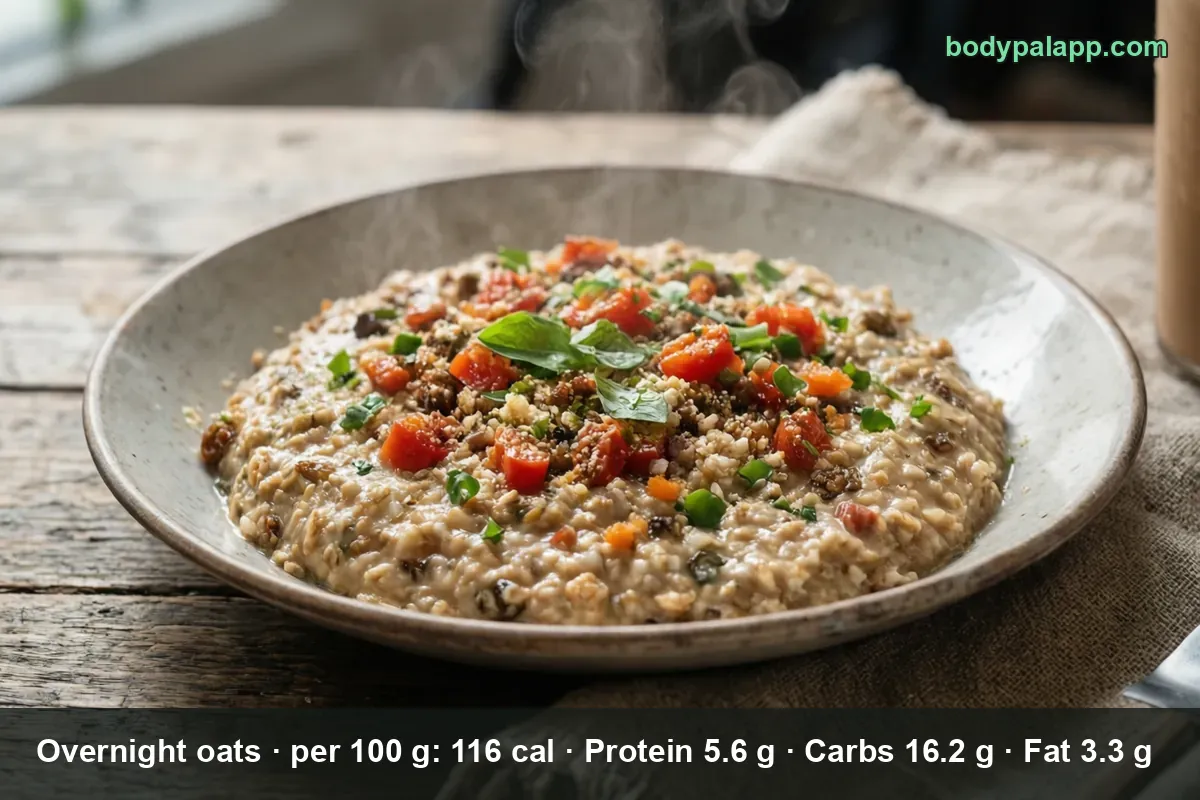
A 1-cup jar of overnight oats soaked in milk comes to 278 calories, and the mix itself runs 116 calories per 100 g. That is the plain breakfast jar: rolled oats plus milk, nothing else stirred in. Swap the milk for water and the same cup drops to 154.
On this page
- Overnight oats quick facts
- US servings, from one ounce to a full jar
- Water, non-dairy milk and the dry oats you start with
- Fiber is the row that surprises people
- How do overnight oats compare?
- Most popular overnight oats brands
- Overnight oats FAQs
Overnight oats quick facts
USDA does not publish a record called "overnight oats." It does not need to. The jar you pull out of the fridge is rolled or quick oats softened in milk, and that is exactly what FNDDS record 2708383, "Oatmeal, regular or quick, made with milk, no added fat" describes. Cold soaking and a hot pan do the same job to the same two ingredients, so the calorie count is the same either way.
The row below is that record. It assumes no butter, no oil, no sweetener and no toppings — the base you build on, not the finished Instagram jar.
| Nutrient | Per 100 g | Per 1 cup (240 g) | % Daily Value |
|---|---|---|---|
| Calories | 116 | 278 | — |
| Total fat | 3.25 g | 7.8 g | 10% |
| Saturated fat | 1.44 g | 3.5 g | 17% |
| Carbohydrate | 16.23 g | 39.0 g | 14% |
| Dietary fiber | 1.7 g | 4.1 g | 15% |
| Total sugars | 5.08 g | 12.2 g | — |
| Protein | 5.56 g | 13.3 g | 27% |
| Sodium | 105 mg | 252 mg | 11% |
| Cholesterol | 9 mg | 22 mg | 7% |
| Potassium | 212 mg | 509 mg | 11% |
% Daily Value is based on a 2,000-calorie diet.
Verified nutrition data
Numbers on this page come from USDA FoodData Central, the U.S. Department of Agriculture’s food composition database, and from manufacturer labels where a branded product is named. Last verified September 2026. How we verify our data →
Two label rows are missing here on purpose: added sugars and trans fat. FNDDS does not publish either value for prepared dishes, so guessing them would be worse than leaving them out. The 12.2 g of total sugars in a cup is not an added-sugar figure — the water version of the same dish carries 0.17 g per 100 g, so the sugars in your jar arrive with the milk. The 252 mg of sodium works out to roughly a tenth of a teaspoon of table salt, and the Daily Values used in that last column are FDA's.
US servings, from one ounce to a full jar
| Serving | Weight | Calories |
|---|---|---|
| 1 oz | 28 g | 33 kcal |
| 1/2 cup, small jar | 120 g | 139 kcal |
| 1 cup, standard jar | 240 g | 278 kcal |
| 1 oz dry oats, yields | 170 g | 197 kcal |
| 1 cup dry oats, yields | 485 g | 563 kcal |
| Per 100 g | 100 g | 116 kcal |
Three of those are USDA household measures: the 1-cup jar, and the two "yields" portions that start from dry oats and end at the soaked weight. The half cup, the ounce and the 100 g line are our own arithmetic from the USDA 100 g figure, not USDA servings.
The two dry-start rows are the useful ones, because that is how people actually build the jar — you measure oats, not soaked oats. One ounce of dry oats swells into 170 g of jar and lands at 197 calories. A full cup of dry oats yields 485 g and 563 calories, and almost nobody wants a jar that size for breakfast. Half a cup of dry oats is the normal starting scoop.
Water, non-dairy milk and the dry oats you start with
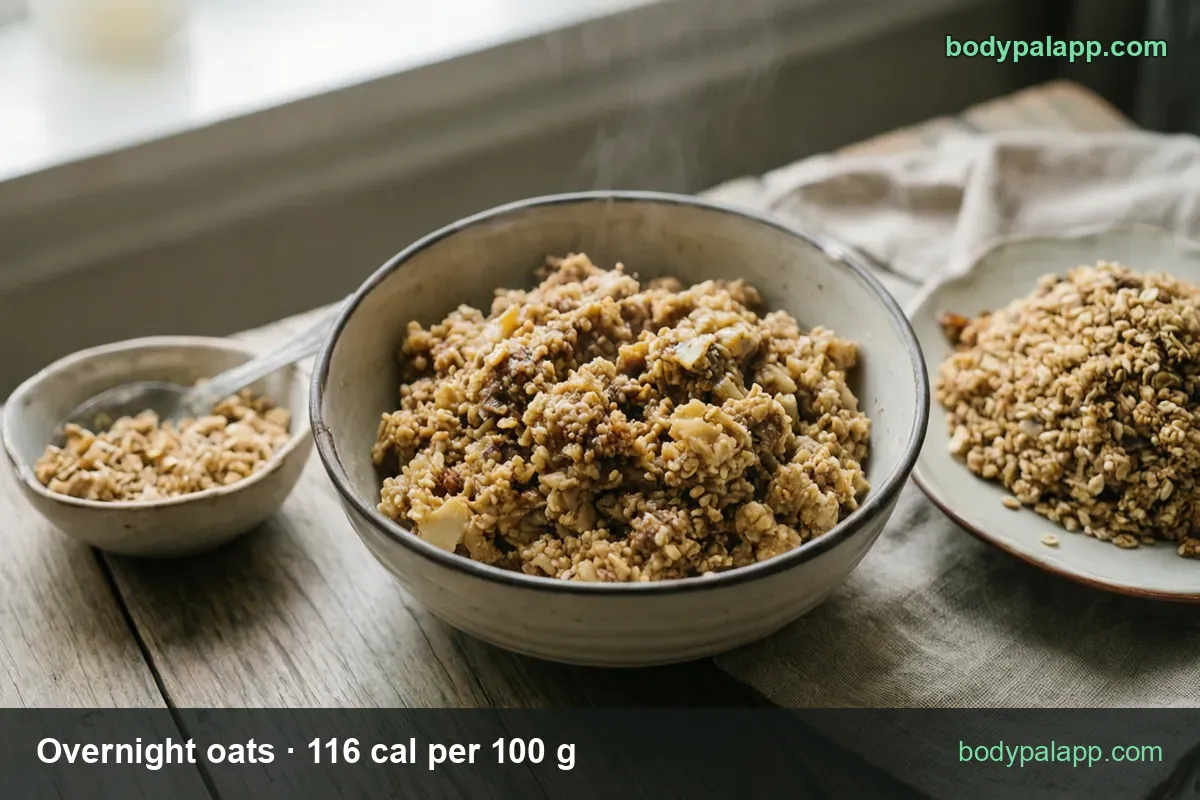
The oats barely move. The liquid moves everything.
| Version | Per 100 g | Typical portion | Calories |
|---|---|---|---|
| Made with milk | 116 kcal | 1 cup (240 g) | 278 kcal |
| Made with water | 64 kcal | 1 cup (240 g) | 154 kcal |
| Made with non-dairy milk | 95 kcal | 1 cup (240 g) | 228 kcal |
| Made with milk, fat added | 128 kcal | 1 cup (240 g) | 307 kcal |
| Dry rolled oats, the base | 379 kcal | 1 cup (80 g) | 303 kcal |
| Quaker Quick Oats, dry | 371 kcal | 1/2 cup (40 g) | 148 kcal |
Water instead of milk saves 124 calories on a 1-cup jar and takes the protein down with it, from 13.3 g to about 5.3 g by our own scaling of the 2.21 g per 100 g figure. Non-dairy milk sits in between at 228. Stirring in butter or oil — the "fat added" row — pushes the same cup to 307.
The dry oats look alarming at 379 calories per 100 g, but that number is measured before any liquid, and you never eat 100 g of dry oats. Half a cup of dry rolled oats is 40 g and 152 calories by our arithmetic from the same 100 g figure. Here is the cleanest way to see where the calories come from: the USDA "1 cup dry, yields" portion is 485 g and 563 calories, while a cup of dry oats on its own is 303 — so the milk in that oversized jar is worth about 260 calories all by itself.
Packaged overnight oat kits are sold dry, and their labels behave the same way. Quaker Rolled Overnight Oats reads 375 calories per 100 g, or 150 for its half-cup 40 g serving; the Quaker Overnight Oats single package is 74 g and 280 calories. Flavored pouches and protein bags from Maker and ONO run 380 to 400 per 100 g. In every case the milk you pour on top is not in that number.
Fiber is the row that surprises people
A cup of overnight oats gives 4.1 g of fiber, which is 15% of the Daily Value — decent, and less than most people expect from something built on whole grain. Dry rolled oats read 10.1 g of fiber per 100 g. Soaked, the same oats read 1.7 g per 100 g. No fiber disappears overnight; the liquid is simply most of what is now in the jar, so everything per 100 g gets smaller.
Protein goes the other way. At 13.3 g, a milk-soaked cup covers 27% of the Daily Value, which is high for a breakfast that takes ninety seconds to assemble and comes mostly from the milk. Saturated fat is the row worth a glance if you drink whole milk: 3.5 g, or 17% of the Daily Value, before any nut butter goes in.
Oats count toward the whole-grain target in the Dietary Guidelines for Americans, and half a cup of dry oats is one ounce-equivalent from the MyPlate grains group. If you are watching sodium, the water version is the lighter pick at 70 mg per 100 g against 105 mg.
How do overnight oats compare?
| Version | Per 100 g | US serving | Calories |
|---|---|---|---|
| Overnight oats, milk | 116 kcal | 1 cup (240 g) | 278 kcal |
| Overnight oats, water | 64 kcal | 1 cup (240 g) | 154 kcal |
| Overnight oats, non-dairy milk | 95 kcal | 1 cup (240 g) | 228 kcal |
| Overnight oats, milk with fat added | 128 kcal | 1 cup (240 g) | 307 kcal |
Our take: for weight loss, build the jar with water or non-dairy milk and keep the toppings honest — 154 or 228 calories leaves real room for fruit. For staying full until lunch, dairy milk earns its 278, because it brings 13.3 g of protein with it. The water jar is the lightest of the four but also the thinnest on protein at roughly 5.3 g a cup. And note what does not appear on this list: soaking versus cooking. That choice costs nothing either way.
Most popular overnight oats brands in the United States
Ranked by how widely each product appears among foods sold in the United States, from the BodyPal food database of over 3.3 million products. Calories are the figures printed on each Nutrition Facts label, checked against USDA FoodData Central.
| Product | Calories (per 100 g) |
|---|---|
| Quaker Rolled Overnight Oats | 375 cal |
| Quaker Overnight Oats | 378 cal |
| Maker Apple & Coconut Overnight Oats | 400 cal |
| Maker Mulberry & Chia Overnight Oats | 385 cal |
| ONO Cinnamon Oat Crunch Protein Overnight Oats | 380 cal |
| ONO Vegan Strawberries & Cream Protein Overnight Oats | 385 cal |
Brand popularity: BodyPal food database. Nutrition: manufacturer labels / USDA FoodData Central.
Overnight oats FAQs
How many calories are in 1 cup of overnight oats?
A 1-cup jar soaked in milk is 278 calories, at 116 calories per 100 g. That is the USDA figure for rolled oats and milk with no added fat. Stir in honey, peanut butter or protein powder and you add those calories on top of the 278.
Do overnight oats have more calories than cooked oatmeal?
No. USDA publishes one record for both, so a 1-cup serving is 278 calories hot or cold. Soaking softens the oats overnight instead of heat doing it on the stove; the oats and the milk are identical. Toppings, not temperature, are what move the number.
How many calories in overnight oats made with water?
154 calories for a 1-cup jar, or 64 per 100 g. That is 124 fewer than the milk version, and the sugars drop from 5.08 g per 100 g to 0.17 g. Fiber stays the same at 1.7 g per 100 g, but protein falls by more than half.
How much protein is in overnight oats?
13.3 g in a 1-cup jar made with milk, which is 27% of the Daily Value. Per 100 g the mix is 5.56 g protein. Made with water the same cup gives about 5.3 g by our arithmetic, so most of that protein arrives with the milk, not the oats.
Are overnight oats good for weight loss?
At 278 calories a cup, with 13.3 g of protein (27% DV) and 4.1 g of fiber (15% DV), a jar sits comfortably inside a normal breakfast budget. What decides it is what you stir in; the USDA record covers oats and milk only. If you want it lighter, water brings the same cup to 154.
How many calories in overnight oats with almond milk?
228 calories for a 1-cup jar. USDA groups almond, soy and oat milks into one record, oatmeal made with non-dairy milk, at 95 calories per 100 g. That is 50 fewer than the dairy cup, with 3.35 g protein per 100 g instead of 5.56 g.
Do overnight oats have more fiber than regular oatmeal?
No. Both read 1.7 g per 100 g, which is 4.1 g in a 1-cup jar, or 15% of the Daily Value. Dry rolled oats show 10.1 g per 100 g, but that is the same fiber before any liquid is added; soaking spreads it through a much heavier jar.
How many calories in Quaker overnight oats?
150 calories for the 1/2-cup (40 g) serving of Quaker Rolled Overnight Oats, and 280 for a 74 g package of Quaker Overnight Oats. Those are dry-mix numbers off the label, at 375 and 378 calories per 100 g. The milk you pour in is counted separately.
Similar foods
- Olive — 26 cal for 5 large olives
- Masoor Dal — 207 cal per cup cooked
- Mexican rice — 279 cal per cup
- Shrimp Lo Mein — 242 cal per cup
- Tuna steak — 185 cal per steak, 6 oz
- Chicken Tikka Masala — 257 cal per cup
Count it without the math
Point the camera at the jar and BodyPal counts the oats, the milk and whatever you spooned on top.


How long does it take to burn off overnight oats?
A 1-cup (240 g) serving is 278 kcal. Enter your weight and the amount you ate to see how long it takes you to burn that off:
lb
| Activity | Time to burn 278 kcal |
|---|---|
| Walking, brisk | 56 min |
| Cycling, moderate | 35 min |
| Swimming, moderate | 40 min |
| Jogging | 33 min |
| Weight training, moderate | 1 hr 2 min |
Times are for a 155 lb adult at a steady pace; change the weight to see yours. The amount is set to the portion in the text (240 g); change it to what you actually ate. BodyPal works this out from your steps automatically.
Want the bigger picture? Calculate your daily calorie needs — your maintenance figure, a target for losing or gaining, and the date you get there.