
How many calories are in chicken pad thai?
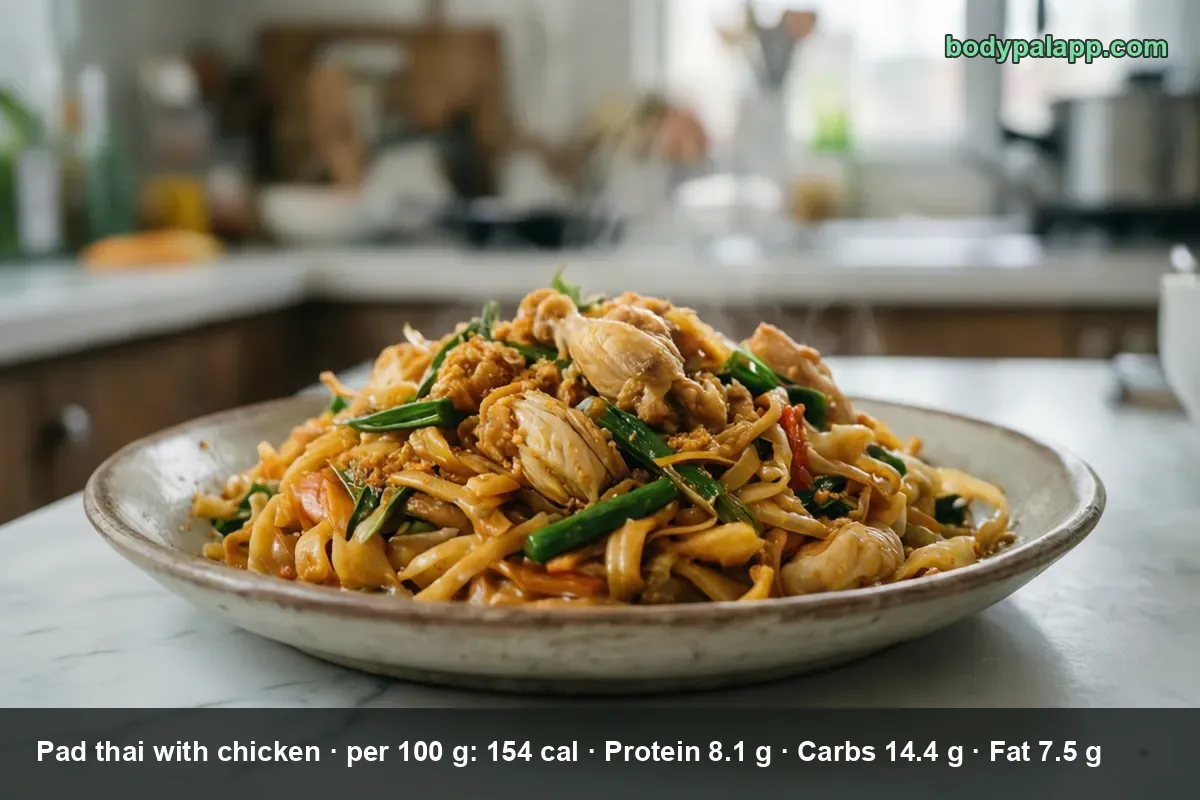
A 1-cup serving of chicken pad thai weighs 200 g and holds 308 calories. Per 100 g the dish runs 154 calories, lighter per gram than chicken fried rice at 173. The catch is volume: a restaurant plate is usually two cups, and that plate doubles every number on this page.
On this page
- Chicken pad thai quick facts
- US servings from one ounce to a full plate
- Restaurant plates and frozen bowls
- Sodium is the row to watch
- Protein and carbs in a cup
- How does chicken pad thai compare with the other versions?
- Most popular pad thai with chicken brands
- FAQ
Chicken pad thai quick facts
The record behind this page is FNDDS 2708806, "Pad Thai with chicken", from the 2021-2023 survey release. It describes the finished dish as people actually eat it: rice noodles stir-fried in tamarind sauce with chicken, egg and scallion. That matters, because the person searching is holding a takeout container, not a bag of dry noodles. There is no Foundation or SR Legacy entry for a composed pad thai, so the survey record is the only honest source for a plated number.
It also comes with a household measure of 1 cup, 200 g, which is the serving used in every table below.
| Nutrient | Per 100 g | Per 1 cup (200 g) | % Daily Value |
|---|---|---|---|
| Calories | 154 | 308 | — |
| Total fat | 7.5 g | 15.0 g | 19% |
| Saturated fat | 1.3 g | 2.6 g | 13% |
| Carbohydrate | 14.36 g | 28.7 g | 10% |
| Dietary fiber | 1.2 g | 2.4 g | 9% |
| Total sugars | 4.06 g | 8.1 g | — |
| Protein | 8.13 g | 16.3 g | 33% |
| Sodium | 384 mg | 768 mg | 33% |
% Daily Value is based on a 2,000-calorie diet.
Verified nutrition data
Numbers on this page come from USDA FoodData Central, the U.S. Department of Agriculture’s food composition database, and from manufacturer labels where a branded product is named. Last verified September 2026. How we verify our data →
Two label rows are missing on purpose. USDA does not publish added sugars or trans fat for mixed survey dishes like this one, so there is nothing to report for either, even though the tamarind sauce clearly contains palm sugar. Cholesterol and potassium are published: a cup carries 96 mg of cholesterol, 32% of the Daily Value, and 304 mg of potassium, only 6%. The egg and chicken drive the first number; the second says this is not a vegetable-heavy plate.
US servings from one ounce to a full plate
| Serving | Weight | Calories |
|---|---|---|
| 1 oz | 28.4 g | 44 kcal |
| 1 cup | 200 g | 308 kcal |
| 1 1/2 cups | 300 g | 462 kcal |
| 2 cups, typical restaurant plate | 400 g | 616 kcal |
| Per 100 g | 100 g | 154 kcal |
Only the 1-cup line is a USDA household serving. The ounce, the cup and a half and the two-cup plate are our own arithmetic from the USDA 100 g figure, not USDA servings.
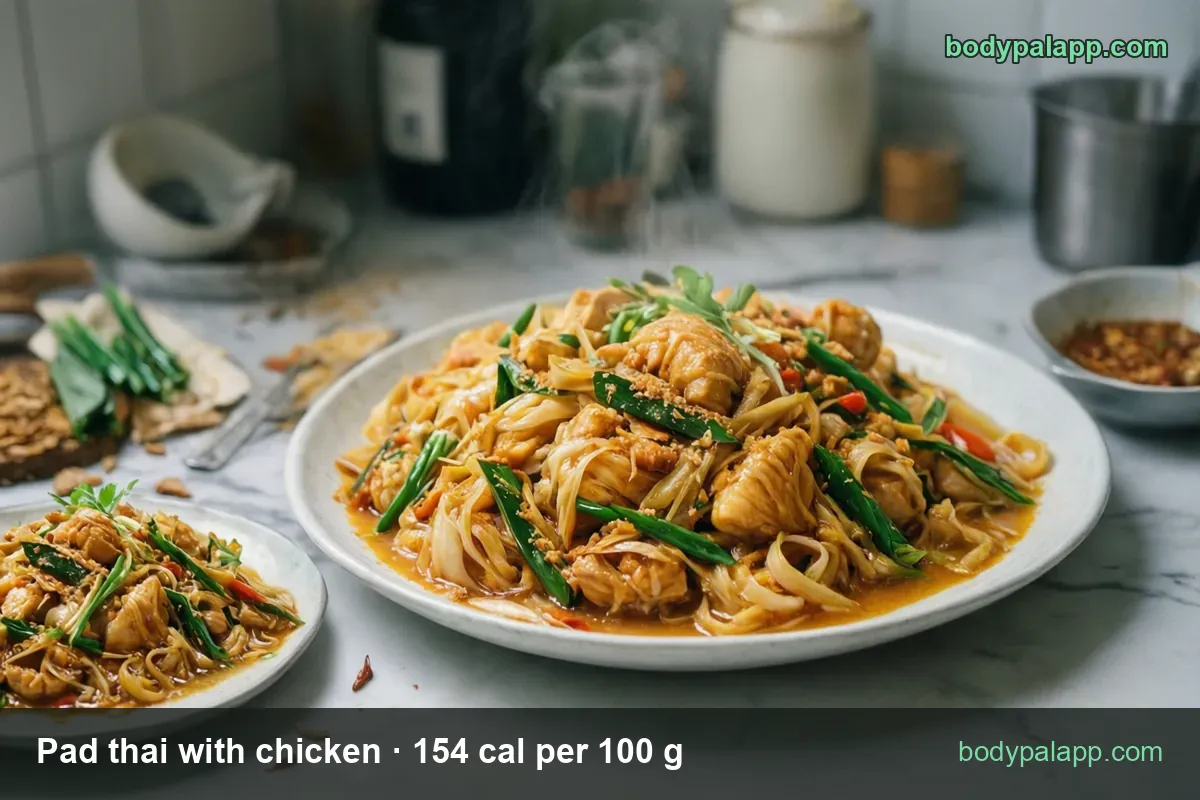
The gap between the cup and the plate is the whole story of this dish. A cup of pad thai is a modest lunch at 308 calories, in the same range as a deli sandwich. Two cups is 616, which is dinner-sized before you touch a spring roll. Restaurant plates and takeout boxes almost never hold one cup, and the noodles pack tightly, so a container that looks like "one serving" can weigh 400 g on a kitchen scale. Weigh your box once and you will know which line of that table is yours for good.
Restaurant plates and frozen bowls
| Version | Per 100 g | Typical portion | Calories |
|---|---|---|---|
| Pad Thai, NFS | 154 kcal | 1 cup (200 g) | 308 kcal |
| Chicken pad thai, restaurant plate | 154 kcal | 2 cups (400 g) | 616 kcal |
| Raley's Pad Thai Chicken, frozen | 125 kcal | 255 g package | 319 kcal |
| P.F. Chang's Home Menu Chicken Pad Thai | 128 kcal | 218 g (1 cup) | 279 kcal |
| P.F. Chang's Chicken Pad Thai bowl | 145 kcal | 275 g bowl | 399 kcal |
"Pad Thai, NFS" is what USDA uses when the diner did not say what was in it, and the agency models it at exactly the same 154 calories per 100 g as the chicken version. If your logging app offers both, the choice changes nothing.
The frozen bowls are the interesting part. All three run lighter per gram than the restaurant dish, 125 to 145 calories per 100 g against 154, because packaged versions carry more sauce and vegetables and less oil. But density is not what lands on your plate. The 275 g bowl still delivers 399 calories, more than a 1-cup restaurant serving, simply because the package is bigger than a cup. Buying the lighter product and eating the bigger box is how people end up surprised.
Sodium is the row to watch
One cup carries 768 mg of sodium, a third of the FDA Daily Value of 2,300 mg. That is roughly a third of a teaspoon of table salt sitting in a bowl of noodles. Fish sauce, soy and the tamarind sauce base are where it comes from, and none of them are optional in this dish.
Now scale it to the plate. Two cups is 1,536 mg, two thirds of the day's limit from a single meal, before soup, appetizers or anything you eat later. The CDC puts average US intake well above the limit already, mostly from restaurant and packaged food rather than the salt shaker. If you're watching sodium, the practical move is not to skip pad thai but to eat half the plate and take the rest home.
Saturated fat, by contrast, is quiet here: 2.6 g per cup, 13% of the Daily Value, because the fat comes mainly from peanut or vegetable oil and egg rather than from cream or cheese. Even the two-cup plate stays at 5.2 g, about a quarter of the day.
Protein and carbs in a cup
A cup gives 16.3 g of protein, 33% of the Daily Value, which is a genuinely good return for a noodle dish. MyPlate counts the chicken and egg here as protein foods, and the two-cup plate reaches 32.5 g, which covers most of a day's minimum on its own.
The carbohydrate number surprises people. Rice noodles feel like a carb bomb, but a cup holds 28.7 g, only 10% of the Daily Value, because the noodles are cooked and heavy with water and sauce. Per 100 g that is 14.36 g, roughly half of what chicken fried rice carries at 27.62 g. If you are choosing between the two on a carb budget, pad thai wins per gram, and it is not close.
Fiber is thin at 2.4 g per cup, 9% of the Daily Value, and total sugars sit at 8.1 g from the sweet-sour sauce. That sugar figure is not comparable to the added sugars limit, since USDA does not split naturally occurring from added sugars in this record.
How does chicken pad thai compare with the other versions?
| Version | Per 100 g | US serving | Calories | Protein |
|---|---|---|---|---|
| Pad thai with chicken | 154 kcal | 1 cup, 200 g | 308 kcal | 16.3 g |
| Pad thai with meat | 160 kcal | 1 cup, 200 g | 320 kcal | 16.4 g |
| Pad thai with seafood | 147 kcal | 1 cup, 200 g | 294 kcal | 13.7 g |
| Pad thai, meatless | 165 kcal | 1 cup, 200 g | 330 kcal | 11.6 g |
Our take: skipping the meat does not make this lighter. The meatless record is the heaviest of the four at 165 calories per 100 g, and it hands back nearly 5 g of protein per cup, because the calories in pad thai live in the noodles and the oil, not in the chicken. Shrimp is the lightest plate at 294 calories, though it also gives the least protein per calorie of the animal versions. For a cheap, filling lunch, the chicken version is the sweet spot: 308 calories a cup with a third of the day's protein.
Most popular pad thai with chicken brands in the United States
Ranked by how widely each product appears among foods sold in the United States, from the BodyPal food database of over 3.3 million products. Calories are the figures printed on each Nutrition Facts label, checked against USDA FoodData Central.
| Product | Calories (per 100 g) |
|---|---|
| Raley's Pad Thai Chicken | 125 cal |
| P.F. Chang's Home Menu Chicken Pad Thai | 128 cal |
| P.F. Chang's Chicken Pad Thai 275 g Bowl | 145 cal |
Brand popularity: BodyPal food database. Nutrition: manufacturer labels / USDA FoodData Central.
Chicken pad thai FAQs
How many calories are in chicken pad thai?
A 1-cup serving weighs 200 g and holds 308 calories, since the USDA record runs 154 calories per 100 g. That cup also carries 16.3 g of protein and 768 mg of sodium. Most restaurant plates hold closer to two cups, which doubles all three numbers.
How many calories in a restaurant plate of pad thai?
Two cups, 400 g, come to 616 calories. That figure is our own arithmetic from the USDA 100 g number, not a USDA serving. The same plate brings 30.0 g of fat and 1,536 mg of sodium, which is 67 percent of the FDA Daily Value from one dish.
How much protein is in chicken pad thai?
One cup gives 16.3 g of protein, 33 percent of the Daily Value, because the record holds 8.13 g per 100 g. A two-cup restaurant plate reaches 32.5 g. The chicken and egg do that work: the meatless version drops to 5.79 g per 100 g, or 11.6 g a cup.
How much sodium is in pad thai?
A 1-cup serving carries 768 mg of sodium, a third of the 2,300 mg Daily Value and about a third of a teaspoon of table salt. Two cups take it to 1,536 mg. Fish sauce, soy and the tamarind sauce base account for nearly all of it.
Is pad thai healthy?
A cup at 308 calories, 16.3 g of protein and 2.4 g of fiber fits an ordinary lunch without much argument. Sodium is the weak spot at 768 mg a cup and 1,536 mg for a full plate. If you're watching sodium, eat half the plate and box the rest.
Is chicken pad thai better than vegetarian pad thai?
For calories, yes. Meatless pad thai runs 165 calories per 100 g against 154 for the chicken version, so a cup is 330 rather than 308. Protein moves further: 11.6 g against 16.3 g per cup. Dropping the chicken leaves more noodles and oil in the same bowl.
How many calories in frozen chicken pad thai?
Store bowls run 279 to 399 calories per package. P.F. Chang's Home Menu is 128 calories per 100 g for a 218 g cup, so 279. Raley's is 125 per 100 g for a 255 g pack, so 319. The 275 g P.F. Chang's bowl is 145 per 100 g, or 399.
How many carbs are in chicken pad thai?
A cup holds 28.7 g of carbohydrate, 10 percent of the Daily Value, with 2.4 g of fiber and 8.1 g of total sugars from the sauce. Per 100 g that is 14.36 g, roughly half of what chicken fried rice carries. Cooked rice noodles hold a lot of water.
Similar foods
- Eye of round steak — 135 cal for 3 oz cooked
- Shrimp Pad Thai — 294 cal per cup
- Toor Dal — 348 cal per cup
- Roast Beef — 142 cal per 3 oz
- Steelhead trout — 143 cal for 3 oz cooked
- Lasagna — 286 cal per piece
Count it without the math
Point the camera at the plate and BodyPal counts the noodles, the chicken and the sauce for you.


How long does it take to burn off chicken pad Thai?
A 1-cup (200 g) serving is 308 kcal. Enter your weight and the amount you ate to see how long it takes you to burn that off:
lb
| Activity | Time to burn 308 kcal |
|---|---|
| Walking, brisk | 1 hr 2 min |
| Cycling, moderate | 38 min |
| Swimming, moderate | 44 min |
| Jogging | 36 min |
| Weight training, moderate | 1 hr 8 min |
Times are for a 155 lb adult at a steady pace; change the weight to see yours. The amount is set to the portion in the text (200 g); change it to what you actually ate. BodyPal works this out from your steps automatically.
Want the bigger picture? Calculate your daily calorie needs — your maintenance figure, a target for losing or gaining, and the date you get there.