
How many calories are in peanut butter and jelly?
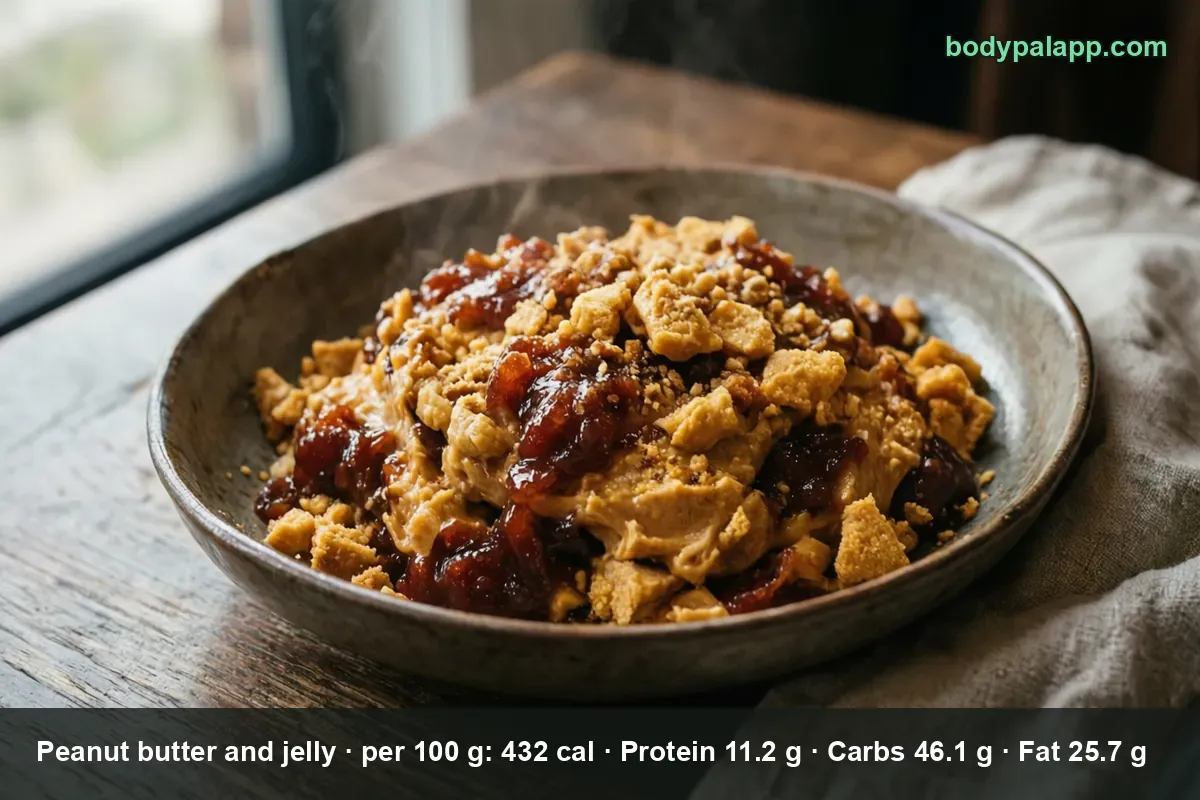
Two tablespoons of peanut butter and jelly, the amount that covers one sandwich, weighs 32 g and carries 138 calories. On its own, with no bread under it, the mix runs 432 calories per 100 g. That density is the whole story here: the spread, not the bread, decides what a PB&J ends up costing you.
On this page
- Peanut butter and jelly quick facts
- US servings from one tablespoon to 100 grams
- The sandwich versions white wheat and lighter builds
- Sugar and fat in a 2 tablespoon serving
- How does peanut butter and jelly compare
- Most popular peanut butter and jelly brands
- Peanut butter and jelly FAQs
Peanut butter and jelly quick facts
The number most people are after is the one for the stuff in the jar and the jar next to it, spooned onto a knife: peanut butter plus jelly, no bread involved. USDA files that as FNDDS 2707543, "Peanut butter and jelly", in the 2021-2023 survey release, and that record is the base for everything below.
There are several other PB&J records in the database, and almost all of them are finished sandwiches. Those come in lower per 100 g, around 361, because most of the weight is bread. Same peanut butter, same jelly, different arithmetic. The sandwich records get their own section further down.
| Nutrient | Per 100 g | Per 2 tbsp (32 g) | % Daily Value |
|---|---|---|---|
| Calories | 432 | 138 | — |
| Total fat | 25.69 g | 8.2 g | 11% |
| Saturated fat | 5.17 g | 1.7 g | 8% |
| Carbohydrate | 46.13 g | 14.8 g | 5% |
| Dietary fiber | 3 g | 1.0 g | 3% |
| Total sugars | 30.86 g | 9.9 g | — |
| Protein | 11.18 g | 3.6 g | 7% |
| Sodium | 228 mg | 73 mg | 3% |
% Daily Value is based on a 2,000-calorie diet.
Verified nutrition data
Numbers on this page come from USDA FoodData Central, the U.S. Department of Agriculture’s food composition database, and from manufacturer labels where a branded product is named. Last verified September 2026. How we verify our data →
Two rows you would expect on a jar label are missing here: added sugars and trans fat. USDA does not publish added sugars or trans fat for this record, so there is nothing honest to put in those cells and they are left out rather than guessed. Cholesterol is zero, as you would expect from two plant foods, and the mix brings 306 mg of potassium per 100 g, which is 98 mg in a 2 tablespoon serving, or 2% of the Daily Value.
US servings from one tablespoon to 100 grams
USDA's own household measure for this record is the tablespoon, and it lists a guideline amount of one tablespoon per slice of bread. Two slices, two tablespoons, 32 g. That is why the 2 tbsp line is the headline number rather than 100 g, which is more than three sandwiches' worth of filling.
| Serving | Weight | Calories |
|---|---|---|
| 1 tablespoon, the guideline amount for one slice of bread | 16 g | 69 kcal |
| 2 tablespoons, one sandwich's worth | 32 g | 138 kcal |
| 1 oz | 28 g | 121 kcal |
| Per 100 g | 100 g | 432 kcal |
The tablespoon lines and the 100 g line come straight from USDA. The 1 oz line is our own arithmetic from the USDA 100 g figure, not a USDA serving, and it is there because jars are labeled in ounces even though nobody eats by the ounce.
Worth knowing before you log it: a tablespoon of peanut butter is heavier and stickier than a tablespoon of jelly, and most people are generous with the peanut butter and stingy with the jelly. If your knife work runs heavy, a "2 tablespoon" sandwich can easily be 45 g, which is closer to 194 calories by the same arithmetic. Weighing the knife once, on a kitchen scale, calibrates every sandwich after that.
The sandwich versions white wheat and lighter builds
Once bread is under it, USDA switches to a 112 g sandwich as the standard piece. Every row below is that same 112 g build unless noted.
| Version | Per 100 g | Sandwich | Calories |
|---|---|---|---|
| PB&J sandwich, NFS or white bread | 361 kcal | one sandwich, 112 g | 404 kcal |
| PB&J sandwich, wheat bread | 360 kcal | one sandwich, 112 g, our arithmetic | 403 kcal |
| PB&J with reduced fat peanut butter, white bread | 339 kcal | one sandwich, 112 g | 380 kcal |
| PB&J with reduced fat peanut butter, wheat bread | 337 kcal | one sandwich, 112 g | 377 kcal |
| PB&J with reduced sugar jelly, white bread | 341 kcal | one sandwich, 112 g, our arithmetic | 382 kcal |
| Frozen crustless PB&J sandwich | 361 kcal | one sandwich, 60 g | 217 kcal |
Three things fall out of that table that no label will tell you.
Wheat versus white is a wash on calories. One calorie separates 403 from 404, and per 100 g it is 360 against 361. What wheat actually buys is fiber: 4.5 g per 100 g against 2.8 g on white, about 1.6 times as much, plus a little more protein. Choose it for that, not for the calorie column.
Reduced fat peanut butter works, but it charges you in salt. The white-bread sandwich drops from 404 to 380 calories, a saving of 24, while sodium climbs from 368 to 401 mg per 100 g. Manufacturers replace some of the fat with starch and salt, which is why the carbohydrate line goes up as the fat line comes down.
Reduced sugar jelly barely touches the calories. Sugars fall from 15 g to 11.11 g per 100 g, roughly a quarter less, but calories only go from 361 to 341, about 20 per 100 g, or 22 across the sandwich. The peanut butter is carrying most of the energy and the jelly swap never touches it.
The frozen crustless sandwiches sold in freezer aisles use the same nutrient profile as a regular white-bread PB&J. They just come smaller, at 60 g instead of 112 g, which is why one lands at 217 calories. That is a portion-size effect, not a lighter recipe.
There is no US branded label for the plain spread itself, only PB&J-flavored bars: Bob's Red Mill's oat bar is 210 calories for a 50 g bar, and a REDCON1 MRE bar is 260 for 67 g. Useful to know if you log the bar and expect it to match the sandwich, because it will not.
Sugar and fat in a 2 tablespoon serving
The 2 tablespoon serving is 8.2 g of fat, which is 11% of the FDA Daily Value for total fat, and only 1.7 g of that is saturated, or 8%. For something this calorie-dense, the saturated fat line is mild. Peanut fat is mostly unsaturated, and the jelly brings none.
Sugars are the busier column: 9.9 g of total sugars in 32 g of spread, from 30.86 g per 100 g. Almost none of that is peanut. It is the jelly and whatever sugar the peanut butter brand adds. The Dietary Guidelines for Americans set a limit on added sugars specifically, but USDA does not publish an added sugars figure for this record, so the split between fruit sugar and added sugar here is unknown and we are not going to invent it. Read 9.9 g as the ceiling, not the added-sugar number.
Protein is the underrated part. Two tablespoons give 3.6 g, 7% of the Daily Value, and a whole white-bread sandwich works out to roughly 12.8 g by our arithmetic from the 100 g figure. Peanuts sit in the protein foods group on MyPlate precisely because of that. Sodium stays quiet in the spread, 73 mg per serving or 3%, and only gets loud once bread joins in, at 368 mg per 100 g of sandwich.
How does peanut butter and jelly compare
| Food | Per 100 g | US serving | Calories |
|---|---|---|---|
| Peanut butter and jelly, filling only | 432 kcal | 2 tbsp, 32 g | 138 kcal |
| PB&J sandwich, NFS | 361 kcal | one sandwich, 112 g | 404 kcal |
| Frozen crustless PB&J sandwich | 361 kcal | one sandwich, 60 g | 217 kcal |
| Oatmeal cookie with PB and jelly filling | 398 kcal | one cookie, 32 g | 127 kcal |
Our take: the filling is the densest of the four per gram, at 432, and that is exactly why the number on your plate is decided by how heavy your hand is, not by which bread you buy. If you are cutting calories, cut the spread and leave the bread alone; going from a heavy 45 g smear to a level 32 g saves about 56 calories without changing anything you can see. If you want the sandwich to hold you until dinner, take the wheat bread for the extra fiber and the full-fat peanut butter for the protein and satiety, and accept the 404. The oatmeal cookie with the same filling looks cheap at 127 calories, but it is a cookie: 2.61 g of protein per 100 g against 11.18 g in the real thing.
Most popular peanut butter and jelly brands in the United States
Ranked by how widely each product appears among foods sold in the United States, from the BodyPal food database of over 3.3 million products. Calories are the figures printed on each Nutrition Facts label, checked against USDA FoodData Central.
| Product | Calories (per 100 g) |
|---|---|
| Bob's Red Mill Peanut Butter Jelly & Oats Bar (50 g) | 420 cal |
| Bob's Red Mill Peanut Butter Jelly & Oats Bar (42 g) | 429 cal |
| Bob's Red Mill Peanut Butter Jelly & Oats Bars | 429 cal |
| REDCON1 MRE Bar Peanut Butter Jelly | 388 cal |
Brand popularity: BodyPal food database. Nutrition: manufacturer labels / USDA FoodData Central.
Peanut butter and jelly FAQs
How many calories are in peanut butter and jelly?
432 calories per 100 g for the peanut butter and jelly mix itself, which works out to 138 calories in the 2 tablespoons that go on one sandwich. Build it into a sandwich with two slices of bread and the whole thing lands near 404 calories, USDA's figure for a plain PB&J on white bread.
How many calories in 2 tablespoons of peanut butter and jelly?
138 calories in 2 tablespoons, or 32 g, which is the guideline amount for one sandwich. Half that, a single tablespoon at 16 g, is 69 calories. The same 32 g carries 8.2 g of fat, 14.8 g of carbohydrate and 3.6 g of protein. One ounce, 28 g, works out to 121 calories.
How many calories in a peanut butter and jelly sandwich?
404 calories for a standard 112 g PB&J on white bread, at 361 calories per 100 g. The frozen crustless kind sold in boxes is smaller, 60 g and 217 calories. Bread adds bulk and salt: the sandwich carries 368 mg of sodium per 100 g against 228 mg for the filling alone.
Is a PB&J on wheat bread lower in calories than on white?
One calorie lower, which is nothing: 403 against 404 for the same 112 g sandwich, or 360 against 361 per 100 g. The reason to pick wheat is fiber. Wheat bread takes the sandwich to 4.5 g of fiber per 100 g against 2.8 g on white, about 1.6 times as much.
How much protein is in peanut butter and jelly?
3.6 g of protein in 2 tablespoons, from 11.18 g per 100 g. That is 7% of the Daily Value for a 32 g serving. A full sandwich on white bread gets to roughly 12.8 g by our arithmetic from the 100 g figure, which is a real share of a light lunch.
Does reduced fat peanut butter make a PB&J lower in calories?
Yes, by about 24 calories a sandwich: 380 instead of 404 for the same 112 g build on white bread, or 339 against 361 per 100 g. Sodium goes the other way, up from 368 to 401 mg per 100 g, so the swap is a trade rather than a straight win.
How many calories in a PB&J with reduced sugar jelly?
382 calories for a 112 g sandwich on white bread, or 341 per 100 g, so about 22 calories under the regular version. Sugars drop harder than calories: 11.11 g per 100 g against 15 g, roughly a quarter less, because the fat in the peanut butter never changes.
How many carbs and sugars are in peanut butter and jelly?
14.8 g of carbohydrate and 9.9 g of total sugars in 2 tablespoons, from 46.13 g and 30.86 g per 100 g. That carbohydrate figure is 5% of the Daily Value. USDA does not publish added sugars for this record, so the split between fruit sugar and added sugar is unknown.
Similar foods
- Manchego Cheese — 120 cal per oz
- Parmesan — 21 cal per tablespoon
- Parmesan Cheese — 118 cal per oz
- Cheddar Cheese — 115 cal per slice (1 oz)
- Sharp Cheddar Cheese — 115 cal per slice
- Cheese Cube — 69 cal per cube
Count it without the math
Point the camera at the sandwich and BodyPal counts it for you, spread and all.


How long does it take to burn off 138 kcal of peanut butter jelly?
A 2-tablespoon (32 g) serving is 138 kcal. Enter your weight and the amount you ate to see how long it takes you to burn that off:
lb
| Activity | Time to burn 138 kcal |
|---|---|
| Walking, brisk | 28 min |
| Cycling, moderate | 17 min |
| Swimming, moderate | 20 min |
| Jogging | 16 min |
| Weight training, moderate | 31 min |
Times are for a 155 lb adult at a steady pace; change the weight to see yours. The amount is set to the portion in the text (32 g); change it to what you actually ate. BodyPal works this out from your steps automatically.
Want the bigger picture? Calculate your daily calorie needs — your maintenance figure, a target for losing or gaining, and the date you get there.