
How many calories are in a peanut butter sandwich?
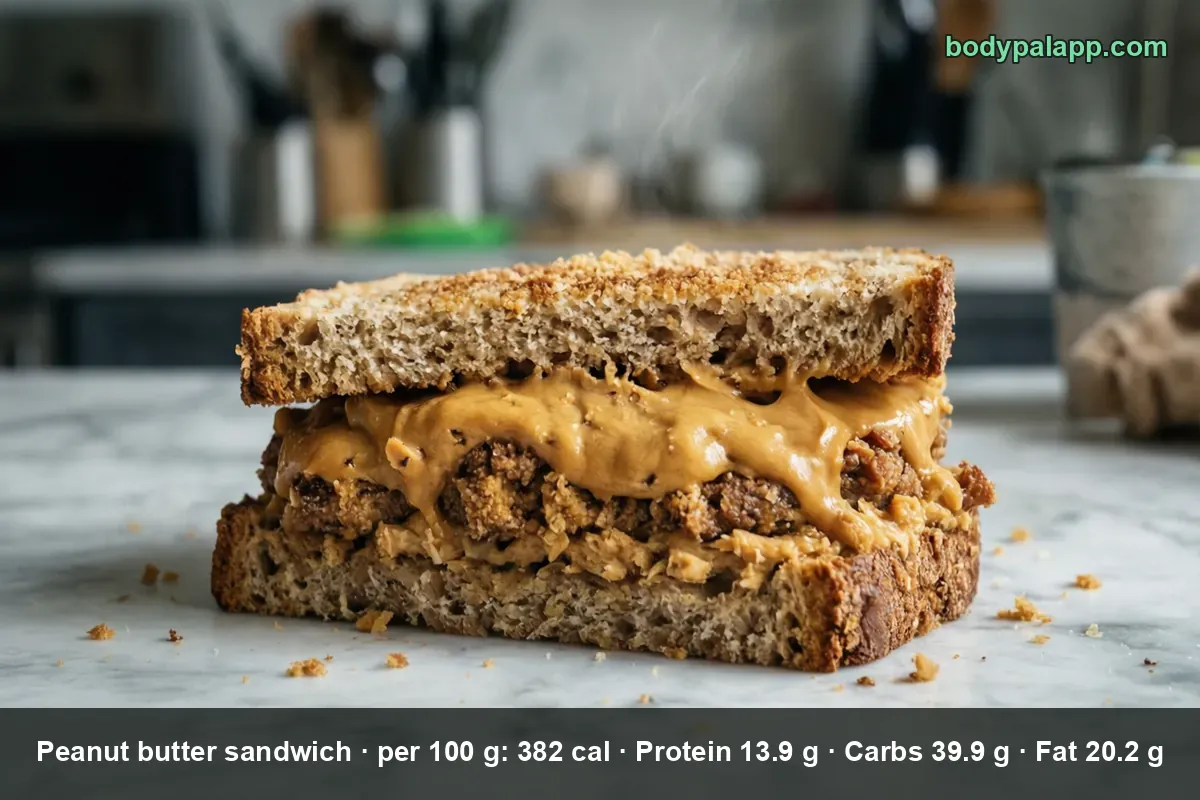
Two slices of bread with peanut butter between them, no jelly, weigh 92 g and carry 351 calories. Per 100 g the sandwich runs 382 calories, so the whole thing lands below the per-100-gram figure — it is lighter than 100 grams. Inside that: 18.6 g fat, 12.8 g protein, 36.7 g carbohydrate.
On this page
- Peanut butter sandwich quick facts
- US servings from one ounce to two sandwiches
- Bread and peanut butter swaps that move the number
- Protein and sodium are the rows to watch
- How does a peanut butter sandwich compare?
- Most popular peanut butter sandwich brands
- FAQ
Peanut butter sandwich quick facts
The row used here is FNDDS 2707549, "Peanut butter sandwich, NFS" — the plain build most people mean when they type the question: two slices of sandwich bread, about two tablespoons of peanut butter, nothing else. It comes with a ready USDA household portion of one sandwich at 92 g, which is the number in the column below.
White bread or wheat bread barely matters for calories, so the generic record is the honest starting point. The separate bread records are in the variants table further down.
| Nutrient | Per 100 g | Per 1 sandwich (92 g) | % Daily Value |
|---|---|---|---|
| Calories | 382 | 351 | 18% |
| Total fat | 20.21 g | 18.6 g | 24% |
| Saturated fat | 4.13 g | 3.8 g | 19% |
| Carbohydrate | 39.85 g | 36.7 g | 13% |
| Dietary fiber | 3.2 g | 2.9 g | 11% |
| Total sugars | 7.13 g | 6.6 g | — |
| Protein | 13.88 g | 12.8 g | 26% |
| Sodium | 442 mg | 407 mg | 18% |
% Daily Value is based on a 2,000-calorie diet.
Verified nutrition data
Numbers on this page come from USDA FoodData Central, the U.S. Department of Agriculture’s food composition database, and from manufacturer labels where a branded product is named. Last verified September 2026. How we verify our data →
Two rows you will see on a jar label are missing here: added sugars and trans fat. FNDDS does not publish either value for mixed dishes like sandwiches, so they are left out rather than guessed. Cholesterol is 0 mg, since nothing in the sandwich comes from an animal, and potassium is 248 mg per sandwich, 5% of the Daily Value.
US servings from one ounce to two sandwiches
| Serving | Weight | Calories |
|---|---|---|
| 1 oz | 28 g | 108 kcal |
| Open-face, one slice of bread | 46 g | 176 kcal |
| One sandwich | 92 g | 351 kcal |
| Two sandwiches | 184 g | 703 kcal |
| Per 100 g | 100 g | 382 kcal |
USDA lists two of these as household measures: the full sandwich at 92 g and the open-face build on a single slice at 46 g. The ounce and the two-sandwich line are our own arithmetic from the USDA 100 g figure, not USDA servings.
That 92 g is the number worth memorizing. A peanut butter sandwich looks substantial on the plate, but it is a light object — lighter than a cup of milk. Log it as "one sandwich" and you are at 351. Log it as "100 grams" and you have quietly added 31 calories that were never on the plate.
Two sandwiches is where the day gets away from people. At 703 calories, a double lunch of peanut butter sandwiches is 35% of a 2,000-calorie day, and it goes down in about six minutes because there is nothing to chew through.
Bread and peanut butter swaps that move the number
| Version | Per 100 g | Typical piece | Calories |
|---|---|---|---|
| Regular peanut butter, white bread | 382 kcal | 1 sandwich (92 g) | 351 kcal |
| Regular peanut butter, wheat bread | 380 kcal | 1 sandwich (92 g) | 350 kcal |
| Reduced-fat peanut butter, white bread | 355 kcal | 1 sandwich (92 g) | 327 kcal |
| Reduced-fat peanut butter, wheat bread | 353 kcal | 1 sandwich (92 g) | 325 kcal |
| Open-face, one slice | 382 kcal | 46 g | 176 kcal |
| Peanut butter sandwich cookie | 478 kcal | 1 cookie (14 g) | 67 kcal |
Wheat bread saves you one calorie and buys real fiber. The wheat-bread record is 380 calories per 100 g against 382 for white — 350 versus 351 on the sandwich, which is noise. Fiber is not noise: 4.9 g instead of 2.9 g, moving the sandwich from 11% of the Daily Value to 17%. Protein rises too, 13.9 g against 12.8 g. If you are choosing bread on calories alone, you are choosing on the wrong row.
Reduced-fat peanut butter saves 24 calories, and charges for it. The reduced-fat build on white bread is 327 calories. Fat falls from 18.6 g to 13.0 g, but carbohydrate climbs from 36.7 g to 40.9 g and sodium goes from 407 mg to 443 mg, because what leaves as fat comes back as solids and salt. Twenty-four calories is roughly one bite of the sandwich.
Reduced-fat peanut butter on wheat bread is the lowest of the four, at 325 calories, 15.1 g protein and 4.9 g fiber. It is also the one that tastes least like a peanut butter sandwich, which is a fair thing to weigh.
Open-face is the only genuinely big cut. One slice of bread, the same peanut butter, 176 calories. Halving the sandwich beats every ingredient swap on the list combined.
The sandwich cookie is a different food that shares the name. At 478 calories per 100 g it is denser than the sandwich, but one cookie weighs 14 g, so it is 67 calories with 5.0 g of sugar. Among packaged versions, Smucker's crustless frozen sandwich style products run near 385 calories per 100 g, and the labeled 52 g piece lands at 200 calories — smaller than a homemade sandwich because the crusts are gone and the bread is thinner.
Protein and sodium are the rows to watch
Protein is the surprise. One sandwich delivers 12.8 g, 26% of the 50 g Daily Value, which is more than a large egg and roughly a quarter of a day's target from a lunch that cost you no cooking. On wheat bread it is 13.9 g. Peanuts count as a protein food in MyPlate's grouping, and the bread quietly contributes a few grams of its own.
Sodium is the row people never expect on something sweet-tasting. A plain peanut butter sandwich carries 407 mg, 18% of the 2,300 mg Daily Value — under a fifth of a teaspoon of table salt, from salted peanut butter plus two slices of bread that are salted before you touch them. The reduced-fat version is higher again at 443 mg. If you are watching sodium, the sandwich is not free.
Saturated fat is milder than the fat total suggests: 3.8 g, 19% of the Daily Value, because most of the 18.6 g is unsaturated fat from the peanuts. Fiber at 2.9 g on white bread is thin for a 351-calorie meal, which is the strongest single argument for the wheat-bread build.
How does a peanut butter sandwich compare?
| Sandwich | Per 100 g | US serving | Calories |
|---|---|---|---|
| Peanut butter | 382 kcal | 1 sandwich, 92 g | 351 kcal |
| Peanut butter and jelly | 361 kcal | 1 sandwich, 92 g | 332 kcal |
| Almond butter, wheat bread | 395 kcal | 1 sandwich, 92 g | 363 kcal |
| Nutella, white bread | 362 kcal | 1 sandwich, 92 g | 333 kcal |
The 92 g servings for the three neighbors are our own arithmetic from their USDA 100 g figures, matched to the peanut butter sandwich so the column compares like with like.
Our take: adding jelly makes the sandwich lighter, not heavier — 332 calories against 351 — because jelly is sugar and water where peanut butter is fat, and it displaces some of the paste. That is the opposite of what almost everyone assumes. Almond butter is the heaviest of the four at 363, so swapping to it for health reasons costs 12 calories per sandwich. For weight loss, the plain sandwich on wheat bread with a thinner layer of peanut butter is the pick; for staying full until dinner, the regular build at 351 with 12.8 g of protein does the job better than the Nutella version at 333, which is mostly sugar.
Most popular peanut butter sandwich brands in the United States
Ranked by how widely each product appears among foods sold in the United States, from the BodyPal food database of over 3.3 million products. Calories are the figures printed on each Nutrition Facts label, checked against USDA FoodData Central.
| Product | Calories (per 100 g) |
|---|---|
| Smucker's Peanut Butter Sandwich | 385 cal |
Brand popularity: BodyPal food database. Nutrition: manufacturer labels / USDA FoodData Central.
Peanut butter sandwich FAQs
How many calories are in a peanut butter sandwich?
A standard peanut butter sandwich of 92 g holds 351 calories, at 382 calories per 100 g. That covers two slices of bread and about two tablespoons of peanut butter, with no jelly. Bread choice barely moves it: the wheat-bread version comes in at 350 calories.
How many calories in a peanut butter sandwich on wheat bread?
The wheat-bread version is 350 calories per 92 g sandwich, one calorie under the white-bread build at 351. What changes is fiber: 4.9 g instead of 2.9 g, or 17% of the Daily Value against 11%. Protein also edges up, from 12.8 g to 13.9 g.
How much protein is in a peanut butter sandwich?
One sandwich carries 12.8 g of protein, 26% of the 50 g Daily Value. On wheat bread it reaches 13.9 g, and the reduced-fat peanut butter version on wheat bread tops the set at 15.1 g, because taking fat out of the paste leaves a higher share of protein behind.
How many calories in half a peanut butter sandwich?
Half a sandwich is 176 calories. USDA lists it as an open-face build on one slice of bread, 46 g, and the arithmetic is simply half the full sandwich. Everything else halves with it: 9.3 g fat, 6.4 g protein, 203 mg sodium and 1.5 g fiber.
Does reduced-fat peanut butter save calories in a sandwich?
It saves 24 calories: 327 against 351 per sandwich. Fat drops from 18.6 g to 13.0 g, but carbohydrate climbs from 36.7 g to 40.9 g and sodium rises from 407 mg to 443 mg. The trade is fat for starch and salt, for about one bite's worth of calories.
How many carbs are in a peanut butter sandwich?
One sandwich has 36.7 g of carbohydrate, 13% of the Daily Value, including 6.6 g of total sugars. Reduced-fat peanut butter pushes carbohydrate up to 40.9 g, since the removed fat is replaced with solids. Wheat bread trims it slightly, to 34.4 g per sandwich.
Is a peanut butter sandwich good for weight loss?
At 351 calories it is a lunch-sized load in something you can eat in four minutes, so portion control matters more than ingredients. It brings 12.8 g of protein and 2.9 g of fiber, which help with fullness. On wheat bread, 350 calories with 4.9 g fiber is the better version.
Peanut butter sandwich vs PB&J: which has fewer calories?
PB&J is lower, at 332 calories per 92 g sandwich against 351 for plain peanut butter. Jelly is mostly sugar and water, so it is lighter per gram than peanut butter: 361 calories per 100 g versus 382. The jelly version carries 16.6 g of fat instead of 20.2 g.
Similar foods
- Fudge — 70 cal per piece
- Funnel cake — 318 cal per cake, 6-inch
- Onion Rings — 282 cal for 8 rings
- Churro — 189 cal each
- Fries — 452 cal per medium fast food order
- Cannoli — 227 cal per cannoli
Count it without the math
Point the camera at the plate and BodyPal counts the sandwich for you, bread and all.


How long does it take to burn off 351 kcal of peanut butter sandwich?
One sandwich (92 g) is 351 kcal. Enter your weight and the amount you ate to see how long it takes you to burn that off:
lb
| Activity | Time to burn 351 kcal |
|---|---|
| Walking, brisk | 1 hr 10 min |
| Cycling, moderate | 44 min |
| Swimming, moderate | 50 min |
| Jogging | 41 min |
| Weight training, moderate | 1 hr 18 min |
Times are for a 155 lb adult at a steady pace; change the weight to see yours. The amount is set to the portion in the text (92 g); change it to what you actually ate. BodyPal works this out from your steps automatically.
Burning it off is one side of it. The other is knowing your number: work out how many calories you need a day, with macros and a goal date.