
How many calories are in pesto?
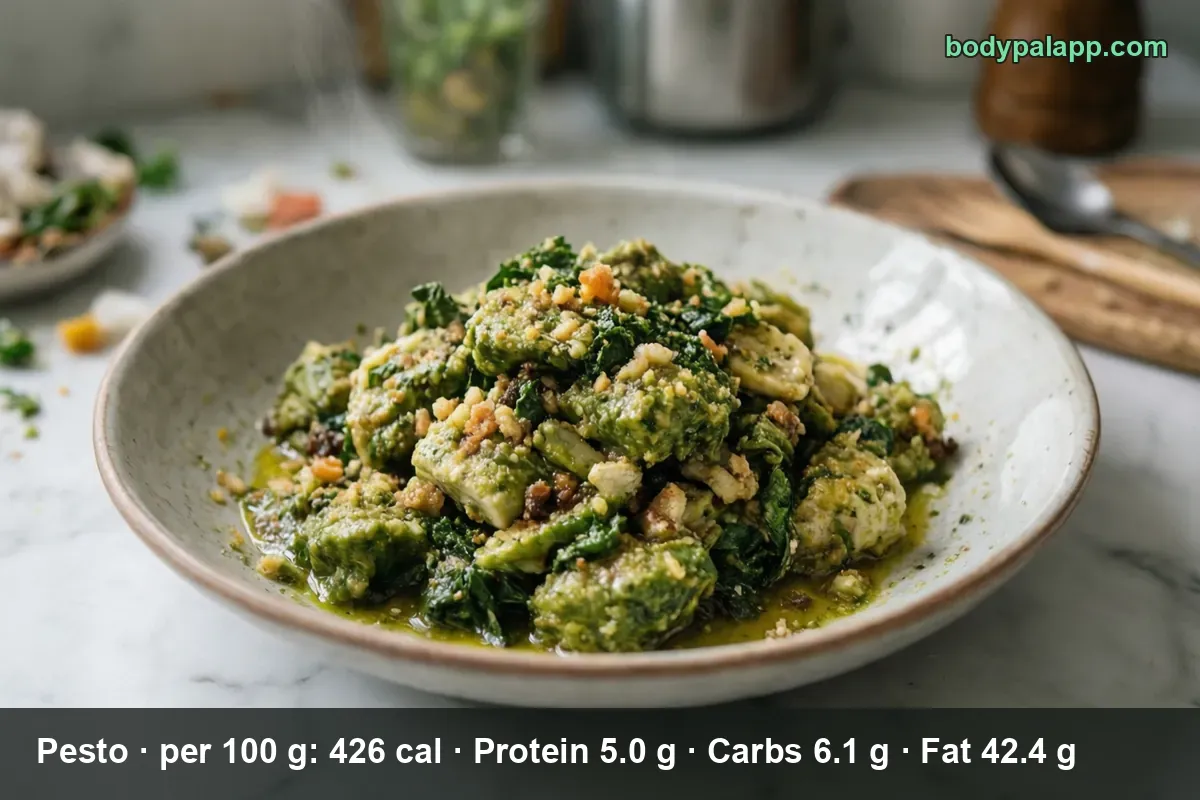
A 1/4-cup serving of jarred pesto weighs 61 g and carries 260 calories. Per 100 g the sauce runs 426 calories, almost all of it oil. That makes pesto one of the densest things most people spoon onto pasta without measuring, and the jar on the shelf is not even the heaviest version of it.
On this page
- Pesto quick facts
- US servings from a spoon to a half cup
- Jarred vs refrigerated vs restaurant pesto
- Sodium is the row to watch
- How does pesto compare?
- Most popular pesto brands
- Pesto FAQs
Pesto quick facts
The row below is USDA SR Legacy 171580, "Sauce, pesto, ready-to-serve, shelf stable". It is the unbranded record for the thing most Americans actually own: a glass jar bought off a dry grocery shelf, not a tub from the refrigerated case and not a restaurant kitchen's own batch. It also comes with a household measure of 1/4 cup, so the serving column is a USDA serving rather than something we invented.
Branded jars in the database circle this record from both sides, from 321 to 661 calories per 100 g, and the FNDDS record for restaurant-style pesto sits at 580, well above the jar. Those get their own section further down.
| Nutrient | Per 100 g | Per 1/4 cup (61 g) | % Daily Value |
|---|---|---|---|
| Calories | 426 | 260 | — |
| Total fat | 42.42 g | 25.9 g | 33% |
| Saturated fat | 7.36 g | 4.5 g | 22% |
| Carbohydrate | 6.14 g | 3.7 g | 1% |
| Dietary fiber | 1.7 g | 1.0 g | 4% |
| Total sugars | 1.92 g | 1.2 g | — |
| Protein | 5 g | 3.1 g | 6% |
| Sodium | 998 mg | 609 mg | 26% |
% Daily Value is based on a 2,000-calorie diet.
Verified nutrition data
Numbers on this page come from USDA FoodData Central, the U.S. Department of Agriculture’s food composition database, and from manufacturer labels where a branded product is named. Last verified September 2026. How we verify our data →
Two rows you would expect on a US label are missing here: added sugars and cholesterol. USDA does not publish either value for this record, so we have left them out rather than guess — a basil-and-oil sauce has no added sugar to declare, and its only cholesterol would come from whatever cheese the recipe uses. Potassium is published: 205 mg per 100 g, or 125 mg in a 1/4 cup, which is 3% of the Daily Value.
US servings from a spoon to a half cup
| Serving | Weight | Calories |
|---|---|---|
| 1 tablespoon | 15.3 g | 65 kcal |
| 2 tablespoons | 31 g | 132 kcal |
| 1/4 cup | 61 g | 260 kcal |
| 1/2 cup | 122 g | 520 kcal |
| 1 oz | 28.3 g | 121 kcal |
| Per 100 g | 100 g | 426 kcal |
Only the 1/4 cup and the 100 g rows come straight from USDA. The tablespoon, half-cup and ounce figures are our own arithmetic from the USDA 100 g value, not USDA servings, scaled by weight.
Here is the trap that costs people the most calories. Most US pesto jars print a label serving of 2 tablespoons, about 30 g, which is exactly half of the 1/4 cup USDA uses as its household measure. Read the label, then scoop with a measuring cup, and you have quietly doubled the entry: 132 calories becomes 260, and 305 mg of sodium becomes 609 mg. A tablespoon is not a rounding error with a sauce this dense — each one is 65 calories, roughly what you would get from a tablespoon of ranch dip.
Pesto also behaves differently from tomato sauce in the pan. Tomato sauce gets ladled; pesto gets stirred through hot pasta until it coats, and a 1/2-cup scoop for two people is a realistic amount for a box of pasta. That scoop is 520 calories and 1,218 mg of sodium, 53% of the sodium Daily Value, before anyone grates cheese on top.
Jarred vs refrigerated vs restaurant pesto
| Version | Per 100 g | Typical serving | Calories |
|---|---|---|---|
| Shelf-stable jar (main record) | 426 kcal | 1/4 cup (61 g) | 260 kcal |
| Refrigerated fresh pesto | 418 kcal | 1/4 cup (63 g) | 263 kcal |
| Classico basil pesto, jar | 372 kcal | 1/4 cup (62 g) | 231 kcal |
| Mezzetta Napa Valley Bistro basil pesto | 496 kcal | 1/4 cup (60 g) | 298 kcal |
| Arugula pesto (Sacla Italia) | 466 kcal | 1/4 cup (58 g) | 270 kcal |
| Red pesto / pesto rosso | 433 kcal | 1/4 cup (60 g) | 260 kcal |
| Restaurant or homemade pesto sauce | 580 kcal | 1 tablespoon (16 g) | 93 kcal |
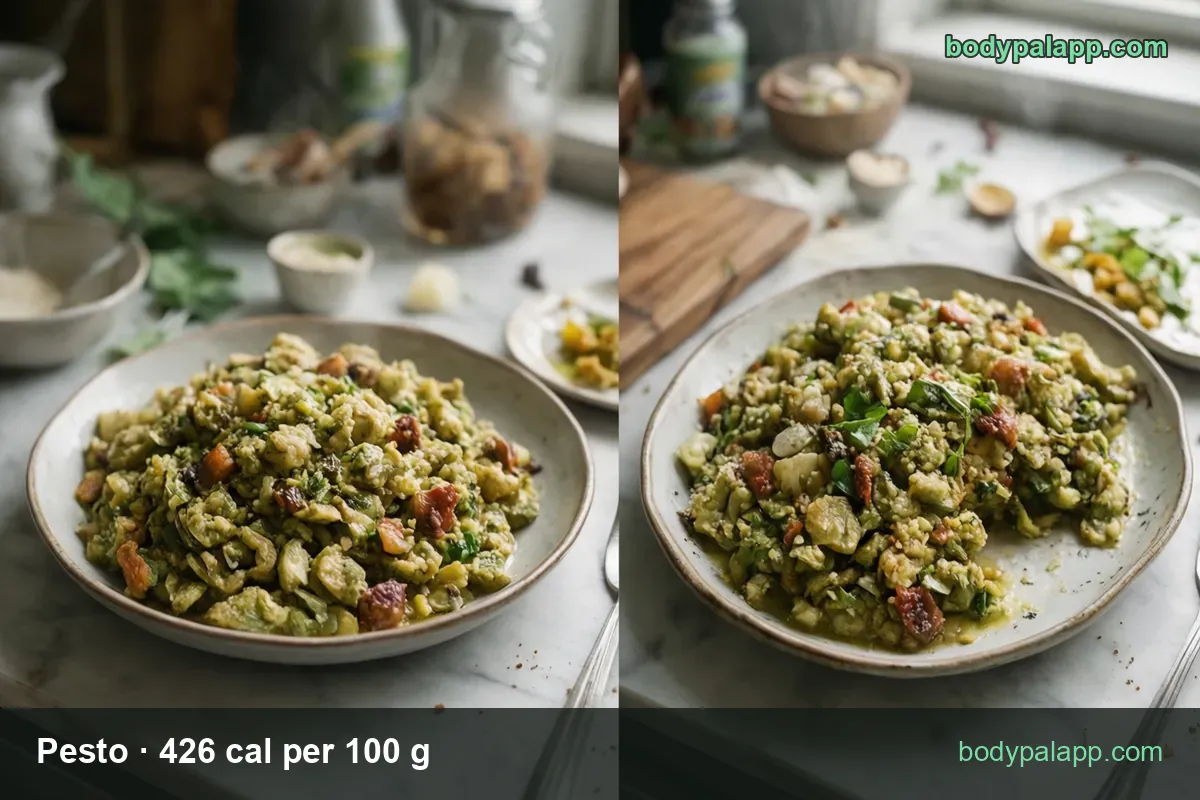
The shopping question people ask — is fresh pesto lighter than jarred? — has a boring answer and an interesting one. The boring answer: 418 calories per 100 g versus 426, a gap of 8 calories that no scale in your kitchen will resolve. The interesting answer is in the other rows. Refrigerated fresh pesto carries 9.83 g of protein per 100 g against 5 g in the shelf-stable jar, and 603 mg of sodium against 998 mg. It is a cheesier, less oily recipe, so it is the better pick if you are watching salt, even though the calories are a wash.
The real spread is between store and stove. Restaurant-style pesto sauce runs 580 calories per 100 g, 154 more than the jar, and 59.17 g of fat against 42.42 g. That is not a data quirk from a different source; it is a different recipe, with a higher share of olive oil and pine nuts and less filler. If you are logging pesto from an Italian place rather than your own jar, the tablespoon is the honest unit, and each one is 93 calories.
Brand labels swing wider than any of that. Academia Barilla's Pesto alla Genovese is 661 calories per 100 g, more than double Cucina & Amore's 321, and the Kroger Private Selection basil pesto lists 110 calories for a 2-tablespoon (30 g) serving. If your jar prints a number, use the jar's number; if it does not, the 426 figure is the right default for shelf-stable green pesto.
Sodium is the row to watch
Fat is what pesto is famous for, and 25.9 g in a 1/4 cup is 33% of the FDA Daily Value. But only 4.5 g of that is saturated, which is 22% of the DV — respectable for something this rich, because olive oil and pine nuts do most of the work rather than butter or cream.
Sodium is the number that sneaks up. That same 1/4 cup delivers 609 mg, 26% of the Daily Value, or about a quarter teaspoon of table salt in a portion that fits in a small ramekin. The Dietary Guidelines for Americans put the ceiling at 2,300 mg a day, so the 1/2-cup scoop above is more than half the day's allowance from the sauce alone. Classico's basil pesto is saltier still at 1,028 mg per 100 g, the highest of the jarred records here despite being the lowest in calories.
The practical move is not to give up pesto. It is to stop treating it as a sauce and start treating it as a condiment, the way MyPlate treats oils generally: two tablespoons on a bowl of vegetables or a sandwich, not a quarter cup stirred into every serving of pasta. Two tablespoons is 132 calories and roughly 305 mg of sodium, and on food that already tastes of something, it is plenty.
How does pesto compare?
| Sauce or dip | Per 100 g | US serving | Calories |
|---|---|---|---|
| Pesto, jarred | 426 kcal | 1 tablespoon (15.3 g) | 65 kcal |
| Ranch dip, regular | 432 kcal | 1 tablespoon (15 g) | 65 kcal |
| Hollandaise sauce | 546 kcal | 1 tablespoon (15 g) | 82 kcal |
| Garlic sauce | 683 kcal | 1 tablespoon (15 g) | 102 kcal |
Our take: pesto is the lightest of these four per 100 g, and by a tablespoon it is level with ranch dip at 65 calories — which is not the reputation it has. What sets it apart is that nobody eats a quarter cup of hollandaise, while a quarter cup of pesto on pasta is normal, and that is where the 260 calories come from. Measure it in spoons like the dip it resembles and it is a cheap way to make vegetables worth eating. Pour it like a pasta sauce and it is the biggest line in the meal.
Most popular pesto brands in the United States
Ranked by how widely each product appears among foods sold in the United States, from the BodyPal food database of over 3.3 million products. Calories are the figures printed on each Nutrition Facts label, checked against USDA FoodData Central.
| Product | Calories (per 100 g) |
|---|---|
| Academia Barilla Pesto alla Genovese Sauce | 661 cal |
| Preferred Selection Pesto Rosso | 433 cal |
| Sacla Pesto alla Genovese Pasta Sauce | 397 cal |
| Cucina & Amore Pesto alla Genovese Basil | 321 cal |
| Sacla Italia Pesto | 345 cal |
| Private Selection Basil Pesto | 367 cal |
Brand popularity: BodyPal food database. Nutrition: manufacturer labels / USDA FoodData Central.
Pesto FAQs
How many calories are in pesto?
A 1/4-cup serving of shelf-stable jarred pesto is 260 calories, and 100 g is 426. Most people use far less than a quarter cup at a time: two tablespoons come to 132 calories, one tablespoon to 65. The number moves with the recipe, not with the brand's marketing.
How many calories in 2 tablespoons of pesto?
Two tablespoons of jarred pesto weigh about 31 g and come to 132 calories, with 13.2 g of fat and roughly 305 mg of sodium. That is the serving printed on most US jar labels, and it is exactly half the 1/4 cup that USDA lists as its household measure.
How much sodium is in pesto?
A 1/4-cup serving carries 609 mg of sodium, 26% of the FDA Daily Value, and that is before the pasta water or the cheese on top. Per 100 g the shelf-stable jar holds 998 mg. Classico's basil pesto is saltier still at 1,028 mg per 100 g.
Is jarred pesto higher in calories than fresh pesto?
Slightly, yes: the shelf-stable jar is 426 calories per 100 g against 418 for refrigerated fresh pesto, an 8-calorie gap that no kitchen scale will make you care about. The real difference is protein and salt. Fresh refrigerated pesto carries 9.83 g of protein per 100 g and 603 mg of sodium.
Is pesto healthy?
Most of the 260 calories in a 1/4 cup are fat: 25.9 g, 33% of the Daily Value, though only 4.5 g of that is saturated. The catch is the 26% of the sodium Daily Value in the same spoonful. Treat pesto as a condiment, not a sauce you ladle.
Does pesto have protein?
A little: 5 g per 100 g in the shelf-stable jar, which works out to 3.1 g in a 1/4-cup serving, or 6% of the Daily Value. Refrigerated fresh pesto nearly doubles that at 9.83 g per 100 g because it carries more cheese and less oil.
Is pesto keto friendly?
On the numbers, yes: a 1/4-cup serving has 3.7 g of carbohydrate, of which 1.0 g is fiber and 1.2 g sugars, against 25.9 g of fat. Restaurant-style pesto sauce is even more lopsided at 5.67 g of carbohydrate per 100 g and 59.17 g of fat.
How many calories in red pesto?
Red pesto, or pesto rosso, runs 433 calories per 100 g, so a 1/4-cup portion of about 60 g is 260 calories, the same as the green shelf-stable jar. The sun-dried tomatoes swap some basil for fruit, but they do not swap out the oil that carries the calories.
Similar foods
- Ranch Dressing — 129 cal for 2 tablespoons
- Ranch Packet — 189 cal per packet
- Ranch Dip — 65 cal per tablespoon
- Brownie Mix — 434 cal per 100 g
- Ramen Packet — 356 cal per packet
- Oat flour — 105 cal for 1/4 cup
Count it without the math
Point the camera at the plate and BodyPal counts the pesto for you, spoon by spoon.


How long does it take to burn off pesto?
A 1/4-cup (61 g) serving is 260 kcal. Enter your weight and the amount you ate to see how long it takes you to burn that off:
lb
| Activity | Time to burn 260 kcal |
|---|---|
| Walking, brisk | 52 min |
| Cycling, moderate | 32 min |
| Swimming, moderate | 37 min |
| Jogging | 31 min |
| Weight training, moderate | 58 min |
Times are for a 155 lb adult at a steady pace; change the weight to see yours. The amount is set to the portion in the text (61 g); change it to what you actually ate. BodyPal works this out from your steps automatically.
This table assumes you know your daily total. If you do not, the daily calorie calculator works it out from five numbers.