
How many calories are in psyllium husk?
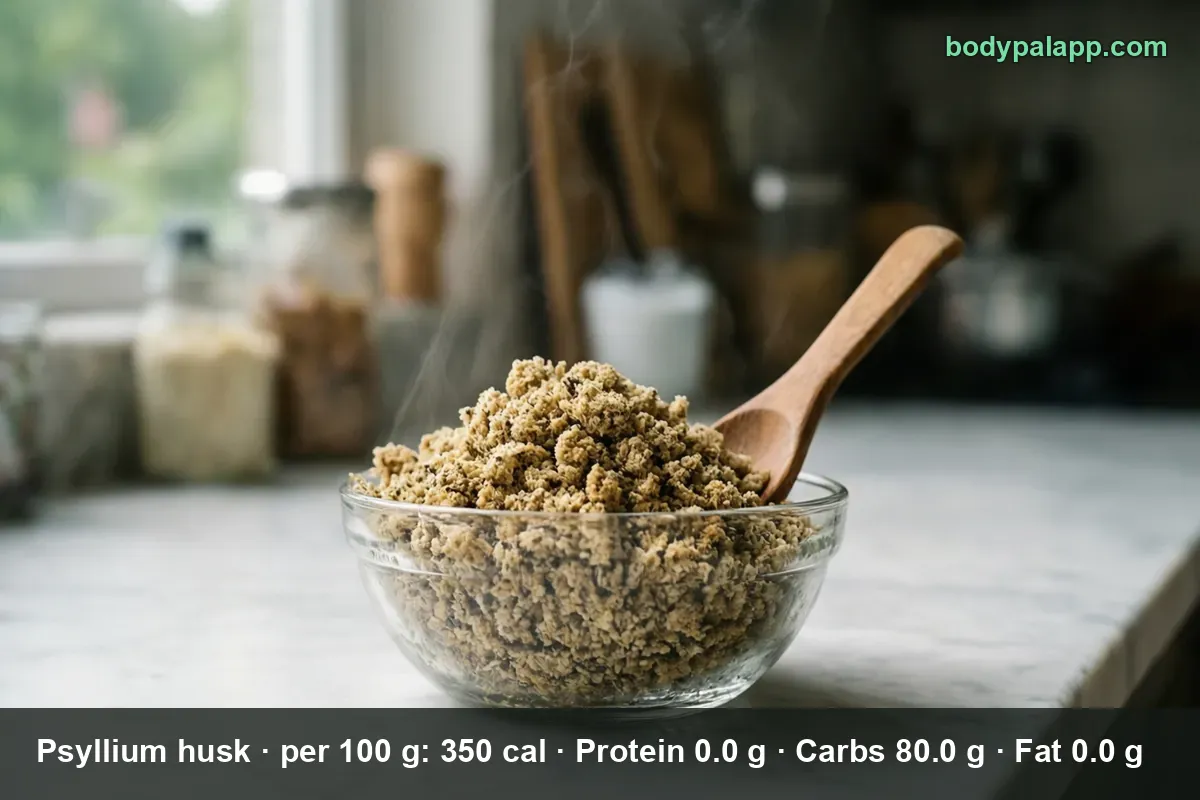
Two level tablespoons of whole psyllium husk weigh 10 g and carry 35 calories. Per 100 g the husks run 350 calories, which sounds enormous until you look at the serving: nobody eats psyllium by the cup. Almost all of that weight is fiber, and fiber is why the label looks so strange.
On this page
- Psyllium husk quick facts
- US servings, from one teaspoon to a full ounce
- Husks, powder and flavored fiber supplements
- Fiber is the row that matters
- How does psyllium husk compare?
- Most popular psyllium husk brands
- Psyllium husk FAQs
Psyllium husk quick facts
There is no generic entry for this one. USDA has no Foundation, SR Legacy or FNDDS record for psyllium husk, so every number here comes from a product label filed in the Branded database. The row used here is NOW, WHOLE PSYLLIUM HUSKS, fdc_id 1666127, the most complete panel of the pure whole-husk records: it is the only one carrying fat, saturated fat, sugars, protein, sodium and cholesterol all at once.
Its label serving is two level tablespoons, 10 g, which is what most people actually stir into a glass.
| Nutrient | Per 100 g | Per 2 level tbsp (10 g) | % Daily Value |
|---|---|---|---|
| Calories | 350 | 35 | — |
| Total fat | 0 g | 0 g | 0% |
| Saturated fat | 0 g | 0 g | 0% |
| Carbohydrate | 80 g | 8.0 g | 3% |
| Dietary fiber | 70 g | 7.0 g | 25% |
| Total sugars | 0 g | 0 g | — |
| Protein | 0 g | 0 g | 0% |
| Sodium | 100 mg | 10 mg | 0% |
% Daily Value is based on a 2,000-calorie diet.
Verified nutrition data
Numbers on this page come from USDA FoodData Central, the U.S. Department of Agriculture’s food composition database, and from manufacturer labels where a branded product is named. Last verified September 2026. How we verify our data →
Cholesterol is 0 mg, as you would expect from a seed coat. Two rows you will not find above: added sugars and potassium are simply absent from this label, and pulling them from a different brand's panel would mix two products, so they are left out rather than guessed. Sodium is the one mineral worth a glance, and 10 mg a serving is under 1% of the 2,300 mg Daily Value — nothing.
US servings, from one teaspoon to a full ounce
| Serving | Weight | Calories |
|---|---|---|
| 1 level tsp | 1.7 g | 6 kcal |
| 1 level tbsp | 5 g | 18 kcal |
| 2 level tbsp, label serving | 10 g | 35 kcal |
| 1 oz | 28.35 g | 99 kcal |
| Per 100 g | 100 g | 350 kcal |
Only the 10 g line is a USDA serving. The teaspoon, the tablespoon and the ounce are our own arithmetic from the USDA 100 g figure, scaled straight down, not household measures printed on the panel.
That ounce line is the useful trap. An ounce of psyllium husk is close to six level tablespoons of very light, very bulky flakes — it looks like a small mountain in a glass and it drinks about as much water. Almost nobody swallows an ounce. When a recipe calls for psyllium by weight, it is usually 5 to 15 g, which is 18 to 53 calories.
Husks, powder and flavored fiber supplements
| Version | Per 100 g | Typical serving | Calories |
|---|---|---|---|
| Whole husks (NOW) | 350 kcal | 2 level tbsp (10 g) | 35 kcal |
| Psyllium husk powder (NOW) | 333 kcal | 1 level tbsp (9 g) | 30 kcal |
| Psyllium fiber powder (Bob's Red Mill) | 375 kcal | 1 tsp (4 g) | 15 kcal |
| Whole psyllium husk powder (Nutricost) | 100 kcal | 1/2 tbsp (5 g) | 5 kcal |
| Psyllium fiber supplement, berry (Metamucil) | 259 kcal | 2 rounded tsp (11.6 g) | 30 kcal |
| Psyllium fiber thins, chocolate (Metamucil) | 455 kcal | 1 packet (22 g) | 100 kcal |
| Psyllium husk health bar (Meta) | 375 kcal | 1 bar (40 g) | 150 kcal |
Whole husks and ground husk powder are nearly the same food, and per 100 g they nearly agree: 350 against 333. The spoon is what changes. Powder settles tight, so a tablespoon of it weighs 9 g and delivers 30 calories, while a tablespoon of loose flakes weighs about 5 g and delivers 18. Measuring the same food by volume gives you 80% more of it in powder form.
The two Nutricost and Bob's Red Mill lines show how far label math can drift on an identical ingredient. Bob's Red Mill files 375 calories per 100 g; Nutricost files 100. Neither is a typo. One counts the carbohydrate in fiber as energy, the other does not, and USDA prints what the manufacturer submitted. That spread — 100 to 375 for the same seed coat — is the single most confusing thing about logging psyllium.
Then there are the products that are only partly psyllium. Metamucil's berry powder is 259 calories per 100 g with 51.7 g of fiber, diluted by flavoring and other ingredients. The chocolate fiber thins are 455 per 100 g and 100 calories a packet, and the Meta health bar is 150 calories a bar with 10 g of fiber per 100 g. Those are snacks with fiber in them, not fiber.
Fiber is the row that matters
The FDA sets the Daily Value for dietary fiber at 28 g. Two level tablespoons of whole husks supply 7 g of it, a quarter of the day, for 35 calories. Nothing else on the panel moves at all: no fat, no sugar, no protein, 10 mg of sodium.
That density is the whole point. The Dietary Guidelines for Americans treat fiber as an under-consumed nutrient, and most US adults land well short of 28 g. Psyllium closes the gap at a calorie cost that rounds to nothing in a day's budget.
Two more things fall out of the numbers. Of the 80 g of carbohydrate in 100 g of husks, 70 g is fiber, which leaves 10 g of anything else — per 10 g serving that is 1 g of net carbohydrate, and it is why psyllium ends up in low-carb bread recipes as a binder. And there is no protein here at all: 0 g on the label. Psyllium is a texture and a fiber, not a macro.
How does psyllium husk compare?
| Food | Per 100 g | US serving | Calories |
|---|---|---|---|
| Psyllium husk, whole | 350 kcal | 2 level tbsp (10 g) | 35 kcal |
| Chia seeds, dried | 486 kcal | 1 oz (28.35 g) | 138 kcal |
| Flaxseed | 534 kcal | 1 tbsp whole (10.3 g) | 55 kcal |
| Psyllium fiber powder (Bob's Red Mill) | 375 kcal | 1 tsp (4 g) | 15 kcal |
Our take: if the goal is fiber per calorie, nothing on this table beats whole psyllium husk. An ounce of chia brings about 9.8 g of fiber but costs 138 calories; 10 g of psyllium brings 7 g for 35. That is nearly three times the fiber per calorie. Chia and flaxseed earn their place for different reasons — fat, protein, omega-3s — and psyllium offers none of that. Use the seeds as food and the husks as a fiber top-up, and log them differently: a tablespoon of flaxseed costs 55 calories against 35 for a full psyllium serving.
Most popular psyllium husk brands in the United States
Ranked by how widely each product appears among foods sold in the United States, from the BodyPal food database of over 3.3 million products. Calories are the figures printed on each Nutrition Facts label, checked against USDA FoodData Central.
| Product | Calories (per 100 g) |
|---|---|
| NOW Whole Psyllium Husks | 350 cal |
| NOW Psyllium Husk Powder | 333 cal |
| Bob's Red Mill Unsweetened Psyllium Fiber Powder | 375 cal |
| Metamucil Berry 4-in-1 Fiber | 259 cal |
Brand popularity: BodyPal food database. Nutrition: manufacturer labels / USDA FoodData Central.
Psyllium husk FAQs
How many calories are in a tablespoon of psyllium husk?
One level tablespoon of whole husks weighs about 5 g and gives 18 calories, our own arithmetic from the USDA 100 g figure of 350 rather than a label serving. It also carries 3.5 g of fiber. Most people take two tablespoons at once, which is 35 calories.
How many calories in a teaspoon of psyllium husk?
A level teaspoon holds roughly 1.7 g of husks, so it lands at 6 calories with about 1.2 g of fiber. That is our scaling from the USDA 100 g row, not a listed serving. Teaspoons show up most often in baking, where psyllium works as a binder.
Is psyllium husk zero calories?
No: the USDA record for whole husks lists 350 calories per 100 g and 35 per 10 g serving. Some labels look like zero because they subtract fiber energy: Nutricost's whole husk powder is filed at 100 calories per 100 g for the same food. The husks are not calorie free.
How much fiber is in 2 teaspoons of psyllium husk?
Two level teaspoons come to about 3.4 g of husks and 2.4 g of fiber for 12 calories, our arithmetic from the USDA 100 g row. That is 9% of the 28 g Daily Value. The label serving of two tablespoons carries 7 g of fiber, close to three times as much.
Psyllium husk vs psyllium husk powder - what changes?
Very little per 100 g: whole husks are 350 calories, NOW's ground husk powder 333. The spoon changes more than the food. A tablespoon of powder weighs 9 g and gives 30 calories, while a tablespoon of loose husks weighs about 5 g and gives 18. Powder packs tighter.
Does psyllium husk have carbs on a keto diet?
The USDA row lists 80 g of carbohydrate per 100 g, but 70 g of that is fiber. A 10 g serving is 8 g of carbohydrate and 7 g of fiber, leaving 1 g of net carbs by the usual subtraction. That is why psyllium shows up in low-carb baking.
Is Metamucil the same as psyllium husk?
Not quite: Metamucil's berry 4-in-1 fiber is filed at 259 calories per 100 g with 51.7 g of fiber, against 350 and 70 g for plain husks. Two rounded teaspoons, 11.6 g, come to 30 calories. The flavoring and other ingredients dilute the psyllium.
How much psyllium husk is one serving?
One serving on the NOW whole husks label is two level tablespoons, 10 g, which is 35 calories and 7 g of fiber, 25% of the Daily Value. Other brands set it smaller: Bob's Red Mill uses 1 teaspoon, 4 g, at 15 calories. Check the panel before you scoop.
Similar foods
- Chocolate Sauce — 133 cal per 2 tbsp
- Boursin Cheese — 80 cal per 2 Tbsp
- Onion Dip — 52 cal per tablespoon
- Salad Dressing — 107 cal per 2 tbsp
- Onion Powder — 8 cal per teaspoon
- Corn Flour — 422 cal per cup
Count it without the math
Point the camera at the glass and BodyPal counts the spoonful for you, husks or powder.


How long does it take to burn off psyllium husk?
Two level tablespoons (10 g) is 35 kcal. Enter your weight and the amount you ate to see how long it takes you to burn that off:
lb
| Activity | Time to burn 35 kcal |
|---|---|
| Walking, brisk | 7 min |
| Cycling, moderate | 4 min |
| Swimming, moderate | 5 min |
| Jogging | 4 min |
| Weight training, moderate | 8 min |
Times are for a 155 lb adult at a steady pace; change the weight to see yours. The amount is set to the portion in the text (10 g); change it to what you actually ate. BodyPal works this out from your steps automatically.
Want the bigger picture? Calculate your daily calorie needs — your maintenance figure, a target for losing or gaining, and the date you get there.