
How many calories are in a bowl of restaurant ramen?
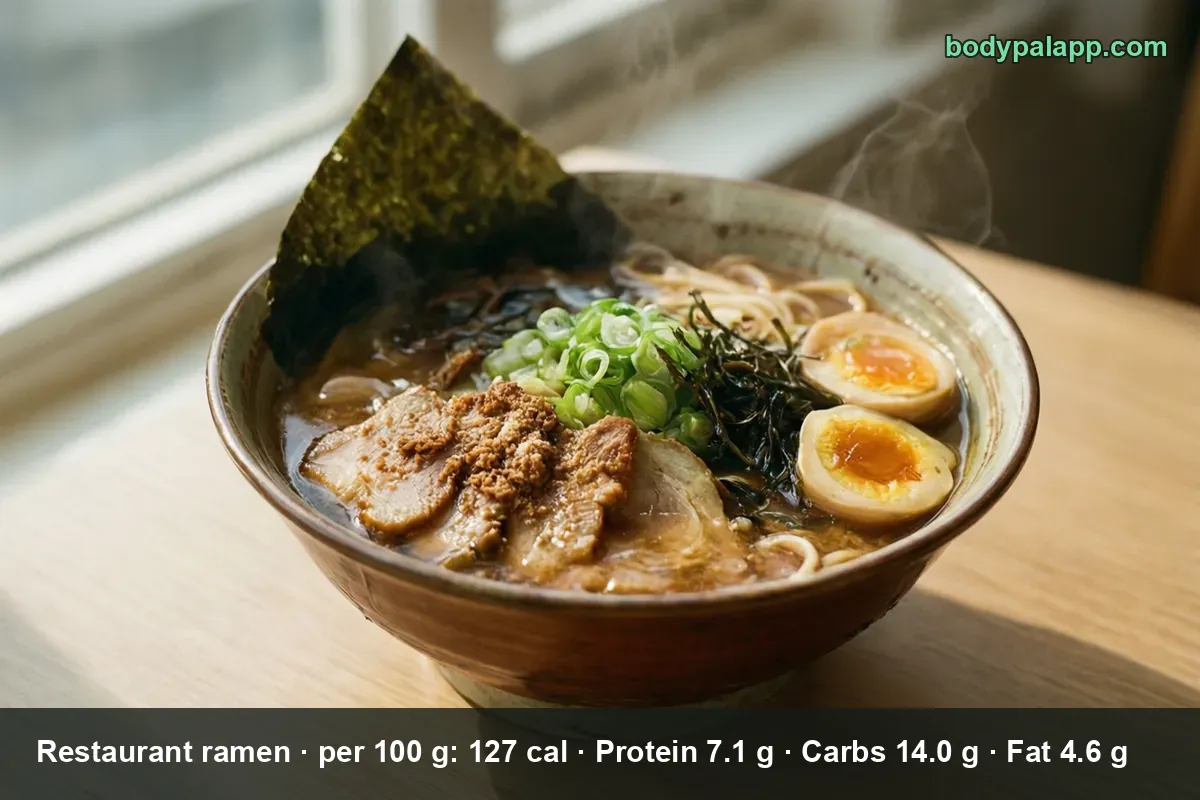
A 1-cup (245 g) serving of restaurant ramen with meat and egg carries 311 calories, and the noodles, broth and toppings together run 127 calories per 100 g. Order the bowl a ramen shop actually puts in front of you, closer to three cups, and the same math lands at 933 calories.
On this page
- Ramen quick facts
- US servings, from one cup to the whole bowl
- Chicken, beef, vegetarian and the dry packet
- Sodium is the row to watch
- How does ramen compare to other Asian soups?
- Most popular ramen brands
- Ramen FAQs
Ramen quick facts
The record that matches what a ramen shop serves is FNDDS 2709158, "Ramen bowl with meat and egg", a survey entry built from broth, wheat noodles, sliced pork and egg in the proportions Americans actually eat them. USDA also lists a generic ramen bowl, NFS with identical values, so nothing is gained by averaging the two.
The dry supermarket packets sit in a different part of the database entirely. They describe a product on a shelf, not a bowl on a table, and their calories per 100 g are more than triple the bowl's because the water has not gone in yet.
| Nutrient | Per 100 g | Per 1 cup (245 g) | % Daily Value |
|---|---|---|---|
| Calories | 127 | 311 | — |
| Total fat | 4.57 g | 11.2 g | 14% |
| Saturated fat | 1.05 g | 2.6 g | 13% |
| Carbohydrate | 13.95 g | 34.2 g | 12% |
| Dietary fiber | 0.9 g | 2.2 g | 8% |
| Total sugars | 0.42 g | 1.0 g | — |
| Protein | 7.13 g | 17.5 g | 35% |
| Sodium | 333 mg | 816 mg | 35% |
% Daily Value is based on a 2,000-calorie diet.
Verified nutrition data
Numbers on this page come from USDA FoodData Central, the U.S. Department of Agriculture’s food composition database, and from manufacturer labels where a branded product is named. Last verified September 2026. How we verify our data →
Two rows are missing on purpose. USDA does not publish added sugars or trans fat for this FNDDS release, so listing either one would mean inventing it. Cholesterol and potassium are published: 53 mg and 96 mg per 100 g, which work out to 130 mg (43% DV) and 235 mg (5% DV) in a cup. The cholesterol comes almost entirely from the egg and the pork.
Look at the protein and sodium rows side by side. Both land on 35% of the Daily Value for a single cup, and almost nobody stops at one cup.
US servings, from one cup to the whole bowl
| Serving | Weight | Calories |
|---|---|---|
| 1 oz | 28 g | 36 kcal |
| 1 cup | 245 g | 311 kcal |
| 2 cups | 490 g | 622 kcal |
| One restaurant bowl, about 3 cups | 735 g | 933 kcal |
| Per 100 g | 100 g | 127 kcal |
Only the 1-cup line is a USDA household measure. The two-cup line, the ounce and the three-cup restaurant bowl are our own arithmetic from the USDA 100 g figure, not USDA servings. Ramen shops do not standardize their bowls the way a chain standardizes a burrito, so the 735 g bowl is a realistic middle, not a rule.
That is the trap with soup. A cup of ramen is a modest 311 calories, roughly a light lunch, but a cup of ramen is a small side dish next to what arrives at the table. The bowl you finish is closer to three of them, and the calories, sodium and cholesterol all triple with it: 933 calories, 2,448 mg of sodium and about 390 mg of cholesterol, again our own scaling from the per-100-g record.
Chicken, beef, vegetarian and the dry packet
| Version | Per 100 g | Typical serving | Calories |
|---|---|---|---|
| Ramen with chicken | 126 kcal | 1 cup (245 g) | 309 kcal |
| Ramen with beef | 137 kcal | 1 cup (245 g) | 336 kcal |
| Ramen with fish or seafood | 112 kcal | 1 cup (245 g) | 274 kcal |
| Vegetarian ramen | 108 kcal | 1 cup (245 g) | 265 kcal |
| Vegetarian ramen with egg | 112 kcal | 1 cup (245 g) | 274 kcal |
| Instant ramen, dry packet | 440 kcal | 1 oz (28 g) | 125 kcal |
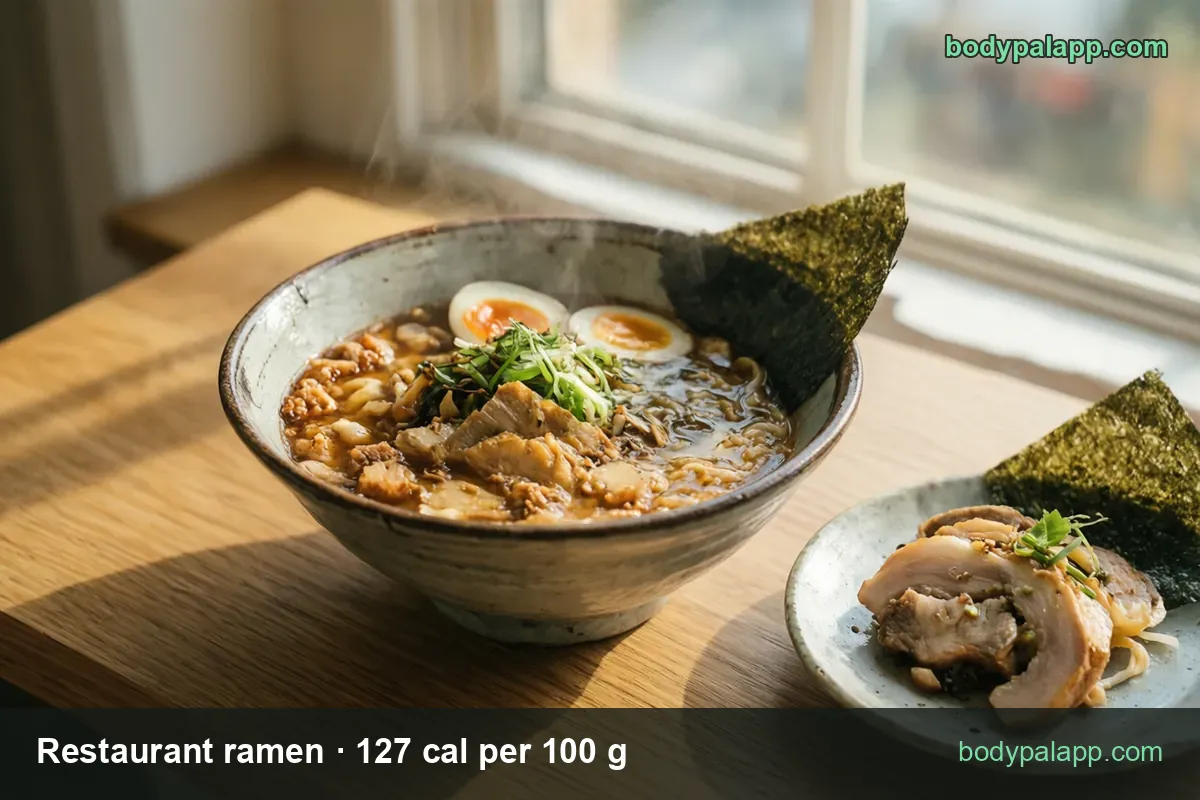
Among the bowls, beef is the heaviest at 336 calories a cup and plain vegetarian the lightest at 265, a spread of just 71 calories. That is a smaller gap than most people expect, because the noodles and the broth are the same in every version and they do most of the work. Swapping chashu for chicken saves two calories a cup. Dropping the meat and the egg altogether saves 46, but it also takes the cholesterol from 53 mg per 100 g down to zero and the protein from 7.13 g to 4.01 g.
Adding an egg back to a vegetarian bowl costs 4 calories per 100 g and returns some of that protein, which is the cheapest topping on the list.
The packets are a separate food. Maruchan's chicken, beef, shrimp and oriental ramen all sit at 442 calories per 100 g, with a label serving of half a block plus seasoning, 43 g, at 190 calories. Samyang Hot Chicken is 389 per 100 g and 545 for a 140 g package; Ottogi Spicy Jin is 417 per 100 g and 500 for a 120 g package. None of them is a restaurant bowl, and comparing their per-100-g numbers with the bowl's 127 tells you about water content, not about which one is lighter on your day.
Sodium is the row to watch
A cup of ramen carries 816 mg of sodium, or 35% of the FDA Daily Value of 2,300 mg. Scale that to the bowl you actually finish and it reaches 2,448 mg, which clears the whole day's Daily Value on its own. The Dietary Guidelines for Americans put the same 2,300 mg limit on adults, and most of that sodium in ramen is dissolved in the broth rather than baked into the noodles.
For scale, the 816 mg in one cup is about a third of a teaspoon of table salt. Leaving a third of the broth in the bowl is the single change that moves this number, and it costs you very little in calories, since the noodles-and-broth base is only 66 calories per 100 g on its own.
The upside is real too. That same cup delivers 17.5 g of protein, 35% of the Daily Value, and a full bowl runs to roughly 52 g by our arithmetic. Very few 300-calorie restaurant dishes do that. If you build the plate the way MyPlate suggests, ramen covers protein and grains in one bowl and leaves vegetables as the gap to fill.
How does ramen compare to other Asian soups?
| Soup | Per 100 g | US serving | Calories |
|---|---|---|---|
| Ramen bowl with meat and egg | 127 kcal | 1 cup (245 g) | 311 kcal |
| Pho with meat | 77 kcal | 1 cup (245 g) | 189 kcal |
| Wonton soup | 33 kcal | 1 cup (245 g) | 81 kcal |
| Miso or tofu soup | 24 kcal | 1 cup (245 g) | 59 kcal |
Ramen is the only one of these four above 100 calories per 100 g, and its cup is 1.6 times a cup of pho. Miso soup is under a fifth of it.
Our take: if the goal is a smaller number, order pho instead of ramen and you keep the noodles, the broth and the meat while cutting the cup from 311 calories to 189. If the goal is staying full, ramen wins outright, because 17.5 g of protein a cup is more than the other three deliver and the fat keeps the bowl satisfying. What we would not do is treat miso soup as a substitute for either. At 59 calories a cup it is a starter, not a meal, and treating it as lunch usually means eating again by three.
Most popular ramen brands in the United States
Ranked by how widely each product appears among foods sold in the United States, from the BodyPal food database of over 3.3 million products. Calories are the figures printed on each Nutrition Facts label, checked against USDA FoodData Central.
| Product | Calories (per 100 g) |
|---|---|
| Samyang Hot Chicken Flavor Ramen | 389 cal |
| Ottogi Spicy Jin Ramen | 417 cal |
| Maruchan Ramen Noodle Soup Chicken | 442 cal |
| Maruchan Ramen Noodle Soup Beef | 442 cal |
| Maruchan Ramen Noodle Soup Shrimp | 442 cal |
| Maruchan Ramen Noodle Soup Oriental | 442 cal |
Brand popularity: BodyPal food database. Nutrition: manufacturer labels / USDA FoodData Central.
Ramen FAQs
How many calories are in a bowl of restaurant ramen?
A 1-cup (245 g) serving is 311 calories, and a full restaurant bowl of about three cups (735 g) comes to 933. That larger figure is our own arithmetic from the USDA per-100-g number of 127 calories, since USDA lists the cup rather than the shop-sized bowl. Bowls vary between restaurants.
How many calories are in tonkotsu ramen?
USDA does not publish a separate tonkotsu record, so the closest match is the ramen bowl with meat and egg: 311 calories a cup and 127 per 100 g. Pork-bone broth is richer than most styles, so treat those numbers as a floor rather than a ceiling for tonkotsu.
How much sodium is in a bowl of ramen?
816 mg of sodium per 1-cup serving, which is 35% of the FDA Daily Value of 2,300 mg. A three-cup bowl works out to 2,448 mg by our own scaling, more than a full day's worth. The cup alone is about a third of a teaspoon of table salt.
How much protein is in ramen?
17.5 g of protein per 1-cup serving, or 35% of the Daily Value, thanks to the sliced pork and the egg. A whole three-cup bowl carries about 52 g by our arithmetic. Vegetarian ramen without egg drops to 4.01 g per 100 g, roughly 9.8 g in a cup.
How many calories are in ramen broth versus the noodles?
USDA does not split broth from noodles, but its plain ramen-noodles-with-water record is 66 calories per 100 g, about 162 a cup by our arithmetic, against 127 per 100 g once meat and egg go in. So roughly half the calories in a topped bowl come from the toppings.
How many calories in chicken ramen?
309 calories per 1-cup serving, at 126 calories per 100 g, which is two calories under the standard meat-and-egg bowl. Chicken ramen is leaner in fat, 3.86 g per 100 g against 4.57 g, but its sodium sits slightly higher at 354 mg per 100 g instead of 333 mg.
Is restaurant ramen healthy?
One cup at 311 calories fits an ordinary lunch, and 17.5 g of protein covers 35% of the Daily Value. Sodium is the catch: 816 mg a cup and 2,448 mg for a full bowl. If you are watching sodium, leave part of the broth behind, since that is where most of it sits.
Is ramen better than instant noodles?
Restaurant ramen is 127 calories per 100 g against 440 for a dry instant packet, but that gap is water, not virtue. Per serving the packet is smaller: 190 calories for 43 g of Maruchan. The dry USDA record also carries 1,855 mg of sodium per 100 g against the bowl's 333 mg.
Similar foods
- Snow Cone — 256 cal per snow cone
- Egg Foo Yung — 108 cal per patty
- Chicken Chow Mein — 288 cal per cup
- Half And Half — 20 cal per tbsp
- Shrimp Lo Mein — 242 cal per cup
- Olive — 26 cal for 5 large olives
Count it without the math
Point the camera at the bowl and BodyPal counts the noodles, broth and toppings for you.


How long does it take to burn off ramen?
A 1-cup (245 g) serving is 311 kcal. Enter your weight and the amount you ate to see how long it takes you to burn that off:
lb
| Activity | Time to burn 311 kcal |
|---|---|
| Walking, brisk | 1 hr 2 min |
| Cycling, moderate | 39 min |
| Swimming, moderate | 44 min |
| Jogging | 37 min |
| Weight training, moderate | 1 hr 9 min |
Times are for a 155 lb adult at a steady pace; change the weight to see yours. The amount is set to the portion in the text (245 g); change it to what you actually ate. BodyPal works this out from your steps automatically.
This table assumes you know your daily total. If you do not, the daily calorie calculator works it out from five numbers.