
How many calories are in a bowl of ramen?
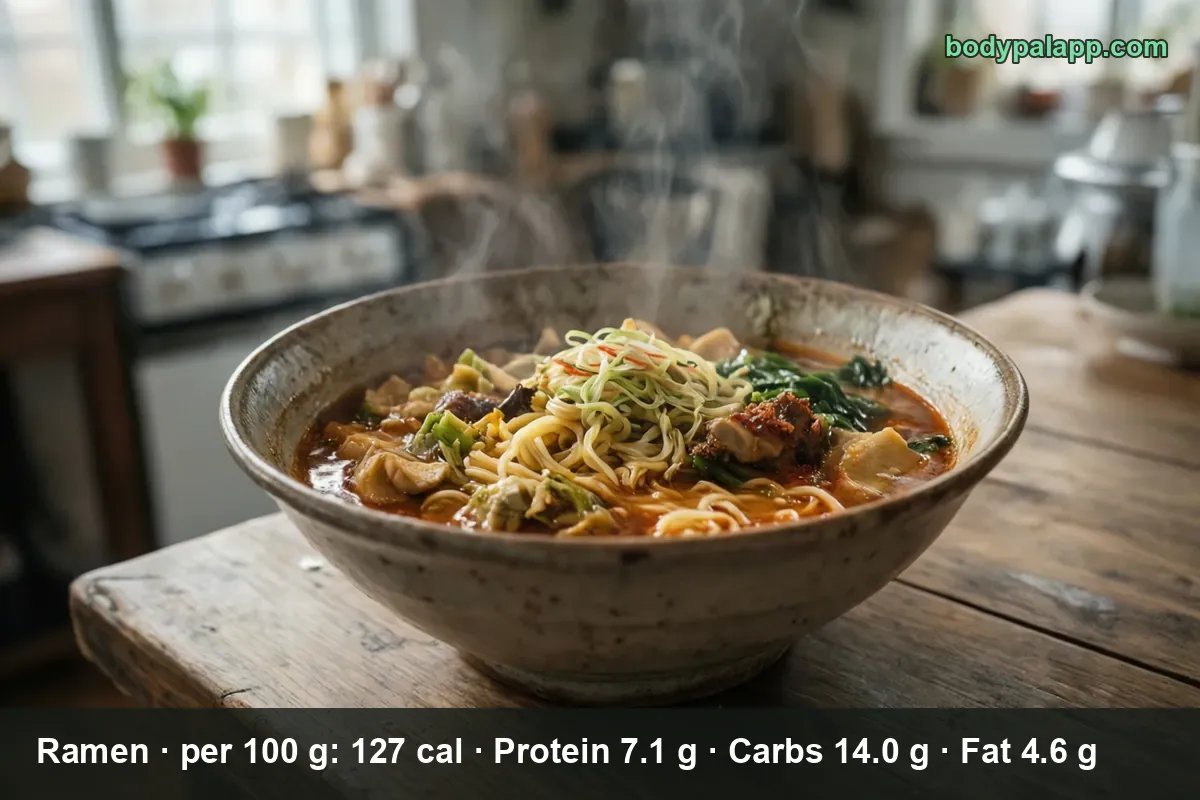
A 1-cup serving of ramen weighs 245 g and carries 311 calories. Per 100 g the cooked bowl runs 127 calories, light for its weight, because most of what sits in the bowl is broth. The catch is that almost nobody stops at one cup.
On this page
- Ramen quick facts
- US servings from one ounce to a restaurant bowl
- Which ramen bowl is lightest
- Instant ramen and the dry block problem
- Sodium is the row to watch
- How does ramen compare?
- Most popular ramen brands
- Ramen FAQs
Ramen quick facts
The number people actually want is for a finished bowl: noodles, broth, a protein, whatever went on top. That is FNDDS 2709153, "Ramen bowl, NFS", and it is the record this page is built on. The separate USDA entry for a ramen bowl with meat and egg (2709158) carries an identical profile, so the two are interchangeable in practice.
A dry instant block is a different food with a different number, and it gets its own section below. Mixing the two is the single most common way people miscount ramen.
| Nutrient | Per 100 g | Per 1 cup (245 g) | % Daily Value |
|---|---|---|---|
| Calories | 127 | 311 | — |
| Total fat | 4.57 g | 11.2 g | 14% |
| Saturated fat | 1.05 g | 2.6 g | 13% |
| Carbohydrate | 13.95 g | 34.2 g | 12% |
| Dietary fiber | 0.9 g | 2.2 g | 8% |
| Total sugars | 0.42 g | 1.0 g | — |
| Protein | 7.13 g | 17.5 g | 35% |
| Sodium | 333 mg | 816 mg | 35% |
| Cholesterol | 53 mg | 130 mg | 43% |
| Potassium | 96 mg | 235 mg | 5% |
% Daily Value is based on a 2,000-calorie diet.
Verified nutrition data
Numbers on this page come from USDA FoodData Central, the U.S. Department of Agriculture’s food composition database, and from manufacturer labels where a branded product is named. Last verified September 2026. How we verify our data →
Two rows you would see on a packaged label are missing here: added sugars and trans fat. FNDDS does not publish either for composite dishes, so there is nothing to report rather than a zero to assume. The Daily Values used above are the FDA reference amounts printed on the Nutrition Facts label.
The cholesterol row is the one nobody expects: 130 mg a cup, 43% of the Daily Value, almost all of it from the meat and the egg. A vegetarian bowl is at zero.
US servings from one ounce to a restaurant bowl
| Serving | Weight | Calories |
|---|---|---|
| 1 oz | 28 g | 36 kcal |
| 1 cup | 245 g | 311 kcal |
| 1.5 cups | 368 g | 467 kcal |
| 1 restaurant bowl, about 2 cups | 490 g | 622 kcal |
| Per 100 g | 100 g | 127 kcal |
Only the 1-cup line is a USDA household measure. The 1.5-cup, restaurant-bowl and 1 oz figures are our own arithmetic from the USDA 100 g number, not USDA servings.
That restaurant bowl is where the real counting happens. A shop bowl in the US holds roughly two cups of soup once the noodles and toppings are in, which puts it at 622 calories, about 34.9 g of protein and roughly 1,632 mg of sodium — 71% of a day's Daily Value in one sitting. If you log ramen as "a cup" out of habit, you are logging half of what is in front of you.
Which ramen bowl is lightest
| Version | Per 100 g | Typical serving | Calories |
|---|---|---|---|
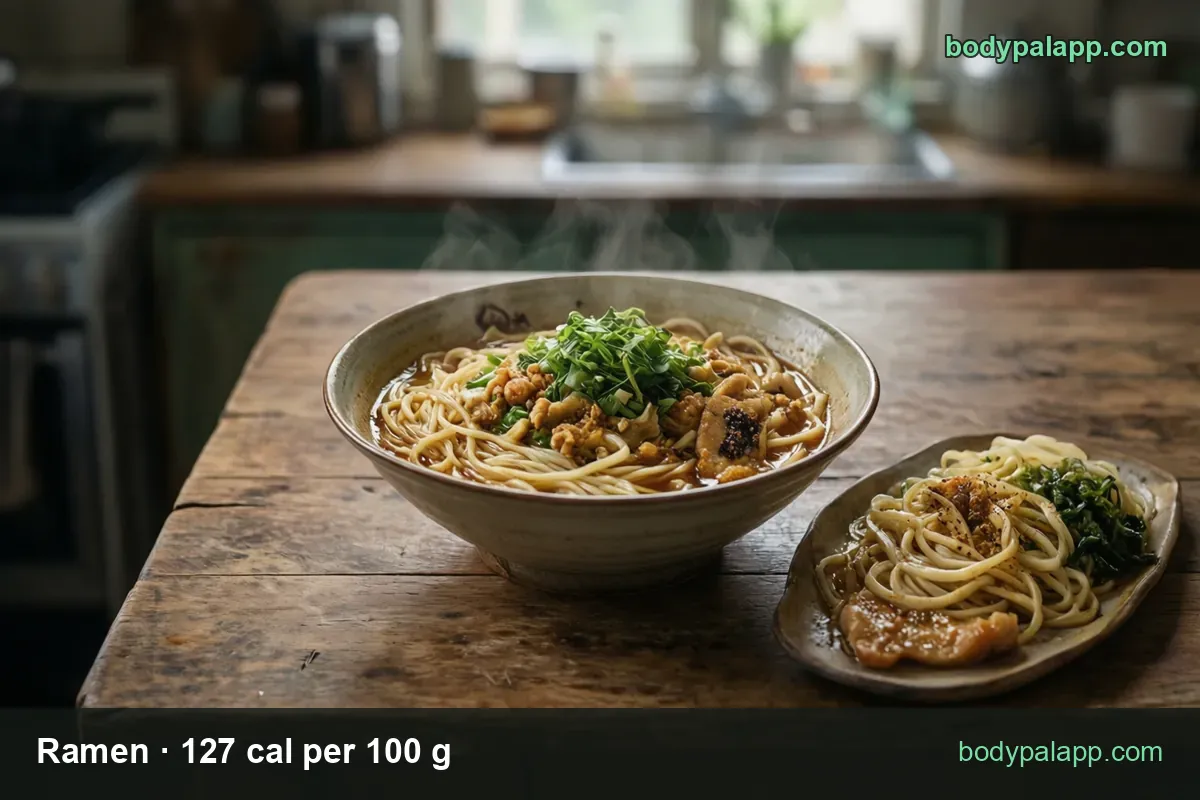
| Beef ramen bowl | 137 kcal | 1 cup, 245 g | 336 kcal |
| Chicken ramen bowl | 126 kcal | 1 cup, 245 g | 309 kcal |
| Fish or seafood ramen bowl | 112 kcal | 1 cup, 245 g | 274 kcal |
| Vegetarian ramen bowl | 108 kcal | 1 cup, 245 g | 265 kcal |
| Vegetarian bowl with egg | 112 kcal | 1 cup, 245 g | 274 kcal |
Beef sits at the top and the vegetarian bowl at the bottom, a spread of 71 calories a cup. Doubled up for a restaurant bowl, that is a 142-calorie decision made entirely by which protein you point at on the menu.
What barely moves is the salt. Sodium across the beef, chicken, fish and vegetarian bowls runs 843 mg to 880 mg a cup, a difference of under 40 mg — the broth base is the same regardless of what is swimming in it. Protein does move: 17.2 g a cup for chicken, 16.7 g for beef, 14.2 g for fish, and 9.8 g for the vegetarian bowl, which loses more than seven grams by dropping the meat.
The vegetarian bowl is also the only one on the list with no cholesterol at all. Add an egg and it climbs back to 274 calories a cup, the same as the fish bowl.
Instant ramen and the dry block problem
A dry block is not the same food as a finished bowl, and the numbers are not close. SR Legacy 171177, ramen noodle soup, any flavor, dry is 440 calories per 100 g — three and a half times the cooked bowl, because nothing has been diluted by water yet.
| Instant ramen | Per 100 g | Serving | Calories |
|---|---|---|---|
| Dry block, half a package | 440 kcal | 43 g | 189 kcal |
| Dry block, whole package | 440 kcal | 86 g | 378 kcal |
Most Maruchan-style packages print the half block as the serving, which is where the "ramen is only 190 calories" idea comes from. Almost nobody cooks half a block. The whole 86 g package, our own arithmetic from the USDA 100 g figure, is 378 calories with about 7.0 g of saturated fat — 35% of the Daily Value, against 2.6 g in a full cup of restaurant-style ramen.
Branded packs run higher still. USDA's label data has a 140 g Samyang Hot Chicken package at 545 calories, a 120 g Ottogi Spicy Jin Ramen at 500, and the 70 g Samyang cup at 295. A packet of instant noodles can outweigh a bowl of the real thing.
The flip side is worth saying plainly: a proper 1-cup ramen bowl at 311 calories delivers 17.5 g of protein, while half an instant block at 189 calories delivers about 4.4 g. Calorie for calorie, the shop bowl is the better food.
Sodium is the row to watch
One cup of ramen carries 816 mg of sodium, 35% of the 2,300 mg Daily Value and roughly a third of a teaspoon of table salt. A full restaurant bowl doubles that to about 1,632 mg. The CDC notes that most Americans already take in more sodium than recommended, largely from restaurant and packaged foods rather than the shaker.
Instant is the bigger trap. A whole 86 g package works out to about 1,595 mg of sodium, 69% of a day's value in a five-minute dinner, and most of that lives in the seasoning packet rather than the noodles. Using half the packet is the cheapest change available.
On the other side of the ledger, the protein line is genuinely good. At 17.5 g a cup — 35% of the Daily Value — a ramen bowl covers as much protein as many people get from a whole lunch, and MyPlate counts the meat, egg and any tofu in it toward the protein group. If you are watching sodium, the fix is portion and packet, not skipping the bowl.
How does ramen compare?
| Soup | Per 100 g | US serving | Calories |
|---|---|---|---|
| Ramen bowl | 127 kcal | 1 cup, 245 g | 311 kcal |
| Pho with meat | 77 kcal | 1 cup, 245 g | 189 kcal |
| Wonton soup | 33 kcal | 1 cup, 245 g | 81 kcal |
| Miso or tofu soup | 24 kcal | 1 cup, 245 g | 59 kcal |
Our take: ramen is the heaviest of the four by a wide margin — nearly four times a cup of wonton soup and more than five times a cup of miso — and the reason is noodle density, not fat. If you want a noodle soup that eats like a meal, ramen is the one; it also brings the most protein, 17.5 g a cup against 14.2 g for pho. If you want the bowl to be a starter rather than dinner, pho at 189 a cup does the same job for 122 fewer calories, and miso at 59 is barely a rounding error in a day.
Most popular ramen brands in the United States
Ranked by how widely each product appears among foods sold in the United States, from the BodyPal food database of over 3.3 million products. Calories are the figures printed on each Nutrition Facts label, checked against USDA FoodData Central.
| Product | Calories (per 100 g) |
|---|---|
| Samyang Hot Chicken Flavor Ramen | 389 cal |
| Samyang Hot Chicken Flavor Ramen Cup | 421 cal |
| Ottogi Spicy Jin Ramen | 417 cal |
| Maruchan Ramen Noodle Soup Chicken | 442 cal |
| Maruchan Ramen Noodle Soup Beef | 442 cal |
| Maruchan Ramen Noodle Soup Shrimp | 442 cal |
Brand popularity: BodyPal food database. Nutrition: manufacturer labels / USDA FoodData Central.
Ramen FAQs
How many calories are in a bowl of ramen?
A 1-cup serving of ramen bowl weighs 245 g and carries 311 calories, and the cooked bowl runs 127 calories per 100 g. A full restaurant-size bowl, closer to two cups or 490 g, lands near 622 calories. Broth, noodles, meat and egg are all counted in that figure.
How many calories are in one pack of instant ramen?
A whole 86 g package of dry instant ramen is about 378 calories, our own arithmetic from the USDA figure of 440 calories per 100 g. The half-block serving printed on most labels is 189 calories, which is why a package looks lighter on the shelf than it eats at the table.
Is ramen high in sodium?
One cup of ramen bowl carries 816 mg of sodium, 35% of the 2,300 mg Daily Value and roughly a third of a teaspoon of table salt. The instant pack is the bigger problem: a whole 86 g package runs about 1,595 mg, 69% of a day's value in one meal.
How much protein is in ramen?
A 1-cup serving of ramen bowl gives 17.5 g of protein, 35% of the Daily Value, from 7.13 g per 100 g. That comes from the meat and the egg. A vegetarian bowl drops to about 9.8 g per cup, so the broth and noodles by themselves contribute fairly little.
Is ramen good for weight loss?
At 127 calories per 100 g, ramen is light for its weight, since most of the bowl is broth. The catch is portion size: a 490 g restaurant bowl is 622 calories with about 1,632 mg of sodium, our arithmetic from two USDA cups. If you are watching either number, a one-cup serving at 311 calories is the better pick.
How many calories in ramen without the broth?
USDA does not publish a drained-noodles row, so the closest record is ramen noodle soup with water added at 66 calories per 100 g, or 162 calories a cup, with no meat, egg or vegetables. Most of the sodium sits in the broth, so leaving it behind cuts salt more than calories.
Chicken vs beef ramen - which has fewer calories?
Chicken, by 27 calories a cup: 309 against 336 for beef, or 126 versus 137 per 100 g. The gap is fat, 3.86 g against 5.19 g per 100 g. Sodium is almost identical, 867 mg versus 865 mg a cup, so the swap changes the calorie line and little else.
How many carbs are in ramen noodles?
A 1-cup serving of ramen bowl has 34.2 g of carbohydrate, 12% of the Daily Value, from 13.95 g per 100 g. Fiber is only 2.2 g of that. The dry instant block is far denser at 60.26 g per 100 g, because nothing has been diluted by broth yet.
Similar foods
- Snow Cone — 256 cal per snow cone
- Egg Foo Yung — 108 cal per patty
- Chicken Chow Mein — 288 cal per cup
- Half And Half — 20 cal per tbsp
- Shrimp Lo Mein — 242 cal per cup
- Olive — 26 cal for 5 large olives
Count it without the math
Point the camera at the bowl and BodyPal counts it for you, broth and toppings included.


How long does it take to burn off ramen?
A 1-cup (245 g) serving is 311 kcal. Enter your weight and the amount you ate to see how long it takes you to burn that off:
lb
| Activity | Time to burn 311 kcal |
|---|---|
| Walking, brisk | 1 hr 2 min |
| Cycling, moderate | 39 min |
| Swimming, moderate | 44 min |
| Jogging | 37 min |
| Weight training, moderate | 1 hr 9 min |
Times are for a 155 lb adult at a steady pace; change the weight to see yours. The amount is set to the portion in the text (245 g); change it to what you actually ate. BodyPal works this out from your steps automatically.
Want the bigger picture? Calculate your daily calorie needs — your maintenance figure, a target for losing or gaining, and the date you get there.