
How many calories are in a salad with dressing?
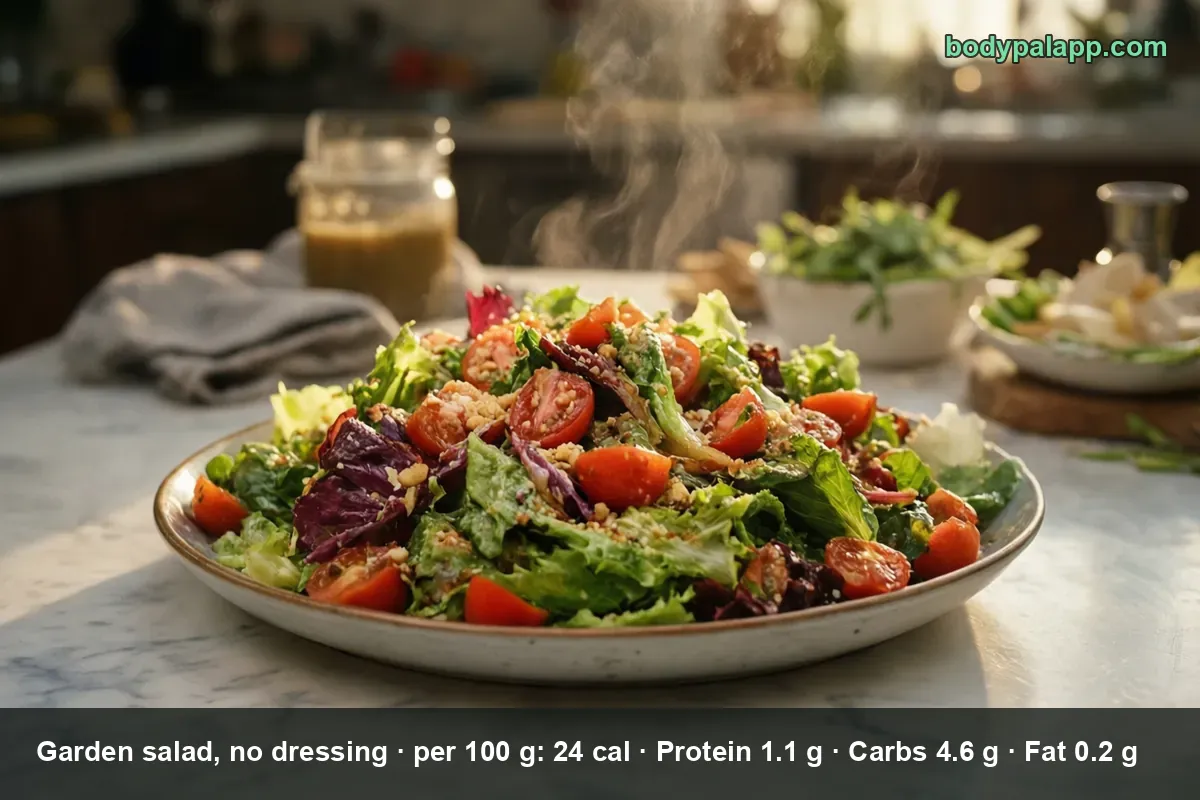
A 94 g side salad, mixed greens with tomatoes and carrots and nothing poured on it, is 23 calories, or 24 calories per 100 g. Pour 30 g of ranch over it, about two tablespoons, and the same bowl becomes 152 calories. The dressing outweighs the vegetables more than five to one.
On this page
- Salad with dressing quick facts
- US servings, from one cup to two
- What the dressing adds
- Cheese, egg and avocado change the base
- Sodium is the row to watch
- How does a salad with dressing compare?
- Most popular salad with dressing brands
- FAQ
Salad with dressing quick facts
There is no single USDA record called "salad with dressing." In the current FNDDS release the greens and the bottle are separate foods, so the honest way to cost a dressed salad is to price the bowl and then price the pour. The base here is FNDDS 2709822, "Lettuce, salad with assorted vegetables including tomatoes and/or carrots, no dressing", which is exactly what a restaurant side salad or a rinsed bag of greens looks like before anything is added.
The USDA household measure for that record is a 94 g side salad. Everything below is that bowl, undressed. The dressing gets its own section, with numbers for ranch, Italian, light and mayonnaise-type, because that is where nearly all the calories live.
| Nutrient | Per 100 g | Per 1 side salad (94 g) | % Daily Value |
|---|---|---|---|
| Calories | 24 | 23 | — |
| Total fat | 0.2 g | 0.2 g | 0% |
| Saturated fat | 0.04 g | 0.0 g | 0% |
| Carbohydrate | 4.58 g | 4.3 g | 2% |
| Dietary fiber | 1.5 g | 1.4 g | 5% |
| Total sugars | 1.9 g | 1.8 g | — |
| Protein | 1.07 g | 1.0 g | 2% |
| Sodium | 39 mg | 37 mg | 2% |
% Daily Value is based on a 2,000-calorie diet.
Verified nutrition data
Numbers on this page come from USDA FoodData Central, the U.S. Department of Agriculture’s food composition database, and from manufacturer labels where a branded product is named. Last verified September 2026. How we verify our data →
Two label rows are missing on purpose. USDA does not publish added sugars or trans fat for mixed salad records in this FNDDS edition, so printing a number for either would be an invention. Cholesterol is 0 mg, as you would expect from vegetables, and the bowl carries 256 mg of potassium, 5% of the Daily Value. For the Daily Value percentages themselves, FDA sets the reference amounts used above.
US servings, from one cup to two
| Serving | Weight | Calories |
|---|---|---|
| 1 oz | 28.3 g | 7 kcal |
| 1 cup | 73 g | 18 kcal |
| One side salad | 94 g | 23 kcal |
| Two cups, dinner-plate bowl | 146 g | 35 kcal |
| Per 100 g | 100 g | 24 kcal |
The cup and the side salad are USDA household measures. The two-cup bowl and the ounce are our own arithmetic from the USDA 100 g figure, not USDA servings, which is why they land on tidy multiples.
Notice how flat that column is. Doubling the greens from one cup to two costs 17 calories, less than a third of one tablespoon of regular dressing. This is the trap in "I had a huge salad" logging: the volume of leaves is almost never the problem, and the tablespoon count almost always is.
Retail salad kits are a different animal, because the dressing packet is already counted in. USDA's Branded records put them between 120 and 160 calories per 100 g, from a Taylor Farms organic lemon parmesan kit at 120 to a Good & Gather brown sugar balsamic chopped kit at 160, with a Dole Caesar kit at 150. Per 100 g, a kit is five to nearly seven times the plain greens it is built on.
What the dressing adds
| Dressing | Per 100 g | Typical pour | Calories |
|---|---|---|---|
| Ranch, regular | 430 kcal | 1 serving, 30 g | 129 kcal |
| Salad dressing, NFS | 430 kcal | 1 tablespoon, 15.6 g | 67 kcal |
| Italian, commercial regular | 240 kcal | 2 Tbsp, 29.4 g | 71 kcal |
| Mayonnaise-type | 250 kcal | 30 g in the bowl | 75 kcal |
| Light dressing, NFS | 160 kcal | 1 tablespoon, 16.2 g | 26 kcal |
| Mayonnaise-type, light | 158 kcal | 28 g in the bowl | 44 kcal |
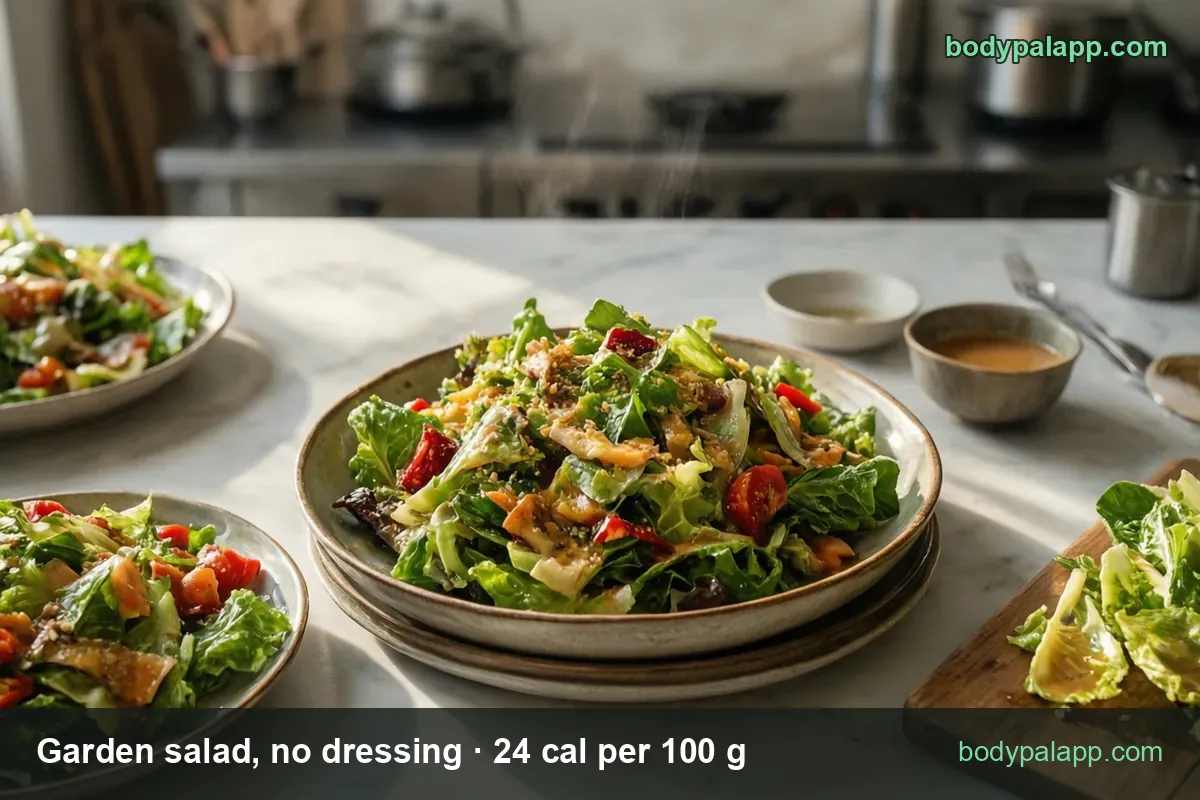
The Italian pour is our own arithmetic from the USDA 100 g figure, scaled to 29.4 g; the rest are USDA serving weights. Regular ranch is the reference American dressing at 430 calories per 100 g, and 44.54 g of that 100 g is fat.
Put the two halves together and the same 94 g bowl looks like six different lunches.
| The same 94 g bowl | Dressing calories | Bowl total |
|---|---|---|
| Nothing on it | 0 | 23 kcal |
| 1 Tbsp light dressing | 26 | 49 kcal |
| Light mayonnaise-type, 28 g | 44 | 67 kcal |
| 1 Tbsp regular dressing | 67 | 90 kcal |
| 2 Tbsp Italian | 71 | 94 kcal |
| 30 g ranch | 129 | 152 kcal |
The spread from top to bottom is 129 calories, and every one of them came out of a bottle. Restraint with the pour is worth more than any swap you can make in the bowl: one tablespoon of the regular stuff still lands the whole thing at 90 calories, which is a genuinely small lunch side.
Cheese, egg and avocado change the base
Before the dressing, the mix-ins already move the number. These are all USDA records for undressed salads, scaled to the same 94 g bowl so they can be read side by side.
| Salad base, no dressing | Per 100 g | Same 94 g bowl | Note |
|---|---|---|---|
| Greens only, no tomato or carrot | 23 kcal | 22 kcal | least sugar, 1.55 g per 100 g |
| Greens with tomatoes and carrots | 24 kcal | 23 kcal | the base used above |
| With avocado | 54 kcal | 51 kcal | 2.7 g fiber per 100 g, the highest here |
| With egg and cheese | 71 kcal | 67 kcal | 4.24 g protein per 100 g |
| With cheese | 91 kcal | 86 kcal | 6.08 g fat, 146 mg sodium per 100 g |
The 94 g columns are our own arithmetic from the USDA 100 g figures, not USDA servings. Even at the top of that table, the cheese version at 86 calories is still less than a 30 g pour of ranch. That is the whole story of this food in one line: the greens and the toppings are close to four times apart, the dressing is more than five times the greens on its own.
If you want the salad to carry a meal rather than sit next to one, the egg-and-cheese base is the useful pick, at 4.24 g of protein per 100 g against 1.07 g for plain greens. MyPlate counts the leafy portion as vegetables either way.
Sodium is the row to watch
Undressed, this bowl is a rounding error on the salt line: 37 mg, 2% of the Daily Value. Add 30 g of regular ranch and you add 270 mg, which is 12%. Together that is 307 mg, or 13% of the 2,300 mg daily limit named in the Dietary Guidelines for Americans. Roughly 88% of the sodium in a dressed salad comes from the bottle, not the vegetables. In plain terms, the ranch is about an eighth of a teaspoon of table salt.
Here is the part most people get wrong. Light dressing is a calorie product, not a sodium product. USDA lists light dressing at 833 mg of sodium per 100 g and the regular version at 810 mg. Per tablespoon that is roughly 135 mg light against 126 mg regular, our arithmetic from the 100 g figures. Calories fall from 67 to 26; salt does not fall at all. If you are watching sodium rather than calories, oil and vinegar measured by the tablespoon is the better move, and the light bottle is not the answer it looks like.
Saturated fat behaves better. The 30 g ranch pour brings 2.1 g, 11% of the Daily Value, on top of essentially none from the greens.
How does a salad with dressing compare?
| Food | Per 100 g | US serving | Calories |
|---|---|---|---|
| Garden salad, no dressing | 24 kcal | one side salad, 94 g | 23 kcal |
| Salad dressing, NFS | 430 kcal | 1 tablespoon, 15.6 g | 67 kcal |
| Salad with egg, cheese, tomato | 71 kcal | one side salad, 168 g | 119 kcal |
| Chicken caesar garden salad, no dressing | 63 kcal | one salad, 286 g | 180 kcal |
Our take: for weight loss, keep the base plain and measure the dressing, because a level tablespoon of the regular bottle at 67 calories tastes like a dressed salad while a free pour of 30 g costs 129. For fullness, the chicken caesar base is the better buy at 180 calories for 286 g, since it brings 8.52 g of protein per 100 g and gives the meal something to hold onto. The one combination worth avoiding is a big undressed bowl plus an unmeasured pour, which is where a 23-calorie side quietly becomes a 152-calorie one.
Most popular salad with dressing brands in the United States
Ranked by how widely each product appears among foods sold in the United States, from the BodyPal food database of over 3.3 million products. Calories are the figures printed on each Nutrition Facts label, checked against USDA FoodData Central.
| Product | Calories (per 100 g) |
|---|---|
| Good & Gather Brown Sugar Balsamic Chopped Salad Kit | 160 cal |
| Dole Caesar Salad Kit | 150 cal |
| Taylor Farms Southwest Chopped Salad | 140 cal |
| Marketside Avocado Ranch Chopped Salad Kit | 130 cal |
| Ready Pac Organic Chopped Complete Salad Kit | 130 cal |
| Taylor Farms Organic Lemon Parmesan Chopped Salad Kit | 120 cal |
Brand popularity: BodyPal food database. Nutrition: manufacturer labels / USDA FoodData Central.
Salad with dressing FAQs
How many calories are in a salad with dressing?
About 152 calories for a 94 g side salad with 30 g of regular ranch, roughly two tablespoons. The greens are only 23 of that; the dressing brings 129. Swap to a light bottle at one tablespoon and the same bowl lands near 49 calories.
How many calories in a side salad without dressing?
23 calories for a 94 g side salad of lettuce with tomatoes and carrots, which USDA lists at 24 calories per 100 g. That bowl also carries 1.4 g of fiber, 1.0 g of protein and 37 mg of sodium, so almost nothing counts against your day.
How many calories are in 2 tablespoons of ranch dressing?
129 calories for 30 g of regular ranch, the USDA serving that works out to about two tablespoons. It also brings 13.4 g of fat, 2.1 g of it saturated, and 270 mg of sodium. That is more calories than five plain side salads put together.
Which salad dressing has the fewest calories?
Light dressing, at 26 calories a tablespoon (16.2 g) against 67 for a regular tablespoon of the same style. Light mayonnaise-type dressing is 44 calories for a 28 g helping, and regular Italian is 71 for two tablespoons. Measuring the pour saves more than switching bottles does.
How much sodium is in salad dressing?
810 mg per 100 g for generic salad dressing and 901 mg for regular ranch, which is 270 mg in a 30 g pour, or 12% of the 2,300 mg Daily Value. The greens under it add just 37 mg, so the bottle supplies about 88% of the bowl's sodium.
How many calories in a bagged salad kit?
120 to 160 calories per 100 g for the retail kits in USDA's Branded database, dressing and toppings included. A Dole Caesar kit is 150 per 100 g and a Taylor Farms organic lemon parmesan kit is 120. Because the packet is counted in, your number moves with how much of the bag you eat.
Does light dressing have less sodium?
Barely, and slightly the wrong way: 833 mg per 100 g for light dressing against 810 mg for the regular version, so a tablespoon runs about 135 mg light and 126 mg regular, our arithmetic from the 100 g figures. Light cuts calories, from 67 to 26 a tablespoon, not salt.
How many calories in a cup of garden salad?
18 calories for one cup, 73 g of lettuce with tomatoes and carrots. Two cups make 35 calories, about half of what one tablespoon of regular dressing brings at 67. A full 100 g of the same greens is 24 calories, with 1.5 g of fiber and 272 mg of potassium.
Similar foods
- Salad — 23 cal per side salad
- Tomato Sauce — 59 cal per cup
- Arugula — 5 cal per cup
- Broccoli Rabe — 21 cal per cup
- Cabbage — 22 cal per cup chopped
- Cabbage Boiled — 17 cal per half cup
Count it without the math
Point the camera at the bowl and BodyPal counts the greens and the dressing for you.


Burning it off is one side of it. The other is knowing your number: work out how many calories you need a day, with macros and a goal date.